Rewriting the Pedagogical Playbook:Teachers Take the Lead in Classroom Innovation
Sherry Shang / photos Jimmy Lin / tr. by Phil Newell
November 2014


Twenty years have passed since major education reforms were launched in Taiwan in 1994. This year, 2014, is also the first year of 12-year compulsory education. Over the past two decades, waves of reform have swept over every aspect of education: laws and regulations, systems, teacher qualifications, curriculum, pedagogy, textbooks.... After two decades of transformation and regrouping, the face of education in Taiwan has changed enormously.
Today, 20 years on, a new tide of education reform has appeared on the scene, one that began fermenting among teachers themselves. Teachers are influencing each other, sharing ideas, linking together, and proselytizing, and teachers’ groups are blossoming everywhere. They want to join hands to redraw the very playing field of education, and they are determined to become the shapers of a revolution in reorienting how students learn.
September 28, traditionally identified as the birthday of Confucius, is Teachers’ Day in Taiwan, a special day for teachers nationwide. Normally a placid day marked by staid ceremony, this year the atmosphere is more highly charged. Proponents of a revolution that will change the way students and teachers interact will hold a huge rally in central Taiwan. Their themes are “Flipping Chinese” and the “BTS Flipped Classroom.”
In the vanguard of this army are Zhang Huicheng, a teacher of Chinese at Taipei Municipal Zhongshan Girls’ High School, and Yeh Ping-cheng, an associate professor in the Department of Electrical Engineering at National Taiwan University (NTU).
On this day, more than 2200 teachers from all over Taiwan are gathered at the private Ming-Der Senior High School in Taichung to experience this largest-ever organized “self-directed learning” event on behalf of the new pedagogical revolution. Teachers, school principals, parents, people from the supplementary tuition industry, and university students still studying to be future teachers, having come from all over Taiwan like the faithful on a pilgrimage, listen intently as the two pioneering educators Yeh and Zhang articulate their theory and practice.
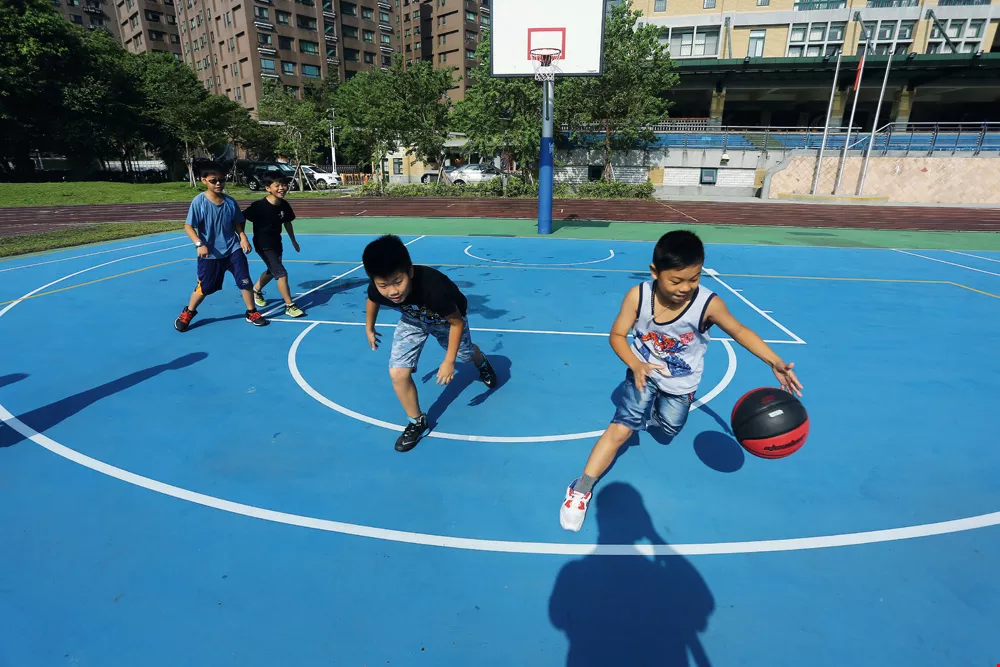
Students at Longpu Elementary School in Sanxia District of New Taipei City are focused in class and happy on the playing field.
Yeh, who is concurrently associate director of NTU’s Center for Teaching and Learning Development, is a prime mover behind this wave of turning education upside down. He is also the director of NTU’s “Massive Open Online Courses” (MOOCs) project. The concept he advocates is called the “BTS Flipped Classroom.” In the last year or two, it has cast sparks into the minds of educators at all school levels, re-igniting fires of enthusiasm for teaching.
BTS stands for “by the students,” and emphasizes student autonomy. The core idea is to allow students to study for themselves, raise their own questions, and make their own judgments. The method is for the teacher to first make video recordings of the lecture material for the course, then let the students “do the lectures at home” while “doing homework in class” (like projects and problem solving). Not only does this enhance instructional efficacy, teachers no longer need to grade homework—the students take care of everything themselves!
There is an underlying purpose, in terms of educational philosophy, to the BTS idea. It is to allow students to develop “a taste for learning.”
Yeh says that under the long-established old-fashioned pedagogy of cramming information into students’ brains, it was impossible for teachers, no matter how skilled, to cultivate a taste for learning in them. Therefore he advocates returning the initiative in learning to students.
In order to stimulate students to be self-motivated to learn, Yeh has even linked courses to online gaming, hoping to seduce students into “an addiction to learning.” For example, to move up a level in a game, first you must solve a math problem. He later took this idea a step further, integrating online gaming into the NTU MOOCs curriculum by creating a “PaGamO” platform (the word comes from Taiwanese and means “learning through playing”), which is the first innovation of its kind in the world.
In addition, as Yeh told this reporter, in general teachers have few opportunities to see how others handle certain classes. But through mutual observation and mutual discussion, a kind of virtuous circle will take shape. Teachers can pick up ideas from how their colleagues operate, and this will inspire them to new thinking and new attitudes, which they will then naturally share with others. The impact will snowball.
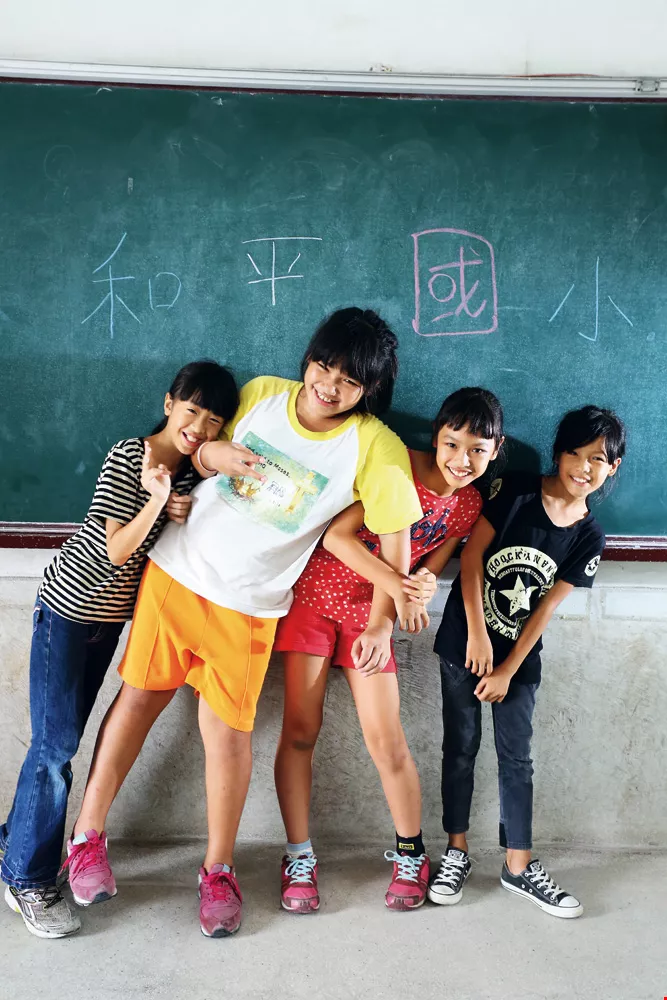
Being taught with new methods designed to revitalize the classroom, students at Heping Elementary School in Taitung are all smiles.
Classroom teaching should not just be one teacher fighting the good fight alone. When it comes to educators observing and learning from each other, you have to mention Zhang Huicheng, a teacher of Chinese literature at Taipei’s Zhongshan Girls High School. (See article, p. 14.)
For 17 years, Zhang worked quietly to change the mind-numbing pedagogy of force-feeding facts to students. Last year, he decided to open up his classroom to outside observers to witness the new educational method he devised entirely on his own, which he calls “Learn, Consider, Communicate” or “Flipping Chinese.” Incredibly, already more than 2000 people have come to observe him in action in the classroom.
There has been a very broad response to Zhang’s innovative pedagogy. As of this writing, more than 12,000 people have joined the “Flipping Chinese Pedagogy” virtual community, the number of members in the social network “Class Management” has surpassed 8000, and over 4700 people make up the “Flipping Chinese 319 Tour” network. In addition, more than a thousand have joined “Learning Community Notebook” while “Come On, Teacher, Flip!” has brought together more than 2900 members…. And this list does not even include small virtual communities of teachers subdivided by subject, region, or other criteria.
Ming-Der Senior High teacher Zhuo Yilan, who was the moving force behind 2200 people voluntarily using their Teachers’ Day holiday to come to Taichung for “self-directed learning” about the new pedagogy, first encountered “Flipping Chinese” only in May of 2014. Zhuo was immediately inspired by Zhang Huicheng’s example, and after learning the system, quickly announced that she would open her classroom to observers. She was amazed to discover that people actually showed up, and for one class there were 40 teachers and parents in attendance!
After these classes ended, many of the teacher-observers would offer their own opinions or raise questions about the details of how the teaching method should be applied in practice. This feedback from her colleagues gave Zhuo the determination to embrace an attitude of “no turning back,” and she has gone on to organize many activities for self-directed study and to collectively discuss and prepare courses.
In a brief two to three months, she has held more than 30 such events. “With everyone gathering together, you don’t feel isolated. We provide a setting where likeminded teachers can come in from the cold and find a warm environment,” she explains.
The strength derived from this “collective support” has rapidly resonated with teachers in other cities and counties. In Taipei City alone, there are now more than 20 “collaborative learning” groups that meet in person each month to prepare classroom material, observe each other’s methods, discuss how the classes are going, and generally share their thoughts on the rewards and hardships of teaching as a profession. The groups vary in size at around 20–30 members, and are not limited to teachers from Taipei City only.
These numbers reflect the passion and profound hopes that many teachers feel about innovative methods that hold out the promise of revitalizing the classroom.
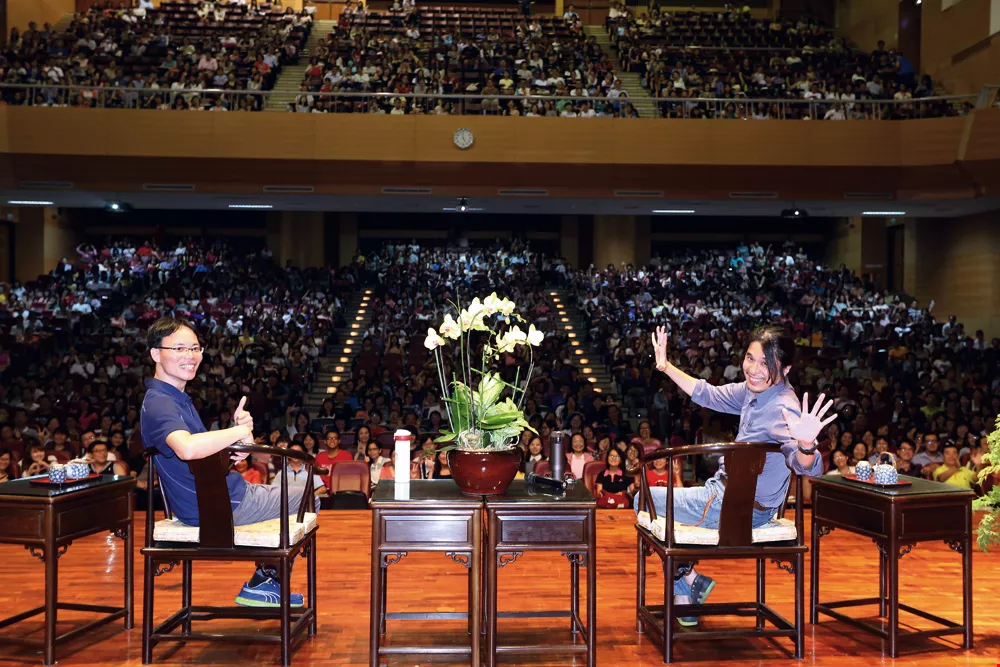
Zhang Huicheng (left) and Yeh Ping-cheng (right) address a gathering of 2200 teachers and other interested parties on their respective educational philosophies: “Flipping Chinese” and the “BTS Flipped Classroom.” They share the lofty aim of radically transforming pedagogy in Taiwan.
Yeh Ping-cheng’s “BTS Flipped Classroom” and Zhang Huicheng’s “Flipping Chinese” have inspired diverse and highly creative experiments, and support from other sources has been a powerful force in supporting teachers as they move forward.
For example, former TrendChip Technologies Corporation chairman Fang Shin-jou created a foundation which in turn has founded an Internet platform called the Junyi Academy. Modeled on the Khan Academy, a non-profit educational institution founded in 2006 by Salman Khan, an American of Bangladeshi ancestry, Junyi offers resources—attuned to Taiwan’s existing primary and junior high curricula and completely free of charge—that support “flipped classroom” teachers or remedial education.
Though Junyi formally went online only at the end of 2012, as of October of 2014 already over 100,000 people have registered, and over 1 million have utilized the “Exercises” part of the website.
The government sector is also lending a hand. The Ministry of Education, having studied the “learning community” idea of the Japanese education guru Manabu Sato, is encouraging primary and secondary schools to break out of the traditional model whereby “the teacher talks, the students passively listen,” and shift to a student-centric approach. In particular, the MOE is encouraging schools to adopt “collaborative learning,” such as students forming small discussion groups or being encouraged to take the initiative to express their own opinions in class.
Collaborative learningLast year the Taipei City Bureau of Education began a special program focused on “high-school curriculum and instructional working groups.” The program encourages teachers who wish to upgrade the quality of instruction to organize cross-school communities and also provides a platform for dialogue.
Lan Weiying, a chemistry teacher at Taipei Municipal Lishan High School who is also a school inspector in the bureau’s division of secondary school education, says there are quite a few deeply committed teachers out there who are, without fanfare, trying out innovative ways to enliven the classroom. Recently the “flipped classroom” has come into vogue and, now that some people have come forward to lead the trend, this will encourage even more teachers to courageously rewrite the rules of the pedagogical game.
Last January, in order to acquaint her colleagues with collaborative learning, Lan opened up her classroom and set up the “Lishan Learning Community.” Moreover, she organized a series of citywide workshops for teachers of the natural sciences, and encouraged others to form cross-school networks of teachers of individual subjects in order to collectively prepare class material.
Lan says that one benefit of bringing together teachers from different schools is that it has become clear that the new ideas have to be tweaked to fit different types of students. For example, teachers in a given group might come from elite magnet schools, district high schools, and vocational high schools, and their pupils reflect very different educational backgrounds.
The hope behind the new methods is that students will learn to think for themselves. Lan recalls how she once asked a student in her chemistry class a question for which the textbook provided no definite answer. The student was dumbstruck, and in fact no one in the class could even venture a guess. That moment struck her as an especially forceful example of how students just memorize material to give correct answers on the tests, but don’t learn how to think.
But today, after a mere half year of trying out collaborative learning, her students not only vie with one another to answer questions, they enthusiastically come forward to stand up in front of the other kids and share their ideas. “Having revitalized instruction to this degree, the textbook has become merely an auxiliary tool, and the standardized ‘correct answer’ has transitioned to students reaching a conclusion after discussion. Learning in this way produces totally different results, and is much more meaningful,” says Lan.
The transition goes transnationalThe current wave of pedagogical reform—the “BTS Flipped Classroom,” “Flipping Chinese,” open classrooms, collective preparation—is not only making waves in Taiwan. People in other countries are also taking notice of the transformation in Taiwan’s educational system. As a result, they are undertaking closer observation of, and exchange with, Taiwan.
For example, in September a group of Singaporean Chinese teachers came to Taiwan and observed classes being taught by Zhang Huicheng at Zhongshan Girls’ High. In August, three teachers from the “Flipping Chinese Workshop” went to Vietnam’s Chinese School to share pointers about how to practice Flipping Chinese instruction. And in October, Yeh Ping-cheng and Junyi Academy CEO Ray Lu were invited to mainland China’s Shandong Province to spread the word about the flipped-classroom education method.
In addition, Rick Levin, who was president of Yale University from 1993 to 2013 and who recently became CEO of Coursera, a for-profit educational technology company that offers massive open online courses (MOOCs), was so impressed when he heard about what Yeh Ping-cheng was doing with BTS and the flipped classroom here in Taiwan that he personally asked Yeh to develop an English-language version of his flipped-classroom curriculum to put on Coursera and share with educators in the West.
Seeing Taiwan’s educational reform blossom, Zhang Huicheng modestly recalls the words of Aisin-Gioro Yu-yun (1906–2011), a Confucian scholar who was a mentor to Zhang: “If you keep at anything, no matter what it may be, for ten years, then you are bound to have at least some level of success.” Zhang notes, “We still have nine more years to go with ‘Flipping Chinese,’ so we have to stay on the path and keep moving forward.”
Yeh Ping-cheng, on the other hand, is less reticent about predicting future success for educational reform. “Just at National Taiwan University, for instance, they hire 70 to 80 new faculty per year, so over ten years there will be 700 to 800 new professors. Educational reform is something that will inevitably happen over time, as the number of new teachers comes to form a critical mass, and the baton is passed along each to the next!”

@List.jpg?w=522&h=410&mode=crop&format=webp&quality=80)


