Flowing: Building Taiwan the BeautifulCCA Exhibition on Architecture in Taiwan
Text by Yang Ling-yuan / photos Jimmy Lin / tr. by Jonathan Barnard
August 2004


Apart from those who have studied architecture or cultural history, few urban dwellers scrutinize building design, methods of construction, or the way that architecture succeeds or fails at blending in with the surrounding environment. But the fact is that there are fine extant examples of architecture from every period of Taiwan's 400-plus years of recorded history. Among these are the Chinan Church on Chungshan North Road in Taipei; the Museum of Taiwanese Culture in Tainan, which was listed as a national historic site before it became a museum; the Chingliao Catholic Church in Houpi Rural Township, Tainan County; the year-old Shihsanhang Museum of Archaeology in Taipei County; and Taipei 101, the tallest building in the world. Their various architectural designs add much color to the beautiful natural landscape of Taiwan.
On the other hand, if you walk in the back alleys of Taiwan-even in Taipei, a city where appearances count-you will see many roughly built structures which were thrown up so that their owners could avoid paying vacant land taxes in areas of high property values. In a mature city, such as Paris, residents have reached a consensus about the city's appearance and are of one mind about building a romantic and cultural city that people worldwide admire. But residents of an immature city can only sit and watch as landowners erect one structure after another that doesn't blend in with the cityscape, or as cable TV companies run cable after cable through the air. Marred and twisted, the appearance of these cities awaits growing consciousness of these issues among their residents.
From February to late May of this year at Taipei's Hua Shan Arts District and the Kaohsiung Museum of Fine Arts, nearly 150,000 people visited Taiwan's first architecture exhibition: the 2004 Architecture Exhibition Taiwan, organized by the Council for Cultural Affairs (CCA). Some of those who attended were intensely curious about Taiwan's architectural history; others wanted to see beautiful works of architecture from across the island.
At the entrance to the exhibit, there were a row of TV monitors outside and two rows inside. These showed interviews with 12 scholars and architects, providing an oral history of Taiwanese architecture. This section of the exhibition, entitled "In Display," provided opinions from a variety of angles about Taiwan's cities, architecture and urban landscape in the 20th century.
Inside the exhibition space were a series of large posters providing a bird's-eye view of the destruction caused by the 921 earthquake, and photographs depicting the process of rebuilding damaged schools and communities, along with documentary films and architectural models. This segment of the exhibition was entitled "Installation."
"The 921 Earthquake could be described as a major turning point for architecture in Taiwan. An unparalleled natural disaster, it caused the architectural community to rethink the designs and construction habits that it had been employing for years," says Gene K. King, the exhibition planner. "The process of reconstructing the damaged areas provided an opportunity to discuss the relationship between architecture, environment and culture."
Another area of the exhibition displayed Taiwanese architecture "In Progress." This comprised displays about several cultural and transportation projects that were either completed in recent years or are still under construction. It also featured exhibits about the fruits of the Gateway Series and Landform Series of the international competition New Taiwan by Design, as well as exquisite architectural models, design drawings and photographs-all aimed at providing a glimpse at the future of Taiwan's architecture and urban landscape.
"Architecture is the first of the eight traditional Chinese arts, and the one with the greatest impact. It is an expression of culture closely connected to people's lives," says event organizer Tchen Yu-chiou, former CCA chairwoman. Many nations have museums or exhibition halls devoted to architecture, which allow outstanding professional architecture to be disseminated among the masses. And the Venice Biennale of Architecture honors excellence in architecture in an international arena.
Understanding the importance of preserving urban culture, the CCA many years ago began its work on historic preservation, but that has involved only examining and preserving buildings of historic value. These efforts cannot perfect the culture of urban architecture or give Taiwan's cities a new general ap-pearance.
"In France, architecture comes under the Ministry of Culture, whereas in Taiwan architecture and the urban landscape are the responsibility of the Construction and Planning Agency (CPA) of the Ministry of the Interior," says Tchen. Apart from construction methods, which she says are appropriate to remain under the CPA, other architectural matters-namely those regarding the urban landscape and buildings' visual design-should be transferred to the CCA, so as to integrate the culture and appearance of cities.
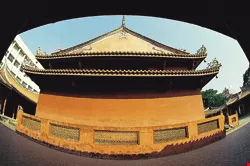
The elegant simplicity of the Confucian temple in Tainan, built in 1665, during the Ming Dynasty. The temple is known as the first school for the children of Taiwan. Even during the Qing administration, the temple was adorned with plaques in its honor.
Gene King Expounds on Architecture
The special characteristics of architecture in Taiwan are 'flux' and 'transformation,'" says Gene K. King, curator of the 2004 Architecture Exhibition Taiwan. A famous architect and editor-in-chief of architecture magazine Dialogue, King says that due to Taiwan's high population density and seafaring culture, it places a premium on functionality. In Taiwan you can see the architecture of Taiwanese Aboriginals and various Chinese groups, as well as Western colonial, Japanese colonial, modernist, postmodernist, deconstructivist, neomodernist and various combinations thereof. But there is a lack of harmony in the blending of these diverse styles. The result is that the overall appearance of Taiwanese architecture is ugly.
"It is only in recent years that Taipei City has begun to be concerned about its overall appearance," says King, "from redoing sidewalks and building shopping centers, to constructing rapid transit lines, to finally making an outline for the city's future."
Prior to this exhibition, at the invitation of the Council for Cultural Affairs, King had found attractive examples of architecture from the unharmonious whole and compiled them into a book: Building Taiwan the Beautiful. Over the course of a year, he invited professional architects to select outstanding examples of architecture from the past century. They selected 84 structures from six different historical periods, completely revealing the special characteristics of Taiwan's architecture. Afterwards, King took this book as the basis for the recent exhibition's "In Display" section, hoping to provide a richer, multidimensional and multifaceted exposition of Taiwanese architecture.
"I broke it down according to eras, letting visitors understand the background and culture of each era and see how they impacted its architecture," he says, citing the example of Tainan City: During the Japanese occupation much of Tainan was still fields and rice paddies. But the Japanese government had already foreseen its future needs and insisted that space be reserved for a park in every district of the city. This idea of preserving public space in communities was ahead of its time. Yet in a modern, profit-driven society it is hard to put into practice.
Each period of Taiwan's architectural history has its own salient characteristics: In the 1950s and 1960s, there was a shortage of building materials, and the public put low demands on the quality of their residences. But in order to make public displays of their authority the governing KMT built commanding buildings that still impress today.
From 1970 to 1985, as society opened up and the economy took a turn for the better, the real estate market showed rapid growth. People had a growing sense of ethnic identity, but at the same time were influenced by the wealth of Europe and America. Consequently, there was a rise of native ethnic architecture and post-modern Western architecture.
From 1985 to 1995 the NT dollar rapidly appreciated, and there was a major influx of capital. With the stock and real estate markets soaring, there was a building boom in Taiwan. Many new hospitals, universities, museums, and other large projects were constructed. Furthermore, almost all the facilities that would be needed over the next few decades were completed at the same time. Because estimates were imprecise and overlooked the potential for unforeseen future needs, many had to be reconstructed not long after they were built. This resulted in much time and money being wasted.
King stresses that compared to the cost of what is put inside buildings and the value of what is produced there, "architecture in itself is a bargain; as Terence Riley, the chief curator of architecture and design at the Museum of Modern Art in New York says, 'The money spent on an architectural space is like what you spend on the bag to hold potato chips.'" Overseas, buildings have come to be regarded as a cheap form of commercial advertising. Many name-brand retailers, such as Prada and Louis Vuitton, have hired award-winning architects to design their flagship stores, which have become standard-bearers of contemporary design.
"Putting up a building doesn't require high technology. Whether architecture succeeds depends upon how much thought the architect puts into a design." King believes that architecture is one of Taiwan's weak links, which is to say that it hasn't been designed to meet the actual needs of users. For instance, in recent years counties have been building museums one after another. Although these are often attractive buildings, the architects haven't thought from the outset about their use as museums. Instead, only after designing the buildings have they concerned themselves about what was going to be displayed, and as a result the exhibition space and the objects being exhibited do not add up to more than the sum of their parts.
Some people say that the architectural character of a place reflects the character of its inhabitants. King agrees. Taiwan is a society that has been rolling along at high speed and has achieved an enviable economic miracle, but this may have caused people here to be so eager for quick success that they only consider immediate advantages. Too often Taiwan's buildings are rushed into being. Architectural professionals have been focused on producing large quantities of buildings when the market is favorable, and quickly unloading them. Commercial considerations have been given much more weight than aesthetic and environmental considerations. And as the cities have grown more and more crowded they have lost some of their grace.
After the successful close of the 2004 Architecture Exhibition, King made a new observation: He has always been very curious about the differences in the development of Taiwan's coastal cities and the coastal cities of other nations in East Asia: Japan, Korea and China.
"Taiwan has a maritime culture, so why hasn't it developed the passionate urban culture that can be found in coastal cities of Europe and America? Why instead do its cities display the conservative and closed-minded style of inland cities?" Perhaps the next time King prepares an architectural exhibition he will unlock that mystery for us.
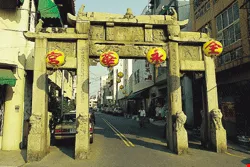
The picture shows a chastity arch from the Qing dynasty (1797) standing alongside modern structures in Tainan.
Wang Ming-hung: Reading the Layers of the City
When we travel abroad, we fol-low tour guides, listening to details about local history and architecture and gaining insight into new places. Yet when we return home, when do we take the chance to learn about our own cities?
"It's about time we took a new look at our cities!" says Wang Ming-heng, professor of Architecture at National Cheng Kung University (NCKU) and a host of the 2004 Architecture Exhibition's "In Progress" program. According to Wang, with the passing of time Taiwanese have come to accept the development of their cities passively: They have not only missed out on city planning, but also have no rights in determining the city's future. Entering the 21st century, Taiwanese cities face issues of sustainable development. Previous mistaken population estimates have led to problems such as surplus of residential areas, damage to the natural landscape, serious pollution of rivers, a decline in quality of public facilities, and a shortage of green spaces. The time has come to reflect on these and make improvements.
Wang Ming-heng cites Tainan, home of NCKU, as an example. Large areas used as farmland were rezoned under ill-considered land readjustment policies, and now sit unused. They cannot be returned to their original use as their farmers have since left or changed occupations. In days gone by, in Tainan's Wutiao Port area, homes lined five waterways similar to the canals of Venice. Baroque construction projects during Japanese rule cut off the waterways, and now only dry chasms remain. Recently, in a favorable development, the city government has been looking to widen this area in hopes of restoring at least two of the waterways.
Wang, who has studied urban planning and development policy for many years, gives an outline of the history of Taiwan's cities: Taiwan's Aboriginal peoples left no architectural traces of note, and it was only 381 years ago that the Dutch left monuments to their colonization at Anping in Tainan. Twenty-six years later, the Spanish arrived in Keelung and built Tanshui's Fort San Domingo in the north. Later, Zheng Chenggong brought his troops to Taiwan. However, they only occupied a small portion of the island's territory, and the rest remained unsettled by the Chinese. It was only as a result of mass immigration from Fujian and Guangdong provinces in China in the rule of the Qing emperor Kangxi that Taiwan finally saw institutionalized urban development. The building of city walls, Confucian temples and other places of worship at this time brought to Taiwan the basic attributes of cities and towns.
146 years ago, the Qing government signed the Treaty of Tianjin with Britain and France and opened Taiwan's ports to international commerce. Waves of Europeans came and built commercial premises in European colonial style, causing the largely agricultural Taiwanese society to confront modernization. The end of the Sino-Japanese War brought Japanese rule to Taiwan. The government, influenced by contemporary European society, directly copied European styles and transplanted them to Taiwan while at the same time trying to remove traces of the Qing Dynasty. The Japanese placed great importance on public works and went to great lengths to promote construction projects such as railways, post offices, and banks, thereby creating the basic infrastructure of Taiwan's cities and towns.
After World War II, the KMT government retreated to Taiwan, bringing with it the large-scale aid of Cold-War-era America. American advisors and city planners brought to Taiwan a new notion of urban areas with a downtown, concentrated residential areas, and suburbs. This, along with President Chiang Ching-kuo's Ten Major Construction Projects policy of the 1970s, which brought highways and further urbanization, led to the rapid "Americanization" of Taiwan's cities and more than 20 years of real estate prosperity, but also caused lasting problems such as rezoned land sitting unused, and excess housing.
"From an agricultural to an industrial society, and again to high technology and globalization-many of Taiwan's cities are in a state of transition, so not only do governments need to analyze and correct trends, but citizens also should start to actively investigate and participate in the process." Wang, who is also the chief cityscape consultant for Tainan City, says that a mature city requires mature citizens, as urban architecture is a living industry and not one of theory or abstraction. Citizens have the right and duty to state their opinions in these matters, and cannot merely allow "experts" to have their way.
"Previously, the government held too much power, monopolizing authority over planning and lawmaking and leaving citizens no scope for participation," says Wang. According to him, currently only Taipei, Taichung, and Kaohsiung can be termed mature cities, as their citizens have become conscious of their spatial environment and not only place demands on their local governments but are also willing to make efforts to cooperate with them. Still, Wang hopes for the development of an "urban charter" that would allow citizens to set the course for the development of their own cities according to their collective ideals and expectations. Changes in administrative leadership would have no influence over the future of the city.
"Actually, everyone has a collective memory of the city, because architectural structures have densely covered the city like carbon copies. If only people attentively read the overlapping layers of the city, they can find the living environment which they desire, and thereby transform the city's destiny." This is Wang Ming-heng's dream.
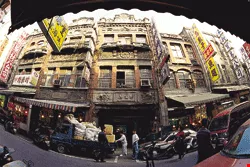
Taipei's Tihua Street is an architectural mix of traditonal Fujianese and modern Western styles, as well as the baroque style popular during the Japanese occupation. It is one of the best examples of the city's development.
Kuo Chao-lee: A Modernist Interpretation of Taiwan's Architecture
Modernism holds the power to liberate: It uses the powers of industrialism, rationalism, and democratization to free the people from the constraints of traditional society. Modernist architecture, therefore, emphasizes the overturning of stylistic conventions. Architects, in order to convey a sense of dynamism, avail themselves of unlimited ideas. They seek the flow and clarity of the space's essence and make positive contributions to modern architecture.
The Dutch modern architect Theo van Doesburg once said that humanity must constantly destroy its old self in order to reconstruct a new self. That is, modernism holds the ability to rebel against modernity: It opposes culture rather than accepting it, and thereby creates new culture. In other words, it is a "reactionary" form of thought."
What does modernism have to do with Taiwanese architecture? In the 2004 Architecture Exhibition, Associate Professor Kuo Chao-lee of Tunghai University's architecture department took modernism as a starting point in his interpretation of the history of architecture in Taiwan. He pointed out that for the past 400 years, Taiwan has been colonized by "outsiders"-whether they be the Dutch, Zheng Chenggong, the Chinese Qing Dynasty, the Japanese, or the post-war KMT government. Now, following the global trend, does Taiwan have a "modernism" of its own?
During the imperial colonial era, the Japanese government dedicated itself to following Meiji Restoration policies of Westernization, while also using Taiwan as a space for experimentation. The Japanese constructed buildings such as the Renaissance-style Governor's Mansion (now the Presidential Palace) and the neo-classical Taiwan Museum. During Japanese civilian rule, leftist intellectuals reacted against imperialist neoclassicism and developed new styles, designing buildings with modernist characteristics to be used as union buildings, schools, medical clinics, and residences. However, this response was in pursuit of a fashionable aesthetic, and not rooted in a critical spirit or pursuit of "liberation."
During the KMT era, Taiwan became swept up in the worldwide trend of nationalism. However, this trend was a tool used by the government to strengthen the legitimacy of its rule, and not the consciousness of the people. Most public buildings of the era exhibit palatial or nationalistic features, from the Talungtung Confucian Temple to the Yuanshan Martyrs' Shrine, the Kaohsiung branch of the Bank of Taiwan, the Grand Hotel, Chungshan Hall on Yangmingshan, the National Palace Museum, and the Chiang Kai-shek Memorial Hall.
Later, a younger generation of mainstream architects sought to redefine Taiwan's Chinese architectural tradition, designing works such as Taipei's Sun Yat-sen Memorial Hall, Shihlin's Fu-le Beverages Building, the Ministry of Education building, and the Sungshan Airport expansion. However, before these expressions of nationalism had their moment, they were overshadowed by the consumerist, commercialized architecture of the 1970s.
In the post-modern period, consumerist commercial architecture gained even more prominence: department stores, shopping centers, supermarkets, chain bookstore complexes-each a city unto itself for shoppers, for whom the meaning of existence is consumption. It is similar to the way modern people display themselves and hide themselves at the same time-in their web of changing fashions and hair colors they create a virtual self-identity and an illusory feeling of permanence. The question is, is this postmodern condition a form of social decay, or a new form of power?
Kuo says that he maintains a critical view of modernist architecture. Historically, we can see in the cities created by the ancient peoples of Europe examples of liberated consciousness greater than those created by modernism-the stadiums and arenas of ancient Greece, the salons of 18th-century France, and Britain's pubs were all created as spaces in which to criticize authority. Taiwan's public buildings, however, are passive products of colonizers. The government builds ever greater and more concentrated buildings, expressing the corruption of power and leaving the people ever further behind.
In order to foster consciousness of a Taiwanese identity and critical faculties, Kuo, founder of Architecture Magazine, is once again using the media. He has collected over 70,000 slides from 1969 onward, and hopes in the near future to establish a website for global architectural criticism to educate people about their ability to be demanding about their housing. Once people have made comparisons and understand the implications of buildings in their own environments, then they can seek true change and liberation.
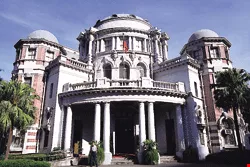
The Control Yuan, built in 1915 during the Japanese occupation, is an example of the imitation Renaissance style picked up by the Japanese Empire from the West.
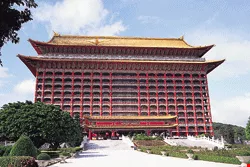
Taipei's palace-style Grand Hotel, built in 1968, is representative of efforts of the postwar Nationalist government to reassert traditional Chinese culture and the authority of its regime.
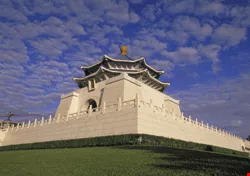
The Chiang Kai-shek Memorial Hall, built in 1980, combines a square floor plan with an octagonal roof, in an innovative design that is distinct from the "palace" style. It is considered one of the last examples of building inspired by traditional Chinese architecture.
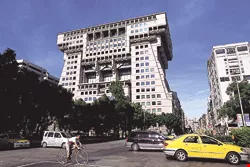
The postmodern Hong Kuo Office Building boldly incorporates classic building elements of the Sung and Ming dynasties, yet fits nicely with the modern business district in which it stands.
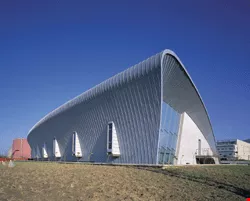
Situated at Pali, Taipei County, the Shihsanhang Museum of Archaeology (2002) has a cutting-edge design and excites interest in ideas about public architecture. (photo by Cheng Jin-ming)
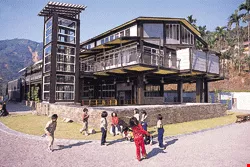
After the 921 Earthquake, the rebuilding of the Nantou's Tannan Elementary School in 2001 put traditional building structures of the Bunun Aboriginal people into use for the new school, resulting in a whole new atmosphere.(photo by Hsueh Chi-kuang)


@List.jpg?w=522&h=410&mode=crop&format=webp&quality=80)


