Four years ago, when we came to Bangkok, our two daughters were in the fourth and first grade respectively. They entered ISB, an international school run by Americans. With students of 45 nationalities, it is a real mini-international society. Here, our children immediately faced two problems: how to catch up in their classes using English, and how to deal with multiculturalism. Today, four years later, as we look back, we've discovered that, as we originally thought, the family is the greatest source of strength for children.
I recall that when our children first entered ISB, they only understood a small amount of English. Yet, vital as it was for them to master English as quickly as possible, we still decided that at home we would only speak Chinese. Looking back, this was a very happy decision. Although after four years of hard work, English is now the "official language" of our children, because of our principled stand at home they do not have the habit of mixing languages, and when Chinese-speaking friends come to our house, our children do not speak any English at all.
Some people might think that our stance is trivial, because after all English is the international language, and there's nothing wrong with speaking English on a daily basis, especially for children getting an American style education. But that is not the way we feel.
In fact, I completely comprehend the advantages of the Western education that our children have received these past four years. For example, they know how to manage their own time, express their own thoughts, and overcome their handicaps. Even our daughter Pony, now in the fourth grade, knows how to find materials on her own to do her homework, while our seventh grader is writing independent research reports that include her own views.
But just because Western education has its advantages does not mean one must abandon one's own culture. How can you expect a child who does not like to speak her mother tongue, or does not do so well, to have a chance to discover the beauty and richness of her mother culture? This is why we decided to work from the level of basic language habits.
For our younger daughter Pony, who did not have any schooling in Taiwan, there was a period of time when the situation was rather difficult. Her English was getting up to speed, but her Chinese was not well rooted. Sometimes it was difficult for her to express some sentences in Chinese. Fortunately she is very patient, and we held our ground on this issue. We always encouraged her and waited for her to take her time thinking, and explained things to her if she could not think of them on her own.
As for her older sister, Abby, we're not worried that she will not be able to keep up the level she had in Taiwan, so we do not use textbooks to maintain her Chinese ability, nor do we force her to go to a Chinese school. The only thing we do is to give her Chinese books with healthy, thoughtful contents, and sit together with her to read classical Chinese literature. Therefore, though Abby has been out of Taiwan for four years, she has not only not become Western in her thinking, but she can even recite the whole book of Tang poetry and some Song ci verse as well, and her ability to read classical Chinese is not bad.
Even now, as I write this essay, Abby is sitting in front of the computer translating some English books that she particularly likes into Chinese. This is one way she improves her Chinese ability, and we give her some help on words and sentence construction. Through this pastime, she sharpens her ability at her mother language and deepens her understanding of Chinese culture.
These days, every night after dinner, my greatest joy is to read one Tang poem with my younger daughter. Although this is a repeat of what I went through four years ago with my older daughter, I'm not in the least bored, and I'm using a different approach. As far as I am concerned, rather than simply teaching Pony Chinese characters to use as tools, I would rather that she come in contact with Chinese culture as she learns. I chose Tang poetry because Pony had learned in school how to write Japanese-style haiku using English. Having learned to write lovely poems in this 17-syllable form, I felt that it was a good time to introduce Tang verse to her.
As I hoped, she enjoys it very much. Each day as we read, she asks many questions. She even translates every poem that she has read into English, recording these in her neat handwriting in her notebook, and adding drawings as well. When I look at these works that she is accumulating, I feel very gratified, and more determined than ever to help my daughters who are receiving a foreign education to find their real selves and explore their own culture.
p.55
This is a picture of Pony's notebook of English translations of Tang poetry. It adds a playful element to our exploration of the spirit of traditional Chinese culture.
p.56
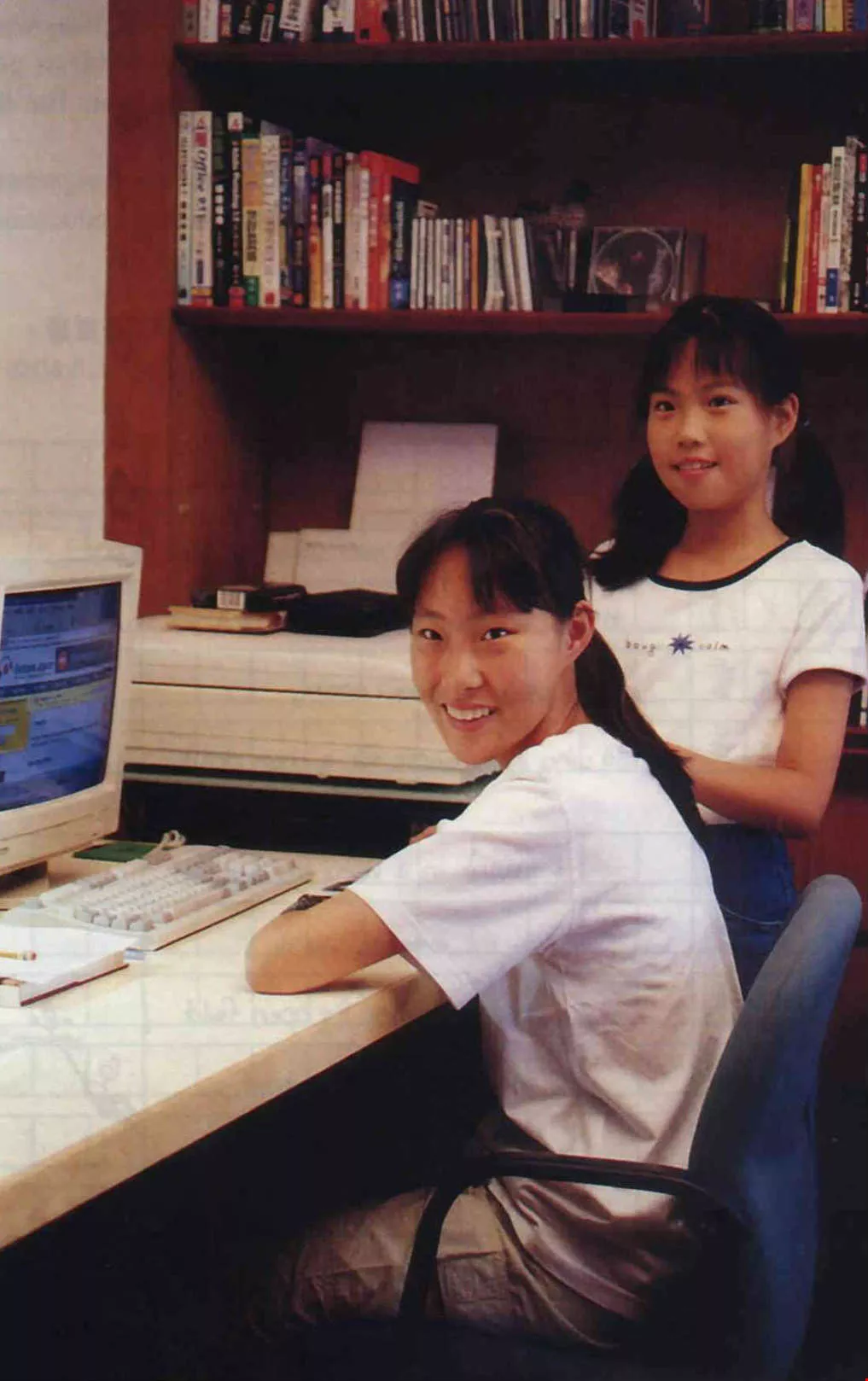
The picture shows our children Abby and Pony (Yue-chi and Shu-chi in Chinese) in our study discussing their homework, and looking for information on the Internet.
The picture shows our children Abby and Pony (Yue-chi and Shu-chi in Chinese) in our study discussing their homework, and looking for information on the Internet.




