

In recent years, the drug Ecstasy-also known in English as E, X, XTC, Adam, and MDMA-has periodically been put under the public spotlight. It is now routine for the police to conduct drug sweeps on dance clubs, where this substance-known in Chinese as the "head waggling pill" for its popularity among dance fans-is commonly used. Yet, at the same time, some in cultural circles who are exploring the relationship between Ecstasy and youth subculture are hoping to persuade society that there is not necessarily any connection between E, hard drug use, depravity, and/or crime.
Where did E come from? What is behind the link with dance clubs (often called "E-pubs" in Chinese)? What are its effects on the body and the mind? How can we best understand the E phenomenon?
It is one a.m. and the rhythms of techno music pulsate through a pub in the Hsinyi commercial district. Young people, filled with perhaps more than simple youthful energy, some wearing white gloves or waving fluorescent light sticks, bop around on a tiny dance floor bathed in black fluorescent light. Waving their hands in time with the music, they look like they are conducting some sort of intense pantomime.
Swimming against a rhythmic current coming at a rate of 180 beats per minute, a twentysomething woman with dyed red hair undulates in time with the pounding percussion; the very notes seem to be coming out of her swirling hair.
Are these people "drug addicts"? Or is this all just some passing pub fad?

A seminar put on by the Bureau of Cultural Affairs of the Taipei Municipal Government in conjunction with the China Times on the subject "What kind of sub-culture is represented by techno music and MDMA?" attracted a packed house. Discussion among leading cultural figures opened up fresh space for interaction between mainstream culture and youth sub-culture.
Techno craz-E
"In Taipei there are at least a dozen pubs that play trance music. If you figure five or six hundred customers a night, I would guess that perhaps more than 100,000 people in Taipei have tried E," opines Inertia Huang, editor-in-chief of Pots magazine, who has done what might be called small scale field research in Taipei pubs.
The media carries stories about E-pubs or E-KTV parlors on almost a daily basis, and E has become a hot topic of conversation among less-than-ecstatic parents. This long-taboo subject naturally arouses a great deal of curiosity.
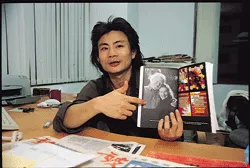
"Say no to drugs, resist the temptation of E." "Mood drugs rampant." "Ecstasy discovered at KTV for fourth time." Mickey Chen, a young film director who does not hesitate to state that he has tried E, has amassed a huge pile of clippings about this drug, and can't help but groan: "The media are making a lot more out of this than it deserves."
Chen, who as a homosexual is in close touch with the marginal and youth subcultures in Taipei, explains the E phenomenon in this way: "In an Ecstasy-enhanced world, dance is no longer just moving your head and shoulders around, but becomes an obstacle-free interaction between the body and the music. E liberates the body's capabilities, and creates a dialogue with one's fears. You forget the wall between yourself and other people, and engage in an intimate dialogue with others."
A foreign teacher in Taiwan named David, who used Ecstasy in the US, relates that he began to take E back in the 1980s, usually enjoying the sense of well-being that it imparts (known to experts as entactogenesis) in a private home in the company of good friends. The drug, he says, also creates a sense of closeness and sensitivity (empathogenesis) that breaks down inhibitions, with results like people playfully rolling around together in bed, hugging tightly, and the like. This is why E is also called the "hug drug." People become willing to talk about their deepest feelings, and have the sensation of connecting in a holistic exchange of thoughts and emotions. Its a great feeling once in a while, says David, though it is best if you don't come to need it to get by.
What should you say to drugs, "no" or "know"? If young people knew more about drugs they could make their own choices and avoid being harmed out of ignorance.
Do you dare?
How serious is the "E problem" from the point of view of the law and law enforcement?
"It's really just about young people being curious, and trying to keep up with a fad," says Sandy Yeh, director of the Continuing Education and Training center at the Central Police University (CPU). Media overindulgence has served as free advertising for the drug, giving young people the idea that E is mainstream. Combined with peer pressure, taking E has become a kind of crowd behavior kids do to be accepted by others.
"Also, Taiwan doesn't have a comprehensive drug education program," says Yeh, so that young people are unable to make informed decisions about illicit drugs. As a result, a lot of teenagers end up trying the drug just to seem hip.
Law enforcement agencies have no record of any E confiscations prior to 1998. A total of 4890 grams (equivalent to about 13,000 pills) were seized in 1999, while 4762 grams were confiscated in the first ten months of 2000. These figures indicate that E has become more prominent in the last couple of years, though it remains a mere drop in the bucket compared to amphetamines, of which 770,000 grams were seized by police last year.
Lin Shih-ku, chief of the Department of Addiction Science at the Taipei City Psychiatric Center, says that the Taipei police send about 400-700 urine samples a month for testing to his hospital. Last year they screened more than 7000 samples, with 68.5% coming up positive for amphetamines, versus only 0.1% positive for E. Clearly, in terms of law enforcement, amphetamines rather than E should be the main concern.
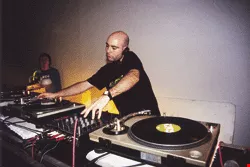
(photo by Jimmy Lin)
Getting to know E
Though E is not in fact very widespread, it does exist, so people should know something about it.
Ecstasy is a chemical compound whose name alone sets the head spinning: 3,4-methylenedioxymethamphetamine. Luckily, we can just call it MDMA. In 1998, it was listed as a schedule 2 substance under ROC drug abuse prevention regulations, and as a schedule 2 controlled substance under the law governing pharmaceuticals. Taiwan does not allow its use for medical purposes.
MDA, the precursor to MDMA, was first made in the second decade of the 20th century by the German firm Merck as an appetite suppressant. MDMA was synthesized in the 1970s. Little notice was taken of the mind-altering effects of these drugs until 1976, when a study by the biochemist Alexander Shulgin opened the way to the use of MDMA in psychotherapy. It was also at this time that it became a recreational drug. By 1988, MDMA had become the most popular drug in the UK and US.
Yeh Yu-chi, attending general psychiatrist at the Pali Psychiatric Center, points out that "MDMA is a stimulant like amphetamines, and also causes altered perception like hallucinogens." MDMA is a synthesized drug. In chemical structure it is a methamphetamine with mild hallucinogenic properties. It is most often seen in the form of white pressed tablets, red or white capsules, or a white crystalline powder. It is usually taken orally in a single dose of 80 to 160 milligrams. It begins to work about an hour after ingestion, reaching a peak in the second hour, with the effects lasting for a total of four to six hours. After ingestion, the pulse quickens, blood pressure rises, the pupils become dilated, and appetite is reduced, but there is less hyper-excitement than is experienced with amphetamines. There are also mild hallucinogenic effects, though much weaker than, say, LSD. Yet, oddly enough, E also induces a sense of tranquility and wellbeing.
Less appealing effects of MDMA include post-use depression and sleeplessness. Persons who take the drug in large doses may suffer nausea, dizziness, and severe palpitations of the lower facial muscles. MDMA is usually taken as a "party drug" that helps maintain energy levels for all-night raves, creating the danger that people in an E-induced euphoria can easily miss signals from their bodies that they are becoming exhausted, overheated, or dehydrated, which in a worst-case scenario could even lead to acute kidney failure.
Lin Shih-ku explains that, while MDMA users must be extra careful about rest and liquids, there have been no reports thus far of use of MDMA leading to addiction or death. But it should be noted that "additives"-such as amphetamines, caffeine, Ketamine, and hashish-have been found in MDMA seized by the Taipei police. The uncertain quality of the MDMA in Taiwan means that users are running an extra risk. Some sources also advise that MDMA should never be used at the same time as monoamine oxidase inhibitors (usually found in antidepressant medication), nor be taken with in combination with amphetamines or alcohol.
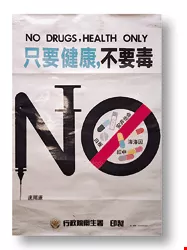
What should you say to drugs, "no" or "know"? If young people knew more about drugs they could make their own choices and avoid being harmed out of ignorance.
Drugs in Taiwan
Should MDMA be considered a dangerous drug? Or more like a mood-adjusting pharmaceutical? Saying that most adults find it hard to accept the idea of a drug that has no medical value but is taken just for recreation, Inertia Huang makes an "alternative" argument: "Every year the number of people killed by alcohol and tobacco far exceeds the number killed by all drugs combined, so why are alcohol and cigarettes legal? Are we more accepting of the latter just because we see them being used by elegant people under sunny skies, while E is confined to dark and noisy pubs?"
Over the course of drug history in Taiwan, each drug has had its own social significance.
Chou Wen-yung, an instructor in the Department of Crime Prevention and Corrections at the CPU, notes that use of amphetamines or FM2 (the "date rape" drug)-which were the most popular a short time ago-was mostly done in private, generally by "bad elements" among young people, so the overall message was very negative. But E is part of a rising club culture, and sends a message that taking drugs can be done openly, can be relaxing, and can even be an element of socialization and positive feeling. Users of E also include a much wider range of age groups, which seems to validate its use. The gathering of a large group together in a pub creates a sense of safety in numbers, or perhaps even a mob mentality, further weakening the psychological restraint of knowing the drug is illegal.
The term E-pubs, which is now very much in vogue, usually refers to places that play techno music, with much the same symbiotic relationship between techno and E as existed in the 60s in the West between psychedelic music and hallucinogenic drugs. Yet, under the impact of ecstasy, pure lovers of the music are getting put off. DJ@llen, one of Taiwan's best known DJs, bemoans the fact that "people just want to get high, blow whistles, and shout... nobody goes to enjoy the music!"
Giovanna Sun, product coordinator at Rock Records, the local agent for many techno albums, reminds us, however, that "openness" in the use of E is purely relative, and in fact overt use of the drug is not that common. It is perhaps for this reason that some fast-thinking businessmen have come up with special E rooms at KTVs, creating modern "opium dens" where users can do their thing out of the public eye.
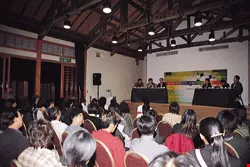
A seminar put on by the Bureau of Cultural Affairs of the Taipei Municipal Government in conjunction with the China Times on the subject "What kind of sub-culture is represented by techno music and MDMA?" attracted a packed house. Discussion among leading cultural figures opened up fresh space for interaction between mainstream culture and youth sub-culture.
Just say know
Of course, it is worrisome that clubs are often managed by criminal gangs, who profit from the sale of E and keep the market hopping with ever-new variations, as Inertia Huang has noted: "New types of E, with different ingredients or packaging, are constantly appearing in pubs. There is a new form of E in pubs every week, while orange 888, green 'cu,' and blue taiji are all high on the drug hit parade."
Obviously MDMA has gone from being a mood-enhancing private party drug to an illicit substance marketed by criminal gangs. Yet heavy suppression tactics that force users underground only help the criminals, and could end up ruining the life of some young people who just want to try E out of curiosity and carelessly get caught in the law's net. Chang Ping-yu, professor and chair of the Department and Graduate School of Crime Prevention and Correction at the NCPU, suggests that more realistic guidelines be drawn up for police action against E, so that the police do not waste time being led around by the media, which tends to exaggerate the E problem.
Inertia Huang also advises legislators and government agencies in Taiwan to take note of foreign precedents.
"The Dutch example, of having 'safe houses' for selected drugs, aims to address the drug issue on the principle of 'just say know.' It is a very creative approach that offers new possibilities." The "safe house" strategy follows the drug from source through supplier, rather than focusing exclusively on trying to restrict users. There are always "safe house" staff on hand at rave parties to test whether the drugs being used are safe. Users and small time dealers bring their drugs forward to be tested, so that not only can the authorities keep abreast of new drugs, they can trace drugs back to their source and work with the manufacturers to keep truly dangerous products from getting to the public.
The Ecstasy phenomenon in Taiwan is a test for the mainstream culture in facing an entirely new social phenomenon. What would you opt for: Suppressing the whole thing, or taking the time to listen and understand?

Singing on stage, chillin' and groovin' offstage. Boundaries fade away in the kingdom of music. (photo by Hsueh Chi-kuang)
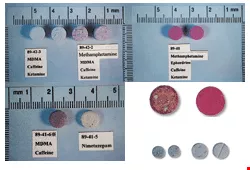
Much of the MDMA (aka "Ecstasy") seized by the Taipei police includes "additives" like amphetamines, caffeine, or Ketamine. The different sizes and colors of the pills make one curious to know more. (rephotographed from file photos of the Taipei City Police)
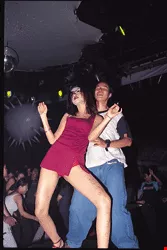
Urban nightlife brings out all kinds-some searching for a one night stand, some who just want a chance to let go and enjoy the music. (photo by Hsueh Chi-kuang)

@List.jpg?w=522&h=410&mode=crop&format=webp&quality=80)

@List.jpg?w=522&h=410&mode=crop&format=webp&quality=80)


