Going to the Office--Chu Te-yung
Kate Yang / photos Chi Kuo-chang / tr. by Anthony W. Sariti
May 2005


Compared with most office work-ers, who have ten to 20 years on the job, 45-year-old Chu Te-yung has less than four years' office experience-and that was more than ten years ago.
Chu's latest work, Going to the Office, came out at the beginning of the year. At the book launching a reporter asked how it was possible for Chu to depict the office-worker psyche so thoroughly, since he himself had not really worked much at all. The fact is, Chu Te-yung is not a woman either, yet he was able to create the hugely popular "City Ladies" cartoon series and depict the female office worker's petty emotions and life to a "T" in a way that was just hilarious.
Also, when he was creating the well-known series "Double-Sound Crackers" about husbands and wives with his usual gentle humor, he was still a single guy.
Gifts from heaven, an innate sense of humor and artistic talent have shaped Chu Te-yung's special ability to look at the absurd nature of this world and make us laugh. The unique humor of Chu's dialog and the gentle caricatures that appear in his cartoon panels are always able to give us an insight or two.
In recent years the works of Chu Te-yung have appeared in Taiwan, mainland China and Hong Kong. They have been made into TV series, movies and stage productions, and people have advised him to set up his own production company to make a quick bundle from the sale of copyrights.
Chu Te-yung, tall and softly spoken, with a slight comedic air about him, disagrees. He says drawing pictures is a means for him to make a living, and also his greatest interest in life. To start a company and run around making money would be just too alien to his character and would violate his nature as a person who doesn't like to go to the office. "Anything that can deprive you of your freedom is something I don't want, no matter how much money it would mean," he says.
Like many artists, Chu Te-yung is shy when it comes to the media. His reserved and retiring character is immediately obvious. As for the straight-combed-back shoulder-length hair that he has maintained for several decades, he says he keeps it because it's easy to take care of.
This is Chu Te-yung. Indifferent to fame and free to do what he wants, following his nature in everything he does.
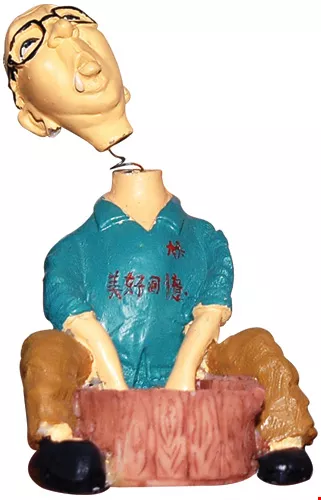
Before Chu Te-yung's cartoons successfully entered the mainland market they were pirated like crazy. Mainland readers were quite familiar with his work early on. On his bookshelves in Taipei lie a number of pirated editions dating back to those days.
Boy at the window
His theme has shifted from men and women living in the city to the psychology of the office worker, and this is related to his experiences growing up. Chu Te-yung says that working is the most boring thing in the world, and an equally boring thing is going to school.
When he was young, Chu didn't like going to school or studying. From kindergarten onward he insisted on sitting next to the window in class because at least there he could see everything outside. If he weren't doing that, then he would bury his head behind his desk and draw cartoons. Both of these activities were a lot more fun than listening to the teacher.
A student with such a personality must have been a headache for the teachers. Once in kindergarten they wanted to have some outdoor classes and the teachers broke all precedent by making a beeline to Chu's home to talk with his mother, asking that he not participate because they were afraid they wouldn't be able to control him and this would affect the outing for the other children.
Since childhood Chu Te-yung has been a non-conformist. In high school he firmly believed that military instructors had no business being in the schools and was always vehemently arguing with them. It took three different high schools before he was able to graduate.
When he was a junior, Chu Te-yung transferred to a private "graduation school" on the outskirts of Taipei to which students were "farmed out" just to get their diplomas. Most of the students were just putting in their time waiting to graduate, join the military then return to society to take up a manual labor job.
When Chu saw the reality of the situation, many thoughts flashed through his mind. He felt no matter how bad he was, he should not sink to this level! It was at this point he took the real initiative to hit the books and get into Shih Hsin University studying film directing.

Chu Te-yung
Working is against human nature
Around 1986 Chu Te-yung got out of the army, joined the world of journalism and started working at the China Times. All he had to do was to come to the office each day in the evening and work for about an hour and a half drawing cartoons on the main topic of the day. Together with additional cartoons for other stories, his work could amount to NT$100,000 a month, a sum that made many people really envious.
Most young people of that era had their heads filled with the idea of battling it out for a position in a large, secure company, spending their working life there and finally getting their pension and enjoying retirement. Even though to the outsider the China Times publishing group seems a stable "golden rice bowl," Chu Te-yung was deeply unhappy. Whenever he could push things off, he would. He was supposed to get to the office in the evening but he always dragged it out to the last second before he would catch a taxi and make his way to the job.
Chu worked like this for four years and then one day he suddenly realized with alarm that although he appeared calm and collected on the outside, in fact he felt as if he were bound with an iron chain. It was exactly the same feeling he had had as a child when he had been taken off to school, so he made the courageous and resolute decision to quit his job.
His girlfriend at the time (now his wife) was the editor of the variety pages at the United Daily News. She, too, was fed up with the system and wanted to get into something creative, so she left her job as well.
The two unemployed young people now used their savings to get married and buy a place to live. After they started to feel the pinch they got in touch with a publisher to discuss doing a book, while Chu Te-yung proceeded to became the earliest home office worker in Taipei.
"I did Double-Sound Crackers then and had a first printing of 200,000." Originally, Chu was hoping to get a good price by printing a few extra copies and so latched on to this rough figure. He never expected the enthusiastic reception readers gave his book and kept increasing the print run until the number of copies reached 400,000.
Aside from publishing books during this period, in a frenzy he took on commercial advertisements and public interest anti-smoking jobs, considerably fattening up his wallet.
Chu thinks back to his most productive period, roughly 1997-98, when he published a total of 12 books of cartoons. Workdays often exceeded eight hours, and he worked far harder than when he used to be at the office. His wife, who had longed to get involved in creative work, had no choice but to devote herself to being his assistant, handling outside contacts and relations with publishers; but loving books more than anything else, she could go through two to three a day, and became a fantastic database which Chu Te-yung drew on for creative material.
But, although he loathed all things having to do with the system, after Chu Te-yung actually joined the ranks of the home office workers his days were strictly ordered and regulated. He would religiously rise each morning a little after eight, have a light breakfast and then bury his head and begin feverishly drawing without a break, except for lunch, right on until the stars came out before he would rest.
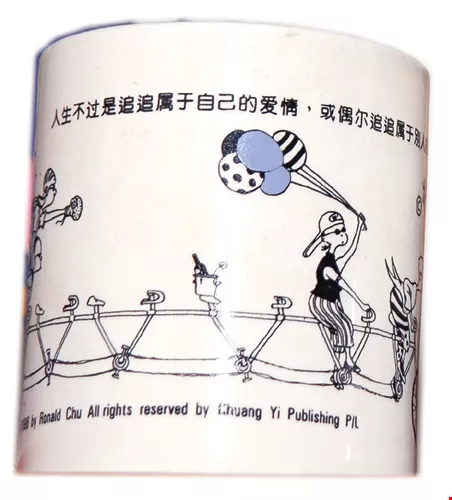
Before Chu Te-yung's cartoons successfully entered the mainland market they were pirated like crazy. Mainland readers were quite familiar with his work early on. On his bookshelves in Taipei lie a number of pirated editions dating back to those days.
Fool's luck
When Chu was working at home during this period he did nothing but drawing, drawing and more drawing, right until the warning signs appeared-his wife discovered that increasingly "he could no longer laugh."
Recalling those days, he says he himself wasn't really aware of anything, but his more sensitive wife felt something was wrong. The creative life requires quiet, concentration, and interest; thus Chu Te-yung would normally throw himself into his drawings, but every time a holiday came along he was sure to pull out all the stops, go out and let off steam, and enjoy some relaxed leisure activity. Later, however, under the relentless pressure of his publishers, he would go into his office even on holidays at the appointed time to draw, and all interest in outside activities disappeared. "Thinking back on it now, I was basically a human machine," he says.
Chu notes that precisely because he was complete master of doing what he liked to do, this led to more and more jobs, raising the work level to impossible heights. His wife wanted him to stop drawing, but he didn't notice anything out of the ordinary until 1998, when his wife put her foot down and put a stop to all his book publishing and commercial projects, leaving only two or three signature cartoon strips. With their five-year-old in tow, the couple then put down everything and went overseas to Singapore, Japan, the US and elsewhere for stays of two to three months.
"This market is such that when you leave, there's always somebody to take your place and fill in, no matter how well or lousily he draws," says Chu Te-yung with equanimity. In 2002 after Chu returned to the cartoon scene following an absence of three years he was faced this ruthless situation. Like many artists, he was willing to run the risk of a temporary hiatus in this tough business, but it only made a comeback for him impossible.
But Chu doesn't see things in such narrowly materialistic terms. "Although I didn't produce much during my three-year break, I got back my interest in life. That's more important than anything. I'm a happy person now and I think my current work is better than before. It's a case of 'fool's luck,'" he says with a happy smile.
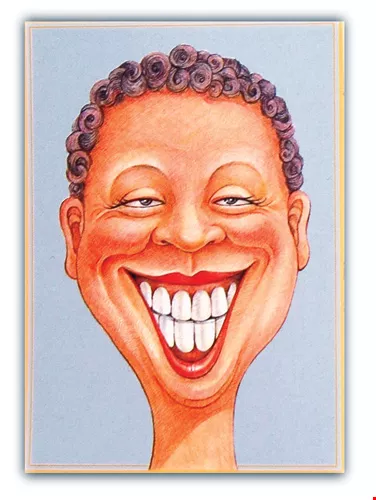
The leading female character of Double-Sound Crackers as drawn by Chu.
Unexpected success
While Chu Te-yung was away from the cartoon scene in Taiwan, his cartoons began to quietly gain popularity in mainland China. Chu says this was like a blind cat catching a dead mouse-purely happenstance. In 1999 the rights to his books were sold for publication in the mainland and, introduced by a friend, he traveled there to check the situation out. At the time mainland commercial mechanisms were still very "primitive." There was no concept of marketing or a production pipeline. The media environment was also closed. On top of this came Chu's own lack of knowledge. All this made it extremely difficult to reach decisions, and it took three more years for the whole business to get on track.
2004 was Chu Te-yung's banner year in mainland China. His City Ladies enjoyed a brilliant success and was made into a TV series, a movie and a stage play, all this leading to the gradual appearance of the author's name in the pages of the major media. Beijing's CCTV also planned to re-do all his cartoon books. Chu had suddenly become the voice for the new class of urban office workers who emerged in the wake of the mainland's economic reforms.
In addition to the various artistic forms of expression his works have taken, not long ago Shengda Technology Co., Ltd. of Shandong got in touch with Chu with plans to manufacture a line of household products products using his cartoon characters, and these are expected out the middle of this year.
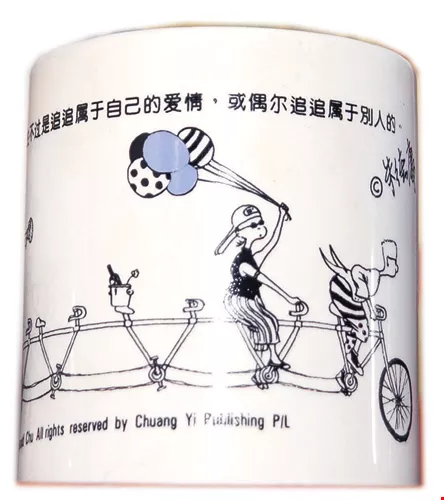
Before Chu Te-yung's cartoons successfully entered the mainland market they were pirated like crazy. Mainland readers were quite familiar with his work early on. On his bookshelves in Taipei lie a number of pirated editions dating back to those days.
Different mindsets
"Going to the office violates human nature. Goofing off, that's what's really in line with people's nature." Chu Te-yung said this more than once at the book launching of Going to the Office. He said that although he knew very well he was lucky to have a soulmate and an understanding wife, whenever she would ask him to do something, as long as it wasn't something too important, he would revert to his habitual nature and often plan on doing a half-hearted job or just going through the motions. This is the "employee mindset."
Aside from the employee mindset, Chu also explores the boss mindset. In his book, he divides bosses into two types: those who have human feelings and those who do not. With his characteristic black humor he says, "A company with human feelings can always be absorbed by one without them!" When asked by reporters whether he might want to be a boss and have a taste of power, he replied, "I could never become the kind of person I hate."
A dozen or so years ago Chu set up his own workshop and hired a few employees, but closed it down in less than a year. "I had to come to the office every day and hold a meeting. Things I could settle in a half hour by myself took hours with others. It was sheer stupidity!" He just couldn't take it.
As an observer, Chu Te-yung likes to look at the absurd side of things. Seeing so many office workers rushing around the streets, he knows each has a story to tell.
"If Double-Sound Crackers depicts the absurd side of marriage, then Going to the Office focuses on the absurd side of office life." Chu hopes that after reading this comic-strip book, office workers will be able to identify with the characters and be comforted, that the book will reduce their anxiety, their feelings of guilt and their sense of ennui on the job.
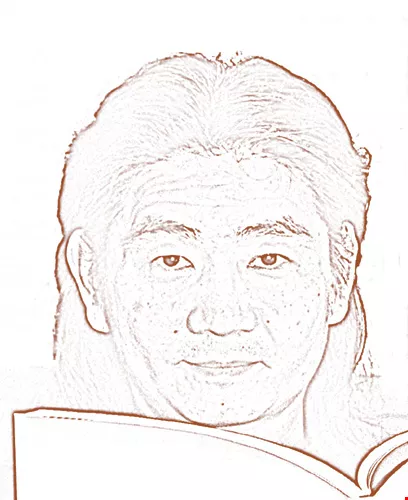
Chu Te-yung
Sleep fantasy
Chu Te-yung, who has spent a lifetime following his own nature, doesn't want to waste his life on "necessary things," and this includes sleep. Chu feels doing anything is better than sleeping. He admits to very few hours of sleep (four or five a night) and has never been one to lie in bed. He says when he wakes each day his eyes are open in an instant and his brain turns on like an electric light bulb, ready to go. He doesn't need any time at all to get awake. He's always ready with the quip that "after you're dead, you'll have plenty of time to sleep."
As he has gradually gotten older, however, Chu has grown rather fond of that time just after going to bed when you get a bit groggy. Then he falls into a dreamy state of mind and most of the time it's as if he is returning to his childhood home. He sees the neighbors' houses and the surrounding countryside, and imagines himself walking and playing nearby. Chu doesn't understand why this should be so, but it is his happiest moment just before he falls off to sleep. He feels very calm, actually returning to his childhood days, the simplest and most beautiful period of any person's life. Perhaps this is also a way to try and free himself from the system that bothers him so much.
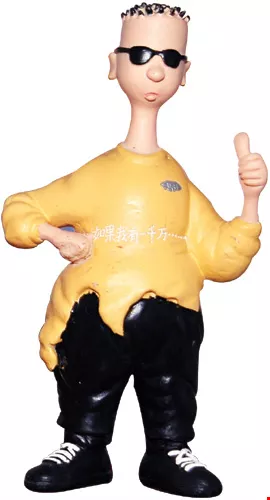
Before Chu Te-yung's cartoons successfully entered the mainland market they were pirated like crazy. Mainland readers were quite familiar with his work early on. On his bookshelves in Taipei lie a number of pirated editions dating back to those days.
Earliest Taipei walkers
In his leisure time when not busy Chu Te-yung likes to take walks with his family. He says he and his wife could be called the first of the old-line Taipei walkers.
As early as 17 or 18 years ago they walked Taipei's every nook and cranny and have traveled the alleyways around Lini St., Chingtien St., and Wenchou St. countless times.
Chu looks at Taipei now and laments a city without memory. Worthless commercial activities have destroyed almost everything old, to the point where even in such a large city traces of the old life are nowhere to be found.
A cartoonist and creative artist, Chu Te-yung does not lead the high life of the rich and famous. If possible, he eats mostly at home. Chu likes to both eat and cook, and once a week makes a trip to the market to buy food. He is known so well by the merchants that they greet him with enthusiasm and even ask how his work is going.
A few meetings with Chu and you see him dressed either in black or gray. He says the clothes he likes can all be mixed and matched but they must be a deep color and have a basic style. Although he loves the clothes of Japanese designers like Yohji Yamamoto and Issey Miyake, devotee of the frugal life that he is, Chu hardly buys a piece of new clothing once a year. All his clothes are old faces from seven or eight years ago. His material demands are low and he doesn't care about fame or success. Nothing is indispensable to him.
Although he gets invitations to many fashionable parties, stay-at-home Chu Te-yung rarely accepts any. He would rather stick to home because for him it's the carefree life that is most important.
After 15 years of doing cartoons at his home office, each day Chu still sets a time to sit down to the table and draw, spending more time at work than the average office worker. The difference is it's his own desk, not an office desk someone else is telling him to sit at.
To a certain extent, Chu has still chosen the office-worker lifestyle for himself. He has found something of a balance point between what he sees as the significance and the absurdity of office work. "If you really have no way out, you can at least choose a work style that more or less suits your nature," he says.
Chu Te-yung is just interested in quietly doing what he wants to do-continue creating cartoons that can represent the Chinese people.
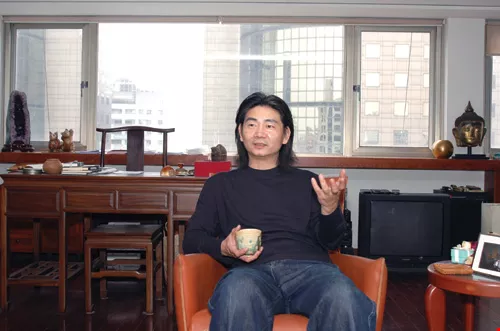
Chu Te-yung's office has spacious windows, an antique desk and a European-style kitchen. Here he discusses business matters and receives visitors-but it's not where he does his creative work. With his strong urban temperament, Chu maintains a certain distance from people, which allows him to lead a carefree life doing whatever he likes to do.
The Works of Chu Te-yung:
The Great Hedgehog; Double-Sound Crackers; Double-Sound Crackers 2; Hello Again, Double-Sound Crackers; Hello Again, Double Sound Crackers 2; Hot and Spicy Double-Sound Crackers; Thunder and Lightning Double-Sound Crackers; Thunder and Lightning Double Sound Crackers 2; City Ladies; City Ladies 2; Dear City Ladies; Pink City Ladies; Swingin' City Ladies; The Sour Generation; The Sour Generation 2; The Sour Generation 3; Sour City; Everything's Happening; Going to the Office
 068.jpg?w=1080&mode=crop&format=webp&quality=80)
Before Chu Te-yung's cartoons successfully entered the mainland market they were pirated like crazy. Mainland readers were quite familiar with his work early on. On his bookshelves in Taipei lie a number of pirated editions dating back to those days.
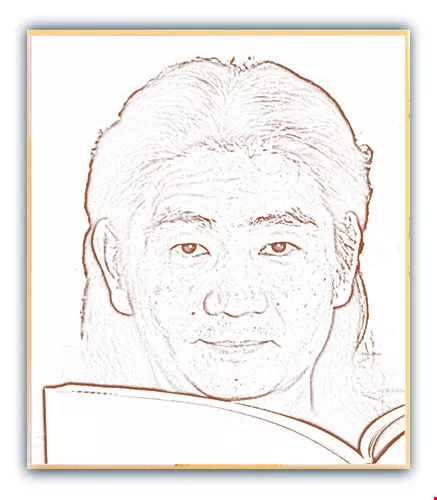
Chu Te-yung
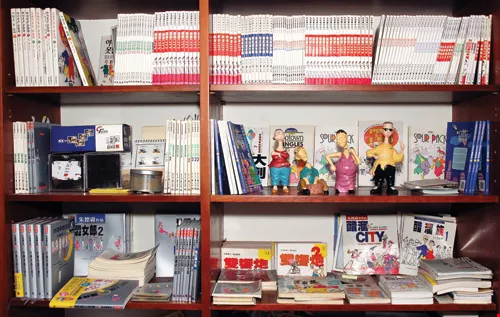
Before Chu Te-yung's cartoons successfully entered the mainland market they were pirated like crazy. Mainland readers were quite familiar with his work early on. On his bookshelves in Taipei lie a number of pirated editions dating back to those days.
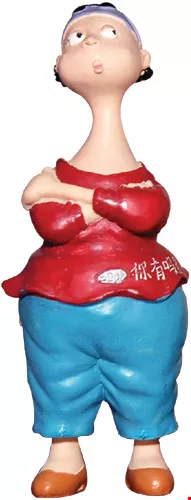
Before Chu Te-yung's cartoons successfully entered the mainland market they were pirated like crazy. Mainland readers were quite familiar with his work early on. On his bookshelves in Taipei lie a number of pirated editions dating back to those days.

@List.jpg?w=522&h=410&mode=crop&format=webp&quality=80)

@List.jpg?w=522&h=410&mode=crop&format=webp&quality=80)


