The Art and Craft of Saxophone Making
Tsai Wen-ting / photos Jimmy Lin / tr. by Phil Newell
June 2005

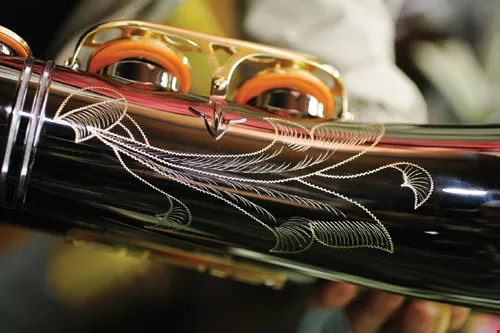
With a simple awl, a master craftsman can carve an elegant design.
The saxophone family
Saxophones, which are wind instruments, can be divided into two categories: brass and wood. The former have metallic mouthpieces, while the latter have wood or bamboo mouthpieces. Houli is famous around the world for manufacturing the wood type.
The saxophone family has four members (from highest register to lowest): soprano, alto, tenor, and baritone.
The most important things in making a sax are the selection of the materials and the craftsmanship in the manufacturing process.
A saxophone has nearly 400 parts large and small. The manufacturing process involves more than ten steps, including cutting, hammering (or hand-pounding), cooling, soldering, finishing (lacquering or plating), buffing, and assembly.

Making a saxophone requires a large number of steps involving a blend of art and craftsmanship.
Bell and body
The first step in making a sax is the shaping of the bell and body of the horn. To create the bell, a sheet of brass is cut according to a pattern and then the edges are welded to form a bell-shaped circle. The shape is carefully refined into an elegant curve by placing it over an iron form and pounding it with a wooden mallet. If a metal hammer is used, the brass will be stretched and flattened, becoming increasingly thin, affecting the consistency of the tone.
When shaping the bell, the process of cooling must also be carefully controlled, so that the metal does not become brittle and crack. After two or three hours of hammering, as the brass becomes tempered, the metal's sound reflection properties improve, which increases the resonance of the instrument.
"I've had apprentices who tried to get out of working by pretending to be sick every time we got to the making of the bell, because this is the most physically demanding part of the process, and there is just no way that it can be done by machine," says Wang Tsai-jui, the boss at Lien-cheng Instrument Company.

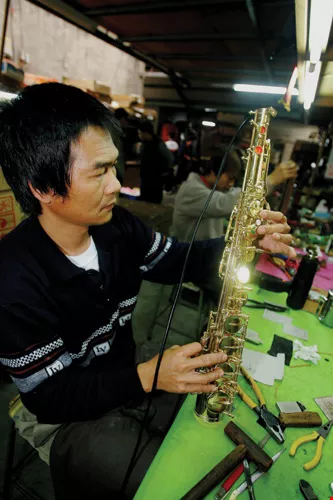
By placing a light inside a saxophone you can see how well the keys seal.
Soldering
Soldering comes next. After being cleaned in borax in order to dissolve away impurities, the body and bell are sealed together by silver soldering them at a temperature of 700蚓. However, when smaller parts are attached to the body, low-temperature "soft" soldering is used, for fear of damaging the horn.
During the soldering of the bell and the body, because the brass includes zinc or tin, oxidization will produce bubbles. So it is necessary to beat the soldered seams with a metal hammer to increase their density, and then they must be buffed flat. Only when there are no visible marks of the soldering process can the sax be considered up to snuff.

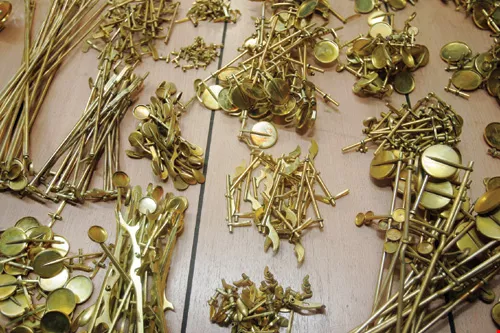
A saxophone has almost 400 parts. It is a highly complex instrument to build.
Finishing and cleaning
After the bell, the body, and the various other parts are all completed, next comes the application of a finish, either by means of lacquering or electroplating. Besides the aesthetic effect, the use of different types of finishes will also give horns different tones. For example, saxes that are silver-plated have a warm, fat tone, and are best suited for playing sentimental ballads. Saxes that are gold-plated have a clear, ringing tone, and are mostly used in classical music. The finish can be brought to a beautiful shine by buffing or, alternatively, sand-blasted to create an elegant matte effect.
After finishing, an "acid bath" is used to wash away any impurities and solder remaining on the surface. If the soldering was not done sufficiently tightly, leaving tiny cracks or gaps, the acidic solution will seep into the crevices, and in the future will slowly penetrate into and damage the luster of the instrument. This is why the soldering process, which looks so simple at first, in fact is very demanding, because it has to be flawless.
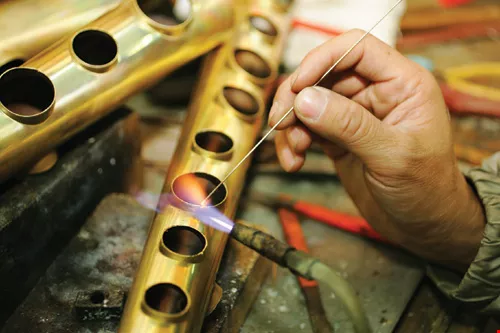
Silver soldering at a temperature of 700°C is hard work and a strain on the eyes.

Assembly and testing
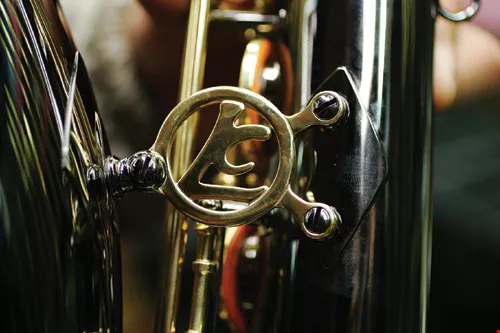
Finally comes the task of assembly. Saxophones have a huge variety of small but sophisticated parts. Take for example the movable "keys" that are pressed to open or close "tone holes" in the sax, thereby determining which note is played. Each key is made up of more than 20 pieces, and each sax not only has 12 keys, but each key has a different shape and construction. This is why the final assembly stage requires the greatest amount of experience and skill of the whole sax making process.
Because there inevitably remain some minor imperfections when all the parts have been attached, after assembly micro-adjustments must be made to correct any remaining flaws; at this point everything depends on the individual skill and experience of the craftsman.
When the assembly stage is complete, the craftsman will insert a small "leak light" into the body of the horn, to see if there are any leaks around any of the tone holes. In the past, before leak-light testing was invented, craftsmen would blow cigarette smoke into the horn; it took about two packs to test each horn. "We didn't need any excuse to smoke back then," recalls 74-year-old Master Chang Lai with a laugh. He jokes, but the dedication required of instrument makers is plainly no laughing matter.