The Gourd Life--Gourd Carver Kung Yi-fang
Kuo Li-chuan / photos Jimmy Lin / tr. by Geof Aberhart
May 2004


The bottle gourd is a kind of melon found throughout tropical and sub-tropical areas. When these gourds ripen, their skin becomes woodlike, making them easy to engrave and paint. Aside from their traditional uses-as food, as serving utensils, and to hold medicine-gourds have found a place in Chinese art thanks to their exquisite curves and simple look. References to gourds can be found as far back as the Book of Songs, and the tombs of the Han emperors are home to an assortment of lacquered gourds.
In later times poets continued to admire the gourd. Song dynasty poet Su Shi wrote of two friends enjoying the simple life-symbolized by the gourd-in his poem "Ode to the Red Cliff." Ink painters have also fallen in love with gourds' simple, elegant form. It is against this rich historical backdrop that gourdwork has developed.
The origins of gourd carving are thought to go back as far as the Tang dynasty, and the Dictionary of Art explains that gourdwork rose in popularity during the reign of Qing emperor Kangxi. The emperor was a fan of cricket fighting, and this led to its popularity amongst the general populace. Carved gourds become common as cages for the crickets, which jumpstarted the art form. It seemed no one, not even the Son of Heaven himself, could resist the beauty of a carved gourd.
Gourd carving in Taiwan started to take off in the 1980s under the guidance of one man, inspired by tales of a magical gourd wielded by demons in Journey to the West. That man is Kung Yi-fang.
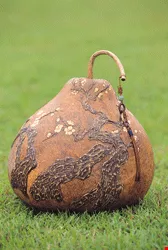
To give his designs are more solid feel, Kung Yi-fang employs a technique of decorative pasting. Here he uses it to give his plum tree a touch of 3D.
Wayward youth
Kung Yi-fang was born in 1949, in the city of Fengshan in Kaohsiung County. He was a country boy, and remembers clearly the water scoop cut from a gourd that his grandmother would use every day. Gourds would often even serve as meals, as his family was quite poor. Sometimes he and his friends would play down by the shed where the gourds were grown. It was almost as if gourdwork was his destiny.
When Kung was in fifth grade, his father cosigned a loan for a friend who then defaulted on his payments. That meant that the family could lose their house, the only asset they had that could pay off the loan. The shadow of this hung darkly over them. One New Year's Eve, Kung's mother took some money she'd scraped together and used it to help prepare a special feast of a kind they were rarely able to have. As luck would have it, the creditor showed up right then, so Kung's mother hurriedly stashed the food in the cupboards. The creditor hung around a while, but eventually gave up when Kung's father didn't show. Once he'd left, Kung's mother brought the food back out-but by then everything was cold.
When it came time for him move on to high school, Kung decided to pack it in, since it was clear to him that his family couldn't afford tuition. A friend of his father, unable to stand idly by and watch Kung drop out, talked him into letting Kung attend a private high school, and so he ended up in a cheaper local school notorious for its delinquent students. Every day the school turned into a battlefield, and sometimes his entire class would just skip school and go nick fruit from local orchards. Kung never did graduate from high school, and ended up joining his father on the road.
After working for the Kaohsiung County Police as a judo instructor and paying off his debts, Kung's father decided to put his medical knowledge to use and started work as a druggist. He would work grinding powders and making tablets, all the while filing for various medical licenses. Eventually he was able to start working as a traveling medicine man. Since Kung had proven unsuitable for the school environment, his father took him on as his right-hand man.
Their medicinal work was mostly done at night, after their day's farmwork was done. Kung had loved drawing since childhood, and spent all his money on art supplies for his hobby. With the family in rough financial shape and art hardly a viable way to make a living, Kung's father wasn't impressed with this obsession, and would often sternly tell Kung off for it, so he carried on with his artwork behind his father's back.
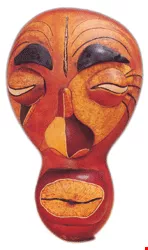
By using a variety of different kinds of gourd and his own "gourd sculpting" technique, Kung is able to produce unique sculptural pieces. This piece, "Aboriginal facepaint," is an example of the amazing results possible with this method. (courtesy of Kung Yi-fang)
Gourds and Chinese macrame
In 1977, Kung's uncle came up with a plan to set up an amusement park at the Akungtien Reservoir. Kung, still fascinated with gourds, suggested to his uncle that he plant some gourds to brighten the place up. Once the gourds had ripened, his uncle sent him to the amusement park to paint them up and decorate the park with them. He found this much less fun than his childhood bamboo-strip engraving, just painting pictures onto the skinned and dried gourds, then lacquering and tying cords around them. But they looked wonderful, and visitors to the park absolutely adored them.
Once when Kung was at the store buying cord, he spotted something-a traditional art that was enjoying a new popularity, Chinese macrame. His head awash with ideas on how to combine this with his gourds, he bought some introductory books and pored over them every night after work.
The economic situation at the time seemed to be looking up, and Kung hoped he could supplement his income with his macrame. He sat down and figured it out: every month his mother was giving him a NT$100 allowance with which he could buy a decent amount of cord. Once he'd knotted it, he could sell it in the night markets, and then reinvest his profits in buying some more cord and repeat the process. That decided, Kung Yi-fang divided his time between studying, making, and selling macrame, changing a hobby into his main source of income and becoming a pioneer in Taiwan's budding macrame industry.
In the next two years competition heated up as more people joined the industry. To find some special tools to give him an edge, Kung headed to Hong Kong. On his trip, he came across a kind of carved gourd known as an "egg gourd" in a department store. This egg gourd, so named for its size and shape, was a magnificent work of skill and beauty, and enraptured him.
Having worked painting gourds, Kung was amazed to find they could be carved too. He bought a few gourds back to Taiwan, and eventually started to try copying the carving on them. He soon realized that these things he had known since childhood could be a great artistic medium, so he dove into the world of gourd carving, with no one to guide him but himself.
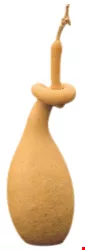
To "tie" the necks of so-called "long-neck gourds," one must encourage the supple, still-growing gourd's neck in the appropriate direction. Kung Yi-fang devoted several years to working out the technique for this, to no avail, until eventually two of his students made the breakthrough.
Making a better gourd
Gourd carving was unfamiliar territory in Taiwan-no one had tried it before, so Kung was basically feeling his way in the dark. By trial and error he worked out everything, from the right kind of gourd to carve, to preserving the gourds, to carving technique.
To preserve his gourds, he devised a three-step process. The first step was boiling. Though gourds may seem woodlike when ripe, they're still susceptible to insects, and over time still go off. Kung figured that boiling them should kill off any germs and get rid of the smell. But would it stave off the insects?" He tried it out with a large gourd, but forgot to consider that things expand when heated-during boiling, the gourd burst open, so the whole thing was a write-off. He tried again, this time making holes in the gourd to release the pressure, and the process worked without a hitch.
After that, he chiseled a hole in the bottom of the gourd and dug out the innards, washed it, and dried it in the sun. Finally, he would soak the gourd in a preservative treatment, so it would be protected inside and out. He still remembers the trouble he had with that last step. He tried using formalin, but found it was too dangerous to use with any ease. So next he tried industrial-strength hydrogen peroxide. Hydrogen peroxide is also highly corrosive, and as Kung found, a spill from a moment's incautiousness could bleach skin and hurt unbearably badly. After some research, Kung finally discovered that hydrogen peroxide could be diluted with water and lose none of its preservative effectiveness, while making it safer to use.
After air-drying the treated gourd, the final step was lacquering its insides, so that they were as waterproof as the outside. From planting to full preparedness takes about two years; a long process, but the resulting gourd is perfect for carving.
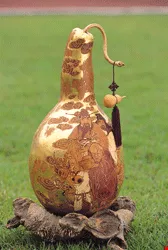
Kung Yi-fang has always enjoyed stretching his horizons and having a go at a variety of things. Remembering watching villagers apply gold leaf to the local temple gods, he was inspired to follow suit. This is one example-his work "Life and Luck."
The melon master
When he had just started carving, he bought his gourds from outside. Then in 1986 he was invited to run a workshop at the Institute for Secondary School Teachers in Taiwan, which sent him running all over the place to find enough gourds. It was then he realized that without a steady supply of materials problems like that were bound to arise. So he bought two plots in Chianan Village in Wushantou, becoming a farmer, tilling the land, and growing his gourds.
Kung explains that the climate in southern Taiwan is about right for growing gourds year-round, although the monsoons, typhoons, and summer heatwaves aren't exactly ideal. Of course, to use the gourds for carving, you have to wait until they're ready for harvest. Kung chose to plant in September and harvest in about March or April.
One year, Kung planted his plots with a kind of mini-gourd, and the entire crop was hit by a mutation, causing the gourds to be more pear-shaped instead of their usual hourglass-like shape. He took this mutant variety in to a seed company, who discovered after some trials that that variety of mini-gourd was particularly susceptible to mutation in cold temperatures-Kung had planted them during winter. The seed company planted another row during summer, which produced gourds of the normal shape. That the temperature difference can have such an amazing effect is more proof Mother Nature can be a queer old bird.
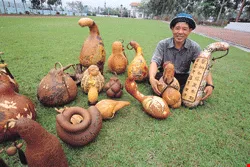
Kung, self-taught in the ways of gourd carving, has dedicated the past few years to training the next generation of gourd carvers and promoting the artform.
As you would carve, so should you grow
In the whole process of growing gourds, there is one thing that Kung has put a massive amount of effort into-"knotting" the neck of "long-neck gourds." As he points out, knotted gourds were produced in the early Qing period, and the Japanese had also succeeded at that same process.
Now, if you wanted to knot the neck of one of these gourds, you'd think it'd be best to do so while the gourd is still young and tender, and hasn't grown into its final form. But Kung Yi-fan tried this for years, and just ended up snapping several hundred gourds without a single success.
Then in 1998 two of his students made a breakthrough, successfully knotting the neck of one of the gourds, a first for Taiwan. Kung realized one needn't forcefully "tie" the neck-it's more a matter of gently guiding its growth, so that when it's fully mature, nature will have done the work itself.
Kung explains that the Qing-dynasty gourd carvers had a kind of molding system that enable them mold things into all kinds of shapes, for example in the form of "The Eight Immortals Crossing the Seas," or "Tripitaka Receiving the Sutras" (from Journey to the West). In 2001, Kung ordered a mold of the bodhisattva Kuanyin, with which he planned to shape a growing gourd. But the melon refused to co-operate, and burst through the steel-reinforced plaster mold by a good ten centimeters. This illustrated to Kung the resilience of nature-even something as small as a young melon could summon such explosive power in the name of self-preservation.
After three years' work, Kung came to the realization that some kind of "escape route" needs to be left in any mold, so that once the melon has fully grown into the mold, it can carry on growing out through that hole, leaving both artist and nature satisfied.
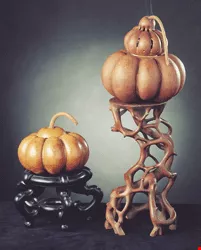
Through the use of a binding system, Kung is able to use ropes and cords to coax the still-growing gourds into whatever shape he desires. Featured are two Qing-dynasty pieces from Kung's collection produced using a similar technique. (courtesy of Kung Yi-fang)
Breaking new ground
Kung's decorative carving technique is the result of years of research into various complementary forms. To enrich the look of his works, he has spent years studying a variety of traditional design methods.
While he was at the Akungtien park, Kung recalls, he would just paint the gourds and then coat them with a protective lacquer. Later, to decorate the gourds, he started etching them. This involved etching lines on the surface layer of the gourd while it's still growing, using either a needle or a knife. The only problem is that the designs on the gourd aren't well defined.
Another design technique he tried is known as "watermarking." This technique consists of scraping portions of the skin off a gourd when it's nearly ripe, and then sticking pieces of black paper into the stripped areas, leaving the gourd to dry in the sun. Once the gourd has gone a pale yellow in the sun, the paper is torn away, revealing a pattern of contrasting dark and light areas.
After the egg-gourd discovery on his 1979 trip to Hong Kong, Kung started experimenting with carving gourds. First he used a relief carving method, dividing his designs into light and dark areas in motifs similar to the Chinese characters carved into stone or wooden chops. Then, to give a his pieces a splash of color, he borrowed from the idea of traditional Chinese "branding": "In historical times," he explains, "'branded pictures' would be drawn with incense sticks or red-hot iron pokers. The modern technique is to use a soldering iron to char lines into the skin of the gourd, producing an ink-like effect."
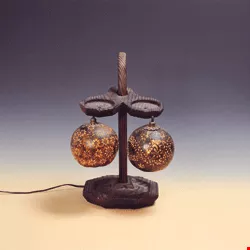
Years ago, Kung seized his chance to make a living from gourd carving, and created this openwork gourd lamp, which has a distinctly old-fashioned feel. (courtesy of Kung Yi-fang)
Decorating the gourds
Then he figured, why not try and give these pieces a bit more color? And so he moved on to using wood stains for the final coat on his peices.
Kung gives a lot of thought to how to give his gourds that extra something. He remembers hours spent watching villagers applying gold leaf to the statues of temple gods, which inspired him to do the same to his gourds. A few years earlier, he went to Japan to study other artists' works, and noticed how the Japanese would affix streamers to the gourds, and so he bought a range of streamers back with him to experiment with. Toying with his personal collection of carved gourds, he noticed that it worked best with the pieces that looked older, so he started looking into artificial aging processes. He would dye the gourds at high temperatures with vegetable dyes, first boiling them for five or six hours, then letting them air-dry. Then he would then boil them for another five or six hours, and again air-dry them, followed by a process of dulling down the surface, making the piece look like it was naturally aged.
He also uses a technique derived from classical flower pressing: with an agate and greenstone pestle he presses, rubs, and otherwise imprints shapes and patterns on the surface of the gourd. As well as sheer elbow grease, this technique also takes skill and patience, just as much now as it did in the old days.
At a demonstration once, an art professor suggested he use a different kind of gourd and try his hand at sculpting. Kung, always keen to try new ideas, spent days mulling over this idea. After much slicing, sawing, gluing and pasting, he created a series of awe-inspiring works entitled "Gourd Sculpture," using motifs from various sources, such as the painted faces of Taiwan's Aboriginals and the signs of the Chinese zodiac. In future Kung plans to take up gourd lacquering, following the lead of the gourds unearthed from the Han tombs.
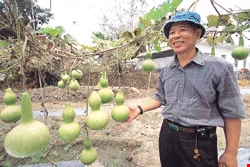
(facing page) Kung Yi-fang believes that anyone taking on gourd carving would do best to grow their own gourds, and thus he himself took on the job of gourd farmer. His plots are planted with bottle gourds, and here he shows off his pear-shaped mutant variety of gourd.
The Bocky Sculp Museum
In art, just as in mountain climbing, the most memorable part is reaching the top; once you get back down to the ordinary world, you get the itch to set out anew and discover new peaks. And Kung Yi-fang, after a brief break, decided to climb a new mountain himself, starting to work on passing on his knowledge of gourd carving through teaching and promotional work.
"If a learner has a foundation to start from, it makes things a lot easier. But even then you need a lot of practice, determination, and patience, since the shape of gourds makes it easy to slip up." Thanks to Kung's efforts, Taiwan's first carved gourd gallery, the Bocky Sculp Museum, has been set up in Hsinchuang Elementary School in Shanlin Rural Township, Kaohsiung County.
Hsinchuang Elementary is just a small school, with a roll of fewer than 100 students. Former principal Huang Hung-ching had originally just planned to have Kung come and hold some classes, having come across a Council for Cultural Affairs' project for promotion of the traditional arts, and so he got in touch. Kung looked at the suitability of the area for gourd growing, and the value of passing on the art, and agreed to work with Hsinchuang Elementary. The school then applied to the CCA for a grant, and for three years, starting in September 1996, Kung held classes every Monday and Friday, and also on weekends during special "community activity" times.
His students came from all walks of life. Classes would even include husbands and wives, brothers, and parents and children. Over time, some of Kung's students went on to establish their own private studios. And thanks to the exceptional work done by Hsinchuang Elementary in promoting gourd carving and their continuing receipt of funding from the county government, they were able to open the Bocky Sculp Museum in 1999. The museum has become a prime example of the CCA's "holistic community building" plan, and became a yardstick for Kaohsiung's "Specialty for each Township" plan; every weekend, crowds throng to the museum.
The museum is the first step for Kung in realizing his dream. In time, with local government assistance he hopes to set Hsinchuang up as a "Village of Gourds," arrayed with studios working in their own individual styles, creating both artwork and everyday tools. Gourds would become a way of life, a creative lynchpin, and the foundation for making the village self-sufficient.
Over the years, Kung Yi-fang has used his amazing imagination and selfless attitude to develop and teach his craft, successfully bringing art out of the constrictive world of glass display cases and into the real world. Through Kung's works, more and more people are coming to appreciate the beauty inherent in even something as simple as a gourd.
Bocky Sculp Museum (inside Hsinchuang Elementary)
Group tours and bookings
Address: #5, Lane 45, Ssuma Road, Hsinchuang Village, Shanlin Rural Township, Kaohsiung County
Phone: (07) 677-1755; website: www.szp.ks.edu.tw
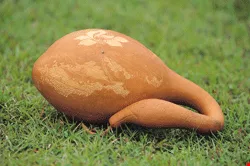
Taiwan is home to over 60 varieties of gourd, and each and every one has the potential for carving. The gourd featured in this picture is known as a "swan gourd," and has been shaped to represent a swan in peaceful repose.


@List.jpg?w=522&h=410&mode=crop&format=webp&quality=80)
@List.jpg?w=522&h=410&mode=crop&format=webp&quality=80)


