A Vision of the Heart--Cheng Ching-wen
Kuo Li-chuan / photos Yang Hung-hsi / tr. by Scott Gregory
October 2005


Most people have only one childhood, but winner of the Ninth National Arts Award for Literature Cheng Ching-wen often says he had two--one in Taoyuan, where he was born, and one in Hsinchuang, where he grew up. In rural Taoyuan, he saw the farmers toil, and in Hsinchuang he got a taste of the industriousness of the common people. He drew upon what he saw for character backgrounds and plot elements for his novels.
In 1933, Cheng was one year old. His 79-year-old maternal grandmother, who had bound feet, walked five hours to Taoyuan to bring him back to Hsinchuang to be raised by his uncle. The sound of crickets in the fields faded and was replaced with the gurgle of the river flowing toward the ocean.
The smell of fresh paint fills the stairwell of the Taipei building where Cheng has lived for over thirty years. His apartment has been completely renovated recently, and stacks of books cover his floor. Cheng leads a visitor through them to show off his newly built study. Elegant woven drapes hang over a bright window, in front of which is a deep brown desk. The desk is the handiwork of the uncle who raised him. Though it's old now, the drawers still open and close smoothly. Japanese-language books fill his shelves, and to one side is the crystal statuette he was given when the English translation of his work Three-Legged Horse won the American Kiriyama Pacific Rim Book Prize. He was the first Taiwanese author to be so honored.
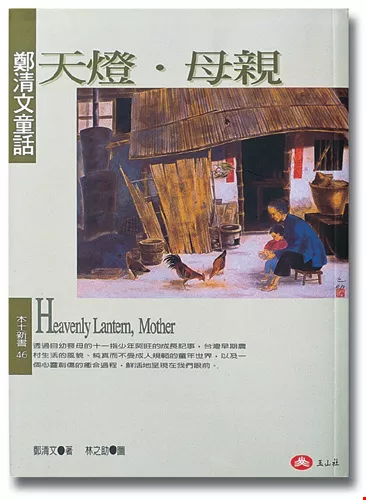
Cheng has written three children's books since 1978. Writing stories for children gives him the joy of creating.
A teacher for life
"I've arrived here by chance. No matter how you look at it, I didn't have the background to become a writer," he says softly, inspecting a shelf full of his own works.
As his uncle had no sons of his own, his grandmother appealed to the family to let the uncle raise Cheng. But Cheng returned to his mother's home in Taoyuan for summer and winter vacations. "When I went back to the countryside," he says, "I'd do just about every kind of farmwork save ox-riding--seeding the fields, transplanting the plants to the paddies, and even making fertilizer from the stocks and fertilizing the soil with it by stamping it into the ground." His birth mother was very good to him. She would save a leg from a chicken they'd butcher for the Lunar New Year holiday, preserve it in salt, and save it for when he came home for summer vacation. When he came home, she'd pull it out and make it into a soup for him.
His stepfather, a savvy businessman, opened a furniture store in Hsinchuang that was the largest store in the area. He didn't like paying taxes, and once during the Japanese colonial era, a tax officer came to inspect his books. Upon seeing the chaotic state the books were in, the officer slapped him on the head with one. "My stepfather was very angry, and he never forgot this insult his entire life," Cheng says. "The Japanese worried that businessmen would skip out on paying taxes so they'd attach tax receipts to shipped goods. To get a bill back so we could use it again, I followed a delivery truck from Hsinchuang to Tucheng. I went by foot both ways."
Cheng had two fathers and three mothers (his stepfather remarried after his first wife died), and none of them were literate. Most of his six elder siblings completed only elementary school. After Cheng graduated from elementary school his stepfather wanted to send him to study woodworking, but with the material shortages in the latter days of World War II the furniture store closed and there was no place for an apprentice. Cheng tested into a private middle school and resumed his studies there.
After the war ended, Cheng was taught the Taiwanese language from a text developed by the teacher. Then, with the arrival of the Nationalist government on Taiwan, Mandarin began to be taught. "Those were chaotic times," he explains. "Nothing was in order, and the curriculum was no exception. My first- and second-year Chinese language tests were given in Japanese. It wasn't until I graduated from middle school that I forced myself to study some of the vernacular."
While in his second year at the Taipei School of Commerce, he met a teacher who would influence his creative process, Chou Liang-fu: "Mr. Chou taught Hu Shih's study method of using the mouth, the eyes, the heart, and also the hands. Using the hands means using a dictionary. Hu Shih said even if you have to sell your clothes and hawk your fields you still need to buy a good dictionary. I literally spent several years' worth of pocket money on a copy of the Tzu-hai dictionary. That sparked my interest in language and created my foundation in it."
After graduating, Cheng took an employment exam and was assigned to Hua Nan Bank, where he worked until just seven years ago. At the time, Hua Nan encouraged its employees to seek higher education. After working for two years, employees who tested into university could take leave to attend and have their positions held for them. In 1954, Cheng placed into National Taiwan University's Department of Business Administration, and while studying there he became interested in classical Russian literature. That was his introduction to the literary world.
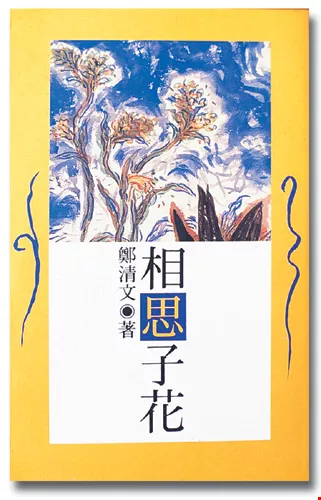
Over the last half-century, Cheng has written more than 200 novellas, won countless awards, and sparked much scholarly discussion.
Many faces of literature
In the 1950s, books were scarce, and many were banned. A collection of works by Russian writers Gogol, Chekhov, and Gorky was one book that inspired Cheng. He bought an English translation of Tolstoy's Anna Karenina in the summer after his freshman year and spent a year reading it with the help of a dictionary. Upon discovering that the Russian nobility of the day often spoke French, and that the French in the novel was left untranslated in the English version, he took up the language so as to better understand the work.
Cheng admits that he was deeply influenced by these classic Russian works. "In those times, Russian society was not affluent, and there were quite prevalent problems of class," he explains. "Writers reflected the social realities in their works. For example, the dramatist Chekhov was himself a member of the serf class, so he was really able to capture the mix of sadness and joy of the lowest rungs of society." In 1958, Cheng published his first work, "The Lonely Heart," in a magazine supplement of the United Daily News. The work was based on the uncle who raised him.
People often ask him how a bank employee could end up writing novels. Cheng draws a parallel with Sanjusangendo, the temple in Kyoto, Japan, which houses 1,000 statues of Kuanyin--everyone can find a face which matches his or her own. "Bank employees' personalities tend toward the practical," Cheng says. "But actually, a bank is also a big community with every type of person. Every day, you deal with all kinds of people. It's enriched my vision and observations of humanity."
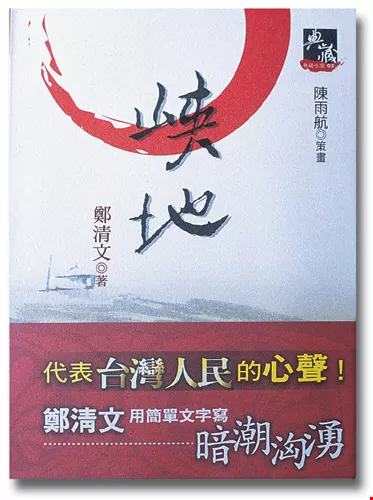
The Information Department of Taiwan Porvincial Government published Cheng's work The Gorge in 1970.
Visions of human nature
His childhood during the Japanese colonial era gave Cheng an early vision of human nature. In his work Three-Legged Horse, Cheng uses the first person voice. A classmate introduces the narrator to a wood-carving eccentric named Tseng Chi-hsiang, nicknamed "the white-nosed fox," who is a member of the Japanese police force. "My father said three legs are worse than four," Cheng says--that saying shows the contempt the Taiwanese at the time had for those Taiwanese policemen who cooperated with the Japanese and sold out their own.
But Tseng Chi-hsiang wasn't always a sellout to the Japanese. He was teased since childhood about a white stripe on his nose, and when he starts to work at the police station, he develops a taste for authority.
He discovers that anyone in the wooden box of a holding cell, whether intellectual or rich businessman, will crumble and beg for a glass of water.
Even though he is just a kid who helps out around the jail, detainees look to him with pleading eyes merely because he is outside the box. He decides to make this "box" big enough to encompass all of society by becoming a police officer, respected and feared by everyone.
Chen Pao-min of "The Informer" is a "Special High" during the Japanese colonial era. For a time after the war he finds himself in a high position due to his status as an informant, able to save or destroy lives with a nod of his head. The times gradually change, however, and even as his very existence is overlooked he stays proud of his background.
He often tells people, even his com-pany's general manager, that he was a "Special High" during the Japanese era. "Special High" is short for "Special High-Level Police," a force directly supervised by the Japanese Ministry of the Interior and feared not only by the Taiwanese but Japanese citizens as well. They were especially feared by the literati.
This love of power severely warps Chen Pao-min's morals and values. At the end of the story, he sees his own daughter with a male classmate entering a hotel restaurant and rushes back home to "inform" on her to his wife. When he tells her he saw their daughter enter a hotel with a man, the wife just calls him ridiculous and carries on cooking. The grating sound of the pot and the spatula banging around is sorrowful, reverberating in the mind of the reader.
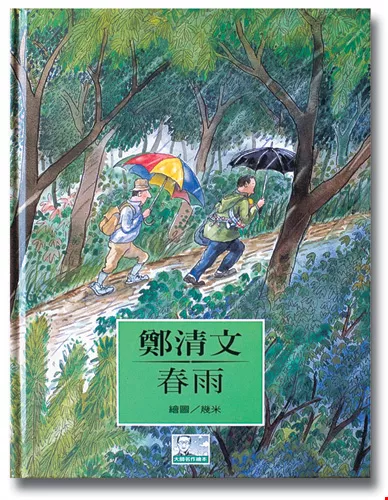
Over the last half-century, Cheng has written more than 200 novellas, won countless awards, and sparked much scholarly discussion.
Tip of the iceberg
Raised in an environment where importance was placed on being forthright, Cheng always provides foreshadowing of despicable characters by way of some sort of incident in their pasts. That's not to make excuses for them, but to point out the innate frailty of human nature.
This calls to mind the American lawyer Clarence Darrow, a lifelong opponent of the death penalty who at age 68 defended two University of Chicago students who had killed a neighborhood boy. Darrow's plea to the judge for leniency touched on war and human nature: "It will take fifty years to wipe it out of the human heart, if ever. I know this, that after the Civil War in 1865, crimes of this sort increased, marvelously. No one needs to tell me that crime has no cause. It has as definite a cause as any other disease, and I know that out of the hatred and bitterness of the Civil War crime increased as America had never known it before."
Cheng Ching-wen is not a heroic figure like Clarence Darrow. He has never laid out his complete vision in his writings, but it is the pulse that drives his stories: "Betel Nut Town" shows how the education system is unable to teach students differently according to their abilities, "The Great Shadow" deals with desire in the workplace corrupting morals, "Hair" is the story of a mother who becomes a thief to feed her son and is almost killed by her husband, and "The Outsider" is about a character who worries that no one will care for his parents if he dies and resorts to violence only to meet a lifetime of condemnation. Cheng always maintains his honest stance, and his "iceberg" style of writing always leaves the moral judgment to the reader. Right and wrong, crime and punishment are never easily discerned, and always depend on points of view.
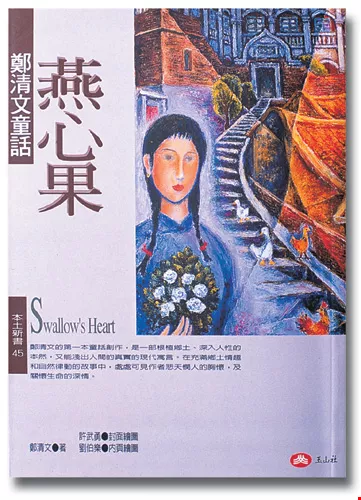
Cheng has written three children's books since 1978. Writing stories for children gives him the joy of creating.
Rediscovering childhood
Since his story "Ghost Girl" was published in Youth Juvenile Monthly in 1978, Cheng Ching-wen has published three children's books: Swallow's Heart; Heavenly Lantern, Mother; and A Diary of Picking Peaches. He found that some elements that could not be completely expressed in novels could be depicted in the language of children. Ernest Hemingway said that writing should be based on experience. Cheng, however, says, if you have no experience you can invent: "Writing children's stories really lets you feel the joy of creating."
The Japanese story of Urashima Taro is the first children's story he encountered. Urashima Taro saves a tortoise, who in thanks brings him to the underwater palace of the Dragon King where he receives the royal treatment. One day, he suddenly wants to go home. The Dragon King gives him a treasure box and orders him never to open it under any circumstances.
Urashima returns to find that everything has changed, and he sees no one he recognizes. He then opens the box. Smoke rises up, and Urashima turns into an old man.
Cheng explains what he sees in the story now: "The treasure box contained Urashi-ma's time, which the Dragon King wished to return to him. It was out of good intentions that the Dragon King told him never to open it, but fate has it that he does." Cheng stresses that when kids read a story, they might not get it right away. Many stories develop in their readers' minds as they grow older and more experienced in life. Cheng says he only began to understand the story of Urashima Taro as an adult.
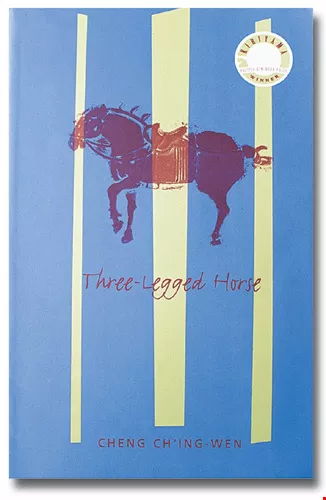
The English translation of Cheng's work Three-Legged Horse won the American Kiriyama Pacific Rim Book Prize. He was the first Taiwanese author to win this honor.
Orphans and innocents
"In writing, I have no any superstitions, and I don't believe that the pen has any great power," Cheng says. "In writing, I am searching for myself and I hope that in the process of searching I can gradually purify myself." Cheng, who has always held on to his sense of self, discovered where he started from while writing children's books. He had been tracing the scars of life, but discovered how to wash them away with wisdom.
In the book Heavenly Lantern, Mother, the main character, A-Wang, is a stand-in for Cheng Ching-wen. You can see elements of the author's childhood fictionalized in his story. In the story "The Occasional and the Necessary," Cheng writes:
"My elder brother stayed in Hsinchuang before. If he could have stayed, Uncle would have adopted him and not me. Because he was older and had already seen more of the world, he couldn't adapt to Hsinchuang and came running back to Taoyuan." From this passage, one can see the desire of this "adoptee" to run away from his circumstances. Perhaps Cheng himself was disappointed that he could not grow up around his birth mother and father despite the fact that his uncle treated him as his own son, so in the story, A-Wang's mother dies while giving birth to him. He never has a chance to receive motherly love, and he is also teased about an extra finger on his left hand.
Professor Chen Yu-ling of Providence University's Chinese department writes in her essay "On Cheng Ching-wen's Heavenly Lantern, Mother":
In psychological analysis, everyone has a living "inner child." "The Orphan" and "The Innocent" are psychological roles of the inner child. "The Innocent" insists that pure goodness and bravery must win rewards. "The Orphan," however, has come to terms with reality and has experienced pain in life. That inspires individual courage in the face of life and reality.
Chen Yu-ling says that A-Wang has the characteristics of the Orphan, but the Innocent remains A-Wang's inner child.
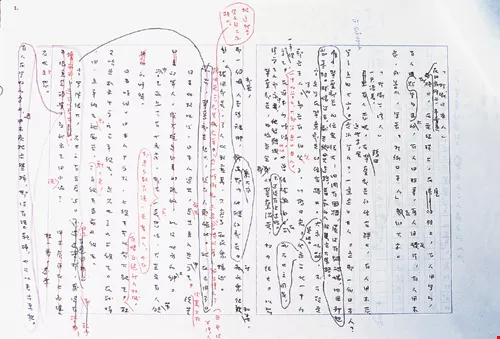
A handwritten manuscript by Cheng.
Searching for mother
Cheng Ching-wen recorded his experience of farm life--the sights, smells, feelings, and sounds--in the vivid world of A-Wang. The vivid depictions of life in the countryside give the feeling that Cheng's reflections on childhood have taken on a spiritual significance. For example, A-Wang lost his mother at birth, so he shows deep emotions toward his mother's grave. Rather than fearing the grave in the deep forest as most children would, he goes to Puwei to look for it frequently. When a typhoon brings torrential rains, A-Wang worries that his mother's grave will be flooded.
A-Wang sits on the back of a water strider. The water strider uses its four legs to glide away on the water and take A-Wang to Puwei. Puwei is on a small hill and higher than the fields, so it hasn't flooded. There are many graves there, including his mother's.
The cartoon fantasy feel brings to mind the "cat bus" in Miyazaki Hayao's anime film "My Neighbor Totoro," which can take riders wherever they desire to go, or Harry Potter's invisibility cloak, which many kids these days wish they could use to disappear.
The adult world finds A-Wang at an early age. He sees the death of a friend, who is bitten by a poisonous snake, and is separated from a beloved cow. He gradually realizes that he'll never be able to escape his natural-born flaw, and even comes to appreciate it:
"A scarecrow only has hands and has no fingers. Without fingers you couldn't grasp things or count. A-Wang always noticed scarecrows' hands. A scarecrow has no fingers. Not only does A-Wang have fingers but he even has an extra one. Slowly he comes to realize that too many and too few were equally bad."
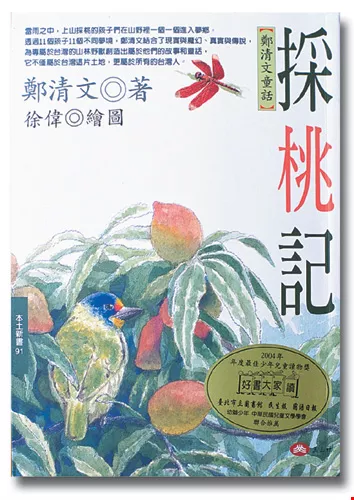
Cheng has written three children's books since 1978. Writing stories for children gives him the joy of creating.
Another game of Go
The British novelist Somerset Maugham said that a writer is not one person but many, so he can create many characters. Cheng admits that there are many facets to his personality and that they sometimes come into conflict, but he knows what it means to be an individual. Throughout the process of creating, he seeks to balance and adjust them.
"I went from an old era to a new one," says Cheng. He received a colonial Japanese education until middle school, and in the sixty years since World War II ended, Taiwan and the world have gone through a series of drastic changes. "My adoptive father was so troubled that he didn't have a son," he says, "and now modern science can clone humans." As he watches his granddaughter surf the web from a laptop computer, Cheng feels out of step with the age of technology.
Cheng is a player of the game Go. At first, he played to improve his skills and to win. Now, he says the point isn't winning but playing a good game: "Writing and playing Go are alike in that in both you seek balance. To play a good game you have to be mature as a player, and to write a good piece you have to be mature as a writer."
Cheng has won numerous awards over the last fifty years, including the Taiwan Literature Prize and the Kiriyama Pacific Rim Book Prize. Cheng says winning an award is like going to the same restaurant to eat the same lunch special as always, but one day there's a bouquet of flowers on the table. But as the aroma wafts over us, we await another good game of Go with Cheng and his deep life wisdom.
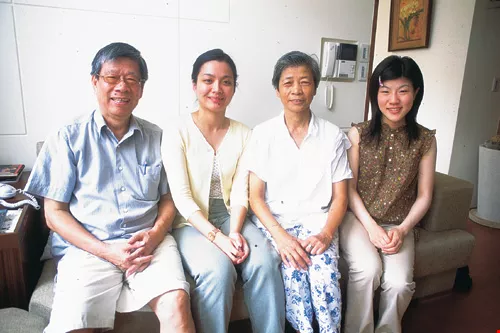
Cheng's works have been translated into many languages and won international attention. Tokyo University graduate student Matsuzaki Hiroko (first right) has studied Cheng's place in Taiwanese literature, and come to visit Cheng and his wife (second right) in Taiwan several times.
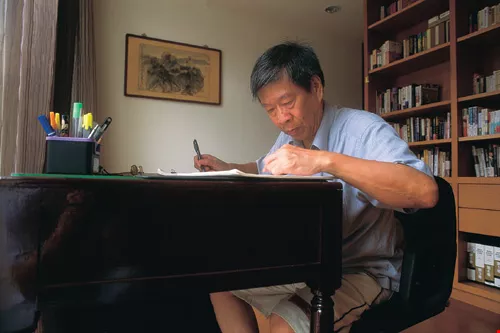
After a recent renovation, Cheng's home of more than thirty years finally has a study. Cheng especially treasures this desk where he does his writing, as his stepfather made it by hand.
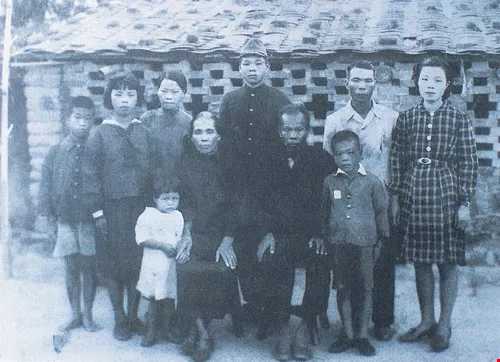
When Cheng was in fifth grade, he couldn't do his homework because his stepfather couldn't afford to buy a workbook for him. The first time he skipped school to run off to his birth parents' home in Taoyuan, it just happened that they were taking a picture to send to Cheng's brother--a soldier in the Japanese army stationed in Manila. In this rare family portrait, Cheng (rear left) stands barefoot among his neatly-dressed family members. Cheng's parents are second and third from the right in the first row.
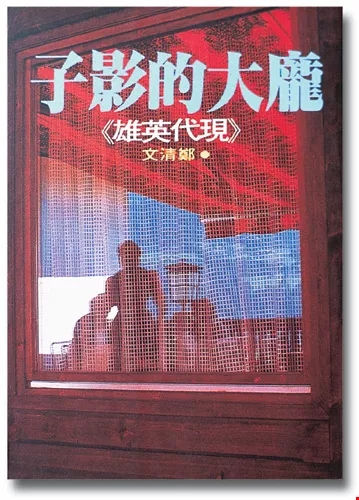
Over the last half-century, Cheng has written more than 200 novellas, won countless awards, and sparked much scholarly discussion.

@List.jpg?w=522&h=410&mode=crop&format=webp&quality=80)


