

Wu Hsing-kuo, who has won the "Armed Forces Arts Competition Award" for best male lead three years running, has recently turned to filming commercials and movies.
"He should have left the opera troupe a long time ago. He can broaden his creative space. It would have been quite a waste to stay in the opera troupe!" is how Lin Hsiu-wei, Wu's wife, puts it.
Posters for Medea, the new production of the Contemporary Legend Theater for July, have already been put up in each cultural center. In the rehearsal hall, Wu Hsing-kuo and Wei Hai-min, both with backgrounds playing the male and female lead roles in Peking Opera, are rehearsing. Director Lin Hsiu-wei is standing next to the stage explaining the basic story outline which Wu then immediately improvises. This new production, which is an adaption of the Greek tragedy, is extremely far from the traditional singing and gestures of Peking Opera. "We are already prepared to have tomatoes thrown," laughs Wei Hai-min.
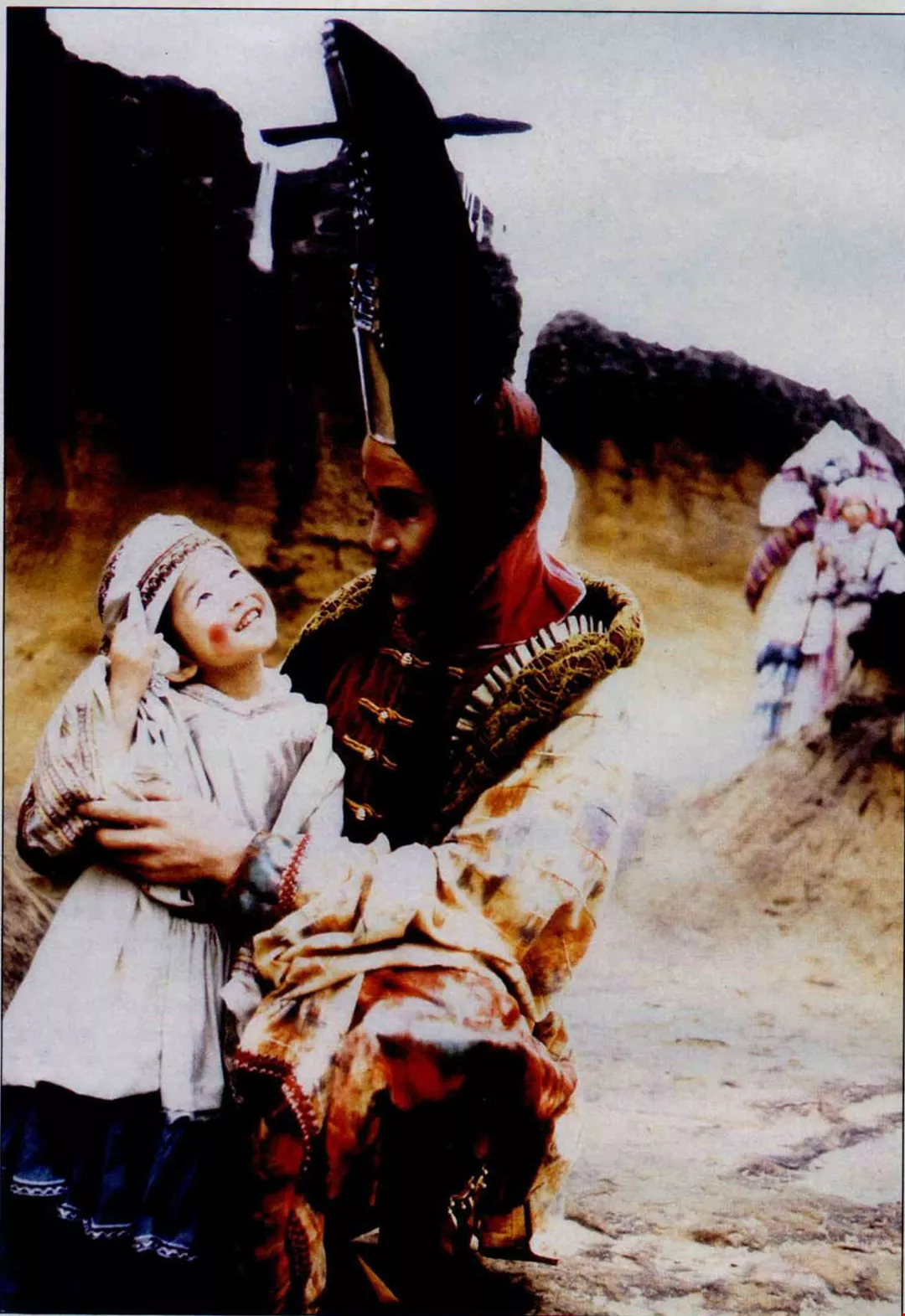
Wu Hsing-kuo has crossed over to movies, and now the costumes for his new performance of Medea have been done by talents from the world of film. ( photo by Huang Chen-yang)
Movieing on:
The rehearsal has not gone well and the three people sit on the floor discussing it. An assistant knocks on the door and comes in saying, "Elder Brother Wu, your ticket to Hong Kong has been confirmed. You fly tomorrow night at seven and the film company will send someone to meet you." Green Snake, a film directed by Hsu Ko, will begin filming as soon as Wu arrives.
There have been no shortage of Peking Opera performers who have developed towards film and television. Wu feels that given Taiwan's diversified environment, plus the unsound situation in Peking Opera, it's virtually impossible for any actor to spend his whole life sailing a single ship. His path has taken him to simultaneously study drama and do modern dance.
At the end of last year, Wu resigned from the Lu Kuang company because he could not get their permission to shoot the film Temptation of a Monk, thus waving good-bye to fifteen years in the troupe. "In this society there are many opportunities and temptations. Just imagine, there aren't many forty year olds who can change professions!" laughs Wu brightly. But he is still unable to completely hide his reluctance at leaving the troupe. Looking at all the Peking Opera materials and videotapes which fill his room, he stresses that he is still an opera performer. In the future he will be even better prepared and will still find some colleagues to get up on stage and put in a good performance of a traditional opera for several days.
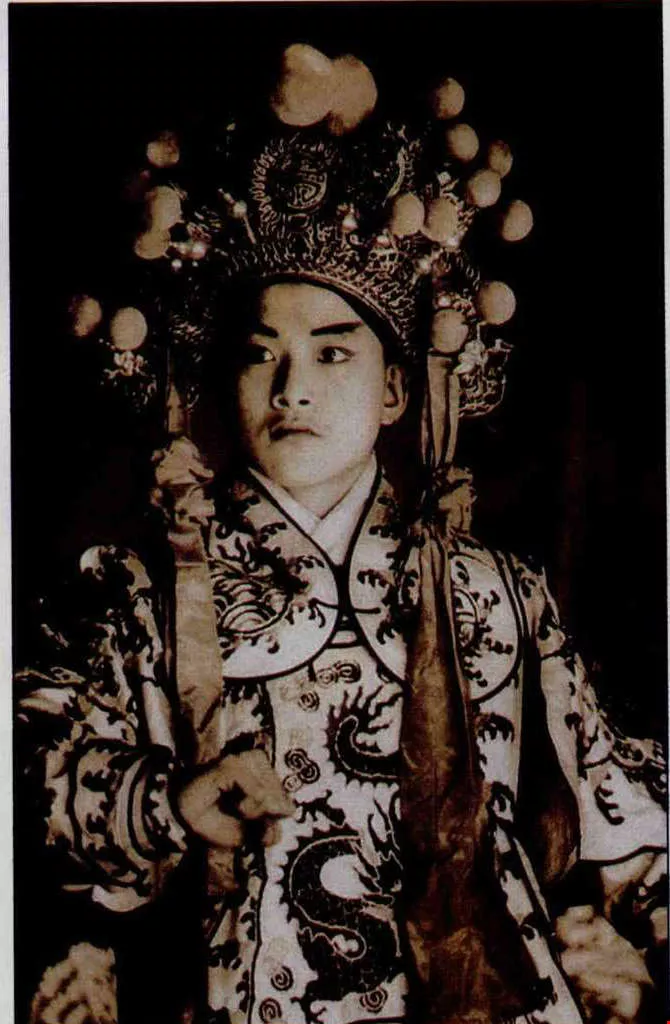
Though life was hard in opera school, the charismatic Wu was able to stand out. (photo courtesy of Wu Hsing-kuo)
Such a small steamed roll:
In 1949 Wu's mother came to Taiwan alone and married his father, who was in the air force. In 1953 they gave birth to their second child. Because the country (kuo) at that time was in turmoil (a Chinese expression for which includes the character chiu, or autumn), they called their new born child Kuo-chiu. Three years later his father died and Wu was sent to a home for children of military martyrs. After graduating from primary school he only tested into a third-rate school. "Life was very hard and I hated studying. Everyone said that children who studied Peking Opera would not turn out bad," says Wu, explaining how he entered into the Fuhsing Peking Opera School. On the basis of the "Chinese Cultural Renaissance" rankings, he changed his name to Wu Hsing-kuo in his second year.
At that time opera schools were still private and they took too many students. "The older students often said that the school would soon close and so no one felt very secure," recalls Wu. At that time, each morning at four o'clock, a group of bald headed little kids would be awakened by older students using sticks. They would pant and chant their way up the mountain under a sky that had still not seen the light of day. They would shout along the way, and the pigs in the slaughter house at the foot of the mountain would call out in response.
With the school in such desperate straits food was pretty poor, and Wu often didn't eat right, just stealing a couple of small steamed bread rolls and eating them at night under his blanket. "Just think, even a child felt that those steamed rolls were small, so you can just imagine how small they really were."
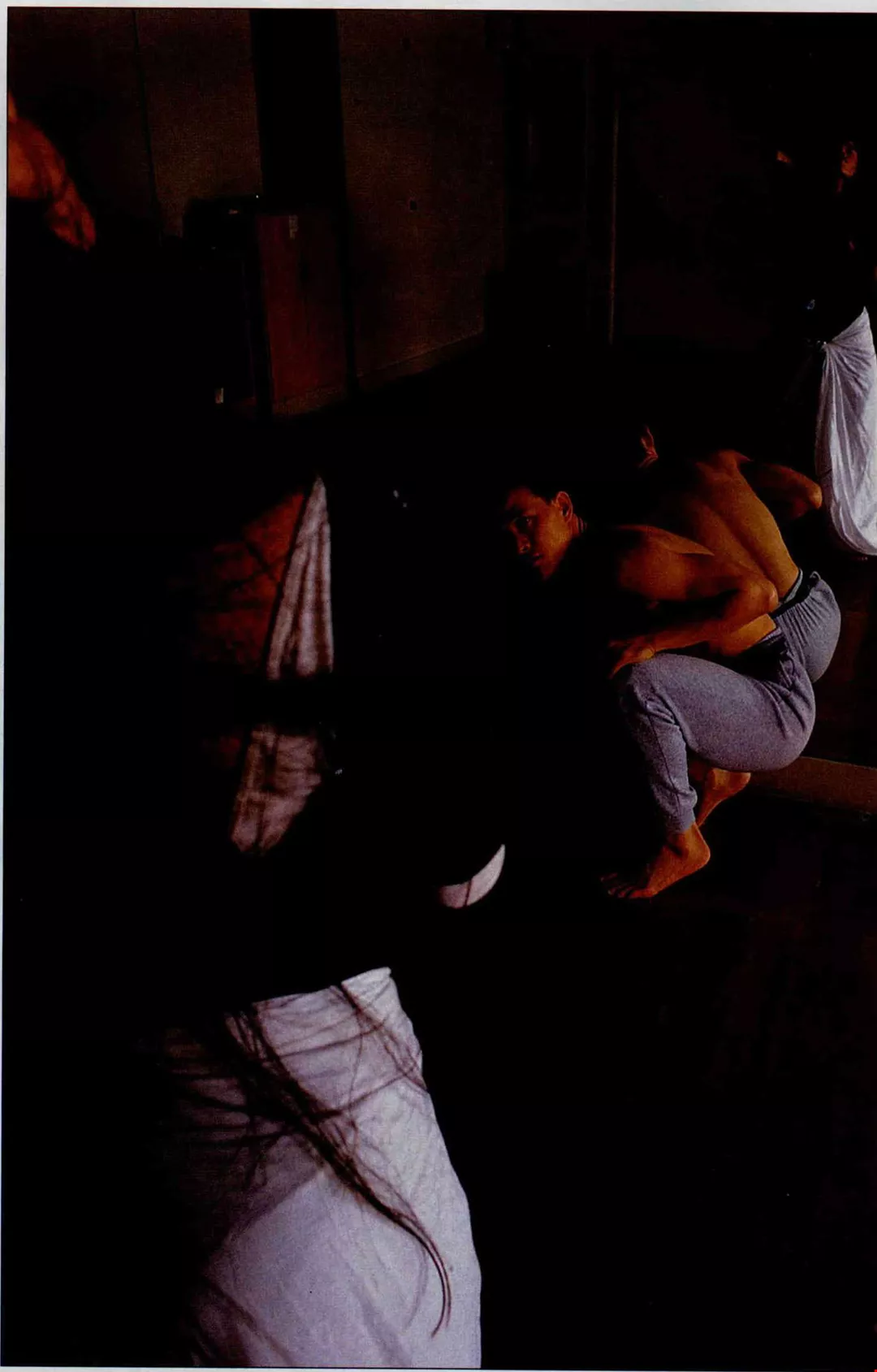
From Peking Opera, the most Conservative art form, to modern dance, one of the most experimental, Wu's travels it drama have not only been broad, they enabled him to meet his wife Lin Hsiu-wei. (Sinorama file photo)
Learning it all wrong:
Later on the school was taken over by the government and life improved considerably. But still the teachers couldn't keep up with the times. Some of them looked at the larger picture and told the students, "don't worry, there are a billion compatriots in the mainland, so never fear there will be no one to watch us." But even more teachers couldn't help but sigh, "Peking Opera's days are numbered!" Even before graduation, many planned to change professions.
Wu, who had been outstanding in school, often had teachers sigh to him, "If this were the mainland there would be good instructors willing to take you." Wu would rise in the middle of the night to practice on his own. "But I was really practicing blind at that time. I was trying to just pick up difficult techniques on my own. I didn't realize that real skill took discipline, and ended up learning things all the wrong way." He regrets that there was no person from the previous generation with a lifetime of accumulated experience to pass along this refined and profound art to him. Even with a lifetime of blind training he would be unable to surpass his predecessors.
Although he had no famous instructors, the teachers at the school all took good care of him. When he graduated from school he was given special permission to go on to further study at the Chinese Culture University. Later, because of an introduction from a teacher at the university, he entered the "Cloud Gate Dance Theater," thus leaping from ancient to modern in a single stride, and meanwhile earning a pair of creative wings.
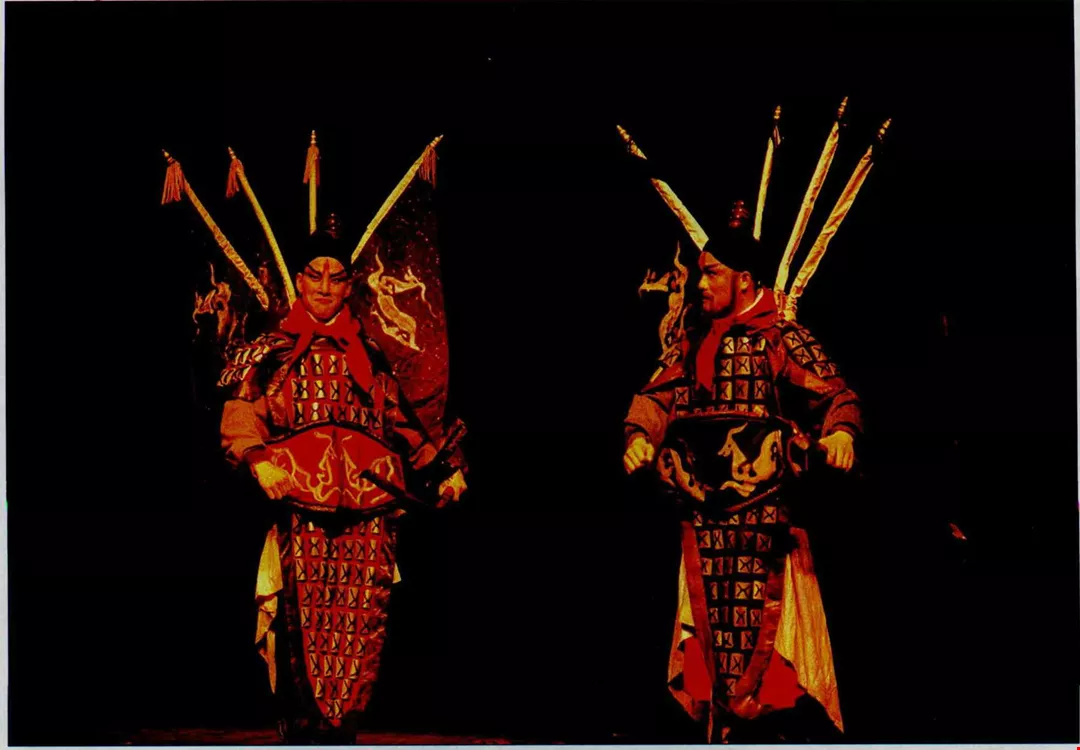
The Contemporary Legend Theater has broken the old mold of Peking Opera and created a new form of Chinese performance. (Sinorama file photo)
Walking out of the past:
After entering Cloud Gate, for the first class, everyone changed into their ballet tights. They waited a long time and only Wu hadn't shown up. Only after being prodded did he come out--having never before dressed this way, he was so embarrassed his face and neck were red. "Being in Cloud Gate was my greatest honor and also the beginning of the broadening of my perspective," states Wu.
Each week they discussed creative themes, and attended classes in literature and music, and practiced calligraphy to understand "restful quiet." They discussed what their own culture is and went down to the countryside to take in folk activities. "In my eight years in opera school I could count on one hand the number of times I went out. We had no classes that involved different perspectives. It was like the first time you learn to swim--strange and frightening at first, but later it is a feeling of complete freedom."
Besides learning creativity, the people at Cloud Gate also had firm ideas. When Taiwan left the United Nations, they proudly showed their vitality before foreigners, which was quite different than the low-key powerlessness displayed by the opera school.
It was during this period at Cloud Gate that Wu met his wife Lin Hsiu-wei. The two often jogged to the public cemetery at Liuchangli in the early morning, and practiced their steps in front of the graves of famous people. Those were the happiest days for Wu Hsing-kuo.
Return to the opera:
After he completed his military service, a teacher from the Chinese Culture University presented him with an opportunity to go to the United States to continue study, but in his heart he wanted to stay at Cloud Gate. Nevertheless, after the renowned Peking Opera performer Chou Cheng-jung declared, "go ask Wu Hsing-kuo if he is willing to study with me," the 26-year old Wu returned to the Peking Opera stage.
At the ceremony to pay his respects to his teacher, the sacred image of the great teacher Tang Ming-huang was placed front and center, and members of the older generation of Peking Opera stood on all sides as Wu kneeled alone in the center. Lin Huai-min, the only outsider invited to the ceremony, originally did not think there would be any conflict between Wu's going to his teacher and dance. But when he saw the rigorous and severe atmosphere, and saw Wu knock his head to the floor, he thought to himself, "this person will never come back."
Devoting himself fully to Peking Opera, Wu has taken a leading role and moreover has won the Armed Forces Arts Competition Award for best male lead three years continuously. It's only that in a military opera troupe, the bosses are all military men rotated every two years. There are also some military training classes, and militarized regulations like punching a time card four times per day. During rehearsals sometimes people would come wearing their leather military boots, too lazy to even change into soft shoes. Each time a public performance was about to begin he would get sick to his stomach or get the flu, though the doctor always said there was nothing wrong. "He has always been someone who tortures himself. He wants to learn and wants to do things but could not break out of the status quo. Once he just sat staring blankly for a whole day and said to me quite seriously that he wanted to become a taxi driver," says his wife Lin Hsiu-wei.
Slow suicide:
Faced with the impression that most people have that Peking Opera is pampered and protected, Wu says in a slightly exasperated way, "It's true, Peking Opera really is protected--but at what cost?" His unhappy belief is that attaching Peking Opera to the military to entertain the troops is not protection but is a form of slow suicide. He says angrily, "Get this straight. It is not a thing, it is culture passed along by our ancestors!" You can understand why he is called "the Little Cannon" in opera circles.
These past few years Wu has been playing tragic figures on stage, even Macbeth or Hamlet. Wu especially likes the historical personage Chuyuan: "He is not one of those who killed himself in a huff after being chased out, but threw himself in the river only after seven or eight years of effort proved worthless."
A contemporary Peking Opera legend:
From opera school to Cloud Gate and then back to traditional opera, Wu's transformations have been great. His organizing of the Contemporary Legend Theater is a legend in itself. Wang An-chi, chairman of the Department of Chinese at National Tsing Hua University, says that to be sure Mainland Chinese Peking Opera is awesome and eye-catching. But Peking Opera in Taiwan has already gone from being an antique to being an art form about which the new generation and all arts workers are concerned. Exploring a new style, Contemporary Legend is another dramatic creation.
After seeing a performance by the Central Peking Opera Company, Wu returned home and practiced hard for several days. As for the accomplishments in terms of adaptations of scripts in the mainland, which have been hailed by Taiwan companies and audiences, these have all been developed in the mainland in the last forty years, "so it's their local culture."
Nevertheless, Wu believes that this is change that still bears the burden of tradition. Today, the problem faced on both sides of the Taiwan Straits is the loss of the young audience, mainly because of an inability to meet the needs of the times. Thus he has boldly adopted a modernized Chinese Opera which is closer to daily life and includes modern theatrical dance and lighting. "I don't see myself as making some kind of revolution in Peking Opera. On the contrary, it's only because I know it is good that I know that I am using it as the foundation to create."
In contrast to the white haired elderly audiences at the performances of the Central Opera Company, Contemporary Legend has been quite successful at attracting a younger audience. Lin Hsiu-wei states that after the curtain call following one performance, a group of girl students ran backstage and began to squeal and cry as soon as they saw Wu Hsing- kuo. Understanding the situation, Lin diplomatically stepped to one side.
Ever since Wu crossed over to making the film Temptation of a Monk, many people from the world of film have appeared in the staff for this year's new Contemporary Legend performance of Medea. For example, Yeh Chin-tien, who has been nominated for a Golden Horse Award for best designer, did the costume design for Medea. "This is a lively and open era. As far as I'm concerned, there is nothing that can't be done," says Wu, his thinking and self confidence shining through. This alone makes him different from the typical Peking Opera performer.
[Picture Caption]
p.13
Wu Hsing-kuo has crossed over to movies, and now the costumes for his new performance of Medea have been done by talents from the world of film. ( photo by Huang Chen-yang)
p.14
Though life was hard in opera school, the charismatic Wu was able to stand out. (photo courtesy of Wu Hsing-kuo)
p.15
From Peking Opera, the most conservative art form, to modern dance, one of the most experimental, Wu's travels in drama have not only been broad, they enabled him to meet his wife Lin Hsiu-wei. (Sinorama file photo)
p.16
The Contemporary Legend Theater has broken the old mold of Peking Opera and created a new form of Chinese performance. (Sinorama file photo)
p.17
What's the dividing line behind traditional and modern? Wu Hsing-kuo has leapt out of Peking Opera to film commercials in the latest fashions. For him, today there are no limits to what he can do. (photo courtesy of Wu Hsing-kuo)

@List.jpg?w=522&h=410&mode=crop&format=webp&quality=80)


