A Feast for Your Eyes Only--The Crab Museum
Chang Chin-ju / photos Diago Chiu / tr. by Robert Taylor
October 2000


As the old saying goes: "At the height of autumn, the air is fresh, chrysanthemums bloom yellow and crabs grow fat."
If you just want to grab crab to eat, any of the restaurants large and small in Taiwan's streets and alleys can rustle up a delectable dish of these flavorsome fauna. But if you want to learn more about crabs, you'll find the most comprehensive crustacean information at the Crab Museum in Ilan County's Toucheng Township. This small but encyclopedic museum presents nearly 700 species of Taiwanese crabs either live or as mounted specimens, enabling Chinese people-who have been eating crabs for 2,000 years-to extend their knowledge of these creatures beyond the limits of their own mouths and stomachs. The museum has also become a center with which researchers and museums in many countries exchange crabs and from which they loan or even buy exhibits.
When fresh autumn breezes rustle through city treetops, restaurants all try to lure guests with plump autumn crabs. Tour groups from Taiwan travel to mainland China's Suzhou and Hangzhou to eat Chinese mitten crabs and watch the tidal bores running up the Qiantang River. On Taiwan's northeastern coast, the Crab Museum which was set up early this year at Peikuan Resort overlooking Tahsi Fishing Harbor also tempts visitors with all kinds of crabs. But this feast is for the eyes only, for what's on offer is not a plethora of rich gourmet dishes, but displays of live crabs and lifelike crab specimens.
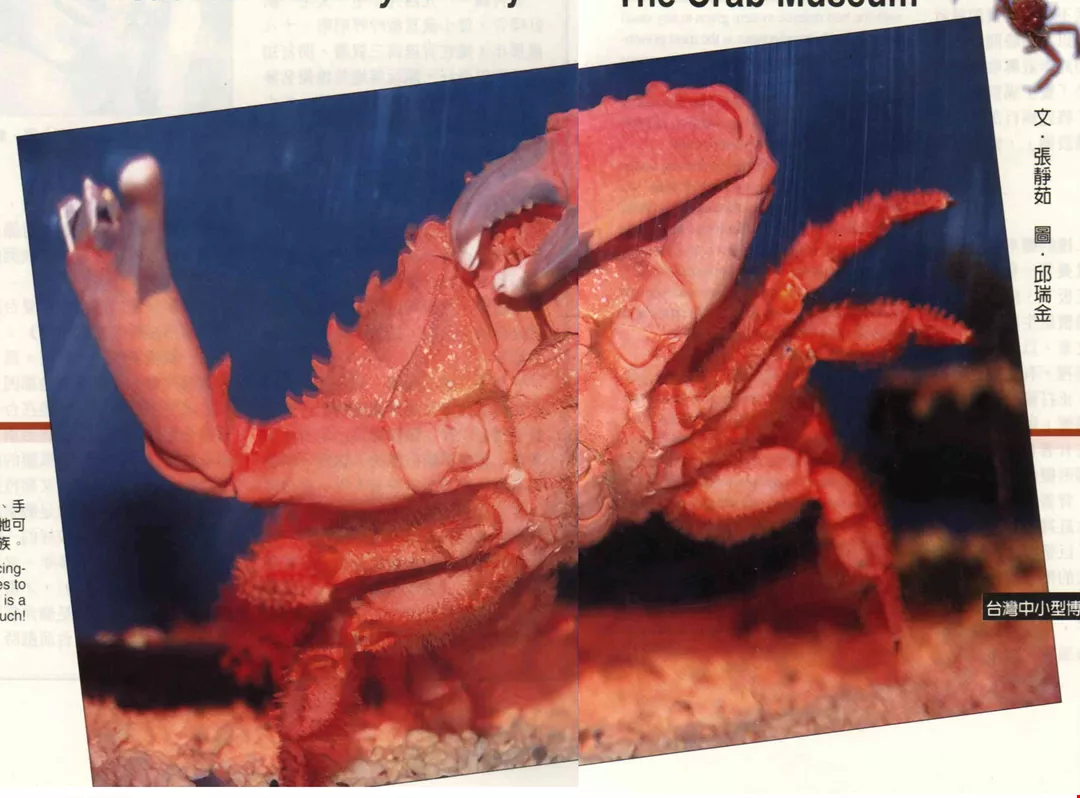
"Roll up! Roll up!" The red-robed, dancing-clawed red crab (Etisus splendidus) loves to grab the limelight. But this little beauty is a poisonous species, so look but don't touch!
The museum occupies some 2,500 square meters of floor space on three floors. The first exhibit we come to on entering starts at the very beginning of crabs' evolutionary story, telling how their lobster ancestors cast off the long whiskers which made them vulnerable to being grabbed and swung around by big fish, to evolve into primitive sponge crabs and hermit crabs. Later, they escaped from using cumbersome borrowed shells to become the crabs we know today with "Claws lifted high over black mud," and "A carapace as broad as a serving dish, with a tomb-like central mound." Looking at the colorful, lifelike exhibits, from the heavyweight American lobster (Homarus americ-anus) to mantis shrimps such as the huge Bathysquilla crassispinosa, we get a backwards view through time at crabs' development.
Lobsters and crabs-the undersea foot-soldiers and generals of Chinese folklore-share a common ancestry. But after the crabs branched off as a separate family, they diversified into a dizzying variety of different species. The bulk of the Crab Museum's collection is made up of more than 700 crab species from Taiwan. However, the exhibits, which fill 36 large upright display cabinets, are not arranged by biological families and genera. Instead they are divided into interesting themes such as poisonous crabs, camouflage experts, outsize crabs, and the tastiest crabs to eat.
The many weird and wonderful crab species vying for our attention present a vivid picture of the rich tapestry of life in the natural world. In a display entitled "Fancy Footwork," we see how the diminutive horn-eyed ghost crab (Ocypode ceratophthalma) has pointed feet which, like spiked running shoes, give it a better grip as it zips across the ground at over three meters a second. By contrast, the rock crab species Plagusia tuberculata, whose back is covered in toad-like warts, has flat "flippers" with which it runs about nimbly on slippery reefs washed over by the waves. The hairs on the legs of Formosan mitten crabs (Eriochier formosa) not only improve their grip, but can also be used to imitate seaweed, so as to entice little fish and shrimps to swim right into the crabs' mouths. When we humans measure ourselves against each other, we are apt to end up feeling inad-equate. But when crabs compare legs, the stakes are even higher. The delicious Chionecetes japonica can stretch out its claws to span a full meter, yet it isn't a patch on the giant spider crab (Macrocheira kaempferi), with its leg span of more than three meters.
The 25 species of venomous crabs displayed in the "Poisonous Crabs" cabinet are blessed with the best defense system given to any small animal. Just how poisonous is the most poisonous crab? A single mosaic crab (Lophozozymus pictor-also known as the red-and-white reef crab or thunder crab), no bigger than the palm of one's hand, contains enough toxin to kill 400 humans or 1.2 million laboratory mice.
Poisonous crabs deliberately harvest toxins from all kinds of poisonous sea urchins, sea anemones and seaweeds, and concentrate them in their bodies. If you are bitten by a snake, you can be treated if the right serum is available. But there are no drugs to treat a poisonous crab's unholy brew of different poisons-all one can do is to induce vomiting to reduce the amount of toxin absorbed. So watch what you eat!
Enchantment (ink wash, paper, collage): A reclining female figure suggests an advertisement for sexual services. This work compels people to think about a society that is obsessed with personal and sexual gratification.
If you look carefully at all 36 display cabinets, it may completely change your ideas about crabs. "At mid-autumn, purple crabs come fresh to market"-descriptions in traditional Chinese literature of plump autumn crabs have deeply influenced later people's assump-tions. Yet in warmer climes, crabs' reproduction is not limited to one season. Taiwan's crabs can produce eggs repeatedly at different times throughout the year. For instance, after spawning at the end of summer, rock crabs mate for a second time in late winter. To make the best use of food resources, different crab species breed at different times.
The exhibit on "River Crabs" features Chinese mitten crabs (Eriochier sinensis) as well as the smaller mitten crabs of Taiwan's rivers. It is with good reason that Chinese mitten crabs, which grow fat on fish and shrimps trapped by sluice gates along the middle to lower reaches of the Yangtze River, have enjoyed an exalted status in Chinese cuisine for over 1,000 years.
Are all crabs eight-legged, sideways-walking "generals"? In fact, explains museum founder Li Kuan-hsing, "all the crab species which can walk sideways can also walk forwards, but the ones which can walk both forwards and backwards can't walk sideways." That's the rule crabs follow when they walk that walk. Most crabs have eight legs in four pairs, but crabs in the antlered crab family have only six legs, for their rearmost pair of limbs have specialized into hook-shaped appendages curled up over their backs, which they can use like hands to grip sea anemones and shellfish for camouflage, and also as shields to ward off attacks from other creatures. The shell-bearing crab Dorippe japonica, which has only four legs, was the first crab species collected by Li Kuan-hsing.
Help from all the harbor
The farm resort run by Li Kuan-hsing's family distantly overlooks Ilan County's Tahsi Fishing Harbor. As the fishing boats gradually return to port late in the afternoon, 28-year-old Li Kuan-hsing and his family often go there to buy fresh-caught fish. While the others concentrate on their purchases, Li Kuan-hsing likes to observe the bustling fish market. A couple of years ago, he noticed that among the sundry fish discarded from the nets as only good for making animal feed, there were actually many fascinating creatures. Curiosity drove him to poke around among the piles of cast-off fish, and he discovered a small, strangely patterned crab with only four legs-a Dorippe japonica. This find overturned his assumption that all crabs have eight legs, and from then on Li, who admits that that moment changed his life, began collecting crabs and preparing crab specimens.
For the last two years and more, Li has been a frequent sight at Tahsi Fishing Harbor, carrying a bucket of icy water with his left hand and busily picking through the piles of scrap fish with his right. Over time, everyone at the harbor has begun to look out for rare crab species for him, and the fishermen no longer simply divide crabs into edible and inedible ones. "Two years ago, I couldn't even tell swimming crabs from rock crabs," says Li. But today he can tell the stories associated with many of the crab species in his museum, and explain their ecology too.
After Li began collecting crabs, he got to know some of the crab researchers who also visit the harbor in search of specimens, and realized that live crabs are even more interesting than dead ones. Now, when fishing boats reach harbor, if the fishermen have a surviving crab they will hurry to inform Li to come and "adopt" it. Deep-sea organisms cannot survive long away from the low water temperatures of their natural habitat. But thanks to the museum's location close to the harbor, Li can quickly take such foundlings back and put them into a tank of cold water to keep them alive. In this way he collected more and more crabs until finally, having no more space for them, with his parents' support he spent nearly NT$2 million to build them "permanent accommodation" at the farm. Thus the Crab Museum came into being.
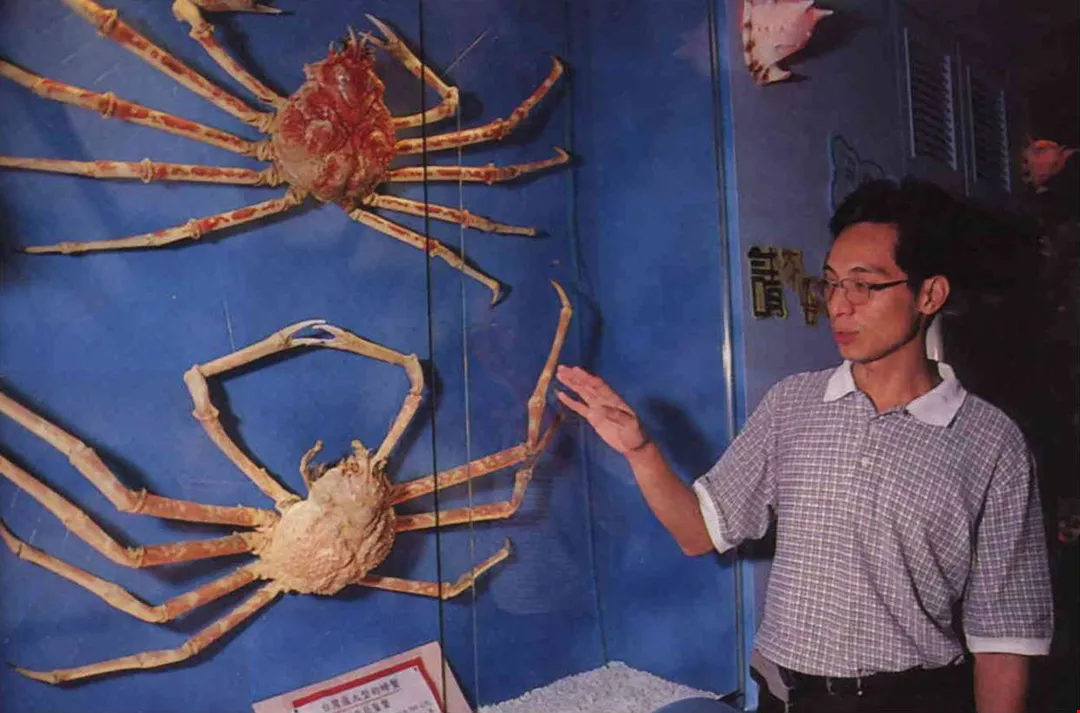
Call me Number One! Next to Taiwanese Crab Museum owner Li Kuan-hsing are two specimens of the world's biggest crab species, the giant spider crab. A live one is valued at NT$1 million.
After looking at the mounted specimens exhibited on the second floor of the museum, visitors can go up to the third floor, where they will find tank after tank of live crabs. Under a blue ceiling, between walls coated with sea sand, these tanks provide homes for the crabs modeled carefully on their original living environ-ments. In one tank piled up with layers of stones, the swimming crab Matuta victor is swimming a sideways breaststroke; in another, the rare corystid crab Jonas distincta is doing a backstroke in pursuit of little fish. In a tank containing a grotto built from stones, a huge sponge crab of the species Lauridromia dehaani stands motionless like a parked flying saucer, its back covered with sponges for camouflage.
On a flat bed of sand in another tank, the antlered crab Paromola macrochira, which lives in the ocean at a depth of 400 meters, is standing to attention, motionless yet fully alert. Its oval body, encased in an orange carapace with a bright yellow underbelly, stands imposingly on eight long, unevenly spread legs, looking for all the world like a modern sculpture.
Here you can admire all kinds of crabs which you will never have seen before, and this too is thanks to the Crab Museum's location in Ilan County. At present there are something over 4,000 species of crab known to science worldwide. But the seas around Ilan County's Kuishan Island are home to a remarkable abundance of crabs-over 400 species have been discovered there, accounting for a far higher proportion of the world total than for any other group of animals in Taiwan.
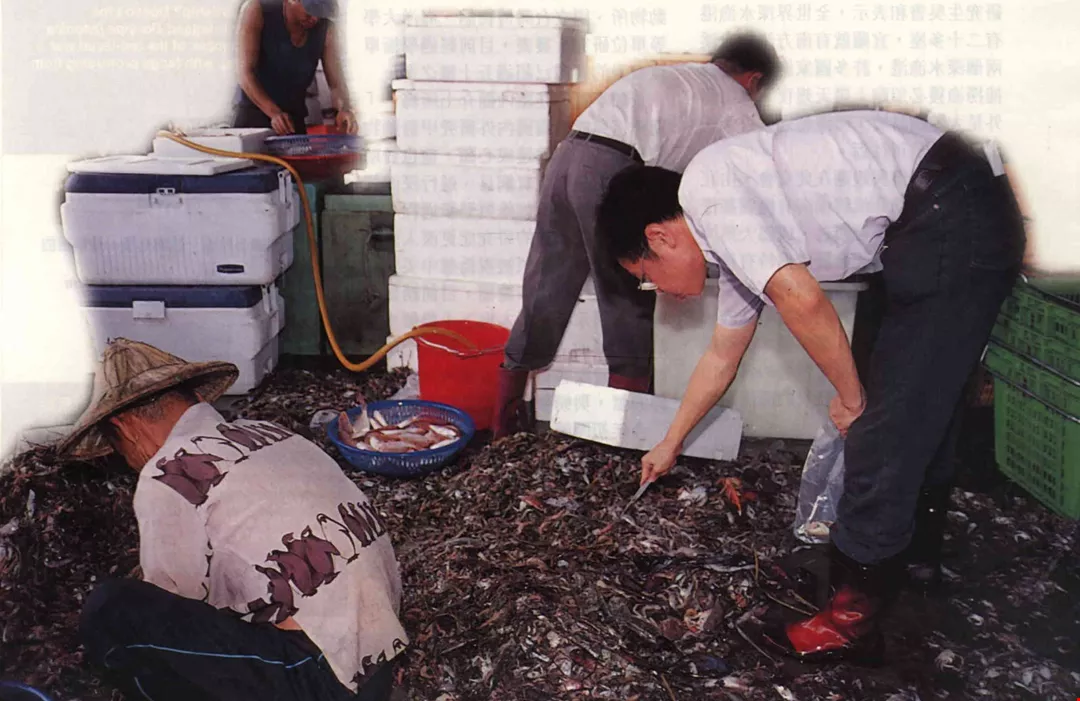
(below)The heaps of discarded sundry fish at Ilan County's Tahsi Fishing Harbor contain many crabs. PhD student Wu Shu-he of National Taiwan Ocean University picks through them carefully, looking for "buried treasure.".
National Taiwan Ocean University doctoral student Wu Shu-he, who researches spider crabs, says that throughout the world there are something over 20 deep-sea fishing harbors. Two of these-Nanfang Ao and Tahsi-are in Ilan County. Many countries' deep-sea fishing fleets have to sail many days and nights to reach their fishing grounds, but just beyond Kuishan Island the continental slope falls away to depths of over 500 meters, near enough for the boats to go out and back in a single day.
Furthermore, the Kuroshio current and the mainland coastal current converge here, the upwelling current off Taiwan's eastern rift valley brings up organic salts from the ocean depths, and a seabed valley forms a natural barrier. Under these conditions, many organisms have developed into unique species, and the sea off Ilan contains a cornucopia of marine life. The northeast coast is also the most diverse section of Taiwan's coastline, with everything from sandy beaches, rocks and coral reefs to marshes and wetlands. And in the Hsuehshan mountain range which rises just behind this coastline, the rivers and streams up to 2,000 meters are home to all kinds of river crabs.
Most of the crabs in the museum's collection of the world's 25 poisonous crab species come from the sea off Ilan. The "Big Daddy" of all crabs-the giant spider crab-was long thought to live only in the waters around Japan. But in recent years these gargantuan creatures have also been discovered in the seas off Taiwan. The Crab Museum has a pair of giant spider crabs with 160-centimeter leg spans, which were caught off northern Ilan. New species are constantly being discovered too. In the museum's deep-sea aquaria, which are kept at a temperature of 8°C, there are three species of deep-sea crabs from the family Gecarcinidae which are as yet unnamed.
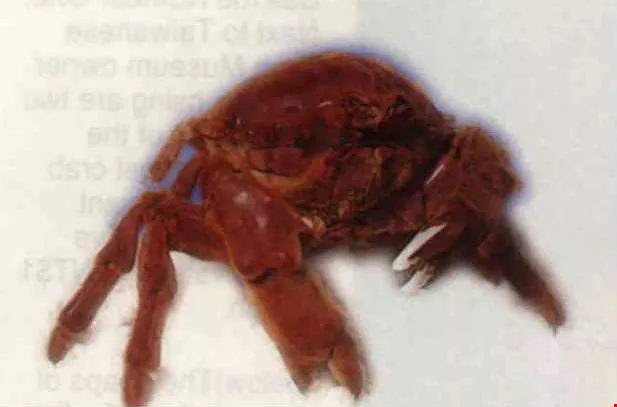
True sponge crabs, with their thick carapaces and powerful claws, have only four walking legs. Their two hindmost pairs of limbs have specialized into "hands" which can hold sponges and shellfish for camouflage, or fend off predators' attacks.
With more crabs arriving daily, Li Kuan-hsing not only does his best to expand his own knowledge of crustaceans, but also shares his work with biologists, by making his crabs available to academic institutions such as the Academia Sinica's Institute of Zoology, the Taiwan Museum and National Taiwan Ocean University. To date, such institutions have published papers describing over 50 new species.
Li Kuan-hsing writes in his introduction to the museum: "We hope it can become an interchange for crustacean research both inside and outside Taiwan." In order to achieve this dream, he also gives financial assistance for PhD students to buy equipment such as fishing nets, and go on field trips such as deep sea surveys or visits to Orchid Island to photograph spider crabs breeding. Li hopes this will help crustacean research in Taiwan achieve greater depth and become more integrative, and that people can see crabs as more than just a delicacy for the dinner table.
After more than two years of collecting and preparation, the sections of the Crab Museum already open to the public include more than 30 aquaria as well as exhibits of mounted specimens. Next year, a "crab park" is due to open on the fourth floor, giving visitors the chance to feed land crabs and box crabs there and get to know them still better.
Since the museum opened early this year, it has not only attracted tourists. Staff from many of the public and private aquaria which have recently opened the length and breadth of Taiwan have also come here to loan exhib-its, and even crustacean researchers from Singapore, Japan and mainland China have come to take a look, in the hope of exchanging specimens. Some have even offered high prices for crabs from the museum's collec-tion, or sought technology transfers in specimen preparation methods.
"Crab doctor" Wu Shu-he, who is cooperating with the museum on a research project, explains why its specimens have attracted so much attention. In the three to four centuries since natural history museums were first established, there were no significant advances in the preparation of crustacean specimens. The pigments responsible for crabs' coloration are not very stable, and the preservatives usually used have a corrosive effect. Thus prepared crab specimens generally look as if they have been boiled. With rapidly fading colors and stiff, unnatural postures, they appear quite unattractive.
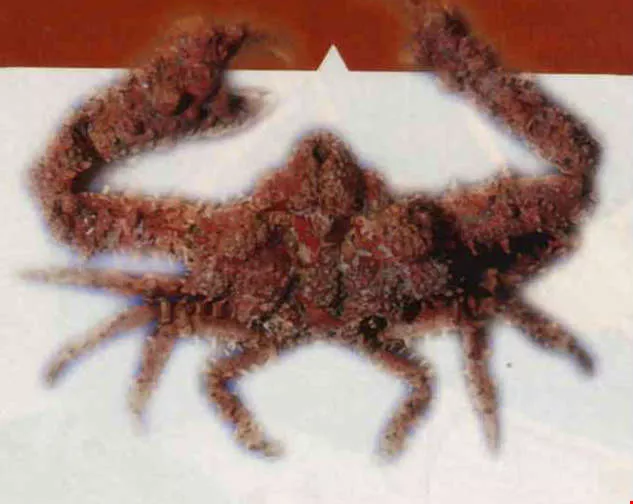
From the moment Daldorfia horrida is hatched, it looks like a lump of seaweed-encrusted coral rock. This unprepossessing disguise enables it to easily grab passing fish and shrimps.
How did the Ilan Crab Museum overcome the difficulties in preparing crustacean speci-mens? Li Kuan-hsing, who studied electronics at university, says he used to enjoy preparing botanical specimens, and was also interested in chemistry. When he was a student he worked in the fresh fish department of a supermarket, where he learned how to prepare, preserve and freeze seafoods. All these factors contributed to his success in preparing specimens for the museum.
When preparing a specimen it is important to remove the flesh without damaging the shell, and to preserve the original colors and maintain the crab's natural posture. Every step requires great skill. Through all kinds of experiments, the museum has developed its own set of precision "lock-picking tools," and uses a technique similar to traditional Chinese miniature carving to extract the meat through small slits made in the tips of the crabs' feet.
Wu Shu-he, who also helps prepare specimens, says that crab shells contain very little protein, so if the flesh is removed completely there is no need to use preservatives at all. Meanwhile, Li Kuan-hsing reveals that he uses "make-up" techniques on specimens, rubbing each carapace with moisturizing cream and sun cream.
Wu Shu-he says that in his experience, to prepare a good specimen you have to put a great deal of effort into understanding the structure of the crab's body. Traditionally, most people preparing crab specimens didn't understand the crabs' "skeleton," and after dismantling the shell and removing the meat they would reassemble it with metal wires, making it look very unnatural. In terms of the structure of their exoskeleton, crabs can be divided into six types. If one is fully familiar with their skeletal structure, then after dismantling and treating the shell one can "click" the parts back into position so that the "joins" are barely visible.
The Crab Museum's preparation techniques are a "treasure" which many would like to get their hands on. The museum's next objective is to publish a crab field guide and a manual on specimen preparation. Recently, the Ilan County government designated the Crab Museum a division of its Lanyang Museum.
As autumn moves towards winter, no doubt many people will not pass up the chance to gorge themselves on crab again this year. But when you are done eating, why not pay a visit to the Crab Museum, and take the time to gain a deeper understanding of crabs. Who
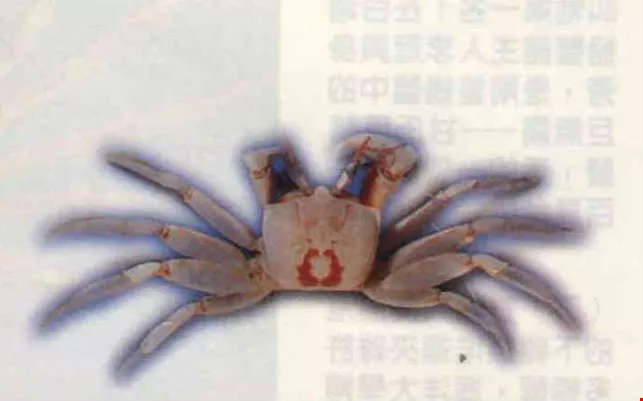
The horn-eyed ghost crab is a fleet-footed member of the crab clan.
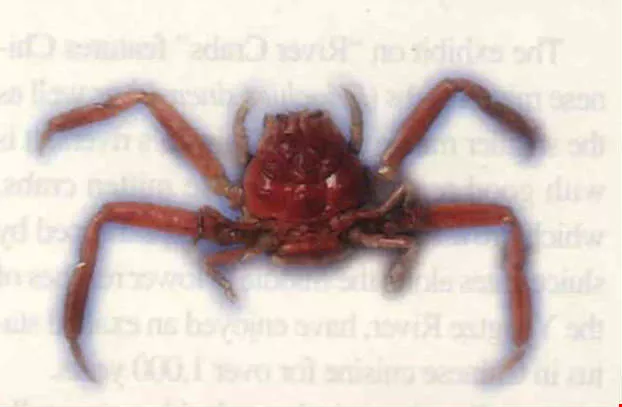
Angry, Your Lordship? Doesn't the carapace of four-legged Dorippe japonica look just like a mask of the red-faced war god Guan Gong, with fangs protruding from his mouth?
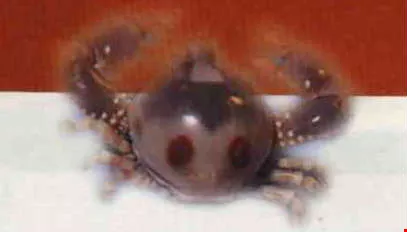
The petite and dainty Leucosia anatum glistens like an elegant little jewel.
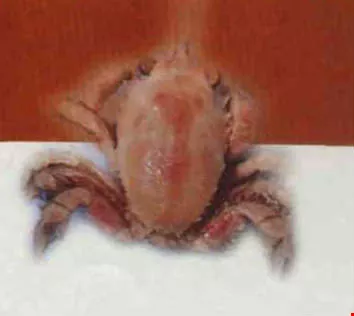
Visitors please take note! Jonas distincta not only walks straight ahead, but even has a "straight and narrow" shell! In fact, many crab species walk forward rather than sideways.
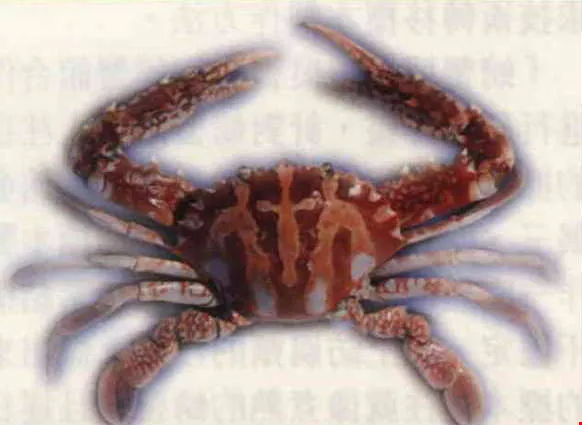
Look familiar? The coral crab Charybdis feriata is a great favorite with Taiwanese restaurant-goers.
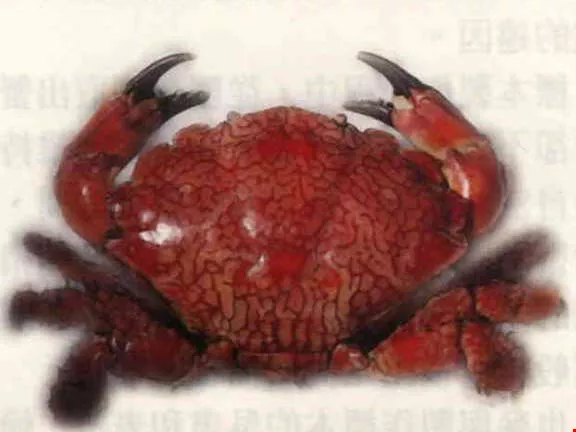
The plump and colorful mosaic crab holds a fatal attraction, for 5 grams of its meat contain enough poison to kill 400 people or 1.2 million laboratory mice.
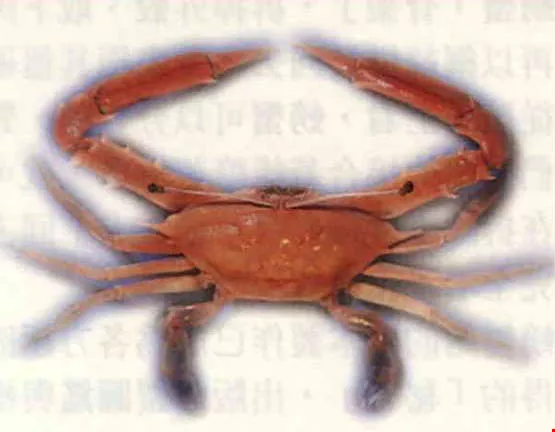
Jeepers, creepers, where'd you get them peepers? The eyes of the swimming crab Podophthalmus vigil are almost as wide as its body.
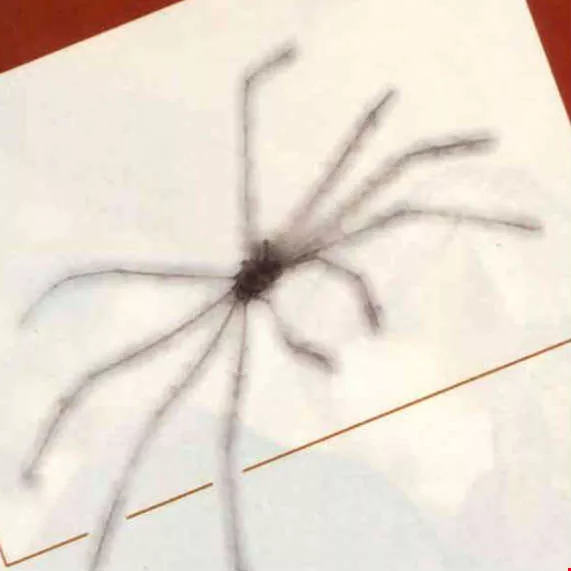
Is it a spider? No, it's crab! To date, less than ten specimens of the antlered crab Latreillia valida have been found anywhere in the world.
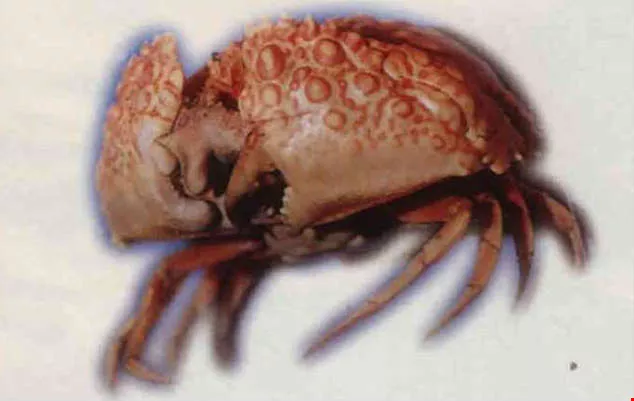
The chunky, powerful claws of the box crab Calappa japonica are regular boltcroppers, capable of crushing even the toughest shellfish shells.
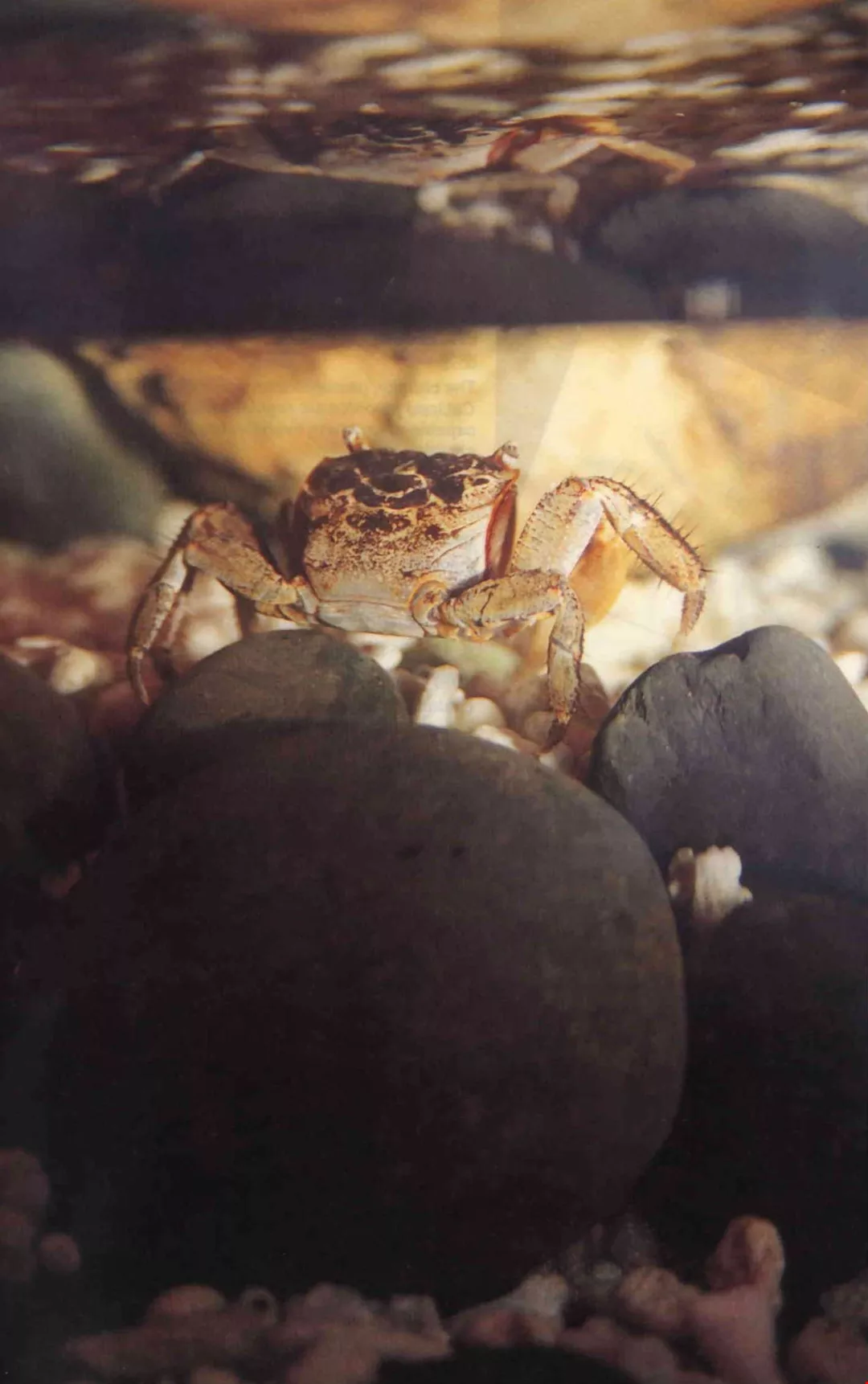
The shy red-clawed crab (Sesarma bidens), hiding in its carefully designed aquarium at the Crab Museum, is a river crab species native only to Taiwan.


@List.jpg?w=522&h=410&mode=crop&format=webp&quality=80)


