

Until this year, there had never been a single exhibition of a representative collection of Buddhist sculptures dating from the Northern Wei Dynasty (386-534 AD) through the Tang Dynasty (618-906 AD). It took almost two years to organize the exhibition recently concluded at Taipei's National Museum of History, which brought together priceless works from several overseas collections.
Of the 42 pieces on show, 19 were lent by the New York Metropolitan Museum of Art while a Tang dynasty stele came from the Princeton University Art Museum. Private owners both in the U.S. and Taiwan lent the remainder of the pieces from their collections to complete the display.
Explaining the significance of the exhibition, Huang Yung-chuan, who helped to organize it, said: "There is a popular misconception that China has achieved little in the art of sculpture. This exhibition should dispel any such doubts. Artists in the past did pay more attention to painting and calligraphy than to sculpture, which was perhaps viewed as an artisan's domain. Nevertheless, China has a magnificent heritage of sculpture, as this exhibition demonstrates."
Huang pointed out that it was not until the 20th century, when foreign art historians began to research Buddhist sculptures in China that more attention was paid to this field. But by that time many important sculptures had found their way into collections overseas. Most unfortunate of all, some were so large that only parts could be taken away, leaving many headless or armless statues on site.
The 42 pieces on display were carefully selected as illustrating artistic developments in several parts of China over a period of almost 600 years. Because the transportation of these sometimes massive but fragile sculptures was a difficult undertaking, the selection was made carefully.
Huang pointed out that the exhibition included pieces from each representative period of the golden age of Buddhist sculpture. Works have come from the most important caves where Buddhist sculptures are found - Yunkang, Lungmen, Tienlungshan and Hsiangtangshan. Materials used for carving include marble, sandstone and limestone.
"We invited many specialists to design the lighting and the layout of the exhibition, and particular attention was paid to providing background materials to accompany each piece so that visitors could appreciate the significance of the exhibition," Huang said.
Buddhist art plays an important role in Chinese art history. During the several centuries from the Northern Wei to the Tang Dynasties, Buddhism virtually became China's state religion, and under the patronage of imperial courts, Buddhist art developed, leaving a huge heritage of paintings, sculptures and architecture.
While Buddhist art was inspired by religion, the works reflect the aesthetic tastes of the period in which they were executed. Changes in popular aesthetic concepts in China over a period of 600 years can be clearly seen from the exhibition.
When Buddhism was introduced to China from India almost 2000 years ago, Buddhist art came as an accompaniment. But like many foreign things introduced into China, Buddhism underwent changes as it was assimilated.
It took several centuries for large-scale production of Buddhist sculpture to begin in China. Representative of this early period are works dating from the Northern Wei Dynasty taken from the Yunkang caves in Shansi province in northern China. These sculptures have a strong Indian influence, but towards the end of the dynasty the sculptures at Yunkang and also Lungmen became more Chinese in style.
During the next stage of development, the Indian influence reasserted itself as contacts with India became more frequent. This can be seen in the sculptures from the Tienlungshan caves in Shansi province, and the Hsiangtangshan caves in Honan province. One feature of this period is the increasing attention paid to anatomical detail.
The Tang Dynasty was more eclectic in its artistic inspiration as interest in foreign cultures increased. At this time many famous Buddhist monks made journeys west to India to acquire original Buddhist scriptures and artifacts.
Tienlungshan cave sculptures dating from the Tang Dynasty are noted for their attention to anatomical detail. But this refinement was not native to China, and as the Indian influence declined after the Tang Dynasty, the tendency waned.
Although the exhibition of stone sculptures stops with the Tang, one wooden carving from the Sung Dynasty (960-1276 AD) illustrates the changes which took place in China's artistic representation of the Buddha.
The success of this exhibition has caused the museum to think seriously about acquiring similar works from overseas. It is also hoped that more private collectors will follow the Cathay Art Gallery's example of purchasing Buddhist sculptures. In this way, art lovers in Taiwan will have even more opportunities to appreciate an important part of China's artistic heritage.
Art teachers in Taiwan would also appreciate the acquisition of more Buddhist sculptures so they can make models for the reference of art students who currently rely mainly on western models and techniques.
After its Taipei showing the exhibition will travel to the newly-finished Art Gallery of the Tainan Cultural Center where it will serve as that gallery's inaugural exhibition, and to the Taichung City Cultural Center for its final showing in Tai wan. Then, at the end of this year, the objects will return to the United States for exhibition at St. John's University.
The National Museum of History has also published a hard bound catalog entitled Chinese Buddhist Sculpture from the Wei through the Tang Dynasties. As well as including numerous plates the book has several essays by experts introducing the works of art and the history of Buddhist sculptures in China.
[Picture Caption]
1. This graceful head of a Bodhisattva dating from the Tang Dynasty, believed to come from Tienlungshan, belongs to the Metropolitan Museum of Art. The delicate modeling of the facial features conjures up a sensual image of a Bodhisattva, while the hairstyle and jewelry probably imitate court fashions. 2. Stark simplicity of this Bodhisattva head marks the mature phase of production at Yunkang, where sand stone sculpture was made during the Northern Wei Dynasty, about 500 AD. 3. The most distinctive characteristic of this image of a seated Buddha is the treatment of its robe. The garment clings tightly to the body as if wet, an effect which recalls the Indian Gupta style. The simple round shape of the head of this seated sandstone Buddha, dating from the mid-Tang Dynasty, is unusual. 4. The serene expression of this Boddhisattva portrays a deep spirituality and possesses the quality of gentleness. Carved from limestone, this head dates from the late Northern Chi Dynasty (550 to 577 AD).
1. Although this Tang Dynasty marble seated Bodhisattva is damaged, the effectiveness of the carving is unimpaired. Everywhere one is struck by the realistic details. 2. Above the main image are six flying apsareses accompanying a stupa. This alabaster object, entitled Stele of the Contemplative Prince, is dated 544 AD. 3. These two near mirror-image Bodhisattvas, belonging to the National Museum of History in Taipei, are clad in Indian skirts. Dating from 700 AD, the figures' ears reach down to their shoulders and are decorated with pearl earrings. 4. This sculpture is categorized as a Dragon stele, owing to the intertwined dragons which form a curved crest. Inscribed stones have a long tradition in China, pre-dating their use in Buddhist art.
1. This 51 cm high hand must have come from a Buddha of monumental size. Although it can be dated to the Tang Dynasty its place of origin has not been determined. 2. This standing Buddha once stood in front of a large acerole which extended above and to either side of the Buddha's body. Made of limestone, it dates from the Northern Chi Dynasty. 3. This sitting Buddha belongs to a type which became popular around 750 AD. Made of marble, the Buddha is seated on an hour-glass type of pedestal. 4. This 800 kg tomb door dating from the Tang Dynasty is similar to one found in recently excavated burial sites for members of the Tang Imperial House.
This two-meter high wooden carving of the Bodhisattva Kuanyin dates from the Sung Dynasty. It belongs to Chen Che-ching, an overseas Chinese in the U.S.

2. Stark simplicity of this Bodhisattva head marks the mature phase of production at Yunkang, where sand stone sculpture was made during the Northern Wei Dynasty, about 500 AD.

3. The most distinctive characteristic of this image of a seated Buddha is the treatment of its robe. The garment clings tightly to the body as if wet, an effect which recalls the Indian Gupta style. The simple round shape of the head of this seated sandstone Buddha, dating from the mid-Tang Dynasty, is unusual.
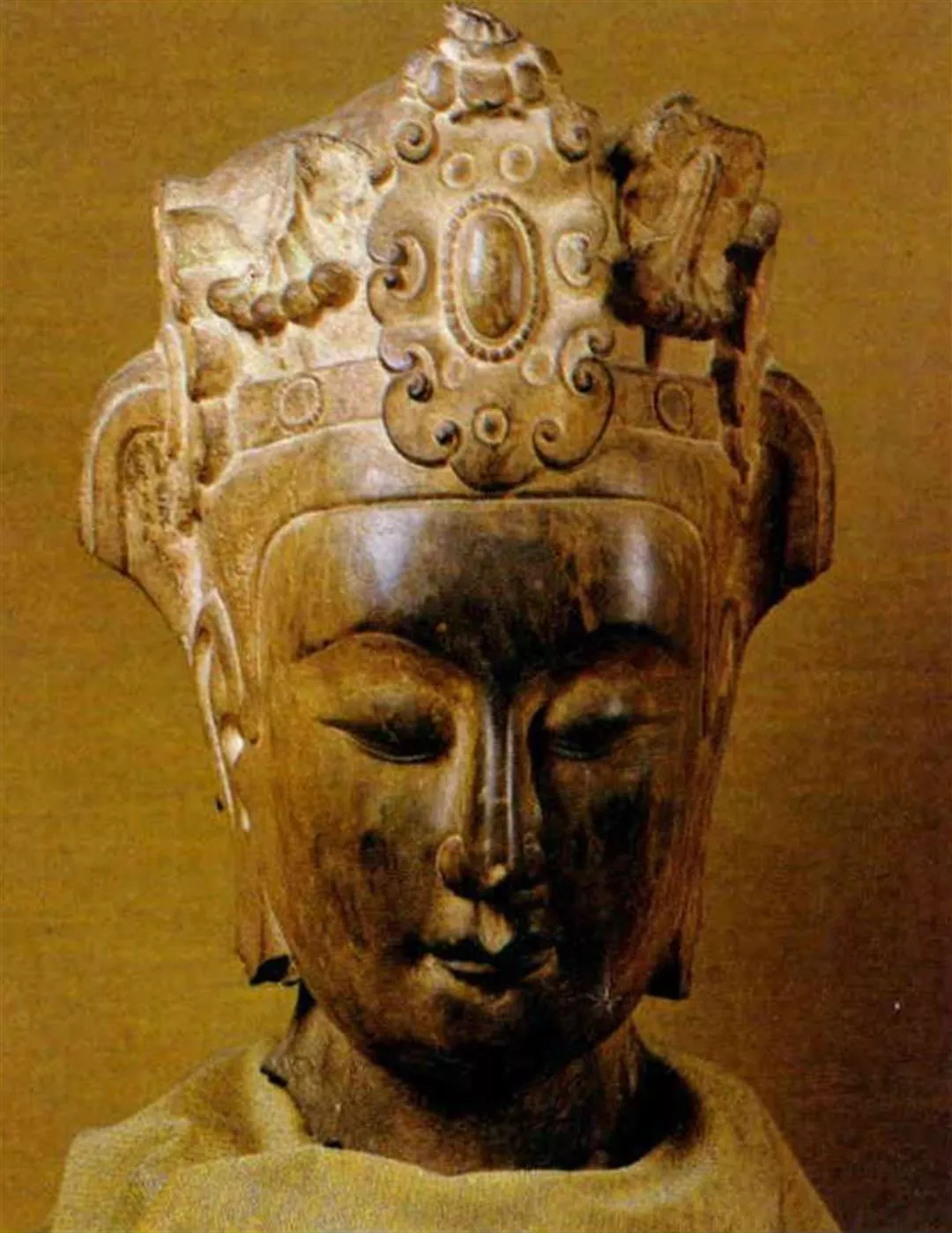
4. The serene expression of this Boddhisattva portrays a deep spirituality and possesses the quality of gentleness. Carved from limestone, this head dates from the late Northern Chi Dynasty (550 to 577 AD).

1. Although this Tang Dynasty marble seated Bodhisattva is damaged, the effectiveness of the carving is unimpaired. Everywhere one is struck by the realistic details.

2. Above the main image are six flying apsareses accompanying a stupa. This alabaster object, entitled Stele of the Contemplative Prince, is dated 544 AD.

3. These two near mirror-image Bodhisattvas, belonging to the National Museum of History in Taipei, are clad in Indian skirts. Dating from 700 AD, the figures' ears reach down to their shoulders and are decorated with pearl earrings.
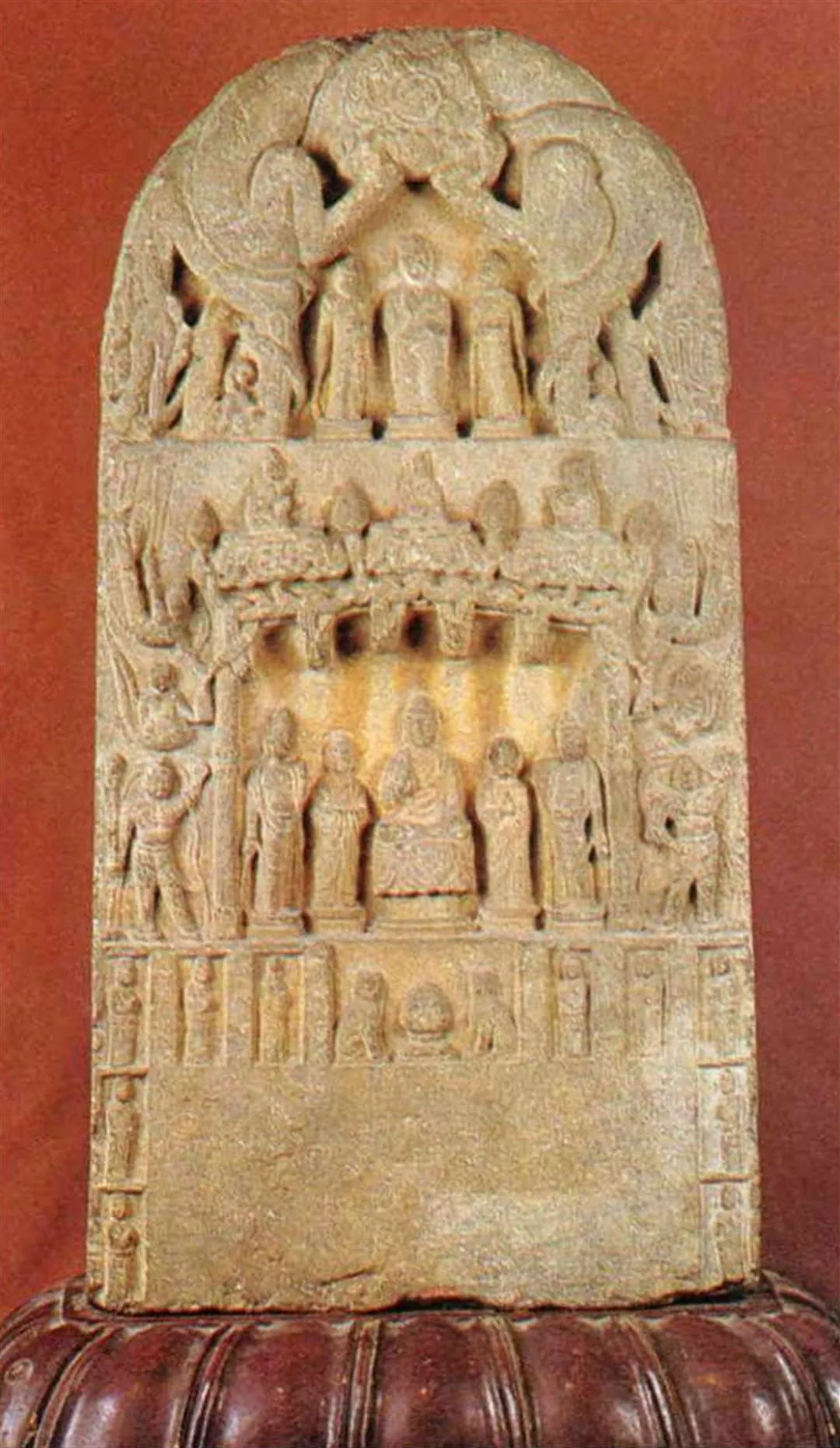
4. This sculpture is categorized as a Dragon stele, owing to the intertwined dragons which form a curved crest. Inscribed stones have a long tradition in China, pre-dating their use in Buddhist art.

1. This 51 cm high hand must have come from a Buddha of monumental size. Although it can be dated to the Tang Dynasty its place of origin has not been determined.
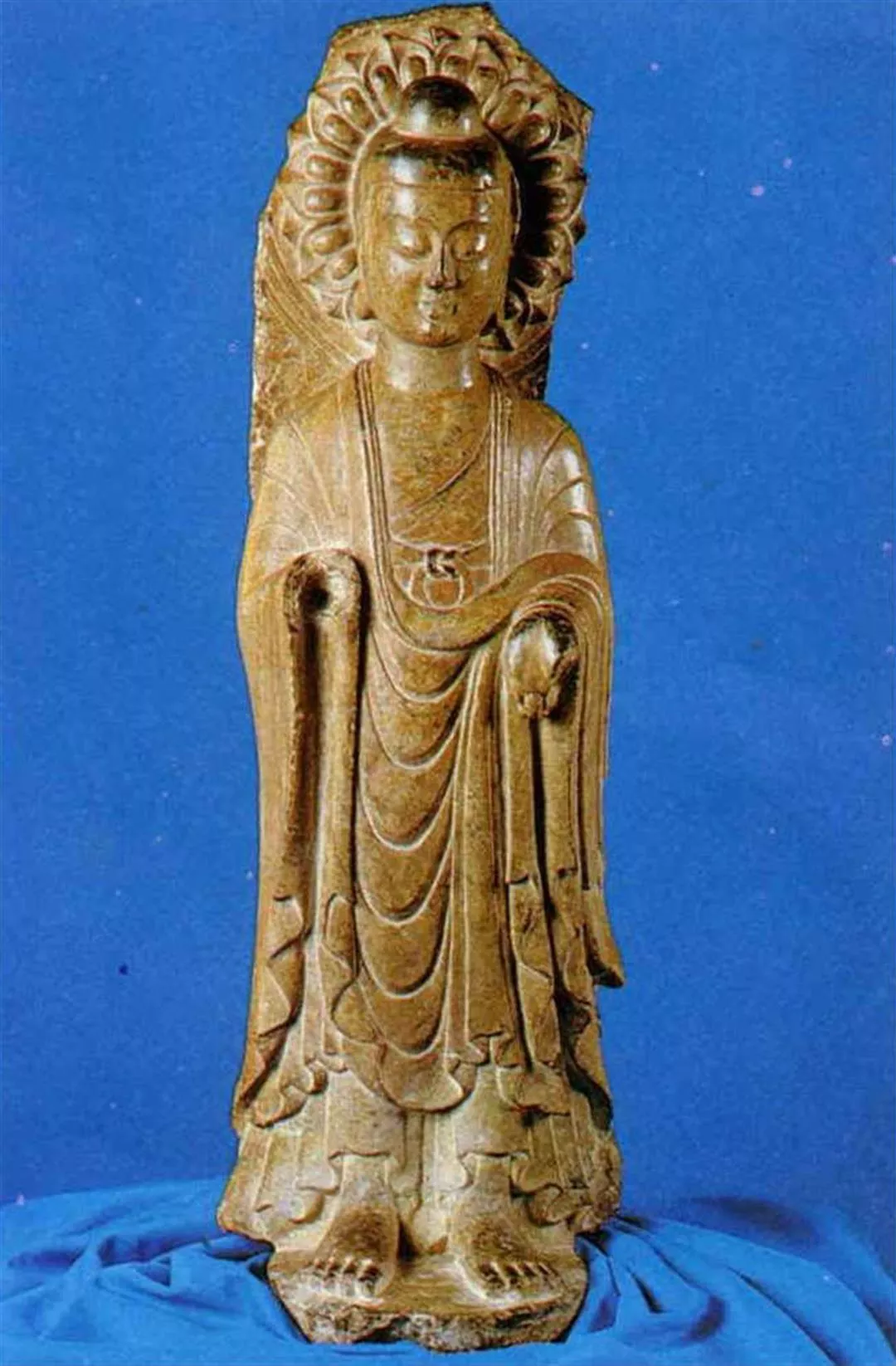
2. This standing Buddha once stood in front of a large acerole which extended above and to either side of the Buddha's body. Made of limestone, it dates from the Northern Chi Dynasty.

3. This sitting Buddha belongs to a type which became popular around 750 AD. Made of marble, the Buddha is seated on an hour-glass type of pedestal.

4. This 800 kg tomb door dating from the Tang Dynasty is similar to one found in recently excavated burial sites for members of the Tang Imperial House.

This two-meter high wooden carving of the Bodhisattva Kuanyin dates from the Sung Dynasty. It belongs to Chen Che-ching, an overseas Chinese in the U.S.


@List.jpg?w=522&h=410&mode=crop&format=webp&quality=80)


@List.jpg?w=522&h=410&mode=crop&format=webp&quality=80)
