Taiwan Mushroom Museum
Chang Chiung-fang / photos Hsueh Chi-kuang / tr. by Robert Taylor
January 2003


The world is full of wonders, and of museums of every complexion. In Taichung County's Wufeng Rural Township, there is a "Taiwan Mushroom Museum" that has close links with the local mushroom industry. It is Taiwan's only mushroom-related museum, and one of only two mushroom museums in the world.
"A shower of rain in the deserted mountains, streams run swift / Carrying cassia buds and pine-flower syrup / The soil is fertile, loose and warm, the rain seeps in / And up pop round mushrooms from the steamy soil / . . . / A bite like goose-web, a taste as sweet as honey / As smooth as nettle-hemp, no hint of astringency / A parasol is not as good as a dome, a button beats a dome / The fragrance lingers between the teeth, better than musk / . . . ."
What exquisite mountain produce is it that the Song-dynasty poet Yang Wanli (1127-1206) describes in this poem as yielding to the bite like the web of a goose's foot, and having a taste as sweet as honey and an aroma that lingers between the teeth? The poem's name-"Mushrooms" gives the game away. That's right! What the poet is singing the praises of is none other than a mushroom.
In human culinary culture, mushrooms have always played a role that cannot be ignored, and poets of every major culture have sung their praises. In ancient times, before mushrooms were domesticated, the deadly poisons that some of them contain made eating mushrooms a risky business. Even today there are often news reports of people being poisoned by eating wild mushrooms.
There are very many different species of mushroom. The earliest classification is to be found in Taishang Lingbaozhi Caopin, which was written in the closing years of the Eastern Jin dynasty (317-420) and later collected in the Dao Zang ("Daoist Canon"); it can be described as the world's first illustrated mushroom field guide. Jun Pu ("Guide to Fungi"), completed in 1245 by Chen Renyu of the Song dynasty, can be said to be the first monograph on mushrooms. Later works on mushrooms include Guang Jun Pu ("Broad Guide to Fungi," 1500) by Pan Zhiheng of the Ming dynasty, and Wu Xun Pu ("Wu's Guide to Fungi," 1703) by Wu Lin of the Qing dynasty.
Chinese people have long loved mushrooms, and with good reason. To this day a bag of dried shiitake mushrooms can be found in almost every family's kitchen, to use as one of the first flavorings added to the hot oil when stir-frying vegetables, or to add to soups. The penetrating aroma whets everyone's appetite.
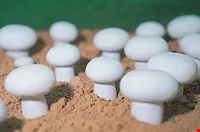
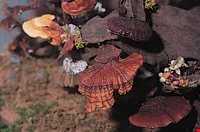
(above, left) Whether button mushrooms (5) or lingzhi (6), the Taiwan Mushroom Museum's model mushrooms are all very lifelike.
The homeland of mushrooms
Taxonomically, mushrooms belong to the true fungi. Human use of fungi can be traced back to the fifth millennium BCE, and scientific research into the medical properties of substances found in fungi also has a history of over 250 years. The main mushroom-growing regions have always been in Asia, where more than 70% of all the world's mushroom species are found.
Mushroom research and promotion began in Taiwan in 1953. Because of the suitable climatic conditions in Taichung County's Wufeng Rural Township, the area gradually came to be the biggest center of mushroom production in Taiwan. Wufeng was also the first place in Taiwan where Western-style cultivated button mushrooms were grown commercially on a large scale, and in 1970 Taiwan became the world's largest exporter of button mushrooms, which earned the country close to US$100 million a year in foreign currency. Today, button mushrooms are no longer such a big seller for Taiwan, but in recent times mushroom farmers in Wufeng have developed production of many other mushroom species. One of these, the enoki mushroom has found markets worldwide, and Wufeng is now the world's biggest producer of enoki mushrooms.
In recent years, to help regenerate local communities, the Council for Cultural Affairs has guided counties and cities in setting up theme museums related to local life. With funding from the Council of Agriculture, the CCA and Taichung County Government, Taiwan's only mushroom museum was set up in Wufeng, which is known as "the homeland of mushrooms."
With planning and assistance from the Taiwan Agricultural Research Institute, the National Museum of Natural Science, the Food Industry Research and Development Institute and National Chung Hsing University, the Taiwan Mushroom Museum at Wufeng has itself grown like a mushroom, shooting up from an invisible spore to produce a splendid parasol.
The Taiwan Mushroom Museum is housed on the sixth floor of the "five-star" Wufeng Rural Township Farmers' Association building, where it occupies a space of around 1300 square meters. Its exhibits mainly cover the development of the mushroom industry in Taiwan over the past 50 years. The museum combines traditional history and classical culture with modern science and technology, and has a strong local flavor. Since it opened at the end of 1998, it has received an average of 200 to 300 visitors a day, thus admirably fulfilling its educational role.
On entering the museum, the first thing to meet the eye is the "mushroom model zone," in which enlarged models of mushrooms are on display. The biggest is a shiitake mushroom 250 centimeters tall, which provides a favorite backdrop for visitors to have their photos taken. To the right is a huge painting, "Taiwan's Four Seasons and Hundred Mushrooms," by Wufeng artist Tseng Po-lu. Based on the Song-dynasty poem "Mushrooms" by Yang Wanli, the painting vividly depicts Taiwan's wild and cultivated mushrooms against the background of the island's four seasons, thus leading visitors into the mysterious world of fungi.
(above, left) Whether button mushrooms (5) or lingzhi (6), the Taiwan Mushroom Museum's model mushrooms are all very lifelike.
Nature's magicians
The Taiwan Mushroom Museum also contains various other zones: the "Taiwanese wild mushroom ecology zone," the "Taiwanese poisonous mushroom ecology zone," "the mushrooms' back garden," "the microscopic world of fungi," "the mushrooms' homeland," "mushrooms and health," "the history of edible mushrooms," and a computer and audiovisual room, to provide a comprehensive and diverse introduction to mushrooms' many different faces.
The Taiwanese wild mushroom zone not only contains photographs of various mushroom species, but also plaster-of-Paris models showing mushrooms and their growing environment.
Fungi grow in three ways: as parasites, saprophytes or symbionts. Parasitic fungi's hyphae (the microscopic filaments of the mycelium, which is the vegetative part of a fungus) directly invade a living plant or other host and feed off it; the hyphae of saprophytic mushrooms invade dead plant material to extract nutrients; and the hyphae of symbiotic or "mycorrhizal" fungi invade the roots of plants and assist them in extracting nutrients from the soil, while the plants provide nutrients to the fungi-they have evolved a "win-win" relationship in which each benefits the other. Pine mushrooms are an excellent example.
Pine mushrooms or matsutake (Tricholoma matsutake) live in a symbiotic relationship with pine trees. They can occasionally be seen on the floor of pine forests in the mountains of central Taiwan, at locations such as Patungkuan and Mt. Ali. To date no method of artificially cultivating pine mushrooms has been developed, so the extremely rare wild mushrooms have sometimes sold for up to NT$10,000 a kilogram.
Truffles, another group of fungi that live in a symbiotic relationship with trees, are greatly prized in Europe and America. Being rare and expensive, they are known as "black gold." Truffles grow below the surface of the soil, so to harvest them farmers in France and elsewhere enlist the help of animals with a keen sense of smell, such as pigs or dogs, to sniff them out.
The "Taiwanese wild mushrooms" section of the museum also includes a special exhibit on the basket stinkhorn (Dictyophora indusiata). The netlike translucent white veil of the basket stinkhorn is now a common sight on food markets in Taiwan, but many people are not aware that it is a fungus, instead mistakenly believing that it comes from bamboo plants. A museum guide explains how this remarkable fungus can grow to full size in the space of eight hours, and shed its veil in only 40 minutes.
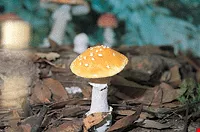
Mushrooms can look very attractive, like all kinds of little umbrellas, but not all mushrooms are edible, and some even contain deadly toxins. The "poisonous mushrooms" display cabinets house an exhibit on Taiwan's poisonous wild mushrooms. As well as photographs to help visitors recognize them, there are also many very lifelike models. No matter how delectable these mushrooms may look, one must remember never to eat them. But what if one does eat one by mistake? The exhibit also explains basic first-aid methods to cope with this eventuality.
After someone eats a poisonous mushroom, the biotoxins it contains generally cause symptoms such as nausea, vomiting, diarrhea and abdominal pain, and in severe cases may cause death due to liver and kidney failure. If someone is poisoned, one should try to induce vomiting as quickly as possible in order to expel the toxins from the body, then arrange for the victim to be transported to a medical facility for stomach pumping and intestinal irrigation.
(above, left) Whether button mushrooms (5) or lingzhi (6), the Taiwan Mushroom Museum's model mushrooms are all very lifelike.
Mushroom families
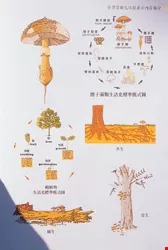
The life cycle of a mushroom-producing fungus can be summarized as follows: a spore germinates and produces hyphae that form a "primary mycelium." If this mycelium comes into contact with another mycelium of the same species, their hyphae can fuse to form a "secondary mycelium." Then fruiting bodies-the actual mushrooms-develop, mature and produce spores, to begin the cycle again.
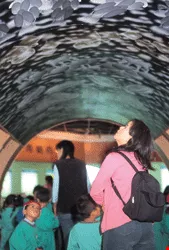
In the "microscopic world of fungi" section of the museum, visitors walk through a tunnel in which they see the spore bodies of various mushroom species enlarged by 500-700,000 times. These spore bodies, most of which are invisible to the naked eye, come in a great variety of different shapes-round, square or even covered in spines. This section also illustrates how mushrooms reproduce.
The section "homeland of Taiwanese mushrooms," shows the natural history of Taiwanese mushrooms in the different seasons of the year. Because of Taiwan's unique soil and climatic conditions, the island is extraordinarily rich in wild fungi. To date over 5300 mushroom species have been recorded here. In terms of global distribution, the species of fungi found in Taiwan can be divided into those that are found worldwide, those found in the northern hemisphere, those found in tropical and subtropical regions, those found in temperate and alpine regions, and those that are unique to Taiwan. Taiwan is geographically special in that it lies in an evolutionary transition zone between southern and northern hemisphere fungi, so that many local varieties and hybrids appear here. For example, the Taiwanese pine mushroom is a local variety, somewhat different from mushrooms of the same species in other regions.
Over ten mushroom species are cultivated in large quantities by mushroom farmers in Taiwan. They including shiitake mushrooms (Lentinus edodes), enoki mushrooms (Flammulina velutipes), black poplar (or "pioppino") mushrooms (Agrocybe aegerita), wood ears fungus (Auricularia auricula), king oyster mushrooms (Pleurotus eryngii), oyster mushrooms (Pleurotus ostreatus), abalone mushrooms (Pleurotus cystidiosus), button mushrooms (Agaricus bisporus), straw mushrooms (Volvariella volvacea), and white jelly fungus (Tremella fuciformis).
From growing wild, to human domestication and cultivation, to today's climate-controlled growing houses, the cultivation of mushrooms has advanced by leaps and bounds. One of the most noteworthy achievements is the invention in Taiwan of a method for cultivating shiitake mushrooms on wood shavings, instead of the logs on which they were traditionally grown. This method, a world first, was developed by a government agricultural agency in 1974, and is now used widely not only in Taiwan but throughout the world.
Private mushroom growers in Taiwan have also been successful in developing the cultivation method used for enoki mushrooms, achieving a huge increase in production quantities from 30 grams per culture jar in the past to 200 grams today.
(above, left) Whether button mushrooms (5) or lingzhi (6), the Taiwan Mushroom Museum's model mushrooms are all very lifelike.
Little mushrooms achieve big things
In terms of their structure, fungi are made up of filaments (hyphae) that have cell nuclei and cell walls, but do not contain chlorophyll. Hence mushrooms mostly grow in damp and dark places.
Current research shows that mushrooms produce at least 100 different natural antibiotics, and that many edible mushrooms have the effect of lowering blood pressure, contain special bioactive polysaccharides that can improve the human immune response and inhibit tumor growth, thus helping to prevent and combat cancer, or have constituents that can reduce blood cholesterol levels. On display in the "mushrooms' back garden" at the museum in Wufeng are real specimens of lingzhi (reishi) mushrooms (Ganoderma spp.), caterpillar fungus (Cordyceps sinensis) and fu ling (Poria cocos), all of which have long been prized as products to improve and maintain health.
The brightly colored lingzhi are bracket funguses with hard fruiting bodies. Few people eat them as food, but some types have medicinal effects. The first specialist pharmacological work to record lingzhi was the ancient Chinese pharmacopoeia Shen Nong Ben Cao Jing ("Shen Nong's Herbal"), believed to date from the 1st century BCE. It distinguishes six kinds of lingzhi: red, orange, blue, purple, white and black. Today, over 100 species of lingzhi are known, and they are the subject of intensive pharmaceutical research in many countries.
The caterpillar fungus, another well known Chinese medicinal ingredient, looks like a small, flat, dried-up insect larva, and there is nothing about it that would remind one of a mushroom. Is the caterpillar fungus-called "winter worm, summer grass" in Chinese-a plant or an insect? The Qing-dynasty book Liaozhai Zhi Yi Wai Ji contains this passage: "Winter worm summer grass is aptly named / In change and birth there is but one qi / One thing can indeed be both animal and plant / The world contains more wonders than we can understand."
The remarkable caterpillar fungus is in fact a fungus that parasitizes the caterpillars of ghost moths (genus Hepialus). Its spores germinate in the autumn and spread through the caterpillars' bodies, finally causing them to die and go stiff. The hyphae form sclerotia (compact masses of mycelium) inside the caterpillars' bodies, and in this form the fungus remains dormant through the winter. The following summer, thin, erect fruiting bodies grow out of the caterpillars, creating the part of the fungus generally referred to as "grass."
Little mushrooms can have countless remarkable uses. As well as the "mushrooms' back garden," the museum's "edible mushrooms" zone also introduces many mushrooms with medicinal effects. The ubiquitous cultivated button mushroom contains the enzyme tyrosinase, from which a drug to reduce blood pressure has been derived. The polysaccharides in button mushrooms also have a tumor-inhibiting effect. White jelly fungus is seen in traditional Chinese medicine as being remarkably effective in restoring yin, strengthening the vital essence, tonifying the kidneys, moistening the lungs, dispelling "heat" and replenishing the vital energy.
Lingzhi, which in traditional Chinese medicine is used to relieve "dampness," as an expectorant, and to treat lung disease, has in recent years also been developed as an anticancer and health maintenance medication. Hen-of-the-woods (Grifola frondosa) is also currently being actively researched as a source of anticancer drugs. Antrodia cinnamomea, popularly known in Taiwan as the "gateway between life and death" mushroom, and also called "blood lingzhi," or "coffin flowers" in mainland China, is a fungus that is mainly found in holes in old stout camphor (Cinnamomum micranthum) trees; it is said by some to be an antidote to poisons and to have anticancer properties. Because A. cinnamomea grows in very small quantities, it is currently one of the most expensive mushroom species around.
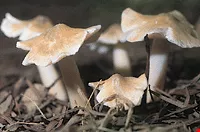
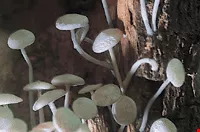
(above) In the "microscopic world of mushrooms" you can see mushrooms' reproductive organs blown up to 500-700,000 times their actual size.(facing page, 1-4) Don't be fooled by appearances-these colourful, attractive-looking mushrooms are all poisonous!(above, left) Whether button mushrooms (5) or lingzhi (6), the Taiwan Mushroom Museum's model mushrooms are all very lifelike.
A mushroom feast
Of course, apart from medicinal uses, the deepest impression most people have of mushrooms is that they are healthy foods that do not burden the body. After visitors to the Taiwan Mushroom Museum have seen the introductions to mushrooms' structure, ecology, cultivation and harvesting, the museum does not forget to finally inform them about how to enjoy mushrooms as a gourmet food. To promote edible mushrooms, and to create a greater diversity of mushroom dishes, in 2000 the Wufeng Farmers' Association began organizing "mushroom feasts," using all kinds of different mushrooms prepared in many different ways. On display in the mushroom museum are models of many dishes, such as "enoki and clam soup," "pioppino and white jade rolls," "oyster mushrooms braised with mixed vegetables" and "mushroom turnover with oyster sauce." All of them are very easy to cook, so why not try them at home and see whether they really do have "a bite like goose-web, a taste as sweet as honey," and whether "the fragrance lingers between the teeth, better than musk"?
(above, left) Whether button mushrooms (5) or lingzhi (6), the Taiwan Mushroom Museum's model mushrooms are all very lifelike.
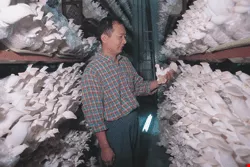
Thick-stemmed king oyster mushrooms have a firm bite but melt-in-the-mouth tenderness, and are rich in proteins, minerals and vitamins. Artificially cultivated, refrigerated and vacuum-packed, they have become a new marketing hit.
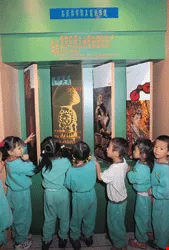
Taiwan's one and only mushroom museum receives 200 to 300 visitors every day. It is an ideal choice as an extramural educational activity for schoolchildren of all ages.
Mushrooms' life cycle


