A Conversation with the Mountains--The Life and Work of Cheng Ping-yuan
Kuo Li-chuan / photos Chen Ping-yuan / tr. by Jonathan Barnard
February 2005


One stumbles upon his works often and unexpectedly. You see them in the image of Mt. Nanhu on the NT$2000 bill, on four sets of Taiwanese mountain stamps issued by the post office in recent years, in the background of the poster announcing the inauguration of President Chen Shui-bian on May 20, on numerous postcards featuring scenic vistas in Taiwan.... The mountain photographs of Chen Ping-yuan are deeply moving in ways that are hard to put into words.
Chen learned the art of photography in the city, but eventually heard the call of the wild mountains. He lugged his camera far from the din of the crowded streets, walking alone into peaceful mountain forests, living like an ascetic monk, trudging step by step far into high mountain snowfields. In the lonely wilds he has endured solitary winters, engaging the mountain forests in affectionate conversations. Existing between thought and emotion, his photographs bear witness both to Taiwan's mountains and to his own uncommon life.
That Chen Ping-yuan, who was born in Taipei in 1956, decided to pursue the calling of photography was in no small part due to his uncle Chen Chin-chang. Back then photography was a pastime of the wealthy. Chen's uncle, a camera hobbyist, often took Chen on photo outings. Chen still has a black-and-white photo, taken by his uncle, of himself aged five with his younger sister in front of the mushroom-shaped eroded rocks of the Yehliu Peninsula. When he turned 15, Chen Ping-yuan borrowed his uncle's precious camera, and got a taste of clicking the shutter. Its sound engendered a love of photography. Although he was the only boy in the family and his father had died when he was little, he grew determined to pursue a career in photography.
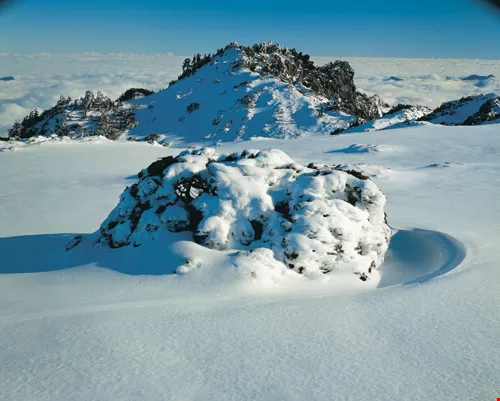
Dusted with snow, Morrison azalea look like ice cream, providing visual interest and beauty. Matched with the distant sea of clouds, they give this cool feast of nature even greater dignity. (locaton: saddle of Mt. Nanhu's main peak)
Not for naught
As a student, Chen would go to bookstores in his spare time to peruse photo collections by such Japanese photographers as Yoshikazu Shirakawa, Shinzo Maeda, and Koyo Okada. Camus' The Myth of Sisyphus long had pride of place on his bedside table. Heaven had condemned Sisyphus to spend night and day rolling a boulder up a mountain, only to let it roll down once he had reached the top. Then Sisyphus would summon all his energy to roll it up again. "Despite his eternal punishment, Sisyphus held an attitude that 'all my hard work will not be for naught.' He accepted the heavy burden of his life without succumbing to despair."
Sisyphus' dogged determination encouraged Chen to throw himself into creative photography. He recalls the days when he first started to learn the art. In 1975, he was 19 and had just enrolled in the photography department of the World College of Journalism. To buy a single-lens reflex camera and rudimentary darkroom equipment, he worked at a Sanyang motorcycle plant during his summer and winter vacations. Day after day he pushed 125-cc motorcycles that had passed inspection from the production line to the warehouse. It was a distance of about half a kilometer there and back. "For every motorcycle I pushed, they paid me NT$2. As a bonus, if we pushed more than 100 bikes in a day, we got NT$2.4 per bike."
For that extra NT$40 a day, Chen worked from early morning to dusk, exhausting himself and moving 12 motorcycles an hour on average. Sweating, he scurried back and forth on the hot asphalt and wouldn't call it quits until he had "topped 100." "I was full of creative passion. To attain my goal of buying camera equipment, I once pushed 152 motorbikes in a single day."
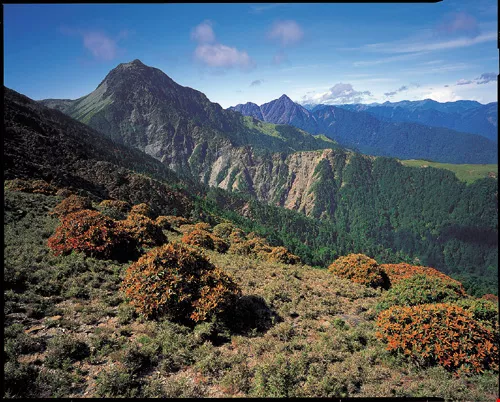
The Central Bank of China used this photograph for the image of Nanhu on the NT$2000 bill. From the Shenmachen grasslands, you get a view of Nanhu's main peak with Central Range Point behind it on the right. The mountain valley between them is the source of the Chungyangchien River, which is where you can find Formosan landlocked salmon, one of Taiwan's natural national treasures.
Treading up Nanhu
In 1981, Chen realized his dream to open his own darkroom. But the joy didn't last very long. About two years later, when the 27-year-old Chen was burning the midnight oil to enlarge an eight-color photo print, he asked himself: "Do I really want to spend my life in a darkroom, working as a 'developer'?" With only odd moments of spare time for creative work, it was a situation that worked against his original intention to pursue creative photography. Chen told himself: "Creating photographs is what the true life of a photographer is about!" He decided to leave the darkroom and give up a promising future in the developing business, to pursue nighttime ecological and alpine photography.
In 1987 Chen won the Chinese Writers' and Artists' Association photography prize for "The Ecology of Insects." In 1989 he won the Chung Shan Educational and Cultural Foundation prize in photography for "In Praise of Wild Wood," which featured his photographs of juniper trees. He was gaining recognition as one of the best young photographers. But despite winning awards for his ecological photography, he felt a greater pull toward mountain photography.
Among the many subjects of his mountain photographs, Chen cherishes peaceful and holy Mt. Nanhu most. In June of 1984, when he first realized his long-held dream of ascending Nanhu, the scenery immediately plucked at his heartstrings: the clouds streaming over the Shenmachen Grasslands, the craggy cliffs of Central Range Point, the magnificent views of encircling mountain ridges from the glacial cirques. It moved him again and again. "My development and creative path as a photographer were not smooth. Enduring suffering was a necessary rite of passage in my creative journey, but the tremendous store of creative material at Mt. Nanhu awaited me to pluck from among its inexhaustible treasures."
In the 11 years from 1984 to 1995, Chen spent a total of 450 days up on Mt. Nanhu. In the last 20 years he has made more than 30 trips into its wilds. He even spent all of 1990 there, exploring every trail and path, and going to places where no-one had trod before, all the while clicking away non-stop. In all four seasons he experienced the interaction of the wild birds and beasts with the beautiful scenery. It fueled his creative energies.
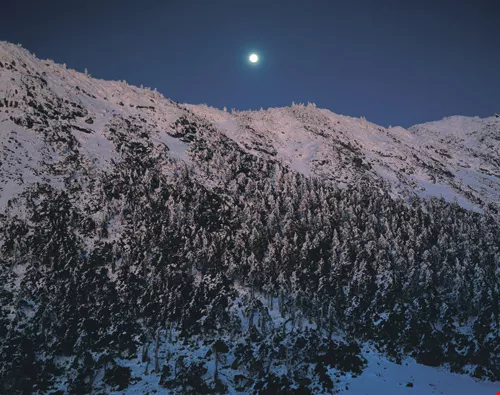
After a bitter cold front passed, Mt. Nanhu offered a rare glimpse of a full moon above its snowfields. The purple aura gave the mountain forests an even more mysterious and peaceful quality. Chen Ping-yuan camped on Nanhu, waiting for this shot of the Lantern Festival moon. Enduring temperatures of -4oC, he waited until about 6:30 p.m. for the moon to rise above the ridge, when his cold fingers clicked the shutter to capture this peaceful image of "the rising moon startling the mountain peaks." (location: Mt. Nanhu's glacial cirques)
Enduring hardship
Mt. Nanhu, which is 3740 meters high, has greater snow accumulations than any mountain in Taiwan. Chen likes to shoot snow scenes, so when cold fronts approach in winter he can be found preparing provisions, and snow climbing and photography equipment, for a trip up onto the mountain.
"Photographing up on the snowfields of Mt. Nanhu provided an ideal test of my physical strength, endurance, ability and determination." To camp out and take pictures for extended periods, he would divide his load and come back and forth several times shifting equipment and food. Consequently, he developed tremendous leg strength. Most hikers need four days to reach Mt. Nanhu and return, but during one week Chen made the return trip three times.
"In the early days I was working with a large-format camera. I started by lugging 30 kilos altogether. Then, after I finished shooting one mountain, I would add a kilo. I kept raising the amount until I was carrying 45 kilos. With the ability to carry so much, I could let my heart and eyes run wild once I got to the mountains because I could stay for half a month."
Before the season's first snowfall, Mt. Nanhu has a bare and melancholy aspect, but the snow turns it into a silver world of peace and magnificence. Once Chen stayed up on its snowy slopes for 75 days in a row so as to capture more images of pure and beautiful rime ice, icicles and ice pellets.
Tight control over food is key to living for long periods on the mountain. He picks foods that are easy to carry, store and cook, and are filling. To reduce volume and weight, the food is all transferred to plastic bags. He consumes about 0.7 to 1 kilo of food a day. For breakfast, he typically only drinks a cup of milk with some oatmeal or a couple of crackers. That lasts him until noon, when he mostly fills himself up with fruit, crackers and tea. For dinner, he eats noodles with carrots, cucumbers, mushrooms or dried meat. If he encounters day after day of bad weather, he moves less and consequently consumes even less food.
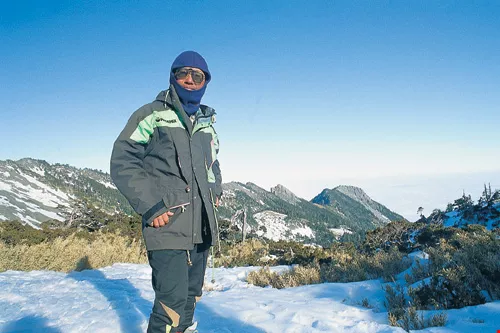
Only by striking a momentary balance between rationality and sentiment is Chen Ping-yuan able to create breathtaking photographic masterpieces. Chen's conversation with the mountains has written a beautiful ode to harmony between humanity and the natural world. (location: the saddle on Nanhu's main peak, with the southeast peak of Nanhu in the distance)
Five dead men
When taking photographs, Chen was most afraid of the dry season at the end of fall. Once, the Nanhu River was affected by a serious drought. He used a soft drinks bottle to collect water dripping off rocks, taking an hour to collect a liter. One year, when photographing Shei-Pa National Park's Shengling Trail, he had to draw 13 liters from the Tachinko Creek (the source of the Tanshui River). Then he lugged it up the mountain along a wild path, all the while fretting that his water bag would puncture and all his effort would be for naught. "When carrying a liter of water, psychologically it feels like a lot more than a liter, because water shakes in every direction. The farther you walk and the longer you carry it, the heavier it seems."
Alone on the mountain, it is precisely that condition of solitude that is hardest to handle. A person only has two eyes, and no matter how much you turn around, you can't see what's behind you. Particularly at night when the mountain range falls into pitch darkness and quiet, one can't help but grow anxious and insecure.
"At the Chengkungpao Cabin on Mt. Chilai and the Yuehleng Cabin on Mt. Nanhu, you are surrounded by dark forest. With so many mountain legends, your nerves tense up at the slightest sound, whether the blowing wind or rustling grass," says Chen, who doesn't try to portray himself as a fearless rugged hero. "In particular, there used to be photos of five people who had died in climbing accidents in Chengkungpao Cabin. When you came into the cabin to spend the night, the images of the dead mountaineers collectively stared at you no matter which direction your gaze drifted. It left you with nowhere to hide. You'd be trembling, but it wasn't from the cold."
Chen is a rational man who puts his faith in knowledge. When he gets into a situation where rationality and knowledge aren't enough, reading becomes his biggest source of comfort. Chu Kuang-chien's Discussing Aesthetics, Tsung Pai-hua's Aesthetics and Atmosphere, Heidegger's Being and Time, Shikano Tado's Journal of Climbing Yushan's East Peak, Camus' The Myth of Sisyphus, and Reinhold Messner's Everest: Expedition to the Ultimate helped to soothe his anxious state of mind and free him from unpleasant imaginings.
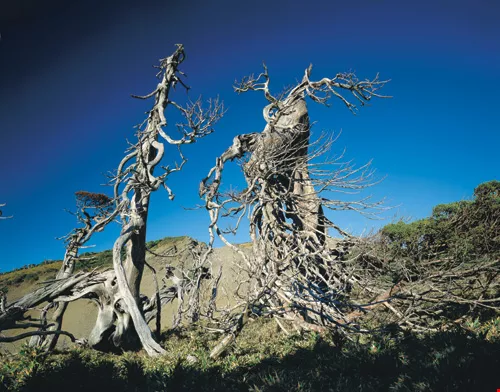
Yushan cypresses endure strong winds, bear loads of heavy snow, and are lashed by thundershowers. The harsh weather gives them an aspect of untamed vitality and imparts an otherworldly atmosphere to the mountain ridges. (location: Mt. Nanhu's northeast peak)
The song of animals
In the deep mountains, apart from scattered climbers, those who interacted most with Chen were the mountain animals. Sly weasels earned both his love and his fear of injury. Several times they entered his tent and liberally sampled his food: whether vegetarian fare or meat, hot and spicy or sweet and sour-they tried them all. Eventually they would select those that met their favor and drag them outside. Chen explains that not only do weasels steal food, but a gland in their anus sprays a foul smell that results in the tent "stinking to high heaven."
Chen once crept up on his tent when he heard a weasel inside, hoping for a close look. He gingerly opened the tent in order to see the animal up close. He didn't expect that after they momentarily confronted each other, the weasel would bark bossily and then proceed to parade around the tent to spread his stink and express his displeasure at being disturbed.
Fortunately, the unwanted guests in the mountains were few and far between, and the poignant moments were numerous. For instance, he saw birds such as the alpine accentor and Formosan laughing thrush trembling while foraging for food in the snowy glacial cirques of Nanhu. "I'd look down at myself, bundled in thick winter clothing, my feet wrapped in warm boots, and then look at the thrushes, with their fading fluffy feathers and naked legs amid the snow. In comparison, human beings have nothing to be proud of." The look from the eyes of the thrush, which endured exposure to the bitter winter, was hard for him to bear. He threw a handful of peanuts out onto the snow. At first, the birds were startled by it. But a few minutes later, he and birds were eating together.
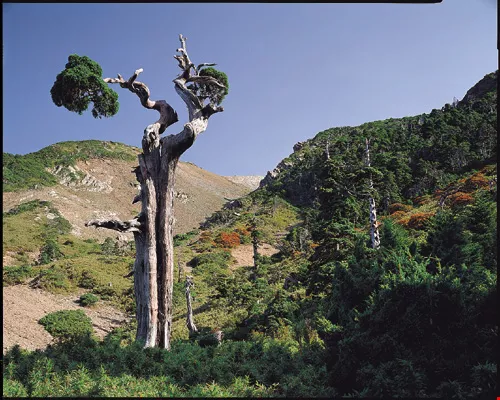
This lone and august Yushan cypress, at the lower glacial cirque near the Nanhu River, is a famous landmark.
Alive in the morning, dead at night
When the snow begins to melt, Mt. Nanhu's plants start sprouting and adorning the slopes. At the end of the winter and beginning of spring the Morrison azalea bloom. From the Shenmachen Cabin, the mountain slopes in the direction of Wuyan Peak and Nanhu's northern peak show hints of red flower buds amid the cold rain and fog, which in the blink of an eye unfold to full bloom of vibrant color.
During summer on Nanhu the high mountain plants seem to compete with each other for beauty. At different times and different places appear resplendent seas of different flowers: Epilobium nankotaizanense, Scabiosa lacerifolia, Sedum morrisonense, Anaphalis nepalensis.... "These glacial relict species of mountain flowers have to withstand the weird summer weather up on Mt. Nanhu, where it might be totally clear in the morning, only to have thunderstorms in the afternoon that seem to consume all of the mountain's life with one intense shower. There's a tragic beauty to such a landscape that's 'in the flush of life in the morning, only to be deathly white at sundown.'"
Nanhu is also a great place for taking photographs of clouds. When shooting clouds, you have to grasp fleeting opportunities. When the moment presents itself the photographer must follow his feelings to have confidence in his decision. Clouds are like a make-up artist that deeply understands the mountains' feelings. With clouds to provide nourishment, mountains will temporarily put aside their brutal character to show their warm and gentle side.
"The air currents and topography transform clouds into myriad shapes. The times I like best are in the early morning and at dusk, when I look out for tadpole-shaped cirrus clouds and rainhat-shaped lenticularis. There are also elegantly beautiful evening clouds." The photos Chen takes of "mountains amid the clouds" are like paintings. He has an excellent command of the aesthetics of rhythmic movement, and the images he captures are something akin to the fantastic realm that the Tang poet Wang Wei described thus: "The river flows beyond Heaven and earth; the beauty of the mountains seems both present and absent."
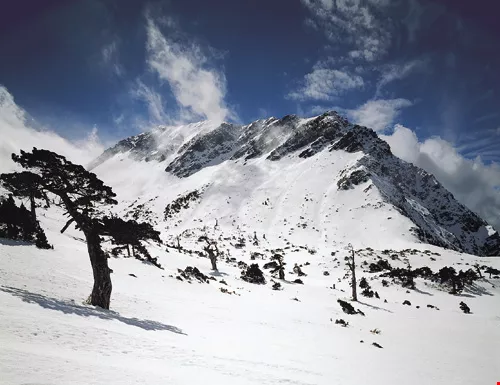
A view of Nanhu's snow-capped main peak from a glacial cirque gives it an especially rugged, almost frightening appearance.
Philosophy of uniqueness
Chen deeply believes that "creativity determines the vitality of a work of art," so he insists on creating unique images. In his studio, he points to a shot of Yushan's main peak from the north peak and explains: "This is the 'common view' that everyone can take; you only need to go to the north peak. Only by getting far from the madding crowd, and placing oneself among the mountains and entering into a conversation with them, can one create unique photographic works of art." To shoot Yushan cypresses, he camped out under the trees for several days, coming to a careful understanding of them, before eventually shooting unique works that are full of vitality and aesthetic sensibility.
Chen believes in photographic destiny. In taking shots of snowy landscapes, he selects campsites that provide broad vistas, so that he needs only "to unzip the tent to see an expanse of snow." When taking photos of snow, he hopes for fiercely cold low-pressure fronts to sweep in and bring ample snowfall. But when camping, he has to crawl out of his sleeping bag several times a night in temperatures in the minus teens to take snow off the tent. At extremely low temperatures, frost covers his camera and lens, so that he can only enjoy the scenery but not shoot it. Sometimes the vistas of rime ice are incredibly beautiful for his eyes to behold, but his hands are so frozen that even the simple motion of clicking the shutter is too much for him; all he can do is take in the scenery and sigh. That's when his destiny is to see but not create.
It's most depressing when fate denies him either. When Nanhu's snowfields are at their most inhospitable, they can be shrouded in fog for ten or more days running, and the cold wind can be unbearably fierce. All he can do is huddle in his 36-square-foot tent, as if it were a jail cell, and pray for a change in the weather-although Old Man Weather may just look on coldly and refuse to cooperate. He has thus spent stretches of more than ten days on both Nanhu and Hohuan, eventually coming down off the mountain full of regrets.
If fate allows, he may take some photographs that he finds satisfactory. Yet sometimes, they slip away from him after they've already been taken. In 1990, Chen was taking photographs on Nanhu, but because the screws on the back of the camera came loose, light got in and ruined more than 300 negatives. Just for the materials, it represented a loss of NT$80,000. Another time water droplets condensed on the film due to the extremely humid air, so it had what looked like a case of "smallpox" after being developed. All the beautiful scenes that he thought he had captured were erased, and the blessings he had thought fate had bestowed upon him were rudely revoked.
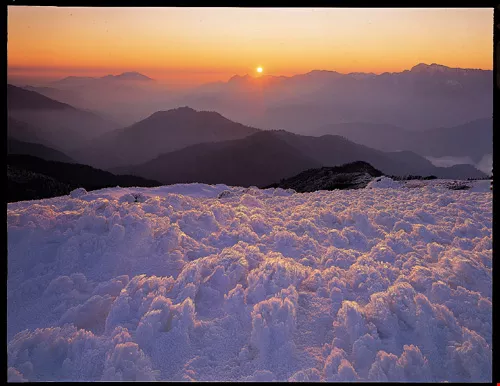
A twilight view from the north peak of Nanhu of Mt. Shenmachen, with its crystal-like snow melding with the green of the mountain forests to provide a beautiful now-you-see-it, now-you-don't kind of fantastical scenery.
Awe for the mountains
Apart from such cruel twists of fate, loneliness and danger are also part and parcel of alpine photography. A few years ago, a senior guide led a group before dusk into the Nanhu glacial cirques. He even came and stood outside Mt. Nanhu Cabin, inside which Chen was resting, to ask about the route. The next morning, perhaps because he wasn't familiar with the way, he fell off a cliff to his death. Chen went to the site of the accident himself, and there he recalled their brief conversation-and how shortly thereafter the guide had entered the realm of the spirits. It filled him with anguish and added to the loneliness of his creative endeavor. After the tragedy, his awe of the mountains grew but his passion for mountain photography cooled a few degrees. In particular, the prospect of running into a Formosan black bear made him fear for his life. All this made him consider leaving the profession.
"But the truth is that the charms of the mountains are simply too great. With the memory of that tragedy fading and my self-protection skills growing, I regained my passion and confidence, understanding that only by looking to the mountains could I revive my spirits." In 1994 he won the National Award for the Arts photography prize for his photos of Mt. Nanhu. His many years of alpine photography have honed both a command of detail and a comprehensive understanding of the big picture. His Mountain Safety Tips and Introduction to Photographing Mount Nanhu are works of more than 10,000 words in which he reveals excerpts from his working journals and conclusions he has reached from some of his experiences. They provide an even better glimpse at his tenderness and selflessness.
Forever a bachelor
Spending many years deep in the mountains photographing, mysterious and with his whereabouts uncertain, people developed great curiosity about Chen and made many guesses about his life. He is still a bachelor who holds great affection for the mountains; but he has elected to do without romance. Once, in love with his first girlfriend, he considered ending his bachelorhood. He put down his camera to fly around the world and spend sweet days together with the girlfriend who lived in America. Yet as someone whose very essence is infused with the spirit of the mountain forests, he knew that if he had a family and children, it would be hard for him to get to the mountains to photograph, so in the end he decided to return to Taiwan and continue his conversation with the mountains, regarding his works of photography as his children, using photography to reveal the subtle emotions and melancholy of hidden corners of his mind.
If you want to compare Bach's cello suites with the magnificence and harmony of Mt. Nanhu, then the feelings expressed in Chen's works are like Chopin's piano impromptus: At first the right and left hands move at different tempos, pounding out a poetic rhythm; it is only by finding a momentary balance between rationality and sentiment that Chen can create photographs that leave people awestruck. Chopin's passionate notes are like the energy with which Chen climbs mountains: the equipment is heavy and the air of the snowfields is thin, but the passion in his heart is never extinguished. The second scherzo is dreamlike and romantic, like his conversation with the mountains. The ridgelines, stands of dead trees, rose finches-both those things that feel and those that don't-transcend time and space and come to a mutual understanding. The third scherzo returns to the main theme, back from a dazzling splendor to a more peaceful beauty. After the rational climbing and sentimental intertwining with the mountain, Chen clicks his shutter, leaving a record of Taiwan's high mountains and attaining immortality for himself.

@List.jpg?w=522&h=410&mode=crop&format=webp&quality=80)


