Taiwan's Literary Stun Grenade-The Ever-Changing Sung Tse-lai
Kuo Li-chuan / photos Jimmy Lin / tr. by Scott Williams
February 2009


Sung Tse-lai has long been a prominent figure on Taiwan's literary scene, having won it over with his characteristically sharp social observations and lively way with a pen in works ranging from the Modernist Yinghai, written while he was still in university, to Daniunan Cun, a short story collection in the Nativist style.
In an unusual move, Sung withdrew from the literary scene and turned to self-cultivation just as his reputation was taking flight. His religious explorations took him from Chan to primitive Buddhism, and eventually led to Buddha Betrayed, a work that sparked a Taiwanese critique of Buddhism. Sung ultimately found solace not in Buddhism, but in Christianity.
He published Feixu Taiwan in 1985, shocking many with his use of black humor to criticize Taiwan's political environment, then went on to create a specifically Taiwanese magic realism in his The City Where the Blood-Red Bat Descended. In more recent years, his earlier ironic tone has given way to the stark simplicity of works like A Wooden Spoon.
In spite of his seeming facility with all the weapons in the literary arsenal, Sung retains an intensely personal style. A literary chameleon, ardent supporter of the pro-independence camp in Taiwanese politics, and heterodox religious seeker, Sung is one of the most fascinating figures on the literary scene. What surprises might he still have in store?
Whether writing humble personal commentary or heated critique, Sung Tse-lai always manages to jolt his readers into a new kind of awareness or even pull the intellectual rug out from under them.
Surprisingly, this author from rural Taiwan loves classical Chinese literature, especially the late-Ming-Dynasty author Kong Shangren's The Peach Blossom Fan, a historical play about the love between essayist Hou Fangyu and the renowned prostitute Li Xiangjun set against the backdrop of the rise and fall of the Southern Ming Dynasty. Sung admires its marvelous wordplay, and keeps a much thumbed copy by his bed to this day.
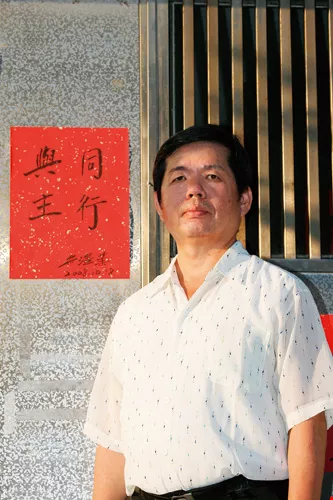
Sung believes "literature is literature and religion is religion," but also argues that a writer himself would still need religious salvation. The "walking with God" sign Sung has pasted up by his door sticks with us after the interview and suggests that his spiritual journey may have reached its destination.
Classical China and the modern West
Sung was born Liao Weijun in 1952 in Erlun Township, Yunlin County. As a middle- and high-school student he got good marks for his writing, but had little interest in the shallow plainness of modern art and literature. Instead, he was drawn to the language aesthetic, rhyme, meter, and imaginary landscapes of classical poetry.
"In literature, I prefer the study of rhetoric," says Sung. "I find the rhetorical world to be a brilliant tapestry." Pieces of classical-style euphuist prose dating from his high-school days are among his earliest literary experiments.
He reached an important turning point in his life and work when he came north to study in the history department of National Taiwan Normal University. There he began reading large amounts of Western literature, including James Joyce's Portrait of the Artist as a Young Man and Finnegan's Wake, as well as Henry James' psychological works. He was even more fascinated by the work of humanistic philosopher and psychologist Erich Fromm.
In his first-year writing course, Sung completely ignored the assigned topics, and instead wrote whatever he felt like writing. His teacher, Chen Man-ming, knew and appreciated talent when he saw it and let Sung do as he pleased. When Chen one day suggested that he try his hand at fiction, he set Sung's creative juices flowing.
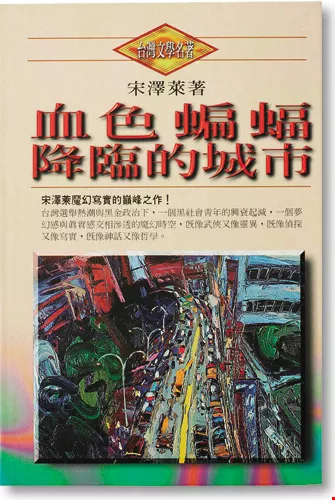
After redirecting his religious studies from primitive Buddhism to Christianity, Sung published 1996's The City Where the Blood-Red Bat Descended, expressing his religious insights via the book's protagonist.
Sickly but precocious
In 1973, Sung published a psychological short story called "Yinghai" in the Chung-Wai Literary Quarterly. In it, he used Fromm's theories to explore human destructiveness and the tangled emotions underlying it, including the Oedipal complex, the necrophilic personality, sadism, and narcissism. Sung's protagonist was so vividly drawn that Yen Yuan-shu, who ran the quarterly in those days, suspected that it was a translation of a German or French work and demanded that Sung produce his original draft before agreeing to publish it.
Readers were more than a little astonished by the story, wondering how a kid of just 20 could have understood the dark, tangled depths of the human soul so well.
While at university, the financially strapped, physically frail Sung learned that he had kidney stones. At times, the pain was so debilitating that he couldn't stand. At other times, he couldn't even bear to sit through two consecutive classes. He also suffered neurological side effects from his medication, including photophobia and an inability to tolerate noise. Sung described himself as "a fragile willow tree fated to die young in the midst of good times" and mentions having "a face as white as death." His own life may well have been the source of the pain he describes in "Yinghai."
Sung sees "Yinghai," now regarded as a classic example of the Modernist short story, as a record and exploration of an individual's state mind. "In those days, I always felt it necessary to describe all the tragic images that had accumulated since childhood, not realizing that this wasn't an escape from sorrow but rather its seed," he says.
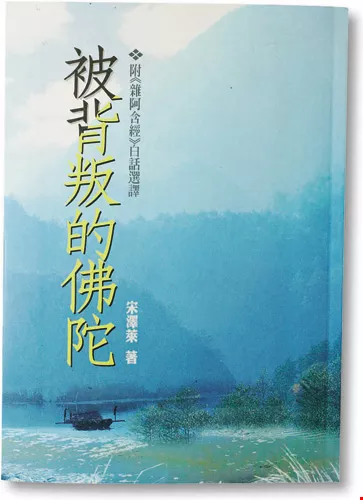
Sung published Buddha Betrayed after nearly a decade spent studying Chan Buddhism, and was subjected to intense criticism for the book's denunciation of Taiwan's traditional Mahayana Buddhism.
A rural lament
After graduating in 1975, Sung was assigned to Fusing Junior High School in Changhua. Out in the working world and becoming aware of the poverty of rural villages, his writing turned from his inner world to the changes taking place in society.
"Industry boomed and the economy flourished in the 1950s and 1960s," says Sung. "But government officials brought about this prosperity by making a decision to sacrifice the agricultural economy on the altar of industrial growth. That led to migration out of rural villages and a breakdown in traditional ways of life." Himself the child of a rural community, he felt duty-bound to use his literary work to unmask the hypocrisy of those who ran the government.
Wanting to write realistic works in a simple, unadorned style, he began casting about for a suitable literary vehicle. The Daniunan Cun series is typical of this period. One of the stories from the collection, "Shengzai yu Guizai de Chuanqi," depicts the futility of the rural people's efforts to resist the merchants. Another, "Tiao Gu Riji," relates Sung's own experiences in the form of a diary.
"Tiao Gu Riji" tells of Lin Baiyi, the scion of a well-to-do rural family who has gone to the city to earn a living. When his business goes bankrupt and he finds himself in need of money and a new strategy, his thoughts turn to the simple folk of his native village. With an eye to the farmers' resentment of their exploitation by grain brokers, he offers them above market prices for their rice, paying 30% upfront and promising the rest later. After he repeatedly postpones his payment of the balance, the villagers realize that he's not their savior, but a crook. Unfortunately, their agreements with him were only oral, leaving them without a legal basis on which to prosecute him for theft, or even fraud.
In "Milestones of the New Generation," author Kao Tien-sheng wrote: "Sung Tse-lai is more ambitious in his depiction of Taiwanese villages in transition, of the poverty and gamut of emotions of rural people, than any other writer of fiction in the history of Taiwanese letters. His Daniunan Cun series is likewise the most vivid and deep fictional portrait of the problems of rural villages in literary history. From this standpoint, Sung has taken up the mantle of Chung Li-ho and Hwang Chun-ming and laid down a new milestone for Nativist literature."
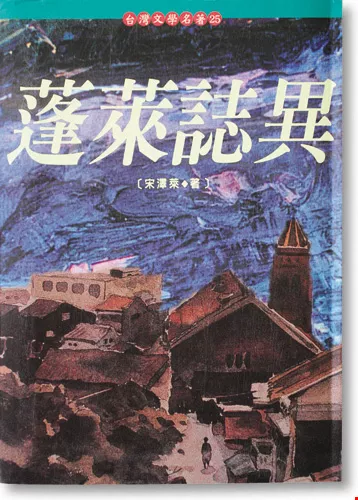
Sung's Penglai Zhi Yi, "a book about the human world" written for his "Taiwanese brothers and sisters," is a sympathetic record of the struggles and sufferings of Taiwan's lower classes prior to 1979.
Unyielding in spiritual exile
In 1977, while Sung was serving in the military in Linbian, Pingtung, a naval sentry suffering from persecutory delusions killed more than ten soldiers.
Among the first on the scene, Sung saw the corpses of his comrades littering the ground, "blown to bits by large-caliber bullets." The memory turned Sung into a nervous wreck and ruined his sleep for more than a month. It wasn't until he was transferred, first to a coastal station at Jiadong and then to the island of Xiao Liuqiu, that he "recovered the part of my mind that had gone AWOL." Seeking to put the tragedy behind him, he began writing a series of only half-fictional romances with protagonists who move from rural communities to coastal ones.
In When Hibiscus Blossoms, the loves, hates, and frustrations of the characters are those you see in everyday life. But no matter how great the injustices or tribulations they encounter, Sung's characters never flee, become dejected, or end their own lives. Instead, they stand firm in the face of adversity. Whether the bride with a knife wound across her neck in "Jiajiao Shang de Xinniang," the young wife ordered arrested in "Yuzailiao Anjian," or the couple pushed to the brink by city life in "When Hibiscus Blossoms," Sung demands that all bear their burdens. They may count for as little as weeds at the edge of a rice paddy, but they are determined to live.
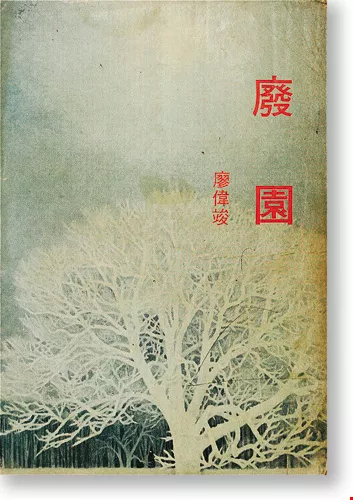
In 1976, Sung published the novel Ruined Garden under his real name Liao Weijun, which was later rewritten as Evil Spirits.
The Naturalistic Penglai Zhi Yi
After completing his military service, Sung went back to teaching. Again in the working world, he saw more clearly that human existence is conditional. But when people are unclear about their innate limitations, those limitations often lead them into dire straits. "More frightening is when people are aware of these limitations, but lack the power to break free of them," says Sung. "In such cases, all they can do is watch with eyes wide open as tragedy approaches."
Published in 1980, Penglai Zhi Yi contains one realistically depicted story after another, each painful and dismaying to read. In "Baiwu Zhen de Huiyi," a couple terrified of hard times is unwilling to spend money on urgently needed surgery for their five-day-old child and watch it die. In "Qiying Shancheng Xingjiao," a man who knows martial arts twists his four-year-old son's limbs to make him appear to be crippled, and forces him to learn terrifying tricks from the martial arts.
Sung tells these stories of Taiwan's poor from the standpoint of one looking to right society's wrongs.
"I did my best to leave a record of what I witnessed in society," says Sung. "They suffer far more than intellectuals, who tend to be at least middle class, can imagine. Our elders who lived in colonial times have many tragedies and grievances that they want to tell us about. But they have a hard time voicing such profound emotions and have been unable to pass them on." His pen has given voice to the words of the elders in his community, providing a true record of misfortunes that had been swept under the rug.
Seeing what he was sure were trumped-up charges following the Kaohsiung Incident of 1979, Sung shook with anger and vented those feelings directly into poetry, including 1981's 200-plus-line Taiwanese-language ode "If Taiwan Is in Your Heart":
The Pacific is a cold and lonely ocean, / Look back to that beautiful place on the Tropic of Cancer, / Where sweet potatoes were everywhere for the picking, / Where the sugarcane rose thick and tall, and all were prosperous / If Taiwan is in your heart, / Let's all sing a song of Taiwan.
Sung published Fu'ermosha Songge in 1983. "I was powerfully affected by the act of writing this collection of poems," recalls Sung. "It drew me into Taiwan's emotional core, and got me started on a comprehensive exploration of Taiwan's history and customs." But martial law was still in force and, in the wake of the Kaohsiung Incident, everyone was anxious. Some authors on the literary scene went so far as to have meetings to condemn the collection, but Sung stuck to his guns. "At worst, I'd stop writing and take up something else. I would have been fine living this life in silence."
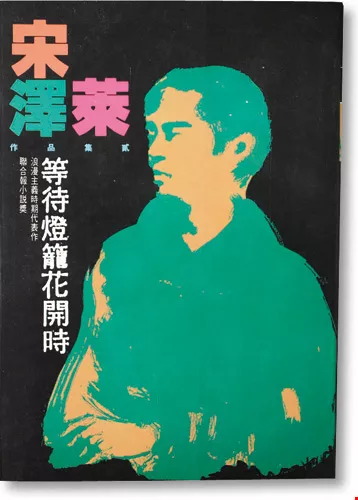
In When Hibiscus Blossoms, a 1988 work from his romantic phase, characters soldier on no matter what kinds of adversity and injustice they encounter.
A novel on pollution
Around the time he was writing these Taiwanese poems, Sung transitioned from practicing meditation on his own to studying Chan (Zen) Buddhism. His encounter with Chan enabled him to cast aside a burden he'd been carrying for half his life. "I'd never felt so relaxed and happy in my 30 years on Earth," he says.
Still a bachelor, Sung spent his days in a small rented room reading books on Chan. Focused on deepening his understanding of it, he lost all interest in writing fiction. When his friends encouraged him to take it up again, he found the contrast between the sense of inner purity that meditation had brought him and the growing pollution of our environment unbearable.
In 1983, Taiwan suffered both the Sunko pesticide disaster and the Lee Chang Yung chemical spill. The next year, the government announced plans to construct 20-some nuclear power plants. These events led to Sung's conception of the "environmental catastrophe novel," and his 1985 publication of Feixu Taiwan, which was selected as one of the year's most influential novels.
The fictional backstory to Feixu Taiwan has the Ultra-Freedom Party taking control of Taiwan's government in 2000. Within five short years, the island has lost all contact with the rest of the world and passenger vessels are forbidden from entering or leaving. In 2010, reports emerge that the island has been destroyed practically overnight with 40 million lives lost, and the rest of the world declares it a restricted area. The world doesn't learn the truth about the island's tragic fate until 2015, when a foreign scholar exploring the ruins comes across the diary of Li Xinfu.
In his diary, Li, a television cameraman, realistically depicts the warning signs: the lack of space resulting from a population of 40 million, the mountains of accumulated trash, the radiation leaking from nuclear power plants, the dust storms pervading the cities, the deadly noise, the soaring suicide rate, and the cold-blooded military actions to slaughter dissidents.
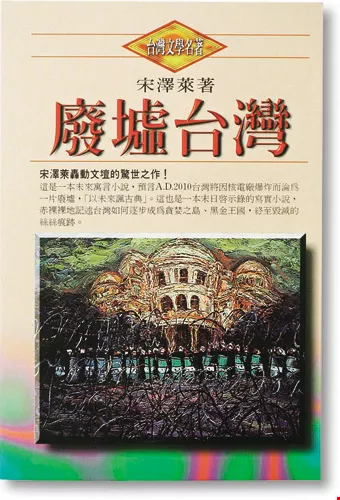
When the government began planning to build 20-some nuclear power plants around Taiwan in the 1980s, Sung had the idea of writing an "environmental catastrophe" novel. Feixu Taiwan was published in 1985.
A prophetic warning
The indifference, emptiness, and self-abandonment of the people in Feixu Taiwan is even more chilling than the degradation of the environment. In this completely materialistic society, people count for nothing. They have no future, no value, "no soul, no god, no good nor evil, no punishments, and no shame." They are walking corpses devoid of all thought.
The elites in this new society want only things that can be immediately seen and grasped, and see the kind of permanent value systems that most people yearn for as mistakes.
But shouldn't opposition intellectuals have stood up to this injustice? Sung includes an acid description of the pampered intellectuals, figures the lower classes refer to as "anesthetized pigs": "These intellectuals have a bagful of ways to compromise. They keep themselves half out of sight, offering small criticisms while covering themselves by fawning. They've developed the mindset of those who are looked after, and are incredibly cautious lest disaster strike them personally."
Ultimately, visual control experts use "educational TV" to take over people's waking and dreaming, delivering suggestions via images. People act like persons possessed and die in droves, jumping from buildings, wrecking their cars, and drowning in the sea. Few manage to remain in their right minds and avoid the effects of "educational TV." Unable to shake off the pain of losing their loved ones, they too choose suicide, leaving this loveless, hopeless island an utter ruin at last.
The accident at the Soviet Union's Chernobyl nuclear power plant, which exposed tens of millions to radiation and threatened all of Europe, occurred shortly after the publication of Feixu Taiwan and seemed to echo the events of the book.
"This wasn't exactly a warning to Taiwan," says Sung. "Instead, it suggested something about humanity's future. Any nation unwilling to address head on the huge issues raised by energy places its survival in jeopardy."
When it came out, most people viewed the novel as a black comedy, but with the modern world facing depleted resources, a worsening climate crisis, pollution, deforestation, and human and cultural contamination, people are genuinely frightened. What about visual control via "educational TV"? Intellectuals who've become "mutant monsters"? Aren't they similar to some of the bizarre phenomena of recent years-the media-run country and the bombshells of the talking heads?
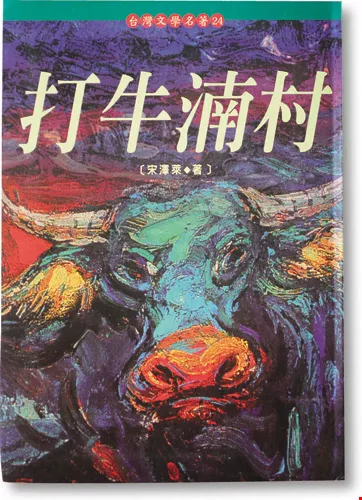
Sung's 1978 Daniunan Cun shocked Taiwan's literary scene with its depiction of rural Taiwanese communities in transition and of the joys, sorrows and difficulties their residents experience. The book won the 10th annual Wu Cho-liu Literary Award the next year.
Taiwanese-language literature
In addition to writing and teaching, Sung has helped lay the theoretical foundations and been a standard-bearer for the Taiwanese Consciousness and New Culture movements. He founded Taiwanese New Culture magazine in 1986, has advocated de-Sinification and encouraged the "theory of Taiwanese nationalism," has tirelessly promoted native culture and Taiwanese-language literature, and sparked the Taiwanese cultural reconstruction and literary revival movements. To prove that modern novels could indeed be written in Taiwanese, in 1987 he published Ruoxiao Minzu, a collection that includes the important short story "Tann-niau Fights Back" a nearly 30,000-character piece written entirely in Taiwanese.
Under martial law, the Taiwan Garrison Command frequently investigated Taiwanese New Culture, confiscating magazines and suspending its operations, finally closing it entirely after it had published just 20 issues or so. But this in no way slowed Sung's promotion of the mother-tongue literature movement. When the national curriculum incorporated Taiwanese language courses in 2001, he threw himself into the composition of Taiwanese-language poetry. "Only by writing in my mother tongue can I fully control the meter and capture the feelings of the people," says Sung, who published two collections of Taiwanese poetry-A Wooden Spoon and Universal Love Song-in that same year.
Buddha and Christ
Sung married and became a father after the publication of Ruoshi Minzu. Finding that the hard work and economic pressures associated with raising three children left him little time for even a momentary breather, his spiritual fatigue grew by the day. To weather the crisis, Sung began studying an early Buddhist text called Samyuktagama that focuses on how monks endured the deprivations of the simple life. He then published the two-volume Buddha Betrayed in 1989 to explore the question of whether one might unknowingly betray the Buddha. The books began a Taiwanese critique of Chinese Buddhism, but also brought a firestorm of criticism Sung's way.
He admits in the book that in spite of studying on his own and raising his consciousness to the level of an arhat, his everyday reality remained difficult. "The sutras never mention an arhat having three children and living with his wife," he says. Unable to completely overcome his workaday difficulties, he turned to Christianity in 1993. Stunned by the many strange events that followed, he began poring over the four Gospels, seeking the primitive Christianity taught by Jesus and his disciples.
Though Sung's tangled, heterodox religious experience has sparked disputes, he has remained sincerely and passionately committed to his quest throughout. In 1996, he published The City Where the Blood-Red Bat Descended, a novel built around the rise and fall of a young mobster. In it, he mixes the chivalric and the occult while also using the protagonist, Tang Tianyang, to expound on his own religious insights.
"I was telling the reader a story while also healing myself," explains Sung. "Immersed in a story with a pen in hand, I can escape the travails of this mortal world and brighten my spirits."
Yet another evolution
Though Sung is now more than 50 years old, his writing has lost none of its power or edge, and he continues to explore his own biography and social consciousness in his work. Always a close observer of politics, in 2002 he published Biancheng Yan Zhu de Zuojia, a thought-provoking political allegory that draws on the Bible story of Lot's wife. He followed it in 2004 with Shei Neng Dangxuan Zongtong?, a daily record of and commentary on his participation in that year's elections and related events.
Sung, who has won the Wu Cho-liu Literary Award, the China Times Literary Award, the United Daily News Literary Award, and the Wu San-lien Award for Literature, looks forward to the day when Taiwan actively fosters the development of professional writers, allowing talented authors to put aside workaday concerns and focus on their creative endeavors.
Since retiring from teaching two years ago, Sung has been pursuing a Master's degree in Taiwanese literature at National Chung Hsing University. Though busy working on his thesis, he already has plans to write a history of Taiwan in Taiwanese. We will no doubt be seeing more of Sung's exciting prose and startling perspective in the near future.


