One Family, Two Master Craftsmen:Tinsmiths Chen Wan-neng and Chen Chih-yang
Text and photos by Kuo Li-chuan / tr. by Jonathan Barnard
August 2003


Lukang is a town rich in Taiwanese culture. Historic temples are everywhere, and a stroll along Lukang's streets quickly reveals how crafts have taken root and grown strong after being passed down for generations. Lukang is home to Taiwan's largest population of traditional craftsmen. Across from the century-old Lungshan Temple, at the Wan-neng ("myriad talents") Tinsmiths, which has been run by the Chen family for four generations, father Chen Wan-neng and son Chen Chih-yang have breathed new life into a traditional craft, raising it into the realm of pure art.
Chen Wan-neng was born into a family of tinsmiths in 1942. His grandfather Chen Tzu came to Taiwan alone in the waning years of the Qing dynasty after hearing about the prosperity of Lukang, and here he made a living as a tinsmith. Wan-neng's father, Chen Tao, followed in his father's footsteps, and likewise Wan-neng began to work in the family business when he was just 14. But unlike Chen Tao's older brother, who grew wealthy as a tinsmith sticking to the tried and true, Chen Tao turned his agile mind to tinkering and innovation in the craft. Among his inspirations was a needle threader that proved to be of great assistance to the elderly. It wasn't, however, much help in increasing the family's fortunes. When Chen Tao passed away, he didn't leave Wan-neng with much apart from excellent skills as a tinsmith.
Before performing his compulsory military service, Chen Wan-neng tried his hand at other jobs, but after he got out of the army he forced himself to consider all the career possibilities of working as a tinsmith.
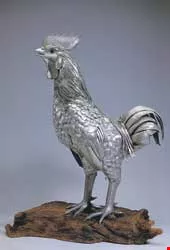
Chen Wan-neng has raised tinware to new artistic heights. In his skillful hands, tin feathers look soft and remarkably lifelike. (courtesy of Chen Wan-neng)
Exquisite, luxurious tinware
"Hitting tin," as tinsmithing is known among its Chinese practitioners, involves casting the basic pieces with stone, copper and iron molds; soldering on smaller hammered or cast pieces; and then finishing by polishing, carving or inlaying ornamentation. Modern archeological research indicates that the Chinese were familiar with the properties of copper, tin and lead at least as early as the late Shang Dynasty (ended about 1400 BCE), and understood the advantages of adding tin and lead to copper. Wonderful bronzeware resulted from combining tin and copper. Tin chunks and thick-plated tin helmets have been unearthed in the ruins of Anyang, in China's Henan Province.
Tinsmithing has its own multi-century history in Taiwan. From the Qing Dynasty's Jiaqing reign era (1796-1821) until the beginning of the Japanese era (1895-1945), tinware represented a booming industry in Lukang, where as many as 60 to 70 tinsmith shops were in business at the same time, and from where local masters and apprentices fanned out all across Taiwan to manufacture and distribute tinware. Back then the local gentry would display tinware in the main halls of their homes as a show of their affluence. When their daughters married, their dowries would contain a lot of tinwork to demonstrate the family's wealth and prominence. These customs brought the Taiwanese tinware industry to its peak.
During the era of Japanese rule, the colonial rulers pursued a policy of Japanizing Taiwan. They destroyed Chinese Taoist temples and built Shinto shrines, and they strictly prohibited the use of traditional Chinese ceremonial objects, such as incense burner tripods and orange-shaped lanterns used in traditional worship. Families put these under tables or in storage, where they rusted or tarnished. In his song "Hauling Wine Bottles," written in 1946 just after the Japanese had left Taiwan, the Taiwanese folk singer Chang-Chiu Tung-sung included a line that a junkman shouted as he walked down the street: "Any old tin, copper or books to sell?" Reflecting the prevailing attitudes of the day, it is a line that pointedly shows how tinware had come to be regarded as something akin to old shoes in need of repair.
Amid the social transformations of post-war Taiwan, the traditional style of tinware fell from favor. Rich businessmen no longer collected pieces of tinware for display, and production steadily declined. In 1954 most of the molds for making tinware that had been passed down in the Chen family since Wan-neng's grandfather's time were lost in the August 7 flood. The flood seemed to wash away a business already losing its roots.
As the young Chen Wan-neng gently touched the stone molds that had once belonged to a mainland master and had been treasured by his father's generation, as he held an exquisite work of cast tin that had been made by a Japanese master, he pondered how tinsmiths had enjoyed the same status as literati during the Ming dynasty. If not of a poetic bent themselves, they would carve famous passages of others' poetry in their tinware. Those who could write poetry and pen calligraphy would carve their own poems, calligraphy and designs into their tin works, producing inscribed artworks that were highly regarded. Chen Wan-neng realized that if the industry wanted to regain the prosperity that it had enjoyed during ancient times when dingyi ceremonial vessels were made out of tin, then it couldn't remained mired in tradition. Tinsmiths had to innovate to get people to look at tinware in a new light.
According to Taiwanese traditional wedding customs, the groom's family must give to the bride's family a pair of dragon candle sticks and red orange-shaped lamps made out of tin, because in Taiwanese dialect the character for tin is a homonym for "gift" and the character for lamp is a homonym of "son." The idea is that they are "giving a son" with the hope that the couple will, like oranges, produce an abundance of seeds. These lamps had shades that were bright red and shaped like oranges, and featured phrases describing their hopes for outstanding male heirs, such as "one of rare talents." These two items were presented at one time and not only took up a lot of space but cost quite a bit too. In the 1960s they represented a significant economic burden. Ever adaptable and attuned to the changing times, Chen designed a dragon candlestick/orange-shaped lamp combo unit.
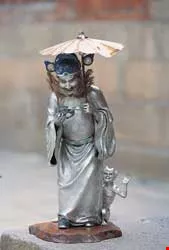
Dharma by Chen Wan-neng. Chen feels deeply that "yesterday's innovations are today's traditions, and today's innovations are tomorrow's traditions," so his creations include both the new and the old.
An industry revives
In 1963 the 21-year-old Chen spent his last penny to buy a regular fare train ticket to Taipei. In his arms was a pair of the combo units that he had exhausted himself tinkering with. Gambling his whole future on tin, he fidgeted the entire six-hour journey. And it was an all-or-nothing gamble because he had no money for a return ticket. He was relying on being able to sell his handiwork.
When he got to Taipei and told the proprietor of a shop what he wanted to show him, the shopkeeper wasn't even willing to give it a look. Tin products by then had almost fallen completely from favor, and most people felt that it was unlikely any young tinsmith could compare to the old masters. The young Chen was thus given the cold shoulder, and he sat waiting for two hours. Finally, the shopkeeper very reluctantly agreed to take a look. Once he did, however, he was surprised at this youth's exquisite craftsmanship, and they immediately cut a deal. A month after he returned to Lukang, he already had orders for 250 and had to use a truck to ship the goods to Taipei. At that moment, Chen Wan-neng deeply understood that "Yesterday's innovations are today's traditions, and today's innovations are tomorrow's traditions." If you work hard to innovate, he realized, you will eventually meet with success.
After he grew more financially secure, Chen tried another innovation. He took a traditional subject called "Chilin gazes at the moon" and incorporated a usable light to serve as the moon. This "Chilin Lamp" was another hit, and representatives from the Confucian Temple in Nagasaki came all the way to get a pair.
Yet, while his improvements on traditional designs were meeting with great approval, they weren't satisfying his creative desires. From an early age he had been a great lover of painting and very familiar with historical folktales, so he decided to leave the ranks of craftsmen, breaking free from the shackles of tradition, and to adopt innovative styles using Western realism to create new works that more richly displayed a purely artistic creativity.
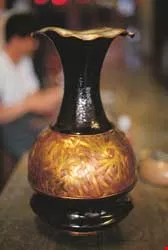
Chen Chih-yang has inherited not only his father's profession but his spirit of innovation as well. The Goat Brings Good Luck, pictured on the opposite page, is simple yet lively, whereas the vase above has integrated bamboo weaving and lacquering techniques, expanding the forms and color variations of metalwork. (photo courtesy of Kuo Li-chuan)
The Chinese zodiac in tin
In Chen's Big Lucky, an imposing looking rooster is taking charge of the morning. Chen made full use of tin's flexibility to contrast the cock's soft feathers, its obstinate and unruly beak, and its two erect legs. Thousand Mile Eyes and Ears that Hear with the Wind, which is part of the collection at Tachia's Chenlan Temple, depicts the two deities that are sidekicks of Mazu, the goddess of the sea. It blends various techniques in a work of great spirit and vitality. The deities' magnificent poses and strong muscular lines reinforce each other to achieve tremendous drama and realism.
In 1991, Chen Wan-neng was invited to participate in an exhibition sponsored by the Council of Cultural Affairs, which took the 12 signs of the Chinese zodiac as its theme. Using cold hard tin to portray the movements and expressions and fur or feathers of those 12 animals was quite a challenge. In the half year that he worked on the project, he raised rabbits and rats in his workshop, would go to the Niuhsu area of Beikang in order to shoot pictures of water buffalo, visited the zoo to gaze at monkeys, perused encyclopedias to gain a better understanding of animal behavior, and then labored on the cut tin pieces on his work table, which were hammered into shape, inlaid with ornamentation and welded without casting. The twelve finished pieces were born of their creator's blood, sweat, and tears. His hard work and innovation was hailed both in Taiwan and overseas, and his works, after making a tour of Taiwan, were shipped abroad for shows in New York, Paris and elsewhere. Museums in Taiwan, Japan, and the Philippines now have works of his in their permanent collections.
Apart from raising tinsmithing to the realm of art, he has been constantly tinkering, improving the properties of tin to make it stronger and harder, to allow it to keep its luster longer, and to give it a silky feel. He has also employed traditional casting, cold forging and detailed carving to expand its expressive abilities.
Traditionally, works of tin easily tarnished, and this was off-putting to collectors. About this point, Chen Wan-neng stresses that most tin objects used to be ceremonial objects, such as dragon candlesticks or orange-shaped lamps. Because pure tin is very soft and has a low melting point, and also because Taiwan has always had to import all of its tin, the costs are high, and many tinsmiths have added lots of lead to economize. The added lead strengthened the tin and made it easier to shape, but before long it oxidized and turned black. This gave the impression that tin objects tarnish easily. But in reality, pure tin does not tarnish.
In recent years, Chen has been experimenting with nearly pure tin objects that use only 1% lead for strengthening. Pure tin is gray in color, and its crystals are long. Works created with it show thin lines on its surface and a silver luster.
For his 40 years of determined innovations in tin, the 46-year-old Chen was given a National Heritage Award from the Ministry of Education in 1988. He was the youngest person to win an award in the handicraft category that year. He also won a National Handicraft Award in 1993 for his new work Treasure One's Blessings.
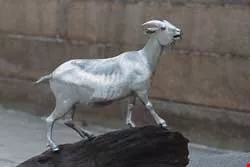
Chen Chih-yang has inherited not only his father's profession but his spirit of innovation as well. The Goat Brings Good Luck, pictured on the opposite page, is simple yet lively, whereas the vase above has integrated bamboo weaving and lacquering techniques, expanding the forms and color variations of metalwork. (photo courtesy of Kuo Li-chuan)
Making breakthroughs
Chen has stayed at the art of crafting tin through all of life's ups and downs and fate's twists and turns. When the tinware industry in Taiwan was at its lowest ebb and many master tinsmiths had left the field, Chen's innovations caused people to take a new look at this centuries-old craft, which in turn led many old tinsmiths to return to the field. Chen takes particular pleasure in that three of his sons have followed in his footsteps to become tinsmiths. His third son Chen Chih-yang has won three National Handicraft Awards of his own. Having two master craftsmen in one family has earned the Chens a high reputation, and has also given the struggling tin industry a new lease on life.
From an early age, Chen Chih-yang was fully immersed in the tin industry, but he also had considerable talents as a painter and liked to doodle. This fondness led him to the graphic design department at Ming-Dao High School in Taichung. After graduation, however, he desired to break through the limitations of two-dimensional arts. By this time his father had a more stable situation in life and had started to design artistic tin pieces, and as Chih-yang saw his father take his draft designs of animals and turn them into lifelike three-dimensional objects, Chen Chih-yang suddenly discovered that the tin sheets that he had been around since a young boy were the best material available for moving from two dimensions into three. At 18 years old, he devoted himself to learning at his father's side the techniques of a tinsmith and the various properties of different metals.
In 1992, when he was 20, Chih-yang won a National Handicraft Award for Struggling Upstream Against the Current, which displays his depth of understanding of the properties of metals and his control over the metalworking process. The different colors of various metals in the work create a marvelous melange effect. In 1994, Chih-yang's The Eight Immortals Cross the Sea was a winner of a Third National Handicraft Award. In the well-known story, the eight realize that problems of the world come from people themselves, and they are able to break through the shackles of human baseness, follow the Tao and become immortal. Chih-yang's work displays the special characteristics of the eight and their mutual expressions of warmth and harmony as they cross the sea, thus conveying his hope that the human world will move toward greater harmony. In that same year, Chih-yang won one of the ten prizes given at the Second National Heritage Awards for Youths.
In 1995, Chen Chih-yang's work Peony Beauty won a prize at the Fourth National Handicraft Awards. This work depicts the beautiful expression, slender figure, and graceful aura of a classical beauty standing in a courtyard wearing pleated clothes that rustle in a slight wind as she holds up a lantern in a courtyard to admire a beautiful peony and seems ready to break into dance. The work employs the original colors of different kind of metals, intricate shell inlay, and fine carving to achieve the beautiful patterns and ornamentation of her clothing. With the evocative peony and modelled mountain rock as the backdrop, the result is an abundantly colorful and attractive work that achieves its results while leaving the metals in their original colors.
Study abroad
Traditional crafts often represent the lonely road to the land of the starving artist. Yet the young Chen Chih-hang was steadfast in choosing this path. "Tinsmithing, to be sure, has fallen on hard times," he thought to himself, "but because it's not a crowded field there is more room for new thinking and creativity. Therefore, its future ought to be pretty good." Coming into contact day after day with the fires of the smelting furnace and hot liquid tin, Chen Chih-yang's thighs bear the scars of many burns, but these don't seem to bother him. "Although tin is just one metal," he explains, "when you add other metals to it, it results in different coloration. By combining these with glazes, you can give tin even greater variation and creativity in its coloration and appearance."
With his father encouraging him to study different cultures and creative methods, Chen Chih-yang used his portfolio of prize-winning works to apply to the BFA program at the School of Visual Arts in New York in 1995. This school, which emphasizes creative experience, encourages their students to be spontaneous and infuse their work with sudden inspiration. This threw Chen Chih-yang for a loop because he had always considered and reconsidered his ideas time and time again. The creative method of grabbing hold of the moment got closer to his true inner way of thinking, without being affected by tired theory.
In 1999, he obtained his BA degree and returned to Taiwan. When he first came back, he was obsessed with exploring the special qualities of his own culture, so he left the tinsmith shop and went out to see Taiwan's mountains and rivers for himself and to understand the local people and culture. For more creative inspiration, in 2001, he entered the master's program in the Graduate Institute of Applied Arts at the Tainan National College of the Arts, with a focus on metalwork.
Created in Taiwan
In 2002, Chen Chih-yang's Formosa, a work deeply imbued with the character and spirit of Taiwan, won Tainan County's first Sweet Osmanthus Award for Handicrafts. In the work, Chen depicts Taiwanese scenery on the outside of a tin canister for tea leaves. The design focuses on the Central Mountain Range and sets against it city skylines and vistas of rivers and flying birds. An occasional cloud may drift by, but when the rain passes, the sun shines on the vast land of Taiwan.
Although he has embraced innovation, Chen Chih-yang has also not forgotten to learn from tradition, which he uses when combining tinwork with various other handicrafts. He has, for instance, been known to use bamboo-weaving techniques. For a tin jar in the shape of a flower vase he increased its elegance by ornamenting the body of the vase with metal weaving. At the National Tainan College of Arts he studied with a lacquerware artist Lai Tsuo-ming. Because the natural colors of metals are quite fixed, and he doesn't like to dye metal, he has chosen lacquer as the best means to add color variation to his metal artwork.
With his father's encouragement, Chen Chih-yang has not only shouldered the responsibility of carrying on the family legacy of crafting tin, but he has also struck out forcefully on his own. In so doing, he has only added to the glorious reputation of this family with two masters under one roof.


