The Ghostbusting Eight Generals
Ventine Tsai / photos Hsueh Chi-kuang / tr. by Robert Taylor
January 1995


In Taiwan folk customs, each time the birthday of a deity comes around, the faithful hold a festive parade around the temple area, with colorfully made-up folk artists and kaleidoscopic performance troupes, to express gratitude for divine beneficence.
These artists and performers are known collectively as yi-chen, which simply means "arts and troupes." Traditional yi-chen have deep religious significance, as well as admirable artistic skills. Modern troupes are mainly in it for the fun or interest, and reflect a slice of contemporary life. With traditional and modern yi-chen constantly evolving, Sinorama has undertaken a continuing series on Taiwan's arts and performance companies to leave a permanent record of where they are today.
Once the make-up master has applied a stern mask of greasepaint to the face of each of the members of the "household generals" yichen troupe, they can no longer speak out of turn, still less sit or lie down, drink or smoke as they please, for they have been transformed from ordinary mortals into warriors serving their spirit, and will soon set off on the spirit's behalf in pursuit of ghosts and demons.
When people see the "Eight Household Generals" at a temple fair, the question they most commonly ask is, "Why aren't there always eight of them?"
Indeed, household general troupes do not necessarily have eight members. They may have four, six or eight, or even as many as 10, 11, 12 or 13. It's just that groups of eight are the most commonly seen, and this is why everyone is accustomed to calling them the "Eight Household Generals."
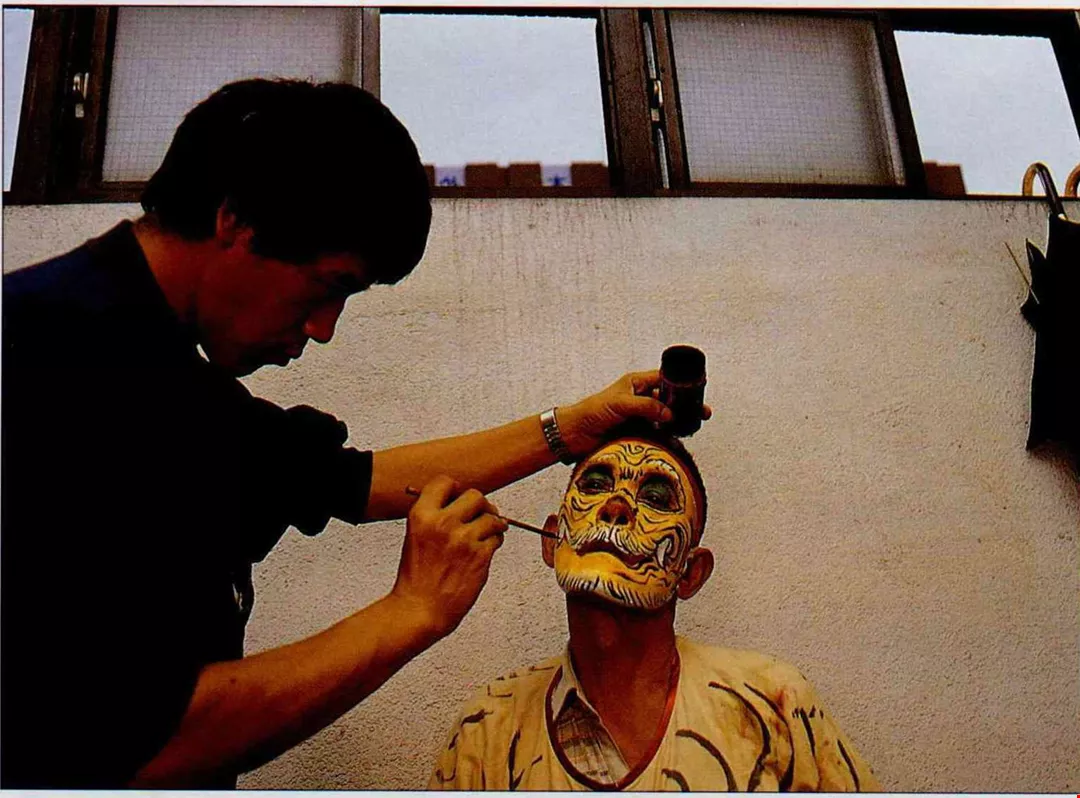
The generals' colorful face paint not only enhances their artistic flavor, it also adds to their air of stern authority.
Heaven's police headquarters
Of all the yichen, one can say that the household general troupes are the kind with the deepest religious significance, so when a performance is in progress there are many taboos to be observed. The generals dance in formation, their faces painted with fearsome patterns, their eyes glaring, lunging down low or leaping up with their arms outstretched lik There really is something awe-inspiring in the way they spar and change places, switching between various formations intended to drive out evil, such as the "Seven Stars" or the "Eight Trigrams," in time with the rhythm called out by the bailiff, who carries their instruments of torture. At this time, outsiders are not allowed to pass through their ranks, for fear of diminishing the power of their formation. And the strings of hardtack biscuits hung around their bodies are not there for them to fill their own bellies, but for young and old to pluck from them. It is said that adults who eat these biscuits will be kept safe from harm, and children who eat them will thrive.
The household generals' main job is to precede the chief spirit on the eve of his tour of inspection, clearing his path by catching ghosts and demons; or during his tour, to catch demons at his behest, and to escort captured evil spirits and plague demons onto the Royal Ship to be sent into banishment. In other words, the role they play is that of a police force.
In Chinese folk beliefs, the system of official posts and functions in the spirit world mirrors that in the world of the living. Among the armed guardians of order, as well as a celestial army, terrestrial soldiers and five battalions of spirit soldiers, there is also a corps of ghost-busting law enforcers responsible for keeping the peace--the "Household Generals." The spirits who have such forces under their command are mostly ones responsible for rewarding good and punishing evil, such as city gods and the Prince of the Green Mountain, or ones responsible for driving out pestilence and keeping the peace in a locality, such as Wangyeh or the Lord of the March. Other spirits, such as female spirits of mercy whose main duties are to help and save those in need, or the patron spirits of particular professions, do not have such forces at their disposal.
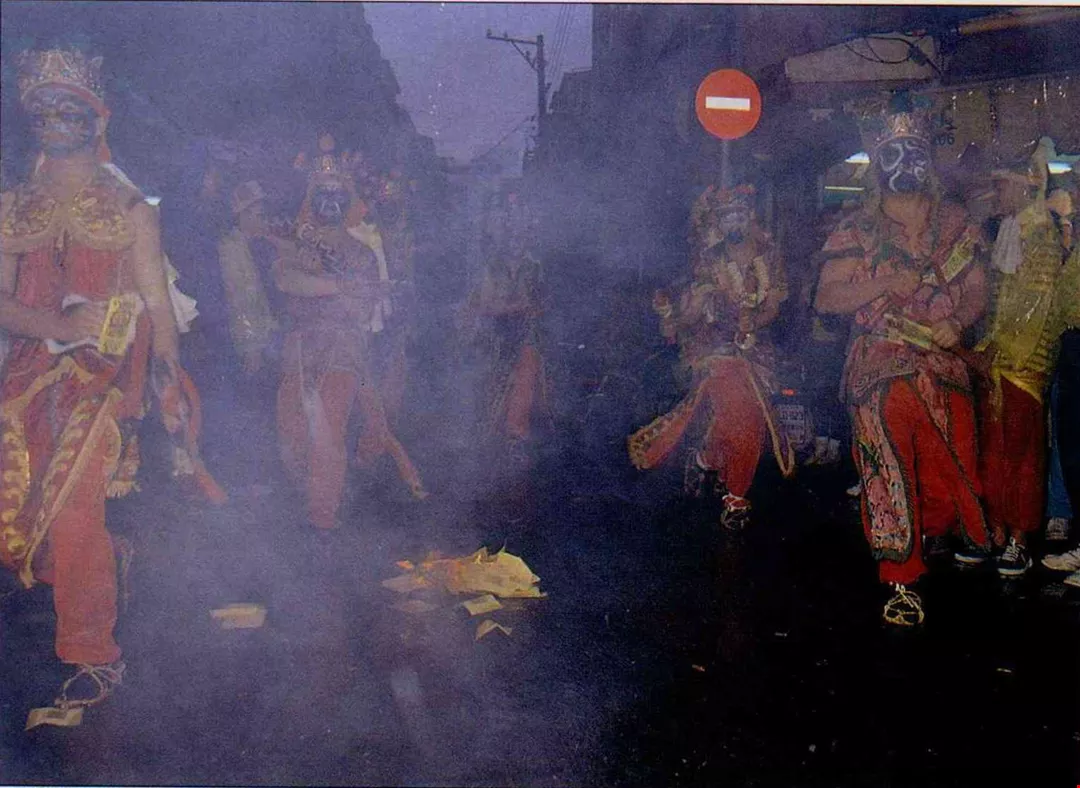
The household generals are a type of yichen with a deep religious significance. The troupe members carry weapons and instruments of torture pasted with amulets and spells, and they wear grass sandals on their feet. When their costumes and make-up are complete, they still have to "go through fire" (jump over burning spirit money) before they can set out.
Patterns of meaning
This troupe of ghost catchers under the command of a spirit does not have a fixed number of members, but a group of 13 is the most complete. These 13 not only have their own duties and position in the troupe's array, but their face patterns and the weapons they bear all have special meanings.
Generally speaking, the "eight household generals" include an "external squad" of four, surnamed Kan, Liu, Hsieh and Fan, who are responsible for arrest and punishment, followed by an "internal squad" made up of the spirits of the four seasons, who are responsible for investigation and interrogation. Leading the way in front of the eight generals is a bailiff who carries 36 different instruments of torture, followed by a civil and an armed runner charged with transmitting orders, while bringing up the rear behind the spirits of the four seasons are a civil and a military judge, who pass sentence and hold prisoners in custody. From receiving the commanding spirit's instructions, to capturing, administering torture, trying and judging, they perform their duties with no less efficiency than earthly law enforcers.
There is nothing haphazard either about the costumes and face paint worn by the spirits of the four seasons, or their symbolism. For instance, the Spirit of Spring is associated with the east, the element wood, the dragon and the color blue, so he is painted with a dragon face like a lotus flower, wears light blue clothing and carries a wooden pail. Similarly, the spirits of summer, autumn and winter all wear special costumes according to their association with the five Chinese elements (see table).
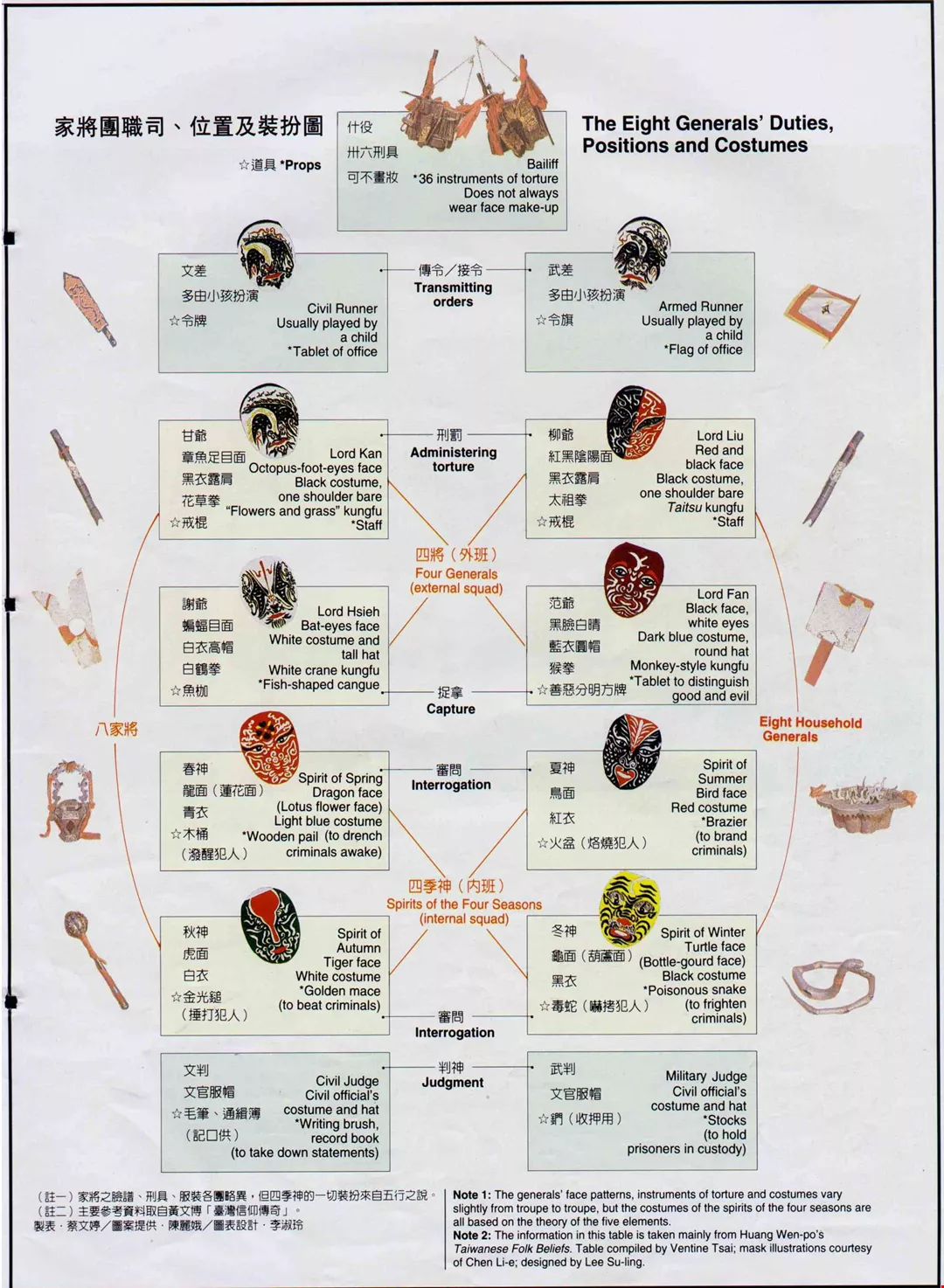
The Eight Generals' Duties Positions and Costumes Note 1: The generals' face patterns, instruments of torture and costumes vary slightly from troupe to troupe, but the costumes of the spirits of the four seasons are all based on the theory of the five elements. Note 2: The information in this table is taken mainly from Huang Wen-po's Taiwanese Folk Beliefs. Table compiled by Ventine Tsai, mask illustrations courtesy of Chen Li-e, designed by Lee Su-ling.
No new blood
The Taipei Hsiahai City God Festival, which falls annually on the 13th day of the fifth lunar month, is one of northern Taiwan's major religious events. Part of what makes it special is the skill of Hsu Lien-cheng, the 70-year-old face-painting master at Hsiahai City God Temple. When old Mr Hsu applies make-up to the performers' faces--sometimes drawing fine lines with a brush, sometimes applying thick strokes of greasepaint with his thumb--he needs no picture to work from, for the pictures are all in his head. Mr Hsu says that one of the most important skills in applying face make-up is painting the eyelids in such a way that the general's face will look the same whether the performer's eyes are open or closed. Only then will he convey an awe-inspiring air at all times.
Though it only takes Mr Hsu three to five minutes to paint a face, he cannot finish a whole troupe even in two or three hours. This is not because his skills are waning, but because not enough people can be found to fill all the roles. This household general troupe has existed for at least four generations, but every year it becomes harder to find performers. This is a problem shared by all Taiwan's folk religions: temple ceremonies are better attended than ever, and when money is needed any amount can be raised, but for jobs where people's own effort is required, new blood is hard to find. "The people who play the generals are all volunteers redeeming vows to the spirits; they don't get paid anything. There used to be a good few thousand people waiting just to get the chance!" says an old Mr Chen, aged 75. As a small child he was weak and sickly, so at the age of seven he vowed that he would play a general, and he has not gone back on that promise in over 60 years. We can say that in today's society, people like this old gentleman are an "endangered species."
What has changed is not only the sense of involvement which comes from active participation, but also the quality of the performances. Chen Chin-ming, head coach of the household general troupe at White Dragon Temple in Tainan, this year won one of the Ministry of Education's "Hsinchuan" awards for people involved in the transmission of Chinese folk arts--the first time a Hsinchuan award has gone to a household general troupe. Mr Chen says that according to custom, seven days before going out on patrol the household general troupe should choose a spot near the temple to set up a "penal house" where all the troupe members have to stay. They should bathe, abstain from eating meat and practice their performance every day. New members also have to swear before the spirit that now that they have become his servants, from this day forth they will serve him alone. As well as being careful of their words and actions, the troupe members must not perform elsewhere for profit.
On the day of the spirit's tour of inspection, after the members have tidied their hair, bathed and put on their costumes, the face-painting master burns incense and reports to the spirit, and purifies the performers' bodies by burning amulets and incanting spells. Then he begins to make up their faces. When he has finished, a temple elder feeds them with wine and rice bestowed by the spirit. From that moment on they are no longer men, but spirits.
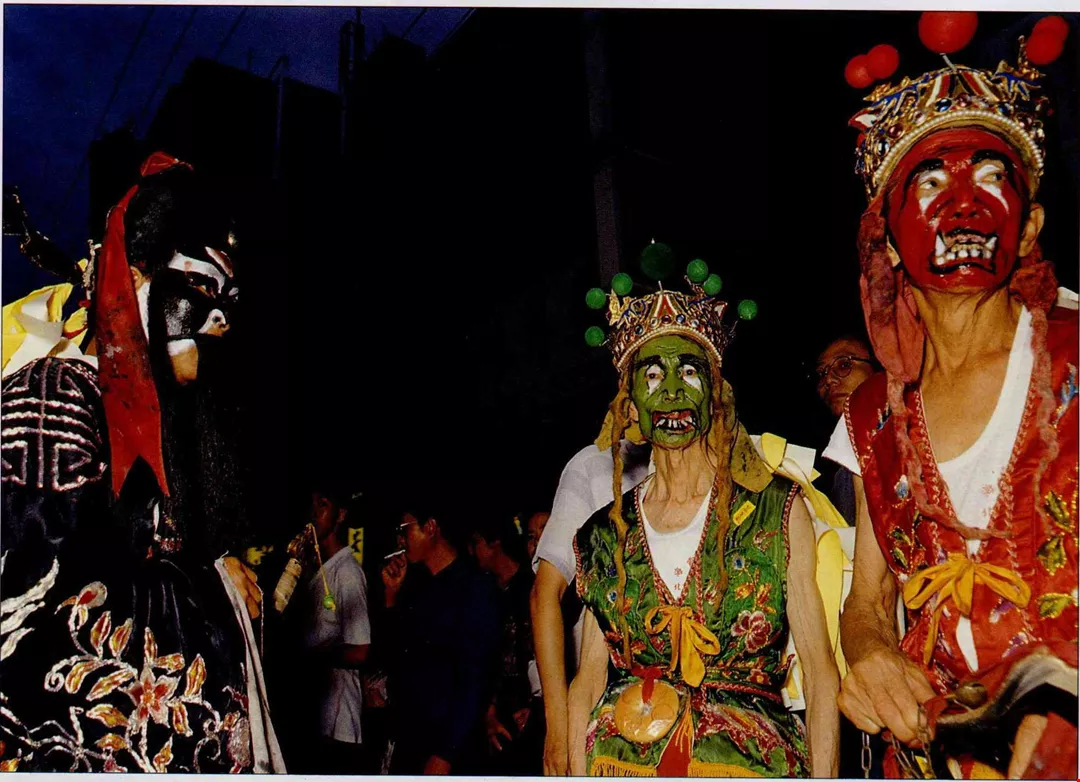
On the eve of the City God's birthday, the Household General troupe from Hsiahai Temple goes out to clear his path of ghosts and demoms.
No different from the spirits themselves?
Then each of the generals sits upright on his chair with his mouth closed. Even if inquisitive children gather round to watch, they must not laugh or curse. "Sometimes mosquitoes bite you, but you can't slap at them, you can only scratch the place lightly," says old Mr Chen with a laugh. When they go out on patrol, they rest only at noon, in the main hall of one of the local people's houses. They sit in two rows facing each other, and while they eat they cover their faces with their sleeves or fans. But very few troupes still really do things so seriously; at most temple fairs one can see nowadays, when the performers' faces have been painted and they have clearly become the incarnation of the spirits, they are still chewing betel nuts, smoking and drinking alcohol; when they are following the spirit palanquin, if they see dancers performing on flower trucks, they still give wolf whistles; and when they are tired they just sit down casually by the roadside and take a snooze. Nowhere does one get the feeling that these are a troupe of "spirit policemen." "In the old days, a household generals' performance was really something to appreciate, but if you see one nowadays you just shake your head," says Chen Chin-ming with feeling.
Most of those who perform in household general troupes today are tattoo-sporting gang members. Young, strong and full of energy, what they care most about in their performances is giving the appearance of a fierce fight. Especially the semi-professional troupes which accept invitations to perform away from home measure their prowess against that of other troupes by the amount of blood which flows, and this is also how they tout for more opportunities to perform. "The way they jump about is fierce all right, but there's not a speck of authority about it," says Chen Chin-ming, who feels that these young people have missed the point of what the household generals are all about.
In this atmosphere of competing to be the fiercest, the household generals' performances are becoming more and more like those of the troupes of shamanistic spirit mediums who strike at themselves with whatever magic weapons they have about them, to prove the unlimited power of the spirit to protect their bodies. Even some elementary and middle school children take part in these gory performances, so it is hardly surprising that the household generals do not figure among the folk arts which the Ministry of Education encourages schoolchildren to participate in.
"During the judging of this year's Hsinchuan awards, some of the panel of judges objected to the household generals being included, but in fact they do show a high level of artistry. In a troupe like that of Chen Chin-ming, one of this year's winners, the members observe strict discipline and carefully follow the traditions. They certainly don't go drawing blood with their swords and sabers just for show," says Tsai Hsin-hsin, one of the judges, explaining why they chose a household general troupe for an award.
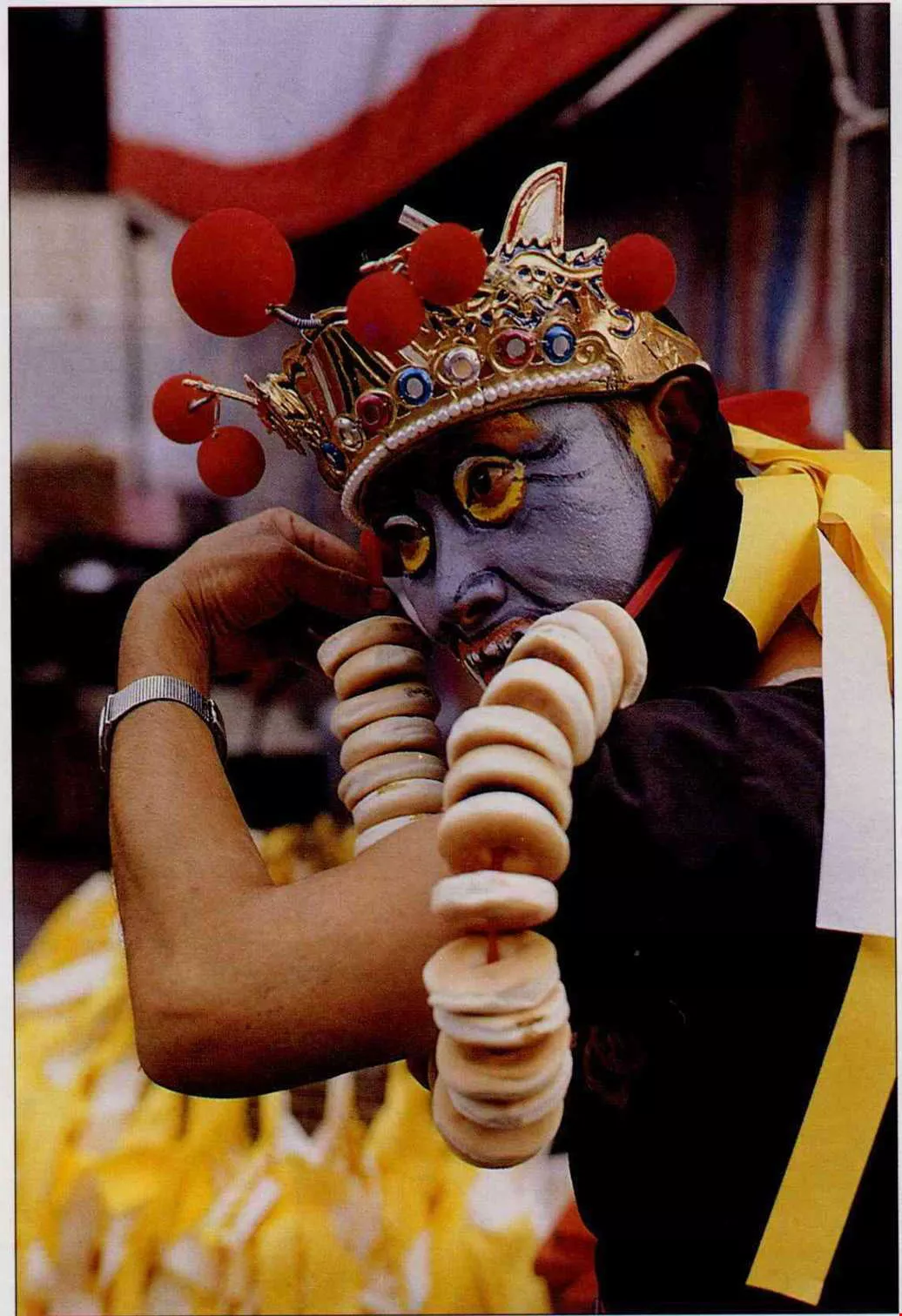
The strings of hardtack biscuits which the generals carry with them on their patrol are for members of the public to take and eat to ward off evil. (photo by Vincent Chang)
The mystery of the dance
Chen Li-e, a teacher at China Junior College of Industrial and Commercial Management, who has studied the household generals and incorporates their performances in her dance classes at the college, not only greatly admires the virile strength and beauty expressed in their movements; she also says that as the generals perform entirely without any musical accompaniment, the changes in their formation rely completely on silent coordination between the dancers.
For instance, the tall and lanky General Hsieh whirls like a white crane spreading its wings opposite the short and stocky General Fan, who squats low and makes monkey-style kungfu movements. "Each of the dancers has a different character, and there is a dialogue between them," says Chen Li-e, going on to explain that the generals' movements and positions can be varied flexibly depending on the size of the space in which they perform. Whether in their make-up, costumes, the themes they stress in their dance or the mystique which they impart, their performance is full of things to delight students of dance.
Researchers with an understanding of yichen believe that the household generals' rich technique and sense of beauty, their authentic vitality and their sense of religious mystique can provide a source of inspiration for choreographers, painters and other creative artists.
However, as more and more of the beauty is lost from yichen performances, the displays most members of the public see exaggerate the bizarre and sensational. The problem this reveals is not one with the household generals themselves, but is symptomatic of the vacuous modishness and degeneration afflicting folk beliefs as a whole, in which form is exaggerated while content is impoverished. As the folk arts approach a turning point, rewarding and commending those groups which approach them with earnest diligence is surely one of the best ways to encourage them.
This is the last in the present series of reports on Taiwan's yichen.
[Picture Caption]
p.107
Led by a bailiff carrying instruments of torture, the spirit's ghost-catching squad sets off on patrol. (photo by Huang Ting-sheng)
p.108
The generals' colorful face paint not only enhances their artistic flavor, it also adds to their air of stern authority.
p.108
The household generals are a type of yichen with a deep religious significance. The troupe members carry weapons and instruments of torture pasted with amulets and spells, and they wear grass sandals on their feet. When their costumes and make-up are complete, they still have to "go through fire" (jump over burning spirit money) before they can set out.
p.109
The Eight Generals' Duties Positions and Costumes
Note 1: The generals' face patterns, instruments of torture and costumes vary slightly from troupe to troupe, but the costumes of the spirits of the four seasons are all based on the theory of the five elements.
Note 2: The information in this table is taken mainly from Huang Wen-po's Taiwanese Folk Beliefs. Table compiled by Ventine Tsai, mask illustrations courtesy of Chen Li-e, designed by Lee Su-ling.
p.110
On the eve of the City God's birthday, the Household General troupe from Hsiahai Temple goes out to clear his path of ghosts and demoms.
P.111
The strings of hardtack biscuits which the generals carry with them on their patrol are for members of the public to take and eat to ward off evil. (photo by Vincent Chang)
p.112
According to custom, once their face make-up is complete the performers should sit in silence with their mouths closed. But nowadays many continue smoking and chewing betel nut just as they please.
p.113
Influenced by shamanistic performances centered on mediums' drawing their own blood, household general troupes often use feats such as piercing themselves with steel needles to demonstrate their unlimited mystic power. (Sinorama file photo)
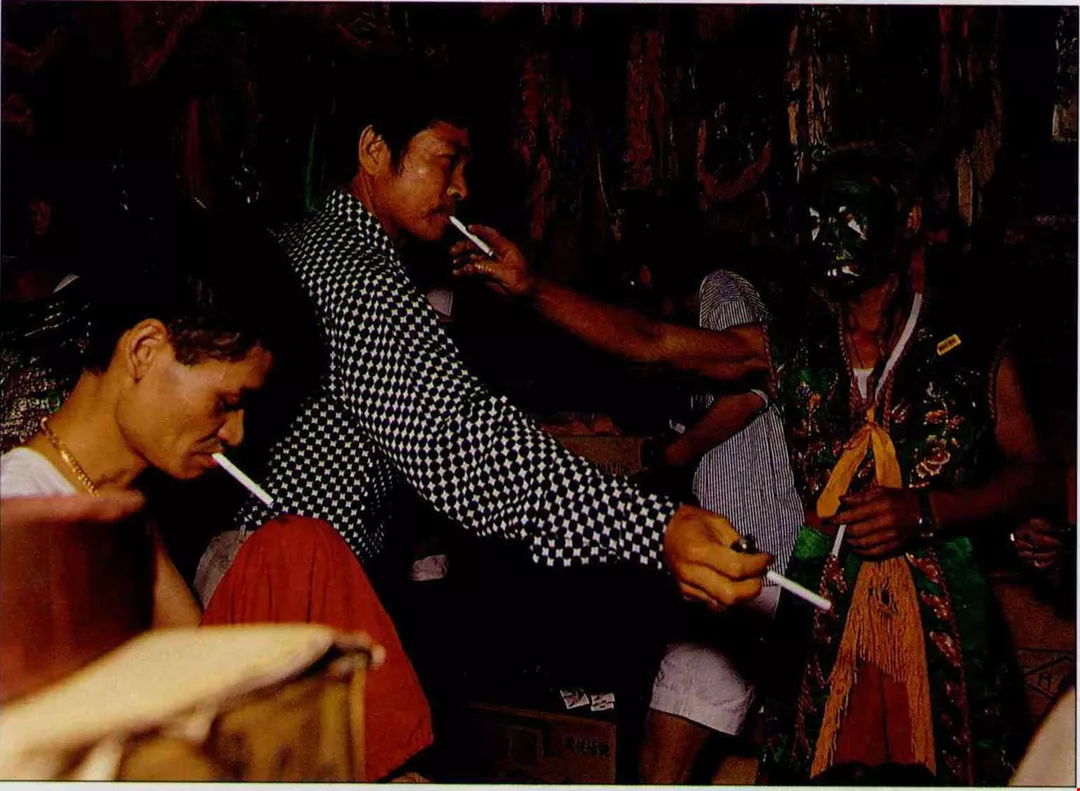
According to custom, once their face make-up is complete the performers should sit in silence with their mouths closed. But nowadays many continue smoking and chewing betel nut just as they please.
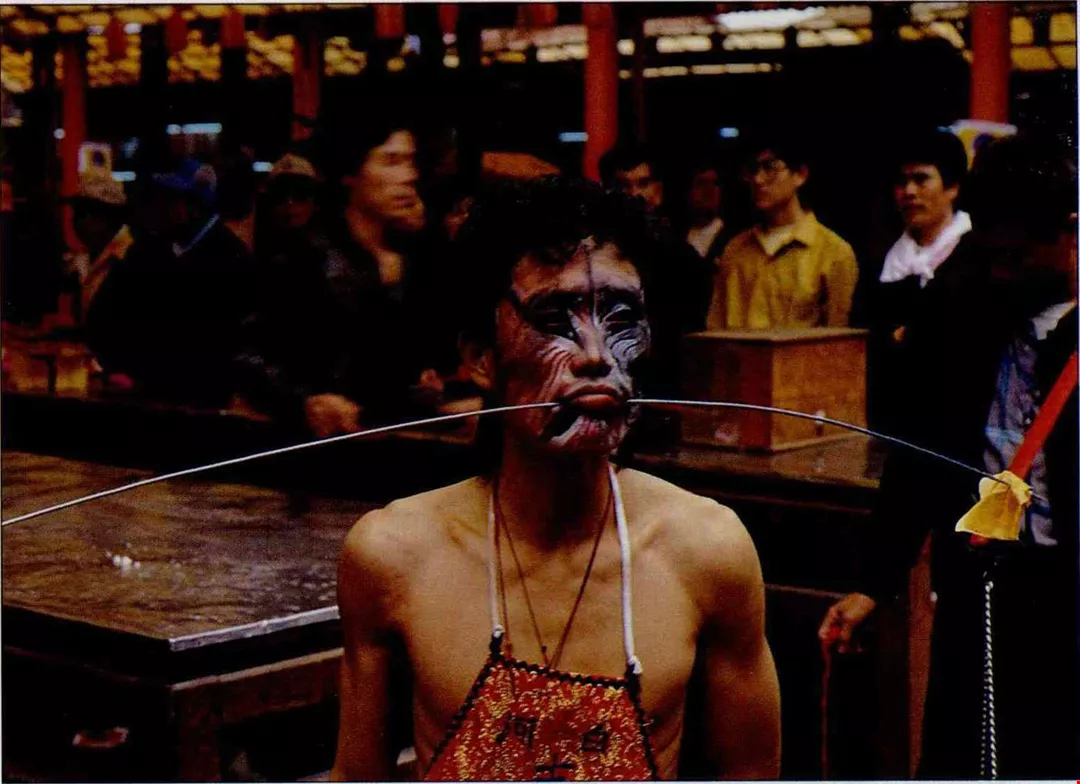
Influenced by shamanistic performances centered on mediums' drawing their own blood, household general troupes often use feats such as piercing themselves with steel needles to demonstrate their unlimited mystic power. (Sinorama file photo)


