

In an era in which all things seem politicized, it's no surprise to find "political painting." And in an era emphasizing "nativism"--which refers in Taiwan to an emphasis on things Taiwanese as opposed to mainland Chinese or foreign--there is naturally "nativist painting." Fine arts are one part of culture, and it is hard to keep them clear from the trends of a given age. How has the fine arts community dealt with that most controversial of terms, "nativist"?
Under nativist fashion, the paintings of the older generation--which depicted the rural Taiwan they knew--have been deemed "hot properties," and treated as if of the same value as the works of international masters. At this year's fall auction at Southeby's, a work by Chen Cheng-po sold for NT$10 million. For a time, all painting exhibitions, whether of the middle generation, young generation, or the most recent "new generation," were sure to add the word "nativist" as a demonstration of their value.
At the end of 1990, Yang Mao-lin, winner of the first Hsiung Shih Fine Arts Award, added the words "Made in Taiwan" to all his works. This pushed nativism to an extreme, and inspired a great deal of debate.
What after all is "nativist painting"? Why is such a deliberate effort made to portray art as being nativist? Amusingly, as in the nativist trends in politics, people in southern Taiwan emphasize not only "Taiwaneseness," but also especially stress how their local character differs from that of northern Taiwan. In recent years the many new galleries springing up in the south have stressed natural subject matter, and bright and intense colors, quite different from the cool style of northern Taiwan.
"Nativism is not a style or an 'ism,' but is a way of thinking about life; it is a close attachment to one's land. No painter in any era can ever escape from where they grew up, or the society in which they exist. And it was the same even for the first generation of older artists," explains art critic Victoria Lu.
The first generation followed the European impressionist style, but they took their canvasses out of the studio to paint directly from scenes of daily life particular to Taiwan: water buffalo, rural farming women, sugar cane fields, and subtropical landscapes. In form, color, and subject matter they displayed a deeply sentimental style that was uniquely Taiwanese.
In the 1970s, after an excessive obsession with Western abstract painting, artists again returned to embrace their native land. Painter Hsi Teh-chin discovered his own artistic path in the patterns of folk art and in Taiwan's beautiful natural landscapes. Later artists quite deliberately hearkened back to vestiges of Taiwan's fading rural society, depicting traditional Chinese family compounds, broken old porcelain jars, or oxcarts. "To include old rural items in a work is a lament for the disappearing warmth and intimacy of rural society in a society which is in fact highly modernized. It's just that artists have tended to stop at mere depiction of objects, without going deeper to the level of reflection about the human condition," argues Hsiao Chiung-juei, lecturer in history at National Cheng Kung University, who has spent many years analyzing art history in Taiwan. He also feels that nativism is something that originally existed quite naturally, and required no particular emphasis. Today, whether one is talking about realist literature focusing on things Taiwanese, or about the loud advocacy of nativism in politics, these things are only a reaction to the fact that natural nativism was repressed for all those years.
Cutting through the fog, "nativism" simply describes the relationship between a people and their land. The land and people change over time, and spark different reactions. Today's artists share the former nostalgia for old rural Taiwan, but have expanded their critical and satirical field of vision to encompass politics, the environment, customs and beliefs, and urban life. This has been dubbed "neonativism."
The thing is, since the people have never been separated from the land, why do artists go to all the fuss of waving flags and shouting slogans a bout it? Because in the past there was a lack of self-confidence in local culture, current artistic behavior, whether manifested through abstract or realist expression, is based not on a normal evolution of thinking, but is a type of overcompensation for past neglect of things Taiwanese . Thus, the fact that people are drawing out nativism as a topic of discussion says something important about the times. The problem is, if artists merely turn to it as a style or mission in life, "it will become an obstacle to creativity," states Ni Tsai-chin, who is both an art critic and a practicing painter. What's more, the style of artists is something that time and art history should classify, not labels that the artists themselves attach to their work.
Artist Hsia Yang describes his own experience as an artist who has been through it all before: "You can't take art too seriously, because then it will become boring. If you set boundaries too early, then you'll only end up suffocating yourself."
Of course many artists feel like they've been framed and couldn't care about the "nativist" label one way or the other. "I was born here, so naturally I draw my subject matter from here" says painter Lu Hsien-ming, declining to make a big deal out of the nativist label.
In recent years Taiwan artists have been able to show their stuff at international exhibitions, such as the "Asian Arts Exhibition" in Hong Kong (arranged by galleries which organized groups of painters to go), and the "Yokohama International Modern Art Exhibition" in Japan.
Some Western countries have also taken the initiative to seek out Taiwan artists. For example, the K-18 exhibition in Germany, held only once every four years, invited seven creative artists--Ho Huai-shuo, Yu Peng, Wu Tien-chang, Huang Chin-ho, Tung Yang-tzu, Kuo Chen-chang, and Chou Pang-ling--to participate the year before last. Last year performance artist Li Ming-sheng was the first person invited to participate in the Venice exhibition held once every two years, which was a timely shot in the arm for Taiwan arts as they head on to the international stage. "If our art does not achieve a certain standard, it would be impossible to even think about international cultural exchange," contends Joyce Hung, the director of the Hanart Gallery. She feels that Taiwan art is thriving for more reasons than just good packaging in the gallery.
Victoria Lu feels that between tolerance for different cultures and sentimental attachment to one's own land, Taiwan already has an internationalist outlook which gives it "autonomy of choice." This internationalist outlook is the true face of Taiwan that it shows to the outside world, and should not be diluted as mere "nativism."
From "rustic" to "nativist," and now to "Taiwan," artists' explorations have gone from blind and exclusionary emotionalism to open-minded confidence and affirmation.
[Picture Caption]
p.23
Under nativist fashion, works by older artists set new records. (photo by Huang Li-li)
p.25
Besides making a contemporary critique, Huang Min-chang's paintings reveal his sentimental attachment to the land. The painting is "Afternoon Gleaming," number 17 in the "Rice Field Series." Oil on linen, 1993; 112x172 cm. (photo courtesy of Sotheby's)
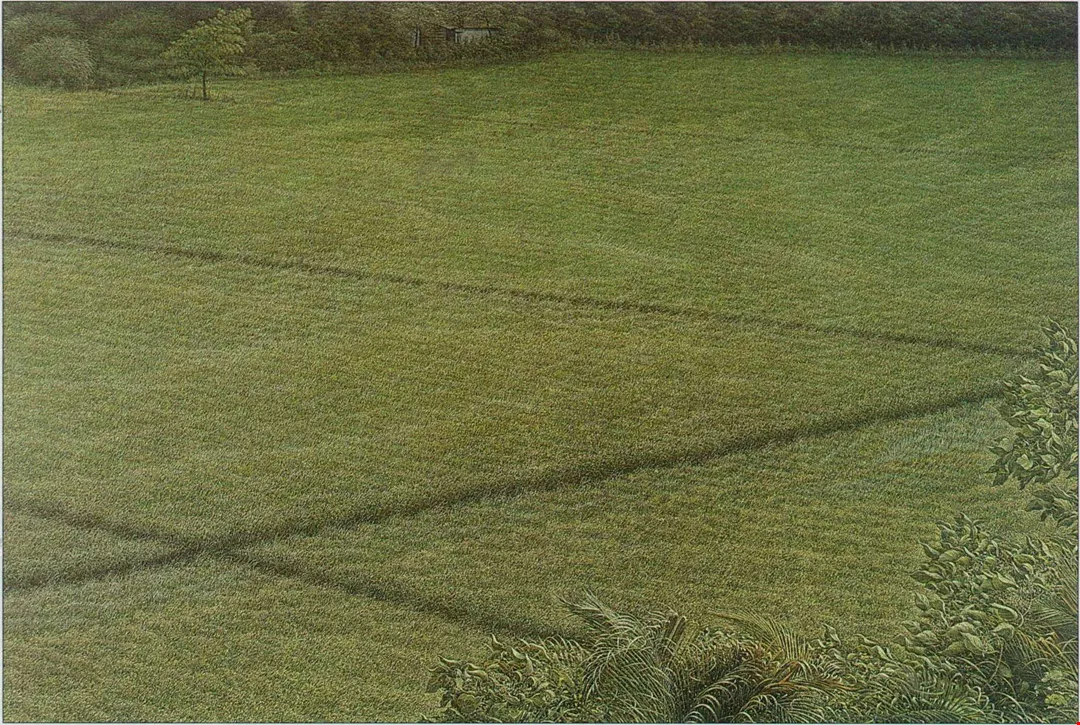
Besides making a contemporary critique, Huang Min-chang's paintings reveal his sentimental attachment to the land. The painting is "Afternoon Gleaming," number 17 in the "Rice Field Series." Oil on linen, 1993; 112×172 cm. (photo courtesy of Sotheby's)
@List.jpg?w=522&h=410&mode=crop&format=webp&quality=80)


