Traces of Axe and Chisel--Woodcarving Master Huang Kuosu
Kuo Li-chuan / photos courtesy of Huang Kuosu / tr. by Michael Hill
May 2005


The cultured town of Lukang in Changhua County is a major center of Taiwan's woodcarving arts. During the Daoguang reign (1821-1850) of the Qing Dynasty, many renowned woodworkers were hired to come to Taiwan from Quanzhou in Fujian Province and participate in the rebuilding of ancient temples in Lukang. Many of them settled in Lukang and passed on their craft. Over 160 years, these arts were taken up by each generation, and nationally famed master carver Li Sung-lin was part of the fourth generation to pass these skills on. Late in life, Li was invited by the Ministry of Education to take on apprentices in the traditional fashion to pass on his art. Huang Kuosu, a woodcarver who began to establish a reputation in recent years, has become one of his most accomplished disciples.
Huang Kuosu was born in 1958 in Lukang. He was first introduced to carving when he was in elementary school, just at a time when the glove puppet epic Shi Yanwen, the Yunzhou Confucianist, performed by Huang Chun-hsiung, was enjoying great popularity throughout Taiwan. So that he could have his own glove puppets, Huang took raw sweet potatoes from a nearby field and used a penknife to carve the shapes of their heads. When he hollowed out their necks and stood them on his fingers, a thousand different heroic soldiers were in his hand.

Journey through a Difficult Pass won first prize in the 2003 National Crafts Awards. The carving depicts the Buddhist monk Xuan Zang in his journey across the deserts of Central Asia. His feet singed by fiery sands and his body buffeted by harsh winds, even as he came close to death time and again, Xuan Zang resolved that resolved , "I would rather travel west and die than return east to save my life."
The young apprentice
In the 1970s, exports of carved furniture manufactured in Taiwan from such high-quality materials as mahogany and ebony were booming. Precious raw materials like cypress wood and cheap labor created a very favorable situation for the export of carved wood products. Attracted by higher salaries, even civil servants were willing to give up their jobs to get into the business. After graduating from middle school, Huang Kuosu also tried his hand at carving as a way to boost his family's income, working along with his fourth elder brother as apprentices at the Jungkuo Woodcarving Company near their home.
Jungkuo produced large amounts of wood construction materials needed for Japanese buildings, with most of its business coming from wooden carvings on windows and doors used in tatami rooms. A quick study, under his brother's guidance Huang Kuosu learned the entire process and was able to work independently within two weeks, earning NT$3,000, or about the same as most adults' salaries, in his first month. Since the shop produced products to set designs and paid by the piece, after working there for one year, Huang Kuosu was making NT$9,000 per month, and was able to carve extremely fine and intricate Japanese-style screens. High pay for work and high praise from friends and family, however, were still not enough to replace this 16-year-old's desire to attend high school.
"When I was going back and forth to work, sometimes I would see my classmates from middle school on their way to high school, and it would always leave me with a feeling of regret," Huang recalls. "Once I hurt myself because I was working too fast, and had to have four stitches in the index finger on my left hand. At that time, I felt that I could not go on like that, and that I had to continue with school." In 1974 Huang began his studies in night school at the Changhua Senior School of Commerce while he continued to work by day at the woodcarving company.
In his first year of high school, Huang Kuosu excitedly rented a camera, never imagining that only four pictures in his first roll of 36 exposures would turn out. Since cameras at that time were manually operated and usually were quite expensive, most people rented them from photography shops when they needed them. Without many chances to practice their picture-taking skills, however, it was reasonable to expect that the quality of the photos taken would not be very good. But Huang would not give up, and instead started to read books on photography. In order to have his own single-lens reflex camera, he even found time to work during his summer and winter vacations from school. "Those days," he says with a smile, "carving was just a tool for me to make money!"

Journey through a Difficult Pass won first prize in the 2003 National Crafts Awards. The carving depicts the Buddhist monk Xuan Zang in his journey across the deserts of Central Asia. His feet singed by fiery sands and his body buffeted by harsh winds, even as he came close to death time and again, Xuan Zang resolved that resolved , "I would rather travel west and die than return east to save my life."
Learning a treasured craft
After graduating from high school, Huang Kuosu was accepted into the Department of Industrial Management at National Chin-yi Institute of Technology. Only then did he leave the woodcarving company, traveling to Taichung to continue his studies. Since he was not very interested in industrial management, he used his time outside of classes to expand his knowledge of art, photography, and painting. Discovering the pleasure of studying on his own, he often read and practiced late into the night.
In 1984, Huang Kuosu established his own commercial photography company. Obtaining the large amounts of equipment and capital required for the business proved to be a challenge, however, and Huang's own modest, quiet personality was not suited to the comings and goings of the business world. Thus when he went home on vacation and saw that his third-eldest brother, Huang Sheng-hsiung, had established his own woodcarving studio and was living a happy, simple life in the countryside, Huang Kuosu couldn't help but think of returning to Lukang and taking up the carver's knife again.
Even though it had been years, when Huang came back to his dusty, rusted tools, he could still put them back to work with the same easy familiarity. "In a society changed by modern technology, choosing something as unpopular as woodcarving as your life's work is part fate and partly because you're suited to it. It's also a decision you arrive at after a great deal of thought." Huang Kuosu knows that it was not only the attraction of his old home but also a greater understanding of his own nature that brought him back. Because of this, even though he was coming back to his old job at the age of over 30, he was still happy to work once again as an apprentice.
In 1988, Huang Kuosu began studying three-dimensional sculpture for Buddhist icons with Huang Sheng-hsiung. He started by doing the preliminary rough cuts, finally gaining a full understanding of their design. After a few years of experience in commercial sculpture, Huang's technique became refined and unrestrained. The creative, artistic ideas he had held for many years quickly began to come to fruition, and he wanted to look for a new path for his own creative work.
In 1991, Huang Kuosu happened to see a notice in the newspaper that the Ministry of Education was accepting applications for "students of woodcarving arts." After a few months of screenings and demonstrations of his work, Huang and three other artists were chosen to study under Li Sung-lin, a nationally acclaimed woodcarving master. As part of the three-year "Project for Training Practitioners in Key National Arts," the group met for three days every week at the Changhua County Cultural Center. Their classes covered relief carving, openwork carving, and three-dimensional sculpture for furniture, windows, human figures, and temple decorations.
"Mr. Li was over 80 years old, yet he was healthy in body and strong in spirit," says Huang. He not only would make designs and perform demonstrations on the spot, but also could use each piece of wood according to its different characteristics. What was most moving to us was that even though Mr. Li was at an age where he could be relaxing and playing with his grandkids, he still insisted on doing his creative work and was always enthusiastic. From him I learned more than just carving techniques-I truly expanded my creative point of view. This had a very strong influence on my decision to move from commercial sculpture to purely artistic work."
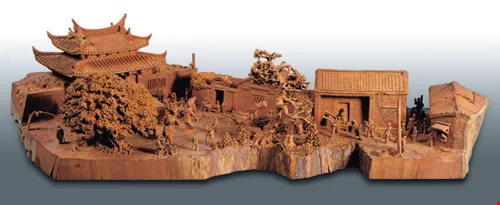
The Night Procession for Blessing shows a popular religious event unique to Lukang. In this 108-centimeter slab of Taiwan beech, Huang gives shape to his childhood memories.
Taking root where you are
Studying with Li Sung-lin was Huang Kuosu's third stint as an apprentice. Inspired by both traditional crafts and modern art, he is undertaking new explorations in his creations, and hopes to produce different kinds of visual experience in his work and to move beyond the emphasis on design to contain the lived experience of history. Before his classes with Li were finished, he had begun to think about his first artistic creation, The Night Procession for Blessing, based on the "night processions" he was so familiar with from Lukang.
"Night procession" refers to a religious ceremony unique to Lukang. To this day, whenever someone in the town falls ill or has a quarrel, the celestial generals Qiye and Baye lead volunteer gods and Wangye figures from local temples to patrol at night through the town's streets to drive out evil sprits and protect the entire town.
In order to fully represent the procession, the challenge to Huang lay not only in what techniques he would use, but how to put his childhood memories into three-dimensional carvings. To produce the forceful presence of the celestial generals as they go out on their watch, Huang prepared about 70 or 80 figures: clan leaders, flagbearers, squads playing gongs and drums, and members of the faithful who follow the group.... The posture and expression is different-and always lifelike-for each figure.
Huang Kuosu obtained a 108-centimeter slab of precious Taiwan beech, and worked with the natural contours of its grain to create his design. With delicate lines, Huang carved Lukang's century-old houses, the main gate of Lungshan Temple, and the speckled stones of the town's snaking alleyways, using brilliant technique to add the solemn procession and people in the crowd as they pray or try to catch a glimpse of the action. To duplicate the beauty of the ancient Lungshan Temple, with its weathered timbers and well-worn walls of brick and stone, Huang even climbed to a high point in the town to take a bird's-eye photo of the temple.

Three generations of people-elderly, middle aged, and children-are set against the backdrop of an ancient temple in Inside, Outside. The work's smooth, gentle lines evoke many warm memories in viewers.
Many faces, many memories
Born and raised in Lukang, from 1994 to 2004 Huang Kuosu has produced a number of works based on his hometown, taking the details of life in ancient Lukang as the source of his inspiration.
"Once you are past the midpoint in your life, all of your memories are of good things," says Huang, reflecting on his state of mind. From his innocent childhood in a small town, to life in a city in the throes of an information explosion, and back again to the simple life in the countryside, in his heart he has always wanted to carve his memories and the memories of people of his generation into sculpture, both as an expression of his feelings and as a record for posterity.
Evening Song depicts a scene at the Chu Ying Society in Lukang where an old man plays nanguan music on the pipa lute; his music expresses sorrow and regret toward his life. In Inside, Outside, three generations of people-elderly, middle aged, and children-are set against the backdrop of an ancient temple. As an old man sits inside playing a short-necked lute, he expresses the history and living wisdom inherited across time. As a baby outside sucks on a pacifier and holds a rattle in his hand, he hearkens back to the old man's wrinkled face, and here we see the hopes and joys of one generation being passed to the next.
A series of Huang's works are filled with lively childhood memories. "The things I remember the most from childhood were the night processions and the temple fairs," says Huang. "As the duties were handed out before the events began, each child scrambled to be a banner bearer, and finally we had to draw lots to decide who did what. The kids who drew the lots to hold the banners were excited and proud of themselves, so in the piece Leading the Procession, the banner bearers always had very proud expressions on their faces. Next to the banners, the job everyone wanted was to play the gongs and drums. Once, my brother and I both drew lots to do this, and the impression left by that feeling of happiness is still with me today. In the carving titled Rapture, I try to show the joy in the two brothers' hearts as they beat the drums and gongs together."
"When I am carving, I change myself into the person I want to carve. I try to understand their thoughts, feelings, and expressions. My inspiration comes from observing the body language found in every type of work, which I then carve out stroke by stroke." Huang's figures are not only filled with lifelike expression; the themes of portraying the variety of people's lives and natures come from his observation of the world and his love for life.

The Night Procession for Blessing shows a popular religious event unique to Lukang. In this 108-centimeter slab of Taiwan beech, Huang gives shape to his childhood memories.
"I'd rather travel west and die..."
When Huang Kuosu first encountered Buddhism four or five years ago, he read works such as the Diamond Sutra and the Flower Adornment (Avatamsaka) Sutra, and began to understand the influence of Buddhist practice on human life. From the lives of the virtuous monks of ancient times, he saw an unwavering, selfless spirit of benevolence, and realized how in everyday life so many people had been robbed of happiness by the many twists and turns of fate. In his study of Buddhism, Huang Kuosu began to look at all compassion and cruelty with a more open heart. In order to pass on his discoveries in and feelings about Buddhism, his work became his best tool for the job.
In 2002, Huang's Journey through a Difficult Pass focused on the travails encountered by the great monk Xuan Zang in his journey to India in search of Buddhist sutras. Xuan Zang traveled alone across vast deserts, his feet singed by fiery sands and his body buffeted by harsh winds. To recreate this scene, Huang spent over a year in search of relevant information in texts and images, tirelessly reading various biographies of Xuan Zang and referring to Xuan Zang's Record of the Western Regions of the Great Tang Dynasty. In creating his carvings, he imagined that he was himself in the wild desert 1,400 years ago, short of food and water and coming close to death time and again. This way he was able to understand Xuan Zang, who resolved , "I would rather travel west and die than return east to save my life."
Using a 120-centimeter piece of Taiwanese phoebe, Huang Kuosu made the base into a hilly, sandy desert landscape, where the dried bones of animals imply the desert's mercilessness. Xuan Zang and his horse stand in the middle of a sandstorm, pressing ahead against the wind, and the carving brilliantly uses outer appearances to display the inner spiritual world of both the figures and their creator. Journey through a Difficult Pass was awarded a first prize in the 2003 National Crafts Awards and is now in the collection of the National Taiwan Craft Research Institute.
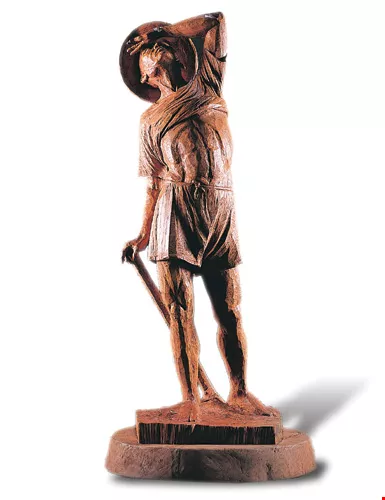
Sweating Under the Hot Sun, silver medal winner in the 2004 Yulon Group woodcarving contest.
Clouds in the sky, water in a bottle
"Buddhist faith has influenced my creative thought. There are countless routes for artistic expression, but when art is a religious practice, aside from transmitting beauty it must also awaken people to goodness," says Huang. I hope that through these works I can give the world some internal force to achieve a complete life." A sense of beauty takes shape on the outside, while ideas of goodness are contained within; these ideas give Huang's works a tremendous vitality. One piece, Fighting Upstream, uses naturally worn driftwood to create a surface of flowing water filled with salmon fearlessly making their way upstream. Speaking to a modern society that has reached both a high degree of technological development and an unprecedented state of emptiness and weakness, Huang reminds us that we should never forget to take nature as our teacher.
Four years ago, needing more creative space, Huang moved from his hometown to Yuchih Township in Nantou County, not far from the epicenter of the September 21, 1999 earthquake. There he can get away from the commotion of life, clear his mind, and be in contact with the natural world day and night. When asked why he chose an unpopular profession like woodcarving, Huang Kuosu reveals strong opinions: "In the course of life, there are traces of the past, the predicaments of the present, and directions for the future. Every kind of life bears a price, and every life is only the result of turns of fate and decisions we make. Good or bad, it's like drinking water: only you know how hot or cold it is. Only when we have something to face and burdens to bear do we move forward."
As the sun sets, egrets take flight, filling the air. Huang Kuosu, born in Lukang, seems to have been destined to be a carver. Serving three apprenticeships brought him to a greater understanding of himself each time, bravely moving from commercial woodcarving to pure artistic work. Moving from a bustling city to the rustic countryside, each turn of events, each realization has been much like the Zen saying, "I come to ask the way, and say nothing else. The clouds are in the sky, the water is in the bottle!"

The Night Procession for Blessing shows a popular religious event unique to Lukang. In this 108-centimeter slab of Taiwan beech, Huang gives shape to his childhood memories.

Three generations of people-elderly, middle aged, and children-are set against the backdrop of an ancient temple in Inside, Outside. The work's smooth, gentle lines evoke many warm memories in viewers.
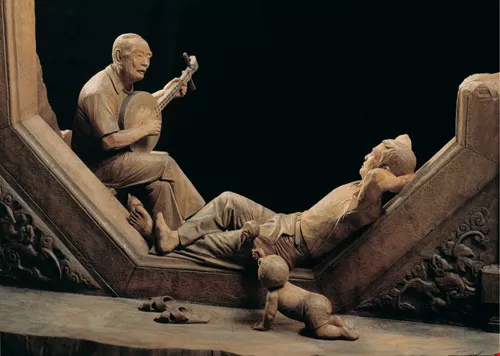
Three generations of people-elderly, middle aged, and children-are set against the backdrop of an ancient temple in Inside, Outside. The work's smooth, gentle lines evoke many warm memories in viewers.
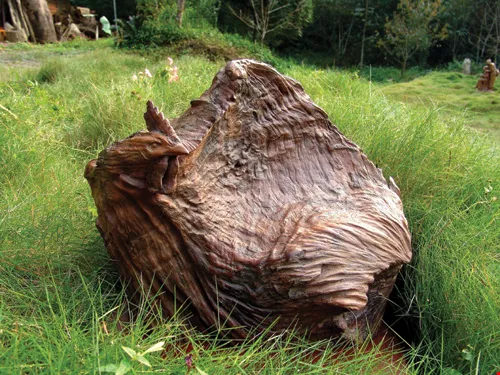
By invitation from the Council for Cultural Affairs and the National Taiwan Craft Research Institute, Huang Kuosu created The Five Virtues of the Rooster for the "2005 Year of the Rooster Special Foreign Exhibition." (photo by Cheng Hung-lung)
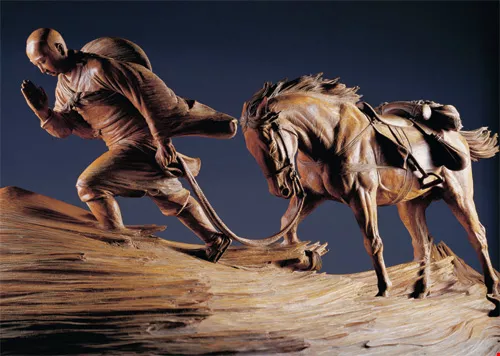
Journey through a Difficult Pass won first prize in the 2003 National Crafts Awards. The carving depicts the Buddhist monk Xuan Zang in his journey across the deserts of Central Asia. His feet singed by fiery sands and his body buffeted by harsh winds, even as he came close to death time and again, Xuan Zang resolved that resolved , "I would rather travel west and die than return east to save my life."
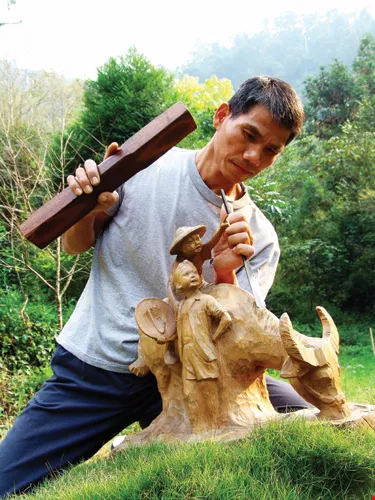
Huang Kuosu changes himself into the person he wants to carve, trying to understand their thoughts, feelings, and expressions. He observes the body language found in every type of work, and carves them out stroke by stroke. (photo by Cheng Hung-lung)
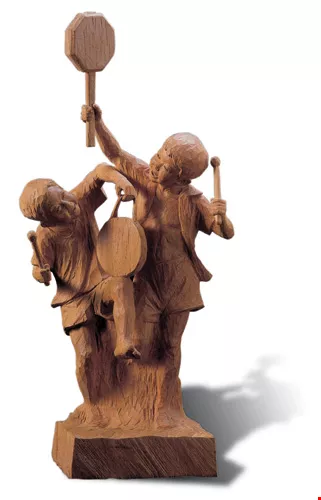
Whenever there was a temple festival, the job every child wanted was to play the gongs and drums. Through a sculpture titled Rapture, Huang Kuosu recreates the children's joy in banging the gongs and drums.

@List.jpg?w=522&h=410&mode=crop&format=webp&quality=80)

@List.jpg?w=522&h=410&mode=crop&format=webp&quality=80)


