Rays of Sunshine--Grandpa Lin Liang
Chang Meng-jui / photos courtesy of Lin Liang / tr. by Scott Williams
April 2009


At 84 years of age, Lin Liang was the eldest author to have a work listed among the China Times Best Books of the Year last year, and the most popular. Many of the other authors at the late-2008 event had themselves been fans of Lin's work since childhood and offered their respects. Even the caterer felt obliged to ask Lin to autograph a paper plate for him. To these people, Lin isn't merely a great writer, but someone who shaped their entire generation's conception of "family."
Lin Liang is a slender man with a thin face and short, wavy hair who seems always to be smiling genially from beneath the reading glasses perched atop his high-bridged nose. He speaks in a slow, measured cadence, and has the air of a schoolteacher or writer. He is, in short, an archetypal Chinese literatus.
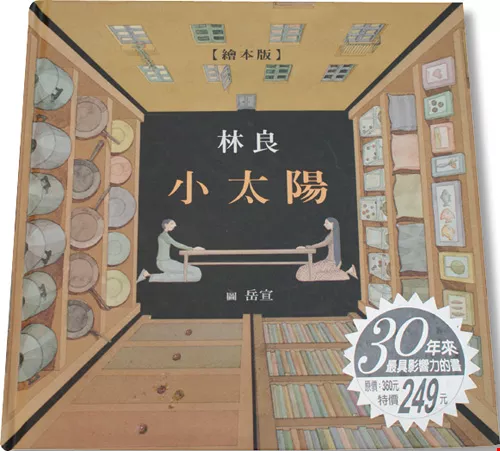
Every time I see Lin Liang, I think of Little Sun and the warm hominess the book exudes. Published in 1972, Little Sun is a collection of essays that has, over the course of 36 years, gone through three publishers and more than 100 printings. A remarkably popular domestic bestseller, its sales to date amount to nearly 300,000 volumes.
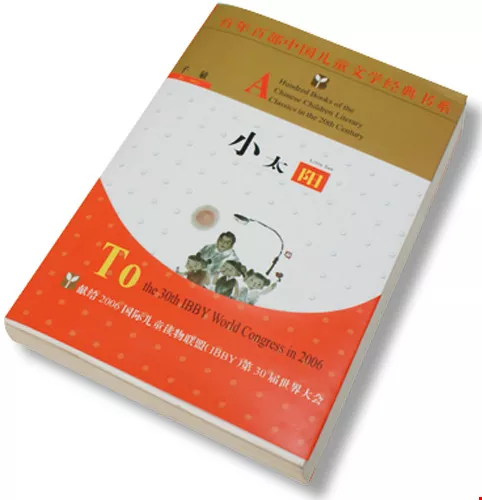
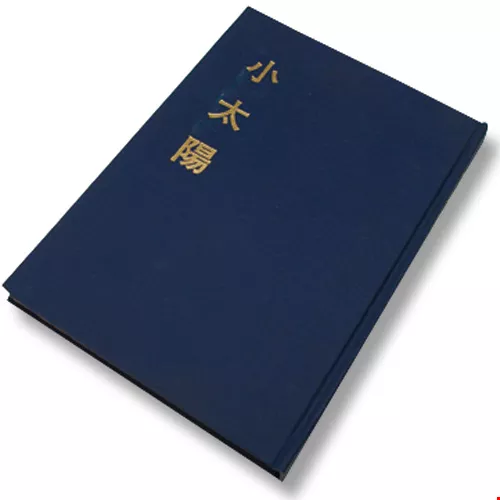
Little Sun was an instant bestseller. Its numerous publishers have given it many different covers over its 36-year publishing history. (above:) Grimm Press's edition. (below, from left to right:) A simplified-Chinese edition from the series "A Hundred Books of Chinese Children's Literary Classics in the 20th Century," the Rye Field Publishing edition, and the Belle Lettres Publisher edition.
A little sun inside
The first piece in Little Sun, an essay entitled "One-Room Home," was published in 1956 in the United Daily News literary supplement and described Lin's first home with his wife. Little Sun includes essays on many of the other cherished firsts Lin experienced over a 14-year period, including his marriage, the onset of parenthood, and life as a father of three daughters. Lin uses his humorous and fluid style to vividly sketch these treasured, never-to-be-repeated moments, teasing out the pleasures that permeate the day-to-day minutiae of a life in a small family.
In 1949, the KMT government hadn't long been on Taiwan, and people here were poor. Parenthood created numerous practical problems for Lin and his wife. For example, few people had washers and dryers in those days, with the result that long days of endless drizzle could lead to indoor diaper disasters. Lin's description of life with his daughter's diapers is comical:
"Her blankets were like a tiny printer, printing out sheet after sheet of warm, damp, pale-yellow diapers.... The sound of hammering began to ring out from our bedroom as we mounted clothes lines... one, two, three, four, five, six. Her diapers marched imperiously across the room like the banners of a conquering army flying in the rain. We had to bow down beneath them to get around the house.... We even ceded airspace above the desk to them. Nearsighted writer that I am, I often found myself placing punctuation marks on water that had dripped from the diapers above."
Writing from the midst of this maze of diapers, Lin compared his daughter Yingying to a "little sun," the kind that you anxiously anticipate in cold, wet weather. The arrival of his second daughter, Qiqi, and his third daughter, Weiwei, introduced ever more new, interesting, and even troublesome events into what was already a lively home life.
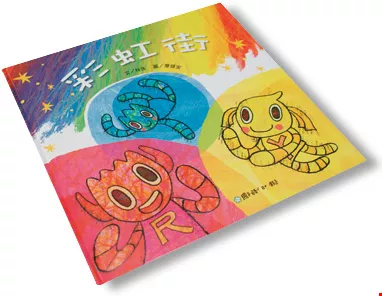
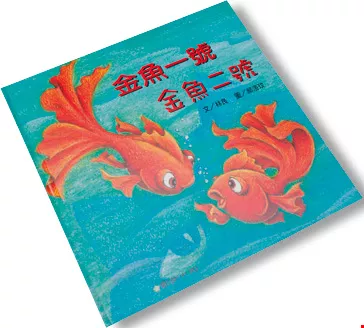
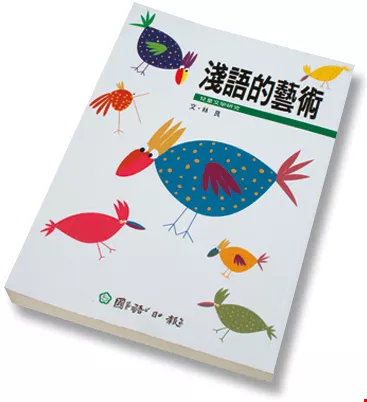
Lin is a prolific writer who has published both essays and children's poetry. (from left to right) 2008's Goldfish One, Goldfish Two, 1993's The Poetry of Lin Liang, 2008's Rainbow Street, 2000's The Art of Shallow Words (all of which were published by Mandarin Daily News Publishing), and 2006's Nursery Rhymes of Little Animals (Min Sheng Pao Publishing).
A loving patriarch
Taiwan's literary community saw Little Sun as something different, which helped generate tremendous buzz about the book when it was released. Author Chiu Hsiu-chih remarked that in those days society was deeply permeated with traditional patriarchal values and thought it beneath a man's dignity to show interest in domestic matters. Chiu argued that, as a result, most writers hardly touched on household minutiae no matter how much they loved their homes and families.
Lin, who sees himself as an extremely "manly man," agreed that it took bravery for a "male chauvinist" to write about "home and family," but argued:
"I don't think of a patriarch as some kind of scowling figure with a stern voice. I'm calm and quiet. I may have seen hard times as a child, but they didn't leave me filled with frustrations. There's no one in the whole world who I want revenge on."
Lin felt that a patriarch could best show his "courage" through the expression of tolerance, fortitude, industry, and perseverance, as well as by bearing up to physical pain:
"If he were the legendary Ban Chao, he needn't have cast aside his writing brush to take up a military career. He'd have smiled and placed his pen softly on the desk, without any noise and without startling anyone. He'd have had a sword, but it would have been symbolic, representing the honing of his skills. He would have worn it the way Christians wear the cross."
Because the role of "patriarch" is by its nature a solitary one, such men are easily moved by the affection their wives and children have for them. Heroes have a soft side, and wives and children can be heroic. It has always been so:
"The family exists for the hero. Why not write of the family? Only a family can keep the hero's bright sword untarnished, keep him strong but not violent, and keep him from evil."
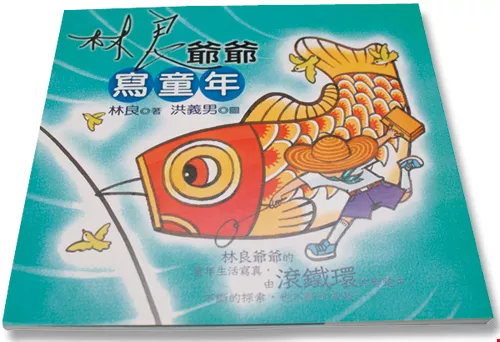
Lin's Grandpa Lin Writes about His Childhood (Youth Cultural Enterprise), which was named one of the top ten books of 2008.
Love your family
Working from this premise, Lin followed Little Sun with A Harmonious Life, Brocade in the Moonlight, Tea Chats, and Sixteen Letters from Dad, all concerned the minutiae of family life. In his hands, these family chronicles became elegant and humorous essays that inspired both laughter and tears, and offered readers a new perspective on the everyday events in their own homes.
Lin didn't write about "family" for himself. He has said that he had no interest in just reporting on events in his home to readers because he knew very well that listening to a man rattling on about his wife and kids and dog Snowy was boring.
Lin's work is based on the belief that there is, without exception, something adorable about every family. He hopes that by conveying that to his readers, he can foster their love for their own families. From this standpoint, he is "leading [his] family and dog in the service of [his] readers."
Lin says that he continues to write because he enjoys it, rather than out of a desire to make his mark in the annals of literature. As a consequence, he doesn't feel the same pressures and frustrations as those who write to live.
"Some people need to have an interesting topic in order to write. They have to write something unique they have experienced personally, or unearth something unknown about society," says Lin. "But I personally feel that a work need only have literary interest; the subject matter is irrelevant."
Lin feels that writing offers two pleasures. There is the fun to be had in assembling words in new ways to express a variety of feelings, much as a painter does with line and color and a musician does with pitch and rhythm. In addition, the process of incubating stories compels him to grow as a person by forcing him to carefully tease out all that he's gleaned from life.
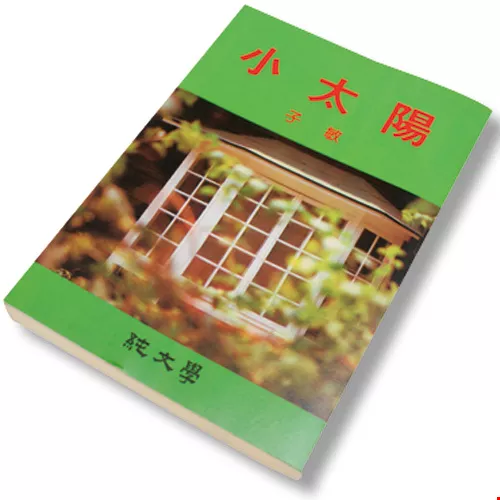
Little Sun was an instant bestseller. Its numerous publishers have given it many different covers over its 36-year publishing history. (above:) Grimm Press's edition. (below, from left to right:) A simplified-Chinese edition from the series "A Hundred Books of Chinese Children's Literary Classics in the 20th Century," the Rye Field Publishing edition, and the Belle Lettres Publisher edition.
Be my father!
Lin was a multitalented dad. He spent days working as an editor with the Mandarin Daily News, and late nights hunched over his desk at home writing. He also took care of his three daughters, personally dealing with physical, psychological, and school-related issues as they arose. He also often put the family's limited funds to use taking them on frequent trips abroad. And, unlike most doting fathers, he gave them more freedom as they grew, allowing them to learn to stand on their own two feet.
Sixteen Letters from Dad was his way of responding to his kids' confusions and helping them learn to be adults.
Lin's initial motivation for writing the letters was his eldest daughter's completion of elementary school and start of middle school. He was busy with work-deadlines and meetings kept him at the office past dinner-and was going two or three days at a time without seeing his daughters. During this period, the written word was his only means of communicating with them, and he sometimes found himself answering his daughter's questions-things like "Why does everyone ignore me?" and "Why are other people different from me?"-in long letters composed in the dead of the night.
Around this time, Pan Jen-mu, a fellow author and head of the editorial division of the provincial government's education department, approached him about doing some writing. He wanted Lin to craft a few pieces about life for young people. Not wanting to preach, Lin drew on first-hand information from his daughter to shape an epistolary work which is still widely read in middle schools.
Hsiao Yeh encountered Lin's work as an adolescent. Now 58 and himself an author, he recalls finding it hard to believe there could be such a great father anywhere in the world.
"Most fathers then were serious and forbidding," recalls Hsiao Yeh. "They were no good at expressing their feelings. They didn't even let their family members talk during meals. In contrast, Mr. Lin seemed always to be smiling and even warmer and sweeter than a mother. He didn't put any pressure on his kids, and was eminently reasonable in his approach to education and communication." This created a kind of yearning in Hsiao Yeh, whose relations with his own father were then somewhat strained. But the book also offered him some solace.
Lin reveals that in those days many young readers wrote to him after reading his book, and a large number of these letter writers wanted him to be their father. Their letters show that children are easily moved, and that they offer you their love in full measure if you just show them some kindness.
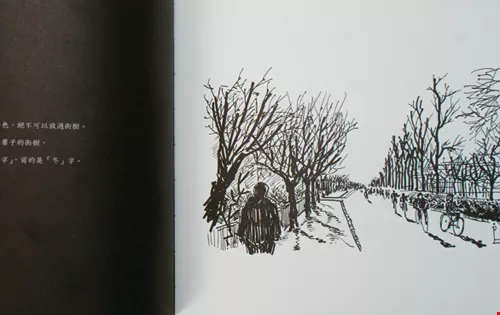
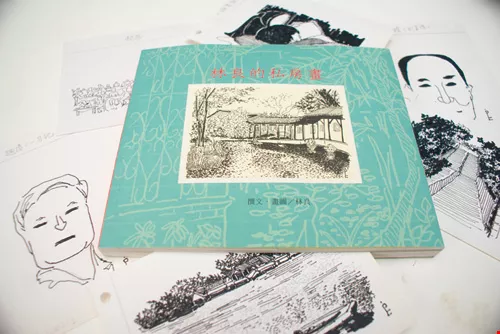
Not just an excellent writer, Lin is no slouch as an illustrator, either. The images on the right are from Lin Liang's Personal Paintings, published by Taiwan Mac Educational Publishing. They include a scene with trees lining a Beijing street in winter, and a reader curled up with a blanket and a book. All were done entirely by Lin himself.
A career with the Mandarin Daily News
Born in Xiamen, Fujian Province, Lin spent his childhood years in Fukuoka, Japan. He began writing at an early age and in 1942 went to work as a reporter for Xiamen's Youth Daily. He also edited the Qing Tian supplement. He wrote everything-poems, essays, short stories-and was even a pretty good illustrator. Arriving in Taiwan in 1946, he joined the Mandarin Promotion Council doing research comparing Mandarin and Minnanese and went on to host a bilingual radio program that taught "Beijing Mandarin" to Taiwanese.
Two years later, he began pursuing a degree in the Chinese department of National Taiwan Normal University, but ultimately graduated with a degree in English from Tamkang College (now Tamkang University). Lin was older than his university classmates, and worked harder, too. When the Mandarin Promotion Council established the Mandarin Daily News in 1948, Lin was named editor-in-chief of the children's supplement. The new job marked the start of his career writing for children, one he has continued to pursue to the present day.
Lin loves kids and often meets with them to chat and tell stories. This helps make writing kids' books a breeze, and adds life and realism to the "kids' stories" he relates in his essays.
Few people realize that Lin has always drawn the "Talk about the Picture" feature for the Mandarin Daily News. Madame Wei-wei, a columnist and long-time colleague, says that every time she reads one of Lin's colloquial poems for children, she can't help but admire the way in which he has maintained his childlike outlook. When he sees a drawing done for kids, he is able to describe it from their perspective. He also writes casual rhymes that sometimes turn into "colloquial poems" that kids can rattle off. Wei-wei offers an example:
"A butterfly flits over / A calico cat awaits / Waiting for it to fly close by / And right into his grasp / The butterfly flits over / Thinking the cat's a flower / Then it sees he's not a flower / And flutters up and away / The butterfly has passed on by / And the calico cat leaves too."
Lin captures the interaction between the calico cat and the butterfly in just these few short, playful lines.
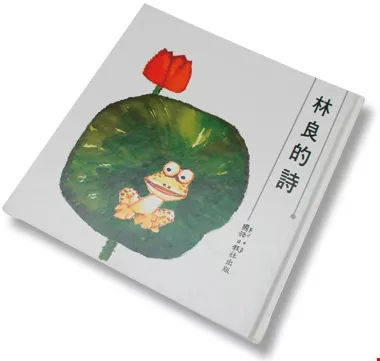
Lin is a prolific writer who has published both essays and children's poetry. (from left to right) 2008's Goldfish One, Goldfish Two, 1993's The Poetry of Lin Liang, 2008's Rainbow Street, 2000's The Art of Shallow Words (all of which were published by Mandarin Daily News Publishing), and 2006's Nursery Rhymes of Little Animals (Min Sheng Pao Publishing).
Children's stories and essays
The paper's family section in 1967 introduced a "tea chat" column that Lin, Hung Yen-chiu, and Ho Fan took turns writing, and that really got Lin's creative juices flowing. While writing children's literature under his own name, he also produced essays as Zi Min. Lin's essays have been collected in eight volumes, including Little Sun, A Harmonious Life, The Attraction of Strangers, and The Art of Shallow Words. His children's literature includes I'm a Fox-Dog, Paper Boat, A Nest of Night Owls, The Second Goose, and Rainbow Street. Lin has also done translations of nearly 200 stories, including "The Gift of the Magi" and "La Luz Es Como El Agua."
Lin writes in his own distinctive style. The paragraph below, from a popular piece entitled "Lunch" that he penned for the Mandarin Daily News, is a case in point:
"I believe I have too little time to dote on my children. They grow up too fast, which can't help but make you think that days on which you are angry at them or take them to task are wasted. Children are like trains zooming past you; you ought to offer up the love you've prepared for them with both hands, take aim and throw it into the passing window as quickly as you can. If you move too slowly, the train will already be gone. The golden years of childhood will have already passed.
Lin's childlike innocence is undoubtedly his most valuable trait. After all, he only produces two types of work-children's stories written for children, and children's stories written for adults.
As his given name implies, Lin has a positive, upbeat, optimistic take on the world, and he somehow manages to make even the intricacies of routine household chores entertaining.
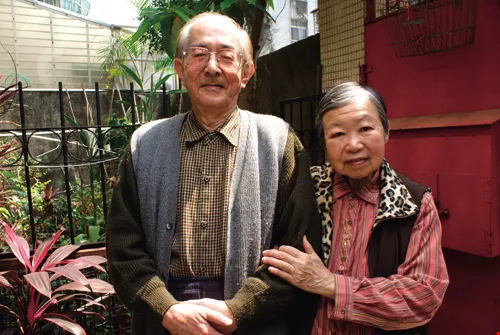
The years may be getting long, but Lin remains fortunate-he enjoys the kind of profound marital bliss that inspires envy.
Don't write your bad moods
Lin doesn't deny that he has a positive outlook and doesn't worry about existential questions. He believes that people can live in harmony, that society is like a forest in which no tree need pillage its neighbor to grow. In his view, people can live well without striving against one another. These beliefs were the impetus for A Harmonious Life.
Lin thinks his work offers something like a "healthy realism." He frequently reminds himself not to write when he is in a bad mood, to ensure that the mood doesn't infect his work. Instead, when he's feeling less than great, he takes a nap or walks to the botanical gardens near his home to look at the lotus blossoms. Once he's feeling better, he picks up his pen again. In this way, he is able to keep his head filled with "good" thoughts.
Lin likes to say, "Literature's beauty and interest are to be sought in the 'quiet' spaces. It's only when we are at peace that we can give matters our most scrupulous attention." This applies to readers as well: "Literature calms the mind, and it's only when we are calm that we can appreciate the written word."
Writing and reading take up virtually all of Lin's time when he's not working. His approach to reading is to "do it in large volumes," and he says it's his custom to finish every book he starts, no matter how grueling or abstruse it may happen to be. He likens the act of reading to inspecting an honor guard; not a word escapes his notice.
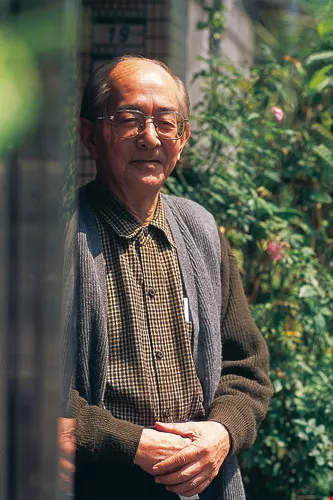
Visiting Lin Liang's home in an early-spring afternoon to shoot some photos, we notice that the warm sunlight inside nicely highlights his scholarly visage. The Japanese part of his heritage is still apparent in his features, as are the good looks he enjoyed in his youth.
Pass on the torch
In 2003 at the age of 80, the Government Information Office honored Lin with its first-ever Lifetime Achievement Award at the 27th annual Golden Tripod Awards. When a reporter asked Lin how he felt about it, he quipped, "The award came a little early!" He went on to say, "The elderly shouldn't spend their time thinking about awards. They should be giving young people more encouragement and greater opportunities."
Lin has never lost his lifelong passion for children's literature. Though he retired from his position as chairman of the Mandarin Daily News in the spring of 2005, he continued to write a column for the paper. A grandfather for many years, he still loves his children like a first-time father, and has an earnest desire to pass on the torch.
In Grandpa Lin Writes about His Childhood, which was named one of the top ten books of 2008, he describes the five stages of his early life. He writes of the loving instruction he received from his parents and the panicky flight from the chaos of war, of his agonizing entrance into the working world and the encouragement he gave himself. Speaking of his own childhood and that of every other growing child, he writes:
"You grow throughout your whole life, from childhood on into old age, slowly coming to know yourself and other people, learning to care for yourself and to care for others. You learn to walk on your own, and prepare yourself to lend a helping hand to others whenever they need it."
Lin's greatest goal, and that which he would find most gratifying in life, would be for every child to make sound choices, be a good person, and live a good and fulfilling life.
Not just an excellent writer, Lin is no slouch as an illustrator, either. The images on the right are from Lin Liang's Personal Paintings, published by Taiwan Mac Educational Publishing. They include a scene with trees lining a Beijing street in winter, and a reader curled up with a blanket and a book. All were done entirely by Lin himself.
Lin is a prolific writer who has published both essays and children's poetry. (from left to right) 2008's Goldfish One, Goldfish Two, 1993's The Poetry of Lin Liang, 2008's Rainbow Street, 2000's The Art of Shallow Words (all of which were published by Mandarin Daily News Publishing), and 2006's Nursery Rhymes of Little Animals (Min Sheng Pao Publishing).
Little Sun was an instant bestseller. Its numerous publishers have given it many different covers over its 36-year publishing history. (above:) Grimm Press's edition. (below, from left to right:) A simplified-Chinese edition from the series "A Hundred Books of Chinese Children's Literary Classics in the 20th Century," the Rye Field Publishing edition, and the Belle Lettres Publisher edition.
Lin is a prolific writer who has published both essays and children's poetry. (from left to right) 2008's Goldfish One, Goldfish Two, 1993's The Poetry of Lin Liang, 2008's Rainbow Street, 2000's The Art of Shallow Words (all of which were published by Mandarin Daily News Publishing), and 2006's Nursery Rhymes of Little Animals (Min Sheng Pao Publishing).
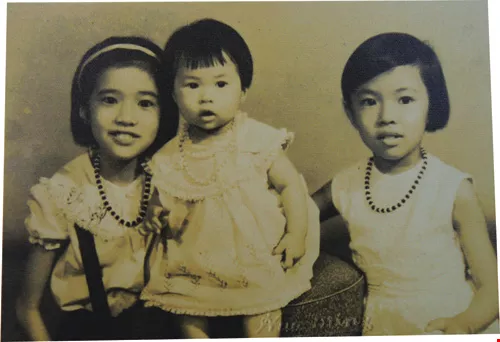
The births of Lin's three daughters, (left to right) Yingying, Weiwei, and Qiqi, were a source of inspiration. In his hands, the drip of diapers and other household minutiae became the stuff of laughter and tears.
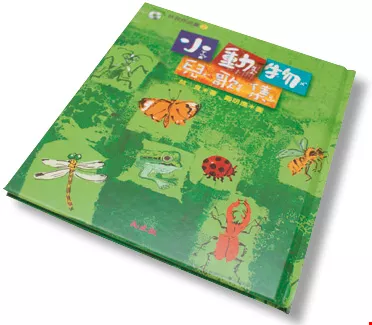
Lin is a prolific writer who has published both essays and children's poetry. (from left to right) 2008's Goldfish One, Goldfish Two, 1993's The Poetry of Lin Liang, 2008's Rainbow Street, 2000's The Art of Shallow Words (all of which were published by Mandarin Daily News Publishing), and 2006's Nursery Rhymes of Little Animals (Min Sheng Pao Publishing).
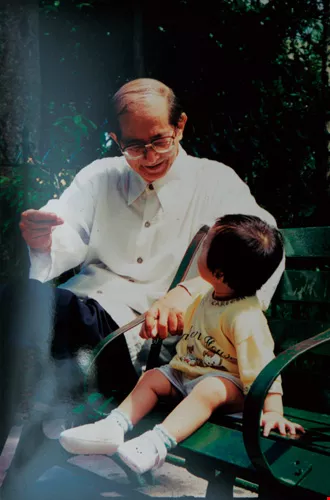
When his granddaughter Tongtong was born, Lin felt like a kid again. His book Tongtong was a natural outgrowth of his daily play sessions with her.
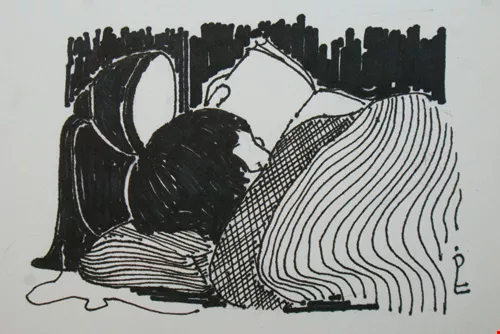
Not just an excellent writer, Lin is no slouch as an illustrator, either. The images on the right are from Lin Liang's Personal Paintings, published by Taiwan Mac Educational Publishing. They include a scene with trees lining a Beijing street in winter, and a reader curled up with a blanket and a book. All were done entirely by Lin himself.


