Always Ahead of Her Time: Chen Li-hung
Sunny Hsiao / photos courtesy of Chen Li-hung / tr. by Robert Taylor
February 1993


(photo by Vincent Chang)
She knows nothing of the women's rights movement, nor yet what feminism means --but she does have a woman's practical strategy for "living an independent, rich life" in a patriarchal society.
How did Chen Li-hung, the only remaining woman photographer to have run her own studio in Taiwan during the Japanese occupation, manage to succeed in the all-male world of photography?
Tucked away on Section 3 of Taipei's Chengteh Road is an old-fashioned photo studio: the Li-hung Photographic Studio. This plain little shop, with no large display window, is no match for the sumptuous studios on Aikuo East Road, known to all as "Brides' Street"; its cramped studio is neither richly decorated nor romantic, and even the newest pictures on display all show people still dressed in styles a decade or two out of date.
Most of the customers who come in make a beeline for the photocopier in the corner. And the few patrons who come to have their picture taken just need technically undemanding I.D. photographs.
Who could guess that when the "Li-hung Photographic Studio" first opened in bustling Taipingting (now Yenping North Road), it attracted an endless stream of customers? Or that its owner, Chen Li-hung, was the first woman ever in Taiwan to open her own photo studio, and one of the very few female photographers to go to study in Japan during the Occupation?
When asked about this change of fortunes, the elegant, sprightly Chen Li-hung says lightly: "After all, I'm nearly seventy; I let the younger generation take over long ago." Most business nowadays, she says, is at weddings and funerals or filming conferences, and she is kept so busy with societies and charity work that shooting and developing photographs has become a "sideline" for her, and she doesn't pay so much attention to the studio's appearance.
Be that as it may, there are still old customers who insist on being photographed by Chen Li-hung herself. "It's a funny thing, but I've been coming here so long, I just can't get used to going to anyone else," a lady of about sixty says as if to herself, but with a hint of praise.
Chen Li-hung, now a director of the Taipei Chamber of Commerce and a standing director of the Taipei Photography Association, was always a pretty woman, but she never married; she is surrounded by several faithful adopted sons and daughters. Her story is a legend which those in photographic circles love to relate . . .
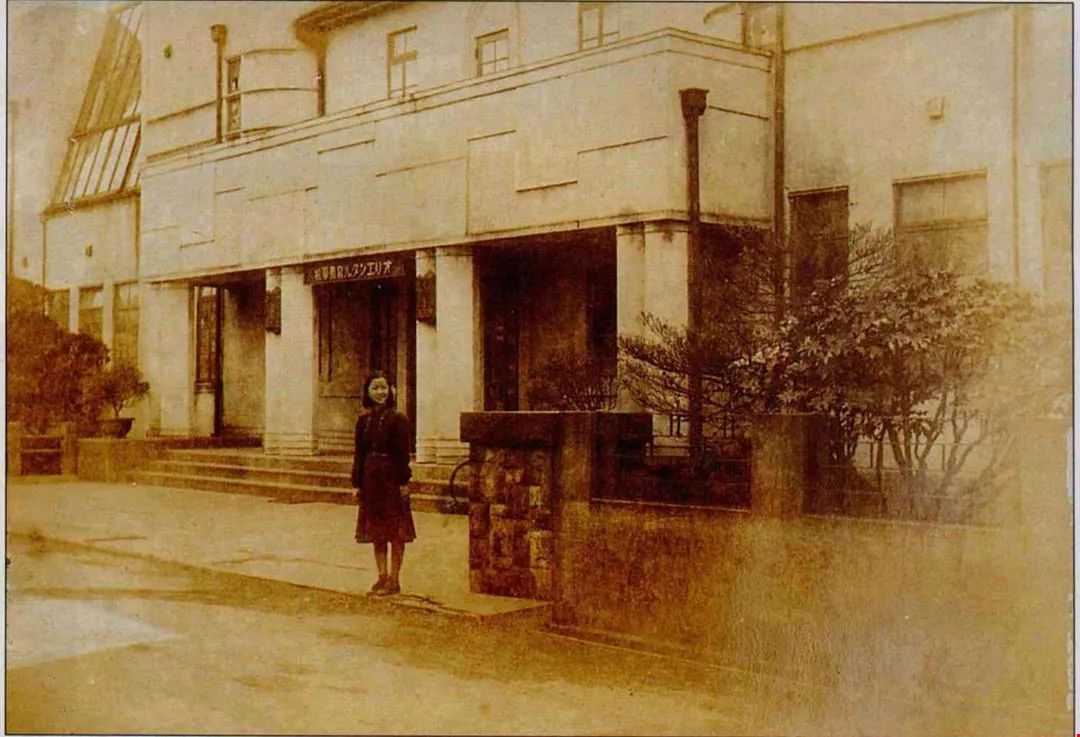
Chen Li-Hung studied photography in Japan. This is a commemorative photo taken in front of the Toyo school; the year is 1943.
Starting a career at 15:
Chen Li-hung came from a farming family in Hsintien, Taipei County. But although her father worked the land, he had once worked at the Japanese Governor's Offices, and was headman of his home village, and so he had a more open mind and wider horizons than most farming folk. And because he suffered from heart disease and was always deeply aware of the need to make provisions for his children's future, he hoped his only daughter could learn a skill which would let her earn her own living.
Mr. Chen had two younger cousins who had built up quite a reputation as portrait artists and photographers; and as Chen Li-hung, who in occupied Taiwan was attending a Japanese home economics school for girls, was both interested in and good at drawing and painting, Mr. Chen encouraged his daughter to study with his cousins.
Many of Taiwan's early photographers started as portrait artists, and then became familiar with photographic techniques. Chen Li-hung is just such an example.
These portrait artists would work from a small photograph of their subject, from which they would draw a scaled-up version; if the customer had no photograph, they would first have to take the picture from which they would then work. Making one portrait from a photograph would take anywhere from two to ten days. Chen Li-hung would spend the whole day bent over her desk, and was often too tired even to eat, which soon ruined her stomach. Her father could not bear to see her go on like this, and advised her to give up portraiture and simply become a photographer.
When Chen Li-hung got the first camera she had ever owned, paid for by her father, she really treasured it.
At the age of only fifteen or sixteen, she began to go with her father's cousins to Chihnan Temple in Mucha at holidays and festivals, to take group photographs of the worshippers and sightseers. This skinny slip of a lass would take a bus from Hsintien to Chingmei at daybreak, and then, carrying her lunch pack and the outsized camera and tripod slung over her shoulder, she would climb up to Chihnan Temple.
The temple attracted worshippers from far and wide, and on most days there would be a dozen or so photographers touting for business outside. As the only girl among so many men, and being so young, Chen Li-hung often attracted the attention and curiosity of the sightseers. Figuring that she must be pretty talented to dare compete with all these men, they would rush to have her take their picture.
She would work busily from ten in the morning till four or five in the afternoon when the visitors gradually drifted away. In the fading glow of the sunset, Chen Li-hung would gather up her day's work and set off for home with satisfaction. For fear of her camera being damaged, she didn't dare to leave it in a store close to the temple as the other photographers did, but instead preferred to carry it to and fro on her shoulder every day. When the bus reached her stop, her father would be waiting there, his big hands ready to take the heavy load from her.
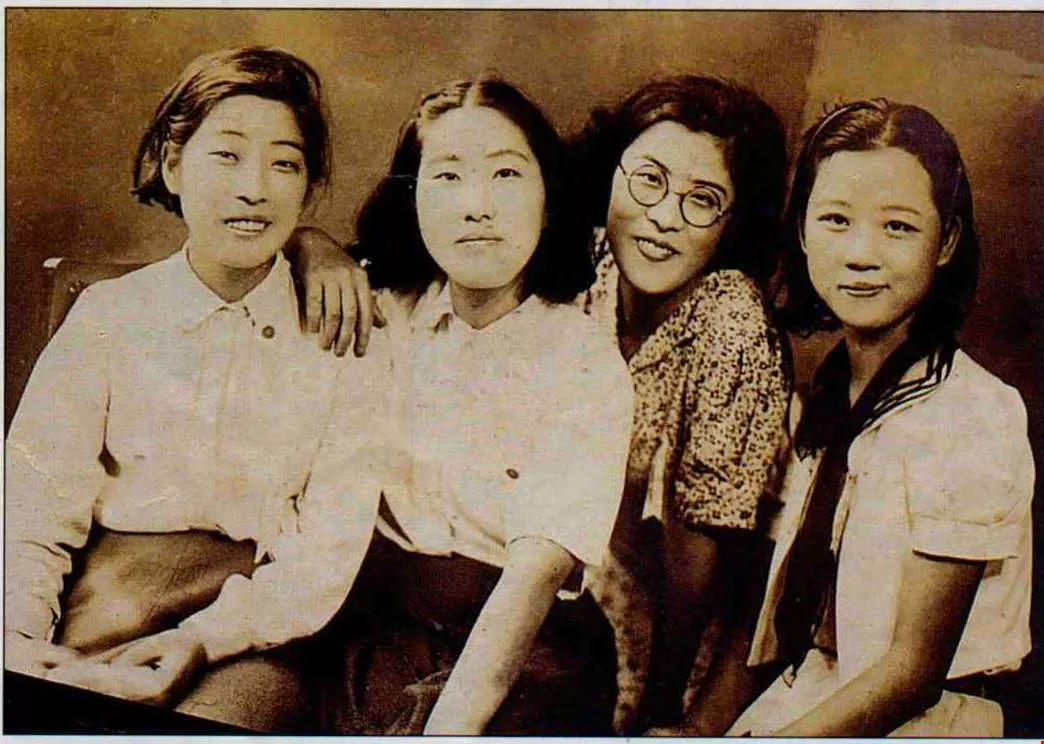
Chen Li-hung (first at right) had only three other female classmates. During the Japanese occupation, female photographers were rare indeed.
Her greatest dream--to study in Japan:
Once the photographers outside Chihnan Temple got to know her, the older men encouraged her to go and study in Japan. A new direction and purpose began to infuse Chen Li-hung's soul. She used to hand over the money she earned taking photographs to her father to help feed the family and only took back a little pocket money, but nevertheless, from then on she worked at her photography with a fresh vigor.
At the time of the Japanese occupation, retouching negatives was one of the most important skills in the photography business. A skilful retouch artist could make wrinkles and pockmarks disappear from a customer's face, which not only affected the quality of the photograph itself, but was also crucial to future business.
She heard that to get into a Japanese photography school she would have to sit an entrance exam: retouching a negative. So she managed to arrange to train for six months at a well-known photographic studio in Taipei City. By working as well as studying, she was able to earn around twenty Yuan a month. "In those days you could buy five pounds of pork for only one Yuan, " Chen Li-hung recalls.
The very idea of a young girl wanting to go abroad alone aroused a tumult of opposition from the outraged Chen family, but her father took her side, and in 1943, at the age of eighteen, Chen Li-hung sailed from Keelung harbor, and after four days and three nights at sea she arrived, dazed and seasick, in Japan.
Of the seventy-two students in her class, only four were girls; and only she and two other boys were from Taiwan. Pretty, young and quiet, Chen Li-hung became the focus of the male students' attention. In those old-fashioned times, the Japanese students at the photography school were mostly from well-to-do, leisured middle- to upper-class families. If girls came to study there it was assumed to be a pastime just " for fun," and so the male students rarely took them seriously.
Although some people were very friendly to Chen Li-hung, and gave her much help in and out of class, there were more who found it amusing to tease her, touch her immodestly or send her love letters. But she was tougher than she looked, and angrily complained to her teacher. One day the teacher sternly announced that any male student reported twice by Chen Li-hung would be expelled immediately. "They were so scared that for a while they didn't even dare speak to me!" Chen Li-hung remembers with a laugh.
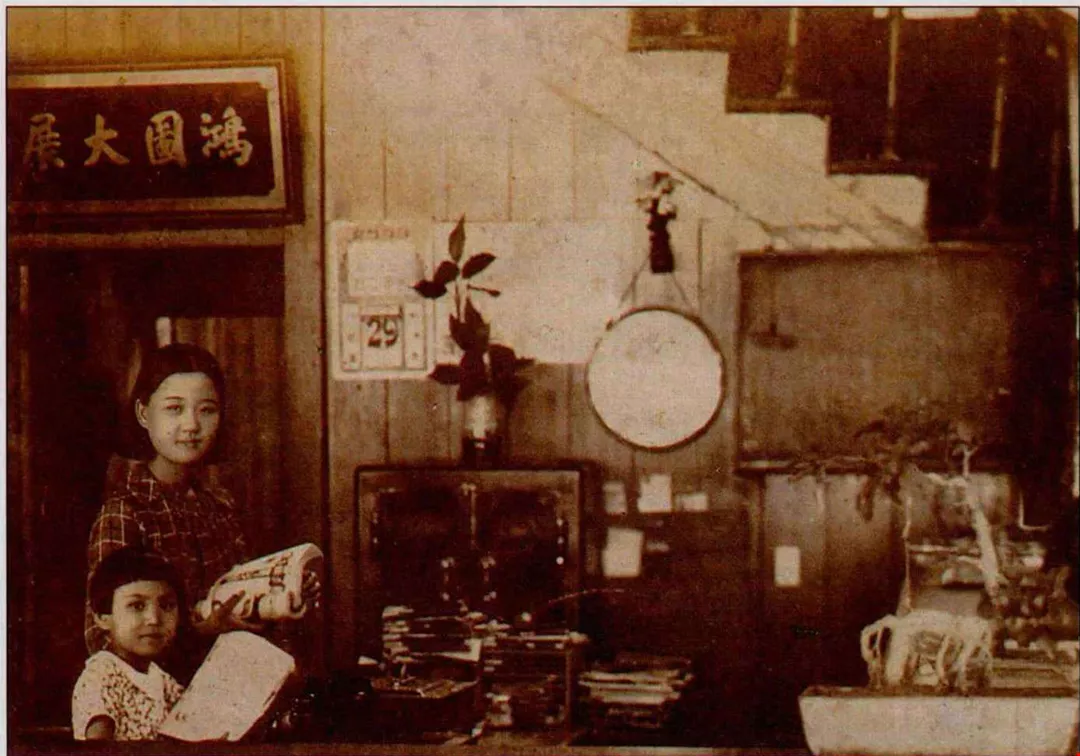
This is a photo of Chen in her home before retrocession.
An ambitious, able student:
Under her teachers' instruction, she grew more and more proficient at retouching. As well as praising her, her teachers found her many opportunities to put her talent to work. Out of class she would earn spending money by retouching negatives, and would even send money home at Chinese New Year and her parents' birthdays.
As her photographic technique improved, she felt more and more acutely that her knowledge of related areas was lacking, so she decided to devote some time to studying advertising and other relevant courses.
After one year, she graduated from the Toyo School of Photography, and then entered its graduate school to study commercial photography and print advertising. Courses at the school were wide-ranging; apart from photography, there were also cinematography and other related subjects. When Chen Li-hung was sent to the famous Matsutake film studios for practical training in stills photography, someone dragged her onto a set for a screen test. The producer's eyes opened wide with delight and he offered to hire this photogenic girl there and then as an actress, and start filming right away. But "my family didn't approve; Father said film stars don't come to a good end," so Chen Li-hung had no choice but to let that dream slip away. Worried that she would really pursue a career in film, her family telegraphed her to return home as soon as possible.
After World War II broke out, people went short of even the most basic things, never mind cameras and film. Chen Li-hung, whose only dream was to open her own studio, had no choice but to put aside her ambitions and go to work at Hsintien City Hall. Every day she would bind her money tightly in the waistband of her trousers, as she shuttled between the City Hall and the air raid dugout where she went to seek shelter from the bombs. "I didn't dare think about the future!" she recalls, unable to suppress a sigh.
In 1945 the Japanese Emperor went on the radio in person to announce Japan's unconditional surrender. Ordinary people filled the air with shouts of jubilation and wept tears of joy. And the photo studio which Chen Li-hung longed for began to take shape in her mind.
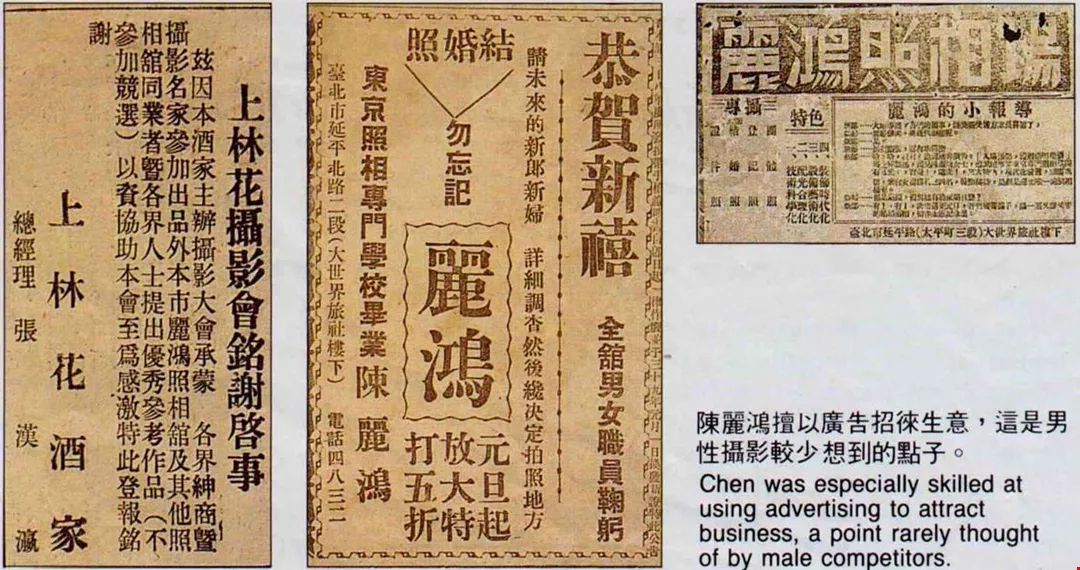
Chen was especially skilled at using advertising to attract business, a point rarely thought of by male competitors.
Setting the world on fire:
In the same year, putting together her voluntary severance pay from Hsintien City Hall and money given by her family, Chen Li-hung chose an auspicious day, and joyfully opened her studio in bustling downtown Yen-ping North Road. Her high window and stylish shopfront, which she had specially decorated by a designer, not only attracted passers-by; other photographers would often send someone to take a look and would even imitate her.
An old customer from those days remembers: "Her studio was ever so fashionable, it was worth going there just to see it!"
In a few years her business gradually became established. Chen Li-hung had a first-class head for business, and a deep sense of the importance of publicity; she was the first of Taiwan's photographers to promote her studio by advertising in the newspapers. She would take a hand in writing the advertisement texts too. One of her adverts, entitled "Li-hung Report," was very progressive for its time:
Fiance: Spring is here, and our parents have given their blessing to our marriage!
Fiancee: Then we should have our wedding right away!
Fiance: Absolutely!
Fiancee: Have you got the clothes for our wedding picture!
Fiance: Haha, haven't you seen Li-hung's ad? 'Suits and dresses provided free of charge when you come for your portrait with us" . . . I hear she graduated from a special photography school in Tokyo; we can choose daylight, natural background or electric light; they have all the latest equipment, the service is friendly, and there are three or four girl assistants who take care of everything; there's not another studio like it in all Taipei you know!
Fiancee: Well then, have you made an appointment with her?
Fiance: Yes, of course! I've chosen this coming New Year's Day; we'll go hand in hand, and she'll take such a sweet wedding picture, which we'll keep forever in memory of the day!
Quite a few people found their way to the studio with the newspaper still in their hand.
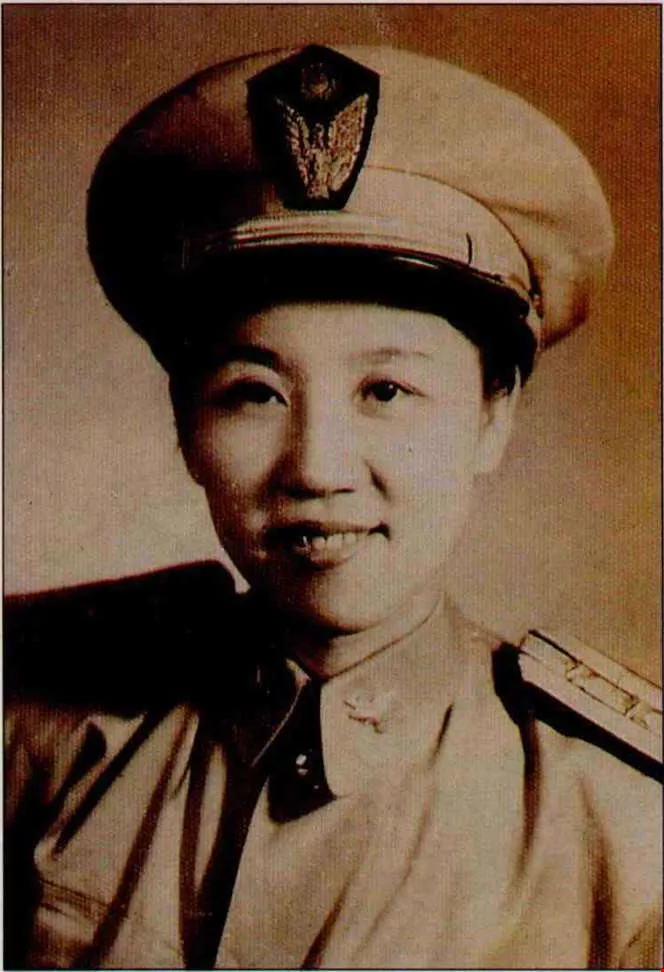
Women dressed as men were the fashion of the times; this is a photo of Chen herself.
A first-class head for business:
The moment customers came in through the door, Chen Li-hung would size up the way they were dressed, how they spoke and the expression on their faces, and before they said it themselves, she would often have guessed what they wanted the photograph for; this made many customers feel that the boss here was a real expert. And she would immediately make up her mind as to what lighting to use and how to pose the subject, which saved a lot of time discussing these things.
Because she was aware of the attraction between the sexes, Chen Li-hung would usually have a male photographer photograph women customers, while she herself would photograph the men. "In front of the opposite sex, people just look different!" Chen Li-hung says with a straightforward laugh, explaining that the customer's mood is very important, and must be considered from the outset. If a subject appeared not to have much confidence in a woman photographer, then once Chen Li-hung had finished taking the pictures she would hand him her business card; the customer would always be flattered to see that he was being looked after by the boss herself, and go away feeling thoroughly pleased.
In the studio itself there were seven or eight lamps at the ready, with two assistants busily adjusting the light and moving the lamps according to Chen Li-hung's directions. She explains that depending on whether a subject's face is long or short, fat or thin, they have to be photographed differently. For instance, a short face can be compensated for by shooting downwards from above, and the right lighting can make a thin face seem fuller. One should never let subjects wait too long in front of the camera, or they will start to appear awkward. When taking a husband and wife, they should be positioned with their faces and shoulders towards each other, not turned away, to express their reliance on each other. And when photographing old or rather conservative people, one should only use level lighting, and not shine a light on their hair for fear of making it look white, or they may think one is deliberately making them appear older or ill-fated.
Chen Li-hung never stopped studying, and twice went to Japanto study cosmetics, for "photography and make-up are related." In the early days, when taking wedding photos, she would have to make up the bride's face; she reveals that if she made her look good to begin with, then it saved a great deal of work retouching the negative later. Under her skilled hands, minor defects such as dry, wrinkled skin, flat noses, small eyes or big mouths would be improved upon before a customer's picture was taken, saving a lot of effort later.
In those days, ordinary photographs were ten dollars a set, and deluxe photos fifteen dollars, while most people's wages were only a few dozen dollars a month. The Li-hung Studio did a roaring trade, with customers having to register and take an appointment card; just the takings from family group photographs at Chinese New Year would have been enough to keep the business afloat for the whole year.
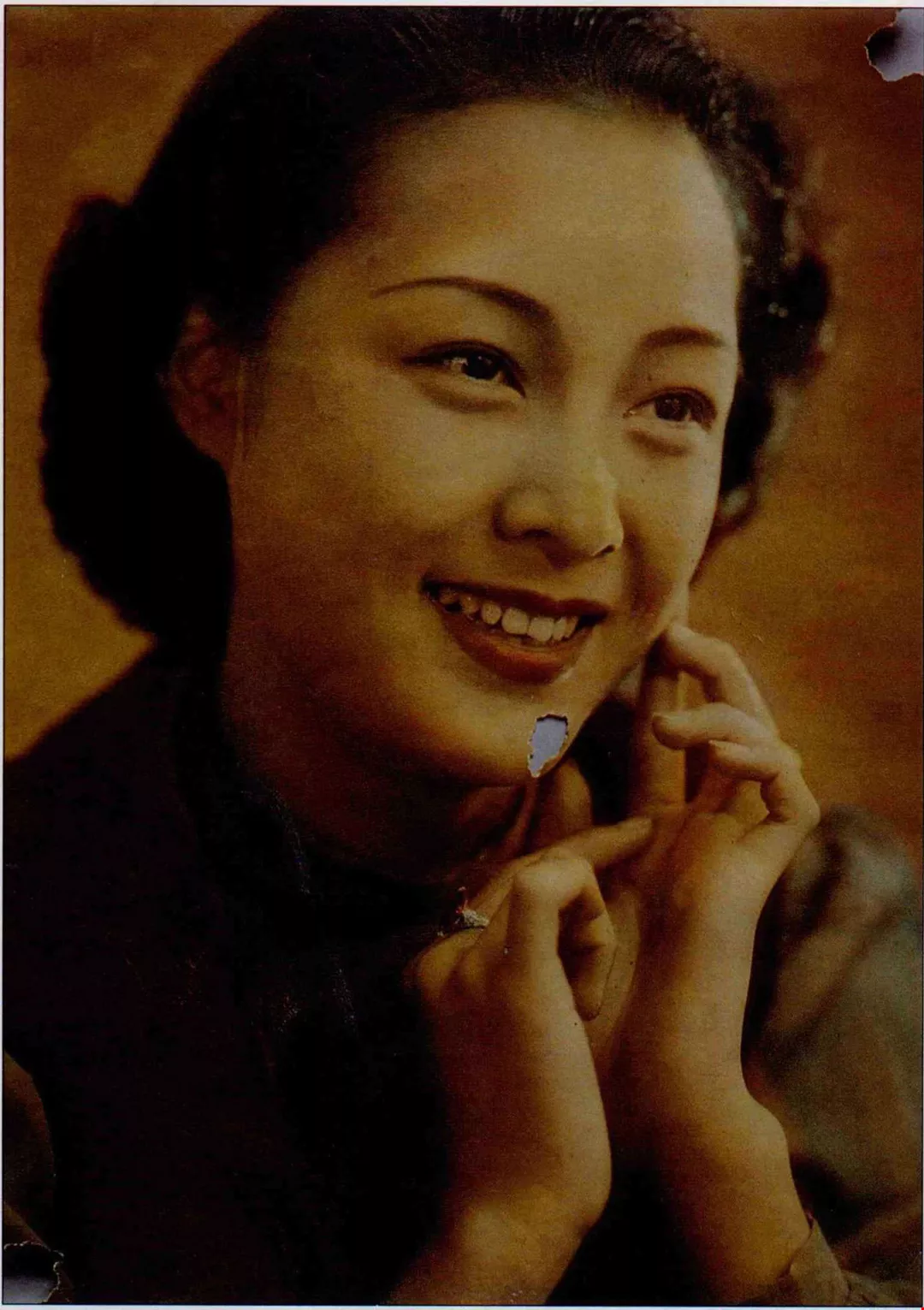
Chen Li-hung's graduation work: She made a black and white photo into a color one, showing her skilful retouching.
A woman's touch in management:
One old and respected photographer, who like Chen Li-hung herself graduated from the Toyo School of Photography in Japan, comments that Chen Li-hung's secret lay in promoting her business by making skilful use of the prestige of studying in Japan, of media advertising and of special offers; these were ideas that would not even have occurred to many of the less imaginative male photographers.
Over thirty years, the Li-hung Studio grew from hiring five or six photographers to employing fifteen or sixteen. Some were even brought over from Hong Kong, and some stayed for ten years or more. Chen Li-hung's style of management was looked upon as something special by others in the business.
She had studied personnel management techniques at a business school in Japan, and from the time when an employee started working for her, she would deposit a monthly sum as severance pay, so that the longer a person stayed, the more they would collect when they left. At the end of each year she would also give a bonus according to performance, and not just pocket the profits herself. She would encourage her most talented employees to set up on their own, and would even lend them the money to do so. "Once they started a family, naturally they would need more money, so they couldn't go on working for someone else . . . . In the old days people were more settled, and might stay with one company all their working life; they would usually only set up on their own if they got married." She says that at the time she never thought about whether she was doing good deeds, she just knew it would have been wrong to do any different! When some of her photographers were slow to marry, she would even play the matchmaker herself, and over the years brought four or five couples together.
Described as "honest to everyone and absolutely straight with her friends" by Chi Hsiu-mao, another old-school photographer who also studied at Toyo School of Photography, Chen Li-hung was not only good at running her own business, but thanks to her characteristic enthusiasm and straightforwardness, and because she had organized various activities and made very many friends, in later years she was able to take on the role of peacemaker in disputes between members of her profession. Her love of harmony not only brought her success in her own business, it also helped make her the first woman ever to become chairperson of one of Taiwan's trade associations.
The first time she stood for election as chairwoman of the Taipei Photography Association, she says, "I was elected, but they didn't want to let me take the job." Some of her colleagues still had male chauvinist ideas, and felt that being led by a woman would be undignified; they "even tried to persuade me that I could do the work, but they should use someone else's name." But she did not give up so easily and insisted on taking on the job, completing not only her first term in office, but going on for a total of four terms as chairwoman of the association.
With social changes and the rise of the new style of wedding photography with all its tricks, the rigid stylistic rules and lighting techniques of the old generation of photographers trained during the Japanese occupation gradually fell from favor. Chen Li-hung decided to change her business strategy and concentrate on video filming. Her nephew Chen Po-tang, whom she raised after her younger brother's death, is now her right-hand man, and she has gradually relinquished her business responsibilities to devote herself to her work with civic organizations. But thanks to her wide circle of friends, her business continues to flourish.
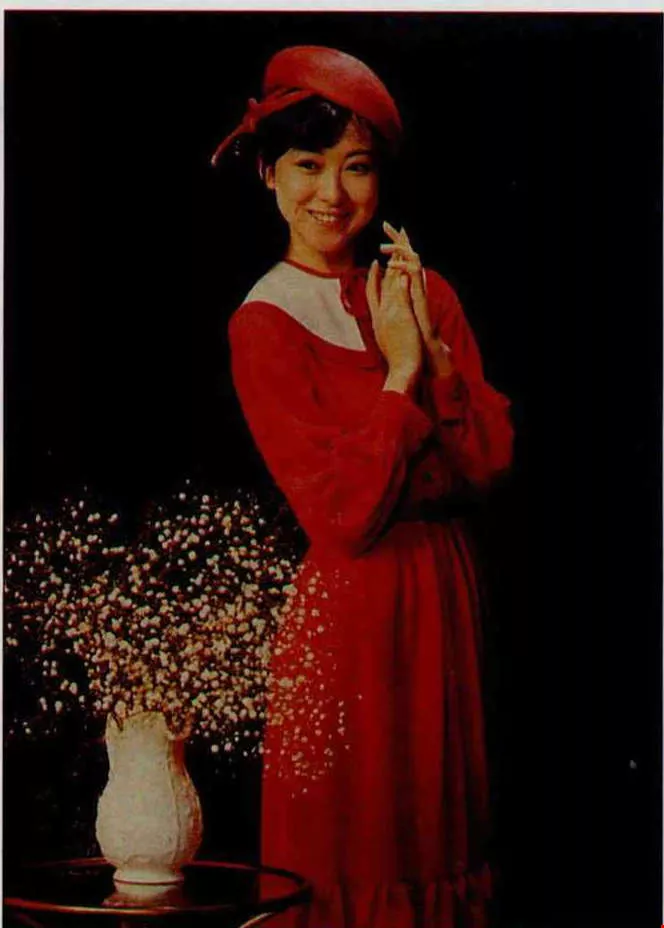
A color photo taken of a customer by Chen Li-hung. The lighting technique is mid-level, creating a richly soft effect.
"I've not done badly:
" Still full of vitality despite her almost seventy years, when Chen Li-hung looks back on her life, she says "I've not done badly." When asked how she has been able to hold a place of honor in the male-dominated world of photography for so many decades, she thought for a moment with her head to one side, then said with traditional Chinese feminine shyness: "By putting everything into my work, I suppose!"
In the eyes of her family and friends, Chen Li-hung's life has certainly not followed the path traditionally mapped out for a Chinese woman. If she has any regrets, is not having married one of them?
Chen Li-hung never married, but there was a time in her youth when she made wedding plans.
He was from Penghu, a graduate of Meiji University in Japan, well-mannered and sophisticated; they had met at a dinner party and got on like a house on fire. Unusually in those straightlaced days, he not only had nothing against Chen Li-hung studying in Japan, he approved of her working in photography, a business seen by many as unsuitable for a woman because it involved "showing one's face in public," and he often gave her words of encouragement. But when World WarII broke out, he was conscripted and sent to the South China Sea, and never came back. "They say that a lot of them caught strange diseases there; when they died they were dismembered and cremated, and their ashes sent back to their families in Taiwan." But in his case, she says faintly, "not even his ashes came back."
Reminded of him, Chen Li-hung can only say over and over again: "It was such a pity!" Fifty fleeting years on, she says, "Now I just sing karaoke, and I forget about everything!"
So unsentimental in everyday life, when she stands in the karaoke club and sings the Japanese song "A Man's Pure Love," who can discern whether a tear wets her eye?
[Picture Caption]
p.25
(photo by Vincent Chang)
p.26
Chen Li-Hung studied photography in Japan. This is a commemorative photo taken in front of the Toyo school; the year is 1943.
p.26
Chen Li-hung (first at right) had only three other female classmates. During the Japanese occupation, female photographers were rare indeed.
p.28
This is a photo of Chen in her home before retrocession.
p.28
Chen was especially skilled at using advertising to attract business, a point rarely thought of by male competitors.
p.29
Women dressed as men were the fashion of the times; this is a photo of Chen herself.
p.30
Chen Li-hung's graduation work: She made a black and white photo into a color one, showing her skilful retouching.
p.31
A color photo taken of a customer by Chen Li-hung. The lighting technique is mid-level, creating a richly soft effect.


