Long-Lost Relatives--Taiwanese Opera on the Mainland
Tsai Wen-ting / photos Pu Hua-chih / tr. by David Mayer
November 2001


Ever since the ban on cross-strait travel was lifted over a decade ago, people with a special interest in various cultural pursuits have flocked to mainland China to get a first-hand look at the land where their chosen interests originated. The tables have been turned in one instance, however. Of the 300-plus types of traditional Chinese opera still performed today, there is a relatively young genre that theater buffs from the PRC have to travel to Taiwan for if they want to see where it was born. Taiwanese Opera, or gezai xi, was first performed in Ilan County some time during the second decade of the 20th century.
It didn't take long at all for the newly born Taiwanese Opera to make its way to mainland China. It proved popular there, and came to be known as Xiang Opera in the Zhangzhou area, while in Xiamen they continued to call it gezai xi, as in Taiwan. Later the mainland fell under the control of the Communist Party, and the societies on the two sides of the Taiwan Strait developed in isolation from each other for close to 50 years. Now, after theater reforms and the impact of the Cultural Revolution, we find that gezai xi in Taiwan and mainland China have diverged in some ways.
Early this autumn a conference was held to examine how Taiwanese Opera has developed over the past century in Taiwan and mainland China. Organized by the Liao Chiung-chih Taiwanese Opera Foundation on behalf of the Preparatory Office of the National Center for Traditional Arts, the conference focused on four cities that have played an important role in the development of this theater genre: Taipei, Ilan, Zhangzhou, and Xiamen.
In addition to academic discussions at the conference, scholars and performers of Taiwanese Opera from Taiwan and the PRC traveled to Yuanshan Rural Township in Ilan County to see the old tree where "gezai Chu" first sang gezai xi nearly a century ago. While there, they took in a performance of "local gezai," the earliest form of Taiwanese Opera, at a park in Yuanshan Rural Township. There they watched as a group of amateurs put on a jocular performance of "Shanbo Checks in at Mrs. Wang's Inn." The actor playing the part of Liang Shanbo was attired simply in a traditional Chinese button-down shirt, and the actor playing the part of Liang Shanbo's attendant was dressed even more casually in a T-shirt. "Liang Shanbo and Zhu Yingtai" is supposed to be a love story, but, says Lin Mao-hsien, a lecturer in the Chinese department at Providence University in Taichung who specializes in "local gezai": "The actors at the park that day heightened the comedic aspects. Their dialogue was very colloquial, and the costumes were extremely simple. The whole idea was to have fun and entertain the audience, and that is exactly what the local gezai of 100 years ago was like."
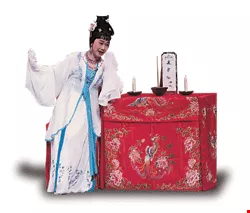
Zheng Xiuqin (top), a Class I performer from mainland China, and Liao Chiung-chih, touted as the best in Taiwan at performing tragic female roles, go head-to-head with the best opera they can serve up. The weeping on stage moved the audience to tears.
Dueling dames of the opera
If the day trip to Yuanshan Rural Township was interesting, the nighttime activities were probably even better, with famous Taiwanese Opera stars from the Taiwan and the PRC strutting their stuff in a cross-strait duel of sorts. Liao Chiung-chih, winner of Taiwan's National Arts Award and touted as the best in Taiwan at playing tragic roles, came on stage dressed in the tattered black rags of Wang Baochuan, who bids a heart-wrenching farewell to her husband amidst the sound of drums calling him back to his military unit. Representing the PRC was mainland China's only gezai xi performer to be designated a "Class I" artist, Zheng Xiuqin, who gave a stirring rendition of the inconsolable grief of the main character crying before her husband's memorial tablet in "Li Miaohui Weeps Through the Night."
The top two starlets from Taiwan and the mainland up on stage crying their eyes out soon had everyone in the audience on the verge of tears themselves. The interesting thing was that gezai xi in Taiwan and the PRC is so alike yet noticeably different in every way, including vocal style and costumes, not to mention the life stories of the actors themselves.
"Some things struck a very familiar chord, such as the gezai melodies, the use of Minnan [southern Fujianese] dialect, and the repertoire. What was different were the vocal and acting styles." This was the observation of Tsai Hsin-hsin, executive director of the Liao Chiung-chih Taiwanese Opera Foundation. According to Tsai, mainland Chinese actors alternate between falsetto and their natural register. They incorporate various techniques from Peking Opera and Western opera. The mainland Chinese vocal and acting styles are very standardized. Taiwanese actors, on the other hand, sing in their natural register. Their acting style is less stylized and more attuned to the tastes of everyday people.
The differences between the two schools of Taiwanese Opera are mirrored in the careers of its two biggest stars, which speak volumes about the diverging paths that the two "sister operas" followed during the half-century after their separation.
Taiwan's best "wailer" is Liao Chiung-chih, who grew up as a sort of "indentured apprentice" of an opera troupe. Liao has performed at every possible type of venue: outdoor stages, indoor theaters, radio, and television. Starting out on the margins of society, looked down upon for her involvement in the stage life, she has now climbed high in society, and is the recipient of a prestigious national arts award. With her superb acting and singing skills, and her wealth of experience in the school of hard knocks, Liao is able to invest real emotion in a role that involves weeping, and her racked sobbing often gets the women in the audience crying right along with her.
The top gezai xi performer in mainland China, Zheng Xiuqin, grew up in the town of Longhai, Fujian Province, where gezai xi is very popular. At the age of 12, she ran away from home with no possessions and tested into the state-run Zhangzhou Experimental Xiang Opera Troupe. From that time forward she has always performed in state-run professional opera troupes. She has done traditional opera, the model operas of the Cultural Revolution years, and contemporary opera, and won recognition as a National Class I actress for her performance in "Spirit of the Opera," a contemporary work of gezai xi. She was subsequently made a delegate to the National People's Congress. In spite of her petite size, Zheng has a very powerful voice: "I can sing as deep as the ocean and as high as the mountains. I can sing in every register." She believes that a song of weeping is a form of artistic expression, and should be beautiful, rather than sound like half-singing, half-crying.
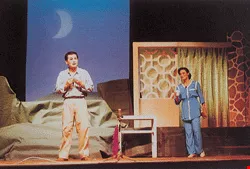
Gezai xi (or Xiang Opera, as it is often called in the PRC) has undergone many changes. Gezai xi troupes in the PRC place great emphasis on contemporary opera and works based on historical episodes. Zhangzhou Xiang Opera Troupe is shown
Two types of gezai xi
Although gezai is the youngest of the 30 or so types of traditional opera that are popular in Fujian Province, it is very well loved by the people there, and is considered one of the five major opera forms of Fujian, along with Min Opera, Chao Opera, Gaojia Opera, and Liyuan Opera. It is most popular in southern Fujian in the Zhangzhou and Xiamen areas. Zhangzhou, in particular, is known as "a gezai xi hotbed."
There were once ten state-run Xiang Opera troupes in Zhangzhou, but the number has been falling in recent years as troupes have begun to merge. The largest of these troupes has about 120 performers and the smallest employs about 60. State-run opera troupes have large numbers of professional performers and spearhead the development of gezai xi in mainland China. Since China embarked upon its policy of reform and liberalization over 20 years ago, however, private, professional Xiang Opera troupes have proliferated, and now number around 300 to 400.
The cross-strait conference on Taiwanese Opera in August started off in Taiwan before shifting venue to Zhangzhou. Fruit vendors on the street in Zhangzhou sell bananas, longans, and pineapples from Taiwan, while the night-market stands sell shaved ice with fruit toppings and other dishes that are very familiar in Taiwan. Visitors often hear strains of Taiwanese pop songs as they make their way through the streets. It all makes the place feel very familiar. A friendly pedicab driver in the city told us in Minnan dialect: "You call it gezai xi in Taiwan and we call it Xiang Opera, but there's no difference." Because the Minnan speakers of Taiwan are all of southern Fujianese stock, Taiwanese Opera was able to spread from Ilan in the 1920s and become very popular in Zhangzhou and Xiamen, and even in parts of Southeast Asia where there are large concentrations of Minnan-speaking overseas Chinese. In all of these places, almost everyone can hum at least a tune or two from Taiwanese Opera.
Taiwanese Opera was developed in the early years of the 20th century by a man nicknamed "gezai Chu," whose ancestors had come to Taiwan from Zhangpu in Fujian Province. Starting out with the four-part Jin Ge musical chorus popular in southern Fujian and Taiwan, he threw in elements of Nanguan Opera, Beiguan Opera, Peking Opera, and Fuzhou Opera. The resulting melange, sung in the local Minnan dialect, came to be known as gezai xi, or Taiwanese Opera, a very easy and enjoyable opera form that grew within 20 years into the most popular opera genre in Minnan-speaking areas. Troupes in Taiwan that had specialized in Beiguan, Gaojia, and Liyuan Opera switched over to Taiwanese Opera, and thanks to the close ties between Taiwan and Fujian, Taiwanese Opera took southern Fujian by storm in the 1920s and 30s.
People traveled in great numbers across the Taiwan Strait in the 1920s. A report from that time prepared by the Japanese consulate in Xiamen indicates that over 6,000 Taiwanese people resided in Xiamen, and more than 20,000 traveled back and forth frequently. As the main port of departure for persons heading to Taiwan and Southeast Asia, Xiamen was naturally the port of entry when Taiwanese Opera made its way from Taiwan to the mainland.
For a long time, everyone believed that Taiwanese Opera made its mainland China debut in 1928 when the San Yue Opera Troupe went to perform at a religious event in a village in Fujian called Baijiao. While en route the troupe performed for three days in Xiamen and, as the story goes, went on from there to become a big hit in Xiamen and beyond. More recent delving into historical records, however, has overturned this version of events. It is now known that an opera troupe in Xiamen (the Two-Pearl Phoenix Opera Troupe) had already switched from Liyuan Opera to Taiwanese Opera in 1925.
After Two-Pearl Phoenix scored a huge hit the very first time they performed "Liang Shanbo and Zhu Yingtai" on Gulangyu Island in Xiamen, they began hiring large numbers of Taiwanese Opera performers. The troupe grew from 30-plus to more than 50 members. The next year, a troupe from Taiwan called Jade Orchid Opera performed for four months running at the New World Theater in Xiamen. Taiwanese Opera houses started popping up all over Xiamen. Shao Jianghai, who would later become an important innovator of Taiwanese Opera on the mainland, was a huge fan of the genre already at that time.
In 1932, Communist troops occupied Zhangzhou for a time. A businessman who fled to Xiamen later returned to Zhangzhou after the Communists left, carrying Taiwanese Opera librettos with him. He hired a group from Taiwan, Nisheng Opera Troupe, to perform in Zhangzhou. Taiwanese Opera caught on quickly, and soon even the hawkers peddling breakfast on the streets were using gezai tunes to tout their eats. There is one story about a bandit leader who ordered his henchmen to "invite" a Taiwanese Opera troupe to put on a performance at his mountain stronghold.
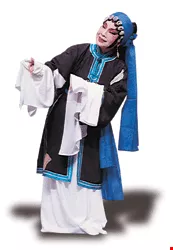
Zheng Xiuqin (top), a Class I performer from mainland China, and Liao Chiung-chih, touted as the best in Taiwan at performing tragic female roles, go head-to-head with the best opera they can serve up. The weeping on stage moved the audience to tears.
Trouble left, trouble right
No different than the larger society, however, Taiwanese Opera was to endure many tragic twists over the ensuing years. After war broke out between China and Japan in 1937, the Kuomintang government banned Taiwanese Opera on the mainland because Taiwan was then under Japanese colonial rule. Some Taiwanese Opera performers were even branded as traitors and thrown in prison. Taiwanese Opera was also banned in Taiwan by colonial authorities who were in the midst of a campaign to convert the Taiwanese into loyal subjects of the Japanese emperor. Fortunately, Taiwanese Opera turned out to be a hardy survivor, and was able to pop up once again in disguised form, with new forms of music and acting mixed in.
In the mainland, Shao Jianghai replaced the qizi style, which was the main style of Taiwanese Opera, with something called the zasui style, which he had been developing in his mind for quite some time. This new version of Taiwanese Opera was dubbed "Reformed Opera" by Shao, who cleverly managed thereby to sidestep the official prohibition. Taiwanese Opera troupes in Taiwan resorted to similarly creative subterfuge, creating new story lines involving wandering samurai and their bushido lifestyle. These hybrid performances were known as ho pe la hi in Minnan dialect (meaning "mish-mash opera," but with "ho pe la" also being a pun on "opera").
In 1949, mainland China fell to the Communists. Just prior to the Communist takeover, the Duma Taiwanese Opera Troupe of Xiamen had traveled to Taiwan with the intention of performing around the island and returning to Xiamen the next July. Little did they know that it would be impossible to return. Duma's new style of gezai xi proved very popular in Taiwan, and people began referring to Shao Jianghai's zasui style as the duma style. It became one of the two main types of Taiwanese Opera, along with the original qizi style. Both were big in Taiwan, but from that time forward, due to the cutoff of cross-strait contacts, the gezai xi of Taiwan's private troupes and the Xiang Opera performed by the state-run troupes of Fujian gradually diverged.
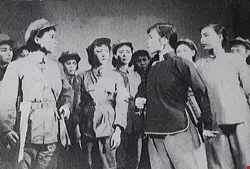
There are more than 300 genres of traditional Chinese opera performed in the PRC, but during the turmoil of the Cultural Revolution all troupes were required to emulate a handful of revolutionary model operas. Gezai xi was no exception. Shown here is a performance of "Qiong Hua." (courtesy of the Xiamen Municipal Institute of Taiwanese Arts)
Politics at the helm
For several decades, all cultural activities were pressed into the service of politics. "The central government began to attach great importance to theater in the 1950s," says Chen Geng, who has been named a National Class I playwright and is currently head of the Xiamen Taiwan Arts Institute. "They established lots of opera academies and state-run opera troupes," says Chen, "and they set many new literature and arts workers to the task of reforming traditional Chinese opera." Once Taiwan and the mainland fell under divided rule, the people on either side of the Taiwan Strait found themselves living in very different cultural milieux.
Political slogans abounded thereafter in mainland China. In the world of opera they said that reform meant "changing opera, changing people, changing the system." The focus of opera reform was summed up as follows: "one priority, two legs to walk on, three items of equal importance." The "one priority" was arts education. The "two legs to walk on" was a reference to the importance of state-run professional opera troupes and the encouragement of private theater troupes. And the talk about "three items of equal importance" meant that traditional opera, contemporary opera, and newly composed works dealing with historical subjects were all equally deserving of attention.
The first leg of reform ("changing opera") included a ban on traditional operatic works that dealt in any way with frightening murders, superstitious beliefs in ghosts or spirits, or sexually risque subject matter. In addition to banning "bad opera," the authorities promoted the creation of contemporary works with edifying content. Among the countless examples are "Elegy of the Emerald Waters" (about someone who dams a river to fight the effects of a drought), "Tears of Taiwan" (about the 228 Incident), "The People's Militia of Fish Island," and "Expelling the Dutch."
The second leg of reform was to "change people." Almost all opera scholars threw themselves into the effort to reform the way opera troupes went about their affairs, and Chinese opera academies turned out large numbers of graduates with uniformly high skills. Opera troupes enjoyed much better conditions back then in the PRC than was the case in Taiwan, where Taiwanese Opera troupes were left to their own devices. Lin Jingquan, a graduate of a national music academy in Fujian Province, edited the lyrics of many gezai xi librettos, making them both colloquial and elegant at the same time. He devised a new cadence, and tied the vocal music more closely to the characters and plots. His efforts greatly improved the quality of gezai xi and helped bring about the great flourishing of gezai xi that was to occur in the 1960s.
But the most important of the three legs of opera reform was "changing the system," which put an end to the tradition whereby all the attention was directed to a few big stars. In the Peking Opera work entitled "Yang Guifei Gets Tipsy," for example, superstar Mei Lanfang made the piece work beautifully with his fine performance despite the fact that there was no plot or dialogue. But today, says Wu Ziming, art-director and director of the Zhangzhou Xiang Opera Troupe, "opera is a collaborative art form. Opera in mainland China no longer trains the spotlight on a single performer. The performer is just one part of the overall concept." For this reason, gezai xi in mainland China has famous operatic works, but no famous performers. The situation stands in contrast with Taiwan, where big stars like Yang Li-hua, Ye Ching, and Tang Mei-yun have established their own troupes. In the past, gezai xi troupes never had scripts. Instead, they would decide on the day of the performance what story was to be performed, a man would hang out placards with the name of each scene, and the performers would wing it. Actors and musicians would communicate with hand signals to make sure everyone knew what was coming next. Standardization in mainland China has put an end to all that. The script has come to take on greater literary weight, and the focus of a troupe is no longer a star performer so much as the script itself, and the director.
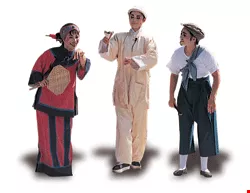
Huang Ganghe (top), a veteran performer with a gezai xi troupe in Xiamen, plays the role of Old Uncle Sung in "Chen San and Wu Niang," his every movement executed with precision. Old-style gezai xi in Taiwan's Ilan County, by contrast, features folksy dialogue and simple costumes, which is what gezai xi was like back in the early days.
Model operas rule the roost
After the Cultural Revolution was launched in 1966, every single one of the 300-plus types of Chinese opera in mainland China was forced to conform to the precepts of the model operas. For gezai xi, says Chen Geng, it meant that "scripts became homogenized, the directing came to resemble that used for a non-musical stage play, the costumes came to resemble those of Yue Opera, and the acting came to resemble Peking Opera."
All forms of traditional Chinese opera were banned, and the scripts, books, costumes, and props were burned.
Scholars from the PRC point out that critics of the model operas mainly zero in on the sameness of the scripts, the emphasis on class struggle, and the fact that all the rich diversity of Chinese opera was reduced to just a handful of model operas. But one scholar notes that "the overall artistic level of the model operas was actually very good, especially the music." Huang Ganghe, a 63-year-old veteran gezai xi performer in Xiamen, likes the way every single note of the music was synched to the movements of the performers: "There was a definite sense of climax and emotion. The model operas had a quicker pace."
The best artists from throughout the nation were brought together to create eight model works of Peking Opera, and these were used to teach aspiring young performers in local troupes and academies everywhere. The acting movements, lights, choreography, every gesture, every position taken on the stage, and the rhythm all had to be based as closely as possible on the model Peking Operas. Any performer who got a bit careless might find himself labeled a "saboteur of the model operas."
They took to singing in the very high-pitched falsetto of Peking Opera, while the costumes and makeup were based on Yue Opera. As a result, gezai xi gradually lost its distinctive character, and came more and more to resemble Peking and Yue Opera. There was also the problem of tailoring southern opera for a northern audience. Chen Bin, a gezai xi music composer who graduated from the music department at the Fujian Provincial Academy of the Arts, has noticed that when he composes music for a contemporary gezai xi work, stirring Western symphonies or military tunes always come into his head subconsciously, which is very much at odds with the warm, homey emphasis of traditional gezai xi.
The impact of the Cultural Revolution did not come to an end with the Cultural Revolution itself. According to Yang Fu-ling, an assistant professor at TzuChi University whose doctoral dissertation was a comparison of gezai xi in the PRC and Taiwan: "The generation of directors who graduated from the academies and took part in the model operas of the Cultural Revolution have continued to be very deeply influenced by the model operas ever since."
After the PRC moved forward with its program of reform and liberalization in the 1980s it became possible once again to take to the stage in ancient garb, but directors, having been through the Cultural Revolution, have made great changes. Guo Zhixian, a gezai xi director in Xiamen who studied in Shanghai during the Cultural Revolution and is now president of Fujian Provincial Academy of the Arts, borrowed the montage technique of cinematography, quickened the pace, shortened the length of each scene, and began using more pronounced lighting changes. Considered a "Shanghai-style director," Guo has brought to gezai xi a decidedly contemporary feel.
The early years after the launch of reform and liberalization in the late 1970s were a high point for gezai xi in the PRC. Chen Bin, who composed music during those years for the Zhangzhou Xiang Opera Troupe, recalls that opera troupes were big money makers at the time: "We performed 'Liang Shanbo and Zhu Yingtai' for a whole year, and ticket sales were outstanding. We never had any chance at all to get out and tour in rural areas."
After going through the fierce struggles of the Cultural Revolution and getting sent down to do backbreaking labor in the countryside, gezai xi composers in the mainland created many new scripts with very trenchant themes. The veteran Chen Zhiliang wrote the very humorous "Rice Dumplings and Soybean Milk," which displays the happy-go-lucky, easygoing temperament of the people of southern Fujian. The younger scriptwriters Yang Lianyuan and Fang Chaohui wrote a gezai xi work (based on the Taiwanese novel "End of the Play") that depicted the adversities faced by gezai xi performers trying to get by in a society in transition. The work elicited a strong response at a big national contest and became the only gezai xi work to win the national Wenhua Prize. On the strength of her performance in "End of the Play," Zheng Xiuqin was named a National Class I performer.
During the current period of reform and liberalization, political interference has largely been replaced by another problem: competition from a wider variety of entertainment alternatives in a more open society. Once overwhelmingly popular, traditional Chinese opera has been rapidly eclipsed by all sorts of new diversions. State-run gezai xi troupes have lost their following in the larger cities, and now must compete with strong private troupes for the chance to perform on rural stages at festivals and holidays.
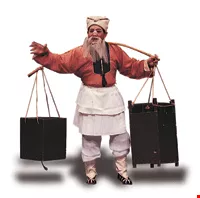
Huang Ganghe (top), a veteran performer with a gezai xi troupe in Xiamen, plays the role of Old Uncle Sung in "Chen San and Wu Niang," his every movement executed with precision. Old-style gezai xi in Taiwan's Ilan County, by contrast, features folksy dialogue and simple costumes, which is what gezai xi was like back in the early days.
Get the hell out!
According to Lin Ku-fang, director of the Graduate Institute of the Arts at Fo Guang University, "Taiwanese Opera is very highly regarded in Taiwan, but on the mainland it's just one of more than 300 different regional opera genres. In that environment, it is naturally more subject to the influence of other types of opera." Yang Fu-ling has found in the course of her field research that for gezai xi troupes in the mainland, "the only way to survive is to seek a foothold in a city and work for recognition at the national level." Because the national government provides 80% of the funding for state-run opera troupes, says Yang, how well a troupe fares with the judges at big contests has a decisive impact on how much money it receives. A gezai xi troupe in the PRC will pour its resources into the creation once every few years of a new work aimed at winning a prize. If a troupe can win the Wenhua Prize, the highest honor in the world of Chinese opera, its reputation will soar.
The judges at the big contests mostly come from Beijing, and one scriptwriter confides that in order to make gezai xi more accessible to judges who don't understand the Minnan dialect, he consciously tinkers with the dialect in his operas so that it resembles Mandarin as closely as possible. When Shih Hui-chun, a gezai xi performer from Taiwan, took part in the big cross-strait conference on Taiwanese Opera this past August, she was disconcerted by the heavy use of falsetto and the strange brand of Minnan dialect used on stage: "In Taiwan when we tell somebody to 'get the hell out of my house,' Minnan speakers normally say shi chio ki, but in the gezai xi from the mainland they had taken the Mandarin expression, gun chu qu, and translated it directly into Minnan dialect. I had to read the subtitles up on the screen just to understand what was said. It was a real barrier for me." Private opera troupes in the PRC agree that state-run troupes these days seem to be performing only for the benefit of a few experts off in Beijing, and that this is different from what gezai xi has always been: an easily accessible form of entertainment for ordinary people.
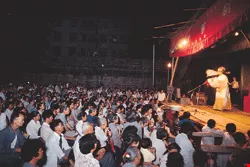
Gezai xi troupes are still in strong demand for performances at temple fairs and weddings in rural southern Fujian Province. Troupes are generally booked solid for more than a half year in advance.
Gezai goes Broadway
The cross-strait conference on gezai xi in August closed in Xiamen with a performance of a big new production called "The Egret Goddess," an important work that premiered in 1998. After eight revisions of the script, the conference organizers invited Dong Shaoyu (a Class I Peking Opera director) and Xie Ping'an (a noted director of Sichuan Opera) to direct the performance in Xiamen.
The story borrows on the fact that Xiamen is affectionately called Egret Island, and features an egret goddess and a scholar named Wan Shi who do good things for ordinary people. The egret goddess uses a magic feather to do her good deeds, while the scholar uses a Chinese lute. The pair get married, but the Snake King arrives disguised as a local village girl and steals the magic feather. In the end, Wan Shi turns into a huge boulder to pin down the Snake King, while the egret goddess gives up her magic feather to save the island, which has been laid to waste. Thanks to the sacrifices of Wan Shi and the egret goddess, the people are able to live in peace once again.
An orchestra in the pit played many new compositions while up on stage dozens of dance academy performers stirred into action when the egret goddess took wing, got married, battled with the Snake King, and so on. Tseng Young-yih, a professor at National Taiwan University and chairman of the Chinese Folk Arts Foundation, concedes that "the show was quite pleasing aesthetically," with all the graceful young limbs and beautiful costumes. But he is not pleased with the changes: "They haven't held onto what is truly beautiful about regional opera. What makes gezai xi special is its witty language and the traditional dance elements that it inherited from Chegu Opera and Liyuan Opera. The singing and dancing that they've introduced in the PRC is like an infusion of the wrong blood type: It could result in death."
In fact, it is not just people in Taiwan who make that criticism; even opera buffs in the mainland make similar comments: "It's like watching a stage musical. It doesn't seem like gezai xi." Opera fans in Xiamen, who are able to watch programming from Taiwan's three broadcast television stations, showed up at the gezai xi conference to jostle for a signed photo of Shih Hui-chun, whom they often see on TV. One of the visitors said: "We folks living in the coastal region prefer the gezai xi from Taiwan. We old folks don't like the new gezai xi." Veteran Taiwanese performer Tu Yu-chin feels that even though the mainland performers move about the stage very beautifully, they don't get the viewer emotionally involved: "It's all very standardized, and not very expressive. They don't make you cry or laugh."
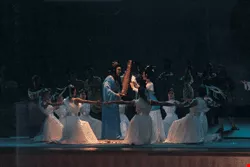
With its artsy lighting and choreography, there is a distinct Broadway flavor to "The Egret Goddess," performed by Xiamen Municipal Gezai Xi Troupe. In recent years, state-run opera troupes in the PRC have worked hard to change gezai xi in hopes of attracting young audiences to traditional Chinese opera, but some critics feel that the changes are increasingly distancing gezai xi from its audiences. (photo by Tsai Wen-ting)
Caged in the zoo
Has this newfangled gezai xi lost sight of its audience? Does it still qualify as gezai xi? Mainland China's gezai xi troupes are clearly not burdened by tradition. The directors of the state-run troupes in both Zhangzhou and Xiamen are unanimous in their enthusiasm for the changes.
Director Wu Ziming argues: "To keep in step with the times and incorporate new operatic elements is very much in keeping with the spirit of gezai xi. Using song and dance to act out a story line is furthermore a worldwide trend. Don't forget that Broadway musicals sank their roots in the streets of the big city and went on from there to gain worldwide popularity." Wu feels that only a jump to an urban style will carry gezai xi to new heights and bring young audiences into the theaters.
Is gezai xi headed for oblivion? Such questions are not a matter of concern for Chen Geng, head of the Xiamen Taiwan Arts Institute: "China has had many wonderful types of entertainment in the past that eventually disappeared. Some of the most popular performing arts of the Yuan and Ming dynasties are gone now. The people of every age need to have their own opera. That's the only way opera can stay alive. We want a gezai xi that is capable of having children of its own."
Chen's real worry is that state-run opera troupes, which are the dominant force in mainland China's gezai xi, may no longer be so good at extemporaneous adaptation, and it may be difficult for different troupes to develop their own unique styles. After all, the performers earn a fixed salary, use standardized scripts, and sing a set repertoire of songs. Chen has been to Taiwan many times, and says: "Gezai xi in the mainland is like an animal in the zoo. Its creativity and competitiveness are practically gone." In Taiwan, by contrast, gezai xi remains a hardy survivor, and can now be seen on outdoor stages, in theaters, and on TV. Its tunes are even incorporated into pop songs and used at small theaters and in TV variety shows.
On the dock of the bay
Although mainland China's state-run gezai xi troupes are headed downhill, the PRC's many opera academies have turned out large numbers of gezai xi performers, and the vast countryside supports hundreds of private professional troupes. These private troupes have many of the strengths of the state-run troupes, and recently have begun to incorporate many beautiful tunes from the gezai xi that they see on Taiwanese TV. Zhang Lijun runs Fujian Zhangzhou Fangyuan Xiang Opera Troupe, one of the best private opera troupes in the Zhangzhou area: "Taiwan's qizi style is so expressive and beautiful." Unlike the state-run troupes, which always use male performers to play young males, Fangyuan has lately taken to using female performers: "Girls play young male roles with more feeling. It's a much more moving experience for the audiences."
Deep in the lushly wooded hills outside Zhangzhou lies the Zhangzhou campus of the Fujian Provincial Academy of the Arts, where the opera department specializes in just one genre: Xiang Opera. Those playing the parts of young girls flick their long, trailing sleeves with a practiced grace, and students show their competent mastery of the fundamentals in a performance of "White Snake Steals the Celestial Herbs." The story line includes a lot of fighting, and gives leaping, tumbling performers a chance to show their skillful handling of swords and halberds.
Meanwhile, back on the pier in Xiamen where Taiwanese Opera troupes first set foot in mainland China, two groups perform gezai xi every afternoon beginning sometime after 4 o'clock. One of them is led by retired performer Ji Zhaozhi, whose ensemble even includes a cello. The amateur performers have pooled their money to buy tables, chairs, and costumes, and each chips in 1 RMB per day for munchies to keep them going from dusk until about 10 o'clock.
Hsin Wan-chiao, a professor at National Taipei University and an amateur performer himself, has spent many years studying Taiwanese Opera, and is deeply intrigued by this street troupe that spends its time "on the dock of the bay." After all, wasn't it just a century ago when "gezai Chu" was sitting on a bench under a big tree in the town of Yuanshan and chatting with a few friends as he pulled his bow over the strings and sang out the first notes of gezai xi?


@List.jpg?w=522&h=410&mode=crop&format=webp&quality=80)


