A Life Runs Through It-- Juming Museum
Tsai Wen-ting / photos Pu Hua-chih / tr. by David Mayer
September 2000


Imagine yourself lying on a velvety green carpet of grass. Above you are sun, sky, and beautiful white clouds. For some reason you are surrounded by giants practicing tai ji quan on a lawn that stretches far off into the distance. Just a dream? No, you're lying on the grounds of Juming Museum, and those "giants" are the works of the noted sculptor Ju Ming.
The next time you find yourself with time on your hands on a sunny day, throw on something casual and head for "the museum with an attitude." A fun attitude.
There's something for everyone here. Located on the northern slope of the Yangmingshan Mountains and overlooking the Pacific coast, the Juming Museum's natural setting and spacious grounds would be worth a visit even if there weren't any sculpture to draw you there. So much the better that you can sit in the sun enjoying world-class art at the same time.
According to museum founder Ju Ming, regardless of whether you come here to soak up art or just to get out of the house and enjoy a change of scenery, you can't help but coming away from this place feeling refreshed. Visitors can lie on the lawn, touch the sculptures, or even climb on them as long as they don't fall off! "You can't hurt these bronze sculptures. In fact, we're happy to see people touching them, since it shines them up."
The fact that you can circle around the sculptures and run your fingers across every line left by the sculptor's knife greatly reduces the distance between visitor and art. Except for the winter months, when Taiwan's northeast coast is visited by rains almost daily, the museum has averaged about 15,000 visitors per month since it opened last September.

Adeline Yen Mah was born in Tianjin and raised in Shanghai before she escaped to Hong Kong. She received a degree in medicine from the University of London before moving to the US in 1964 and establishing a medical practice in California. Mah retired in 1997 to devote herself to the writing of Falling Leaves, which brought her instant international fame.
Located on an 11-hectare site in Taipei County's Chinshan Township, Juming Museum is the largest outdoor sculpture garden in Taiwan. Dotted here and there across the mountainside are the Service Center, museum galleries, outdoor sculptures, ponds, an area for outdoor stage performances, a meeting hall, and much more.
Ju Ming searched for years for a place to put his museum, and he settled on this site for three main reasons. First, he says, it's not too far from Taipei, so it makes for a convenient daytrip for foreigners passing through Taipei. Second, the northeastern coastal area is a popular recreation corridor, with excellent places to see in Chinshan, Tanshui, Yangmingshan National Park, Yehliu, Keelung, and Ilan. Even before the museum was established, there was a ready-made stream of visitors passing through the area looking for worthwhile places to go. The third consideration was scenery. "A sculpture garden has got to have hills and streams to be a real garden," says Ju Ming. "And water is especially important, because a place just isn't alive unless it's got water." When Ju Ming came across this site on the slopes of the Yangmingshan Mountains, covered with wild vegetation, he was very attracted by the fact that four different streams cut across it and he could look out over the ocean.

Adeline's stepmother (whom she calls "mother") and her tycoon father, Yen Hsi-jung.
You enter the museum via the Service Center and pass through a tunnel-like exhibit room lined on both sides by the works of famous sculptors from Taiwan and abroad. Stepping back outdoors again, you suddenly find yourself in a "valley of the giants." Six enormous paragliders dressed in brilliant yellow jump suits are descending toward the ground. There is a very baroque sense of dramatic tension and movement in the scene.
Moving further into the garden, you find a motorcyclist popping a wheelie across the lawn, a sprinter racing over the low hurdles, a high jumper doing the Fosbury flop, and other athletes doing stretches, gymnastic routines with hula hoops, etc. All these works are part of the Living World Series. Each life-sized athlete is made of painted bronze cast upon a mold formed from an original work made of tightly bound sponge.
The Living World Series is one of Ju Ming's more recent efforts, and in it he uses a wide range of materials (wood, stone, sponge, clay, and stainless steel) to present images of everyday people in everyday situations. This series includes more pieces of sculpture and covers a larger area than any other single theme at the museum.
You find a couple of old ladies chatting under a tree. Sitting on a rock, a pair of young lovers sits holding hands and speaking earnestly of the things lovers talk about. A small boy clambers playfully up on his grandmother's knee. A group of naked women stand in a circle, their heads reared back and eyes pointed skyward. Next to the Wishing Pond stand several statues depicting the anonymous sorts of everyday people with whom one crosses paths all the time.
A stainless steel sculpture sits on every bench along the walkway that leads to the wading pool, enticing visitors to take a rest and "sit with the art" for a while. "These works of mine are actually visitors themselves, and the people who come here make up a living part of the exhibit," says Ju. Little does the visitor know upon arriving that he himself has been designed into the sculpture he is coming to see!
In Living World Square, right near the Main Building, a group of men stands about in business suits and overcoats, wearing hats and carrying umbrellas, paying no attention to each other and looking very much like a bunch of business travelers. If you come to the museum on a rainy day and watch actual visitors with umbrellas in hand threading their way among the sculpted gentlemen, the distinction between man and sculpture becomes blurry. "My works don't have pedestals," says Ju, "because I don't want them sitting way up high as if we were supposed to be worshipping them."
The perimeter of Living World Square offers the best panorama of the museum grounds and the surrounding scenery, and the sculptures seem to know it, for they sit on the benches gazing pensively out to sea, toward Keelung Island, Chinshan Bay, and a little fishing village far below.
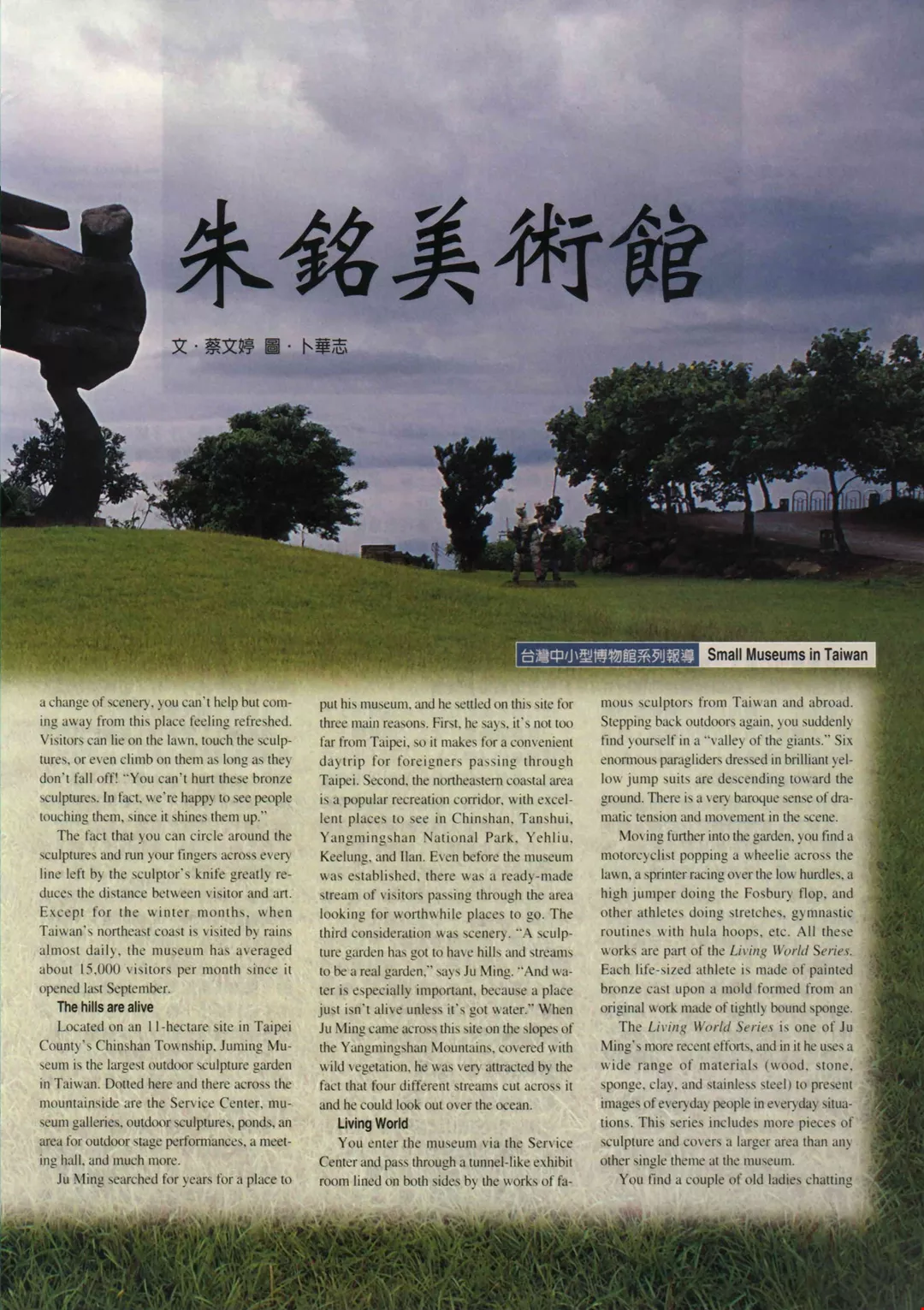
Unlike the easygoing works of the Living World Series that stand dispersed on the periphery, the works in the Taichi Series stand on the lawn in the center of the grounds, projecting an immense energy. These dark-green bronze statues stand over three meters high, not one of them with a face or any other markings of individuality. Each is in a different tai ji quan position. In "Single Whip Dip," "Preparation for Underarm Strike, and other works, and sometimes even in the transition from one work to the next, you can see the essential philosophy of tai ji quan: "In stillness there is movement, and in motion, repose." Every movement carries with it the immense power of the qi.
Tai ji quan and everyday people are the two most important motifs in Ju Ming's work. According to Chang Sung-jen, an art critic who acts as Ju Ming's agent, "Tai ji quan involves a force that is from beyond the realm of ordinary human experience, and art that focuses on this subject could very nearly be categorized as religious art. The people motif, on the other hand, is about the commonplace." To deal with the subject of tai ji quan takes boldness and vigor, while sculpting people requires great attention to detail and very good technical skill. It takes both of these series to fully encompass the artistic range of Ju Ming.
Ju's interest in tai ji quan was sparked over 30 years ago by his teacher Yang Ying-feng, who suggested that Ju practice tai ji quan to improve his health. Ju has hardly gone a day since then without practicing. Now that tai ji quan has been a part of his daily routine for so long, it is naturally on his mind much of the time. "My art work is my life," says Ju. "It's not something that I plan out in advance."
Visitors invariably spend more time at Taichi Square than anywhere else, sitting or lying on the grass. Planted along the borders of the lawn is a row of grey milkwood trees. Many different types of trees were considered, and this species was finally selected for the fact that it has beautiful white flowers, doesn't drop a lot of leaves, and doesn't grow too tall. Ju's youngest son, museum director Ju Yuen-li, points out that tall trees wouldn't work because if they were placed next to a large work, the space would seem crowded, and if placed next to a small work they would overpower it. "That's why we chose the grey milkwood tree. It's just the right height, and doesn't steal the show from the sculpture."
The roofs of the museum buildings have all been designed to call to mind the crown of a well-developed tree. The bronze they are made of has weathered to a dark green color that blends in nicely with the surrounding mountains. The rest area and restrooms, in the meantime, have been built in a rather rustic style that many visitors consider too plain, but this style was deliberately chosen to ensure a coordinated harmony between the architectural structures, the plant life, and the sculpture.
"You can't always assume that the more you build, the better," says Ju Ming, who has clearly put a lot of thought into the arrangement of his museum. "If we put up too many structures in the sculpture zone, it would just place that much more burden on the environment. There's no abstruse theory behind all this. You just have to look carefully at what you're dealing with and think about what you need everywhere on the grounds. If you put something up somewhere and then feel like it absolutely belongs there, it means you've done well."

Mah doesn't have many family pictures from her youth. She is shown here with her brothers and sisters. Adeline is on the right.
Ju has put more time and effort into planning and designing the Main Building than any other part of the museum. You approach the Main Building on foot by crossing an iron bridge that spans a stream, just above which hover several paragliders Ju's teachers
At the age of 15, Ju was introduced by his father into an apprenticeship of three years plus under the traditional wood carver Li Chin-chuan, who specialized in realistic work destined more often than not for use in temples. Sixteen years later, Ju closed up a shop he was running and began an apprenticeship with the famed Yang Ying-feng. Whereas all of Yang's other students were from various art schools around Taiwan, Ju had come to Li without any academic training.
The first work that greets the eyes upon entering the ground floor of the Main Building is Ju Ming's famous In One Heart. In this work, an old ox strains mightily to pull a heavy cart up a path turned muddy by a recent rain. The cart is loaded high with lumber, and the buffalo's hooves are sunk deep in the mud. Four farmers are pushing on the cart from behind. This work won rave reviews when it went on display in 1976. The Main Building also houses a number of other traditional wood sculptures from the early part of Ju's career, as well as brightly colored works from the boldly executed Living World Series of wooden sculptures. These can be found sitting or standing here and there on the ground floor.
From traditional to contemporary, from a downhome ox-cart to everyday scenes of urban life, Ju's work shows the influence of both Li Chin-chuan and Yang Ying-feng, which is why various designs and sculptures by these men are displayed on the second floor of the Main Building.

Grateful though he is for all his teachers have done for him, Ju nevertheless says, "It took a lot of effort to find those two teachers, but it took even more effort to get away from them. Master Yang never actually wanted remake me in his own image, so I first got away from the traditional woodcarving skills that Master Li had taught me, then I had to get away from Master Yang's style. If you've got both your hands full of things from somebody else, how are you going to hold onto anything of your own? Creation is not the same thing as study. You don't create by learning about what others have done. You have to 'forget' what you've learned to find yourself."
But Ju had to get away from more than just his teachers. He also had to get away from his materials. First it was wood. Years of dialogue with wood had forged an extremely close relationship between Ju and his wood. Indeed, everything that could be said between them, had already been said. So he got away from wood, and switched to polystyrene. Then he got away from polystyrene and went to sponge. Then he went to clay, and from there to stainless steel. For Ju, every type of material has a completely different character. Stainless steel is shaped with powerful machinery capable of exerting up to 150 tons of pressure per square inch, while sponge is worked with one's bare hands. Each type of material forces the artist to adopt a different attitude toward it, and to seek a different style. The results of Ju's "escapism" are all on display at his museum.
Every day of his career, Ju has worked to get away from the person he was the day before. Extending his present self into some indefinite future has never been his aim. In this same vein, he has never done anything at all to teach his eldest son, Ju Jun, how to sculpt, because he has never wanted his son to be a carbon copy of himself.
Nonetheless, his eldest son has become a noted sculptor in his own right. Right next to the wading pool is the Ju Jun Area, home to the Zipper Series that Ju Jun has been working on for the last ten years. In one of his works, a giant zipper is being pulled open to expose a crescent-shaped pond filled with lotus blossoms. A little tent-like hut near the pond features a prominently zippered door. And here and there, stones lie about with their "mouths" zipped shut. Ju Jun has used stone and zippers, two seemingly unrelated items, to present the viewer with a totally new image.
This place is hoppin'On weekdays the museum often draws over 1,000 visitors, but they tend to become quite widely dispersed over the 11-hectare site, which manages to maintain an atmosphere of peace and quiet. On weekends and holidays, however, the crowds get bigger and lend a different feel to the place.
Since opening its doors to the public, the museum has organized many different events, including stage performances and an aesthetics course. In addition, the museum has also commissioned performances by many different theater troupes, including Hanlin Folk Arts Storytelling Troupe, Ming-shen Ku and Dancers, Confluence Creative Group, and Cup Theatre. When these troupes come to Ju Ming Museum, they invariably fall in love with the picturesque grounds, which they incorporate into their performances. In addition to performing arts activities, the museum also organizes photo contests, children's art contests, and essay contests. The winner of the second children's art contest, Shih Yu-chu, demonstrated considerable creativity by making cactus out of loofah scouring pads and toothpicks.
"Although Juming Museum mainly exhibits my father's work, he doesn't want for it to be some sort of personal monument," says Ju Yuen-li, who emphasizes that all the outdoor space at the museum makes the museum a very energetic place that shows a continually changing face to the public.
Ju Ming has hired the artist Chuang Ming-chi to fly up every week from his home in southern Taiwan to spend the weekends in residence at the museum painting the outside wall of the Main Building. In bold black lines, Chuang has been covering the wall with assorted images of people and animals in stylized representations reminiscent of aboriginal art. It has been a year since the museum first opened its doors, and Chuang has actually finished with the wall, but he can't seem to stop; his project just keeps expanding, and has now spilled over onto the concrete walkways and the walls of the museum cafeteria. The look of the museum has been changed considerably, but even more important in Chuang's view is the interaction with museum visitors that the project has afforded him. This interaction is almost a form of "outdoor art" in itself, inasmuch as it has enabled Chuang to "plant the seeds" of his wacky work deep in the minds of museum visitors.
In addition to the work of its artist-in-residence, the museum also features a 100-meter art wall which serves as a "canvas" for young artists, who often paint there during visiting hours. There's even a long walkway where children can let their artistic instincts run wild as they color on the flagstones with chalk. Thanks to this imaginative approach, the visitor to Juming Museum can get involved in the creative process himself.
A home for the "children"The museum and its spacious, green grounds have cost Ju Ming his lifetime savings and 12 years of blood, sweat, and tears. What moved him to take on such a monumental project in the first place? Says Ju, "Creating works of art is like having children. They eventually leave home, and you want to see them in a good home. My works are all quite large, and sometimes when schedules don't mesh properly, the works will finish up at one exhibit without another exhibit to send them on to. When that happens, I end up with a bunch of big statues standing outside my front door. I only got started with this museum in order to find a home for my sculpture."
But Ju Ming doesn't go halfway with anything, and so the project took on a life of its own. Ju bought up parcels of land one at a time, and was personally responsible for just about every single detail of preparations, including applications for building permits and the design of the museum structures, the landscaping, and even drainage ditches. The biggest work of art that Ju Ming has ever executed is, in fact, his museum.
During the 12 years that Ju spent preparing his museum, he regularly slept three or four nights a week at the museum's construction site, where he would awake just after 5 a.m. to plan the day's work schedule. Among other tasks, he spent lots of time making models of his museum buildings and using them to discuss plans with architects. The rest of his time was spent in Taipei raising money and sculpting. Because he was unwilling to accept loans from financial institutions for fear of interference in museum management, Ju put in a lot of footwork in his search for funding. When the money ran dry, as it did from time to time, his wife would advise him to "sit tight for a while." The resultant on-again, off-again project thus took 12 full years to finish. Even a resilient pair like Ju and his wife describe the process as "tough... really tough." It was also tough on Ju's two secondhand excavators, which he repaired time and again to nurse them through the project. By the time it was over, the machines had given their all, and Ju commemorated their contribution by converting them into sculpture. They now sit in his atelier, where they serve as a memento to the long years spent getting the museum off the ground.
Built to lastOne of the museum's best-kept secrets is the fact that all of its structures are clad in stainless steel and bronze to protect the buildings from the elements. After devoting over a decade of his life to the museum's construction, Ju has no intention of letting its structures be torn down anytime soon. Over 350 tons of stainless steel have gone into the museum in order to ensure its longevity.
Ju's concern for longevity is also what prompted him to have the land rezoned so that it can only be used as a park. The plots from which it was assembled were originally zoned as either residential or agricultural land, which, unlike park land, can be freely bought and sold. On the day the museum opened, he donated the entire museum (including more than 1,000 of his own works and the museum's many pieces from noted sculptors at home and abroad) to the Ju Ming Culture and Education Foundation. So this museum doesn't just belong to Ju Ming or his family. It belongs to everyone in Taiwan!
It's not hard to find the works of Ju Ming on display in various public places throughout Taiwan, but those are just scattered reflections of the whole of Ju's work. They are like disconnected commas, nouns, and verbs floating around in the cosmos. The museum, on the other hand, is a masterpiece of "expository writing" that would do the Bard himself proud. "Juming Museum," says Ju, "is a complete essay, with an introduction, body, and conclusion. You can see the entire me at this place." Indeed, every brick and roof tile in the museum is a piece of art, and a part of Ju Ming.

@List.jpg?w=522&h=410&mode=crop&format=webp&quality=80)


