Art's New Nobility -The Age of the Curator is Here
Tsai Wen-ting / photos Pu Hua-chih / tr. by Christopher MacDonald
June 1999


Last summer Ni Tsai-chin, president of the Taiwan Museum of Art, organized the "No Destruction, No Construction" event, in which installation artist Cai Guo-qiang set about "blowing up" the soon-to-be refurbished museum, to symbolize its rebirth through fire. (photo by Hiro Ihara)
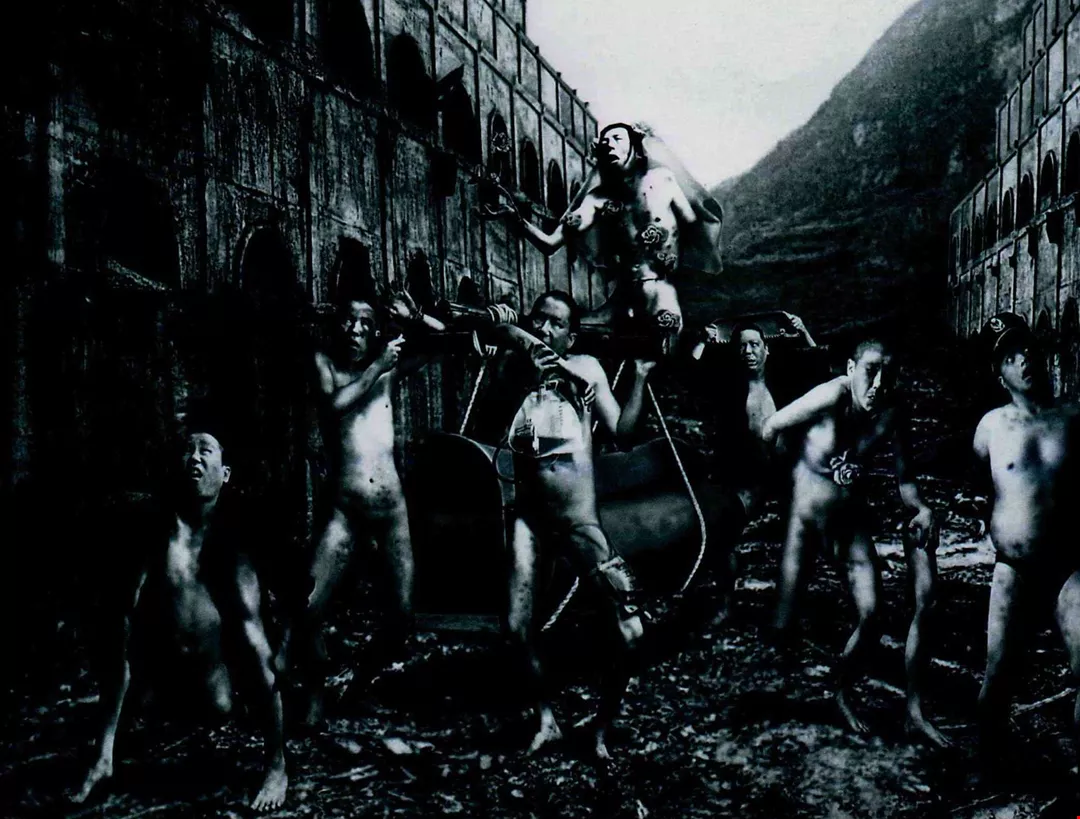
"Revolt in Body and Soul," a series of images created from archive photo graphs by artist Chen Chieh-jen, will be in the Taiwan pavilion at this year's Venice Biennial. (courtesy of Chen Chieh-jen)
When you pick a movie, is it because of the director or because of who's in it? Appearance in a film made by a top director can elevate a little known actor to global fame, and by the same token a talented director needs good actors to bring across the content of the film.
These days, the name of the exhibition "curator" is prominently displayed next to the title of any show that takes place at an art museum or gallery, or at international art exhibitions. In Taiwan, it's a change from the days when the top billing went to star artists. Curators are now springing up all over the place. So what kind of exhibitions can we expect them to produce for us?
It was one evening last August, during the height of summer, and the light was fading from the sky. Filling the open spaces around the Taiwan Museum of Art in Taichung, and crowded onto nearby rooftops, some 20,000 spectators, including over 200 local and international journalists, were waiting for the action-an enormous number given the usual low attendance at art events. It turned out that they had come to enjoy the "bombing" of the museum by Cai Guo-qiang, an internationally renowned explosives installation artist.
At 6:35 p.m., a string of fire snaked skywards, erupting in a ball of flame, before penetrating the roof of the museum and engulfing the two pillars in the main foyer. In all, 600 charges were laid along 2.5 km of fuses, creating a chain of detonations that filled the air with thick gunpowder smoke. So who had the nerve to commission the "blowing up" of Taiwan's leading art museum? The curator of the show was in fact the museum's very own president, Ni Tsai-chin.
The arts community has always considered the Taiwan Museum of Art to have a conservative image, and felt that its vast, dim spaces were not conducive to exhibitions. Beatrice Gysen-Hsieh, the museum's international affairs director and assistant curator, often used to joke that they should recruit an international terrorist group to blow up the place. Cai Guo-qiang is an artist who uses gunpowder as his brush and takes the world as his canvas, and emphasizes dialogue with a selected location-using a line of fire to extend the Great Wall for example, or blasting at the Berlin Wall.
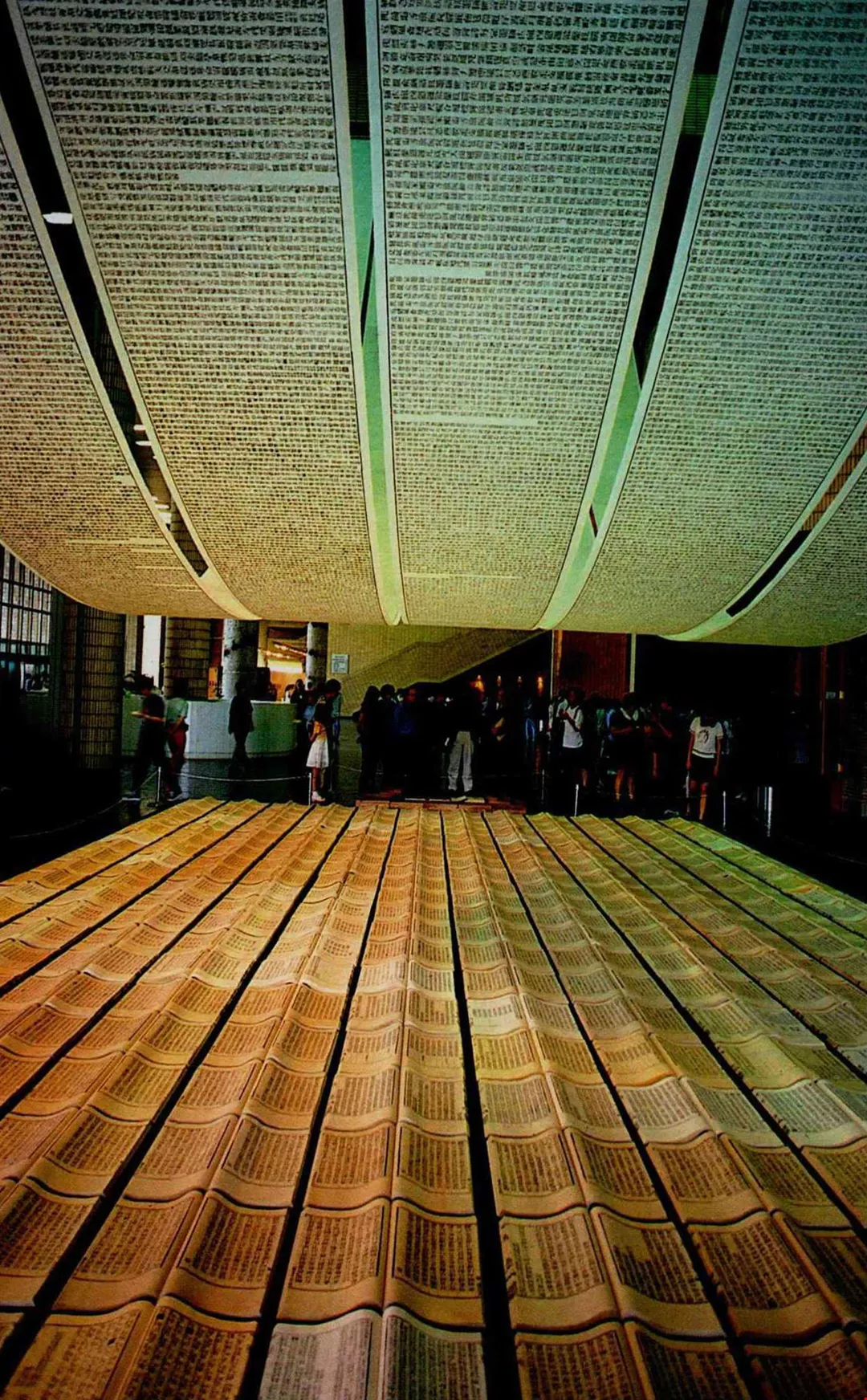
Heaven's Books," mainland Chinese artist Xu Bing's display of thread-bound volumes covered in indecipherable text, formed part of the exhibition "The Power of the Word" at the Taiwan Museum of Art, curated by Chang Tsong-Zung. Along with contemporary artists, the exhibition included pieces by Mao Zedong and the late Hung Tung, and examined the cultural import of the written word within Chinese art and society.
The timing of the event coincided with celebrations for the museum's tenth anniversary, during the quiet August period when the museum was just about to undergo renovations. Ni Tsai-chin decided to commission Cai Guo-qiang to give the museum a thorough New Year-style shake-up, blasting out the old and bringing in the new. As Ni explains: "Without deconstruction there can be no reconstruction. Cai Guo-qiang's 'No Destruction, No Construction' event uses fire to symbolize the rebirth of the museum." For the crowd gathered in front of the museum that evening, it was a great spectacle, like some deafening firework-filled ceremony performed on the eve of Chinese New Year. Not everyone was impressed though. As one spectator said: "This is nothing! Not a patch on our firework festival in Yenshui." Old wine in new bottles
Today is truly the era of the exhibition curator-in Taiwan, in Asia, and in the arena of international arts.
From art museums to commercial galleries, even in old Lukang and remote Nantou, wherever exhibitions are held the newly popular title of exhibition "curator" is now used. The show "Close to Open: Taiwanese Artists Exposed" organized by curator J.J. Shih will appear from mid-June this year at the world famous biennial exhibition in Venice, and the "International Conference of Contemporary Asian Curatorship," hosted by the Taiwan Museum of Art, recently concluded-though the accompanying exhibition, entitled "The Power of the Word" and curated by Chang Tsong-Zung is still running. Some in the arts community are calling this "the year of the curator."
The curator trend has also brought commercial opportunities, and a succession of curator workshops, partnerships and even companies have been set up. Curious visitors to art shows are now asking: What actually is a curator?
The post of "curator," meaning the person who organizes an exhibition, seems to be a new one, but as explained by Wen Shu-tzu, head of exhibitions at the Taiwan Museum of Art, "it's not in fact a new term. The curator is something that has always been with us." During the century-long development of museums, the curator has always been the person at the heart of researching the collection and planning exhibitions . At the National Palace Museum for example, there are specialists in charge of research within the areas of calligraphy and painting, historical documents, and implements, while research on particular themes is conducted in the exhibitions department. However, with the sudden rise of the Chinese term for "curator" within the field of contemporary arts during the last five years or so, that role has leapt to the fore, and the exhibition curator is now similar in role to a movie director.
Making a rough calculation from the events pages of arts periodicals, there are at least 200 art exhibitions taking place around Taiwan during any one month. Artist Wu Ma-li, who frequently introduces new concepts in contemporary art from abroad, says: "Amid the profusion of exhibitions nowadays, art events have to be competitive too. Shows without a theme, without some particular spirit, can no longer attract an audience, so naturally you have the emergence of the professional exhibition curator."
In contemporary art, the concept is always what matters. This is true for both installation art and action art, and now for exhibitions too. "There is also the fact that in the past in Taiwan you couldn't say anything, whereas now people want to say everything," remarks J.J. Shih, who feels that this is very much an era in which exhibitions are designed around particular topics.
In contrast to shows featuring individual artists, exhibition curators apply their expertise and originality in some field of art research, along with a keen nose for developments, to scent out socio-cultural phenomena or artistic trends and present them in the clear format of an exhibition theme.
Wu Jiabao, president of the Chinese Society of Photographic Education, took on the title of independent curator in April when he organized the exhibition "Contemporary Imaging Art of Taiwan." For this exhibition the artists used photography to create "paintings," combining different materials to take photography beyond its conventional role of recording and reporting, and producing a new aesthetic. The show clearly demonstrated what has been called in Taiwan the "fine art fever among photographers, and photography fever among fine artists."
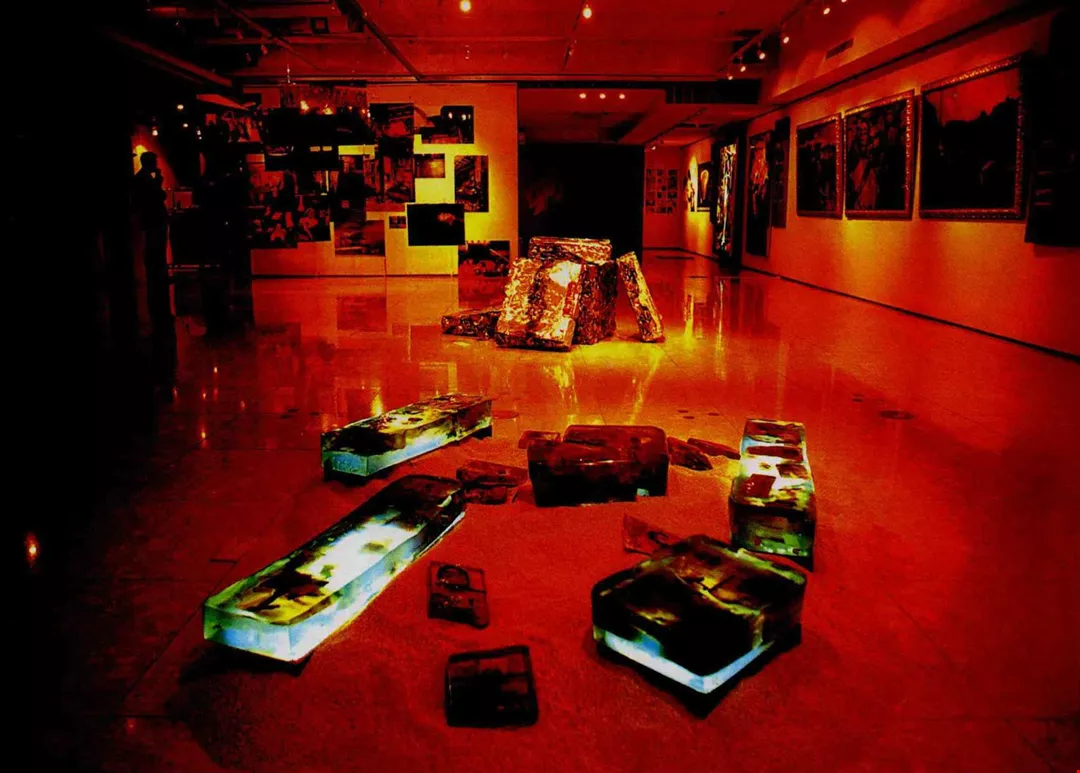
Wu Jiabao's "Contemporary Imaging Art of Taiwan," demonstrates what has been called "the fine art fever among photographers, and the photography fever among fine artists.".
"The curator is like a film director," says Taiwan Museum of Art's Ni Tsai-chin, "and the show itself is a collective work of art." Everything concerning the exhibition, from academic theory, theme structure and selection of artists, to sponsorship, publicity, and catalogue production, is supervised by the curator. "A good curator must be adept in terms of both learning and action," says Mun-Lee Lin, director of the Taipei Fine Arts Museum, meaning that the curator must combine a philosophy, vision, and the ability to implement a project. Mao Zedong was an artist too
In order to be able to pick artists like a director selects suitable actors, curators need to see plenty of exhibitions and observe artists over a long period. Independent curators in particular make frequent trips to the US, Brazil, Italy, Japan and so on to catch the shows. Beatrice Gysen-Hsieh, Taiwan's only member of the International Association of Independent Curators, is one of those who travels the world to catch different exhibitions. Curators with different areas of expertise can bring different philosophies and styles for audiences, giving them shows that are more experimental. One such is the exhibition "The Power of the Word" currently running at the Taiwan Museum of Art.
The entire first-floor space in the museum is filled with different kinds of writing. In paintings by the late Hung Tung, a well-known Taiwanese folk artist, the body of a figure is formed from talismanic-type writing, symbolizing the code to life. Hong Kong's Tsang Tsou-choi, who styles himself the "Emperor of Kowloon," has been writing on utility poles, transformer boxes and other public installations all over the city since the 1950s, to protest the seizure of his clan lands. Although he has never known what art is, his use of written text to stake out territory is an important historical echo of how writing has been applied in Chinese culture. The internationally famous artist Xu Bing uses writing as a medium for his work, and in "New English Writing" he forms Chinese characters out of letters of the roman alphabet. Xu also uses calligraphy to bring out the Chinese feeling in the writing, so as to further examine the contradictory relationship between Chinese characters and their romanized spellings.
Probably the most eyebrow-raising part of the exhibition is the display of calligraphy by Mao Zedong. Curator Chang Tsong-Zung, who frequently travels between Taiwan, Hong Kong and the mainland, says that it used to be only texts by noted literati that were copied as calligraphic models, but after the communists took over people wanted to imitate the brush style of their deified leader Mao Zedong, and many collections and dictionaries of his calligraphy were published. The fact that whatever he wrote carried such weight, lent authority to his calligraphy, and his written characters therefore came to symbolize power itself.
"In the West, they filled plazas with statues of kings. In China, the emperors erected inscribed stone tablets. Seeing this exhibition I realized that Chinese writing actually has multiple possibilities, and also discovered the compelling power of the written word within art, society, and politics," remarks exhibition visitor Tsai Hsi-en, a fine arts graduate who frequently travels abroad.
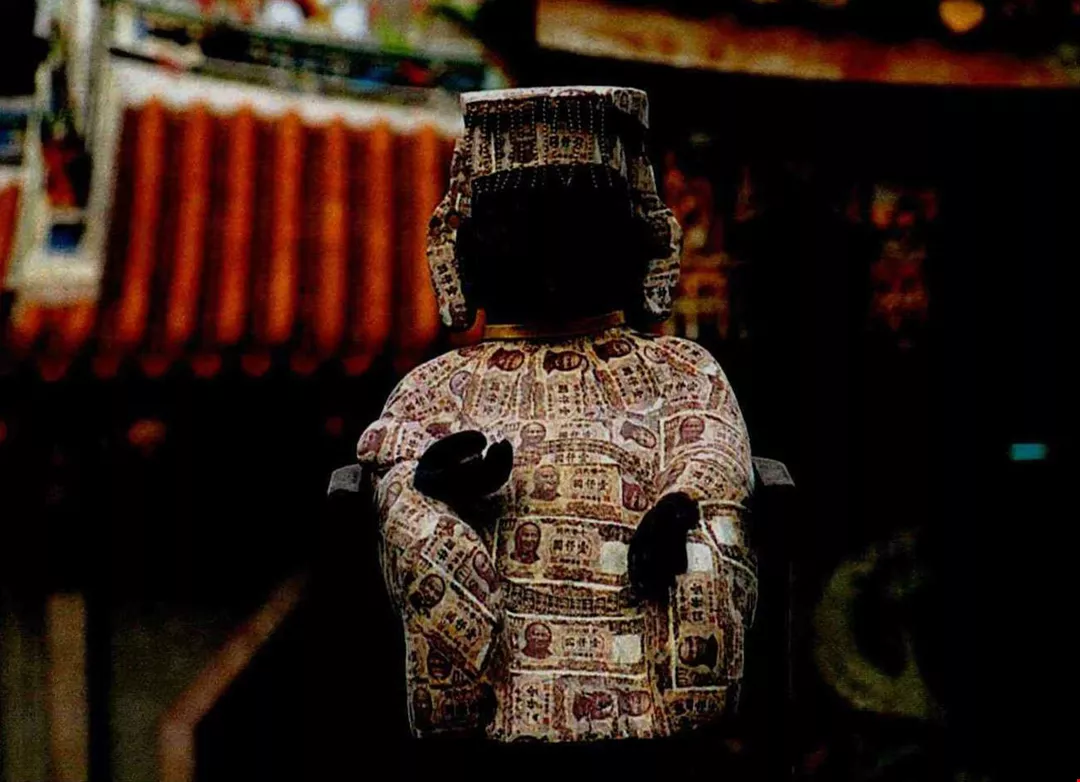
In "The Heart of History," curated by Huang Hai-ming, artist Lien Pao-tsai controversially plastered a statue of the goddess Matsu in banknotes, triggering an angry reaction from the residents of Lukang. (photo by Chen Ming-tsung)
As curator of the exhibition, Chang Tsong-Zung has broken utterly with tradition in terms of his selection of artists (or "non-artists"), but in drawing on such a diverse group of exhibitors he has managed to give full expression to the cultural import of the written word. As Ni Tsai-chin says: "An outstanding curator can take a simple phrase and conduct it into a full-blown symphony. There are many uniquely gifted individuals among the ranks of contemporary Chinese artists, and it takes a curator with the skill of a great strategist to organize them into a dynamic fighting unit." The strategist deploys his forces
In addition to the refinement of a scholar, a curator needs martial prowess, and the administrative savvy to raise sponsorship, carry out PR work and arrange the lay-out of the exhibition in a way that realizes his conception. This is something which the curators produced through Taiwan's academies tend to be weak at, yet it can determine both the resulting quality of the exhibition, and the degree to which the exhibition attracts interest.
Last year, the Taipei Fine Arts Museum invited the famous Japanese curator Fumio Nanjo, who has been active in a number of major international events, to organize the Taipei Biennial Exhibition. As Mun-Lee Lin points out, "It was mainly hoped that his international reputation and connections would help to boost the profile of the Biennial." In fact, thanks to Nanjo's connections, the Biennial was able to feature the participation of international art stars such as Yayoi Kusama and Xu Bing, along with David Ross, president of the San Francisco Museum of Modern Art, the prominent Thai curator Apinan Poshyananda, plus over 100 participants from the international arts media. Some of the heavyweight figures involved in the exhibition did indeed arrive on Fumio Nanjo's coat-tails, and for many of the audience, his name and the exhibition title-"Site of Desire"-was all that they could remember afterwards, unlike the names of many of the participating artists. This is something that disappoints artists who are used to having the lead role, and they worry that they are becoming chess-pieces in the hands of exhibition curators.
This is a point on which Chen Chieh-jen, who is taking part in this year's Venice Biennial, has strong feelings. He thinks that if you can find a good chess player, then why not be a chess-piece from time to time? Chen has been out of view for nearly ten years, during which period he was unable to find opportunities or venues for exhibiting his work in Taiwan-and his previous individual show was only possible because a painter friend of his loaned him an empty five-day slot at a gallery. However, after he had been given a showing at the Taipei Biennial curated by Nanjo, he was invited by Poshyananda, who was in town for one of the seminars, to exhibit at the Sao Paolo Biennial in Brazil. After this year's Venice Biennial he will also do a show in Tianjin, courtesy of the international curator Li Xianting. Chen, who was once so despondent that he considered changing his name, gives a helpless smile and says: "I made it abroad before I could start to make it back here!"
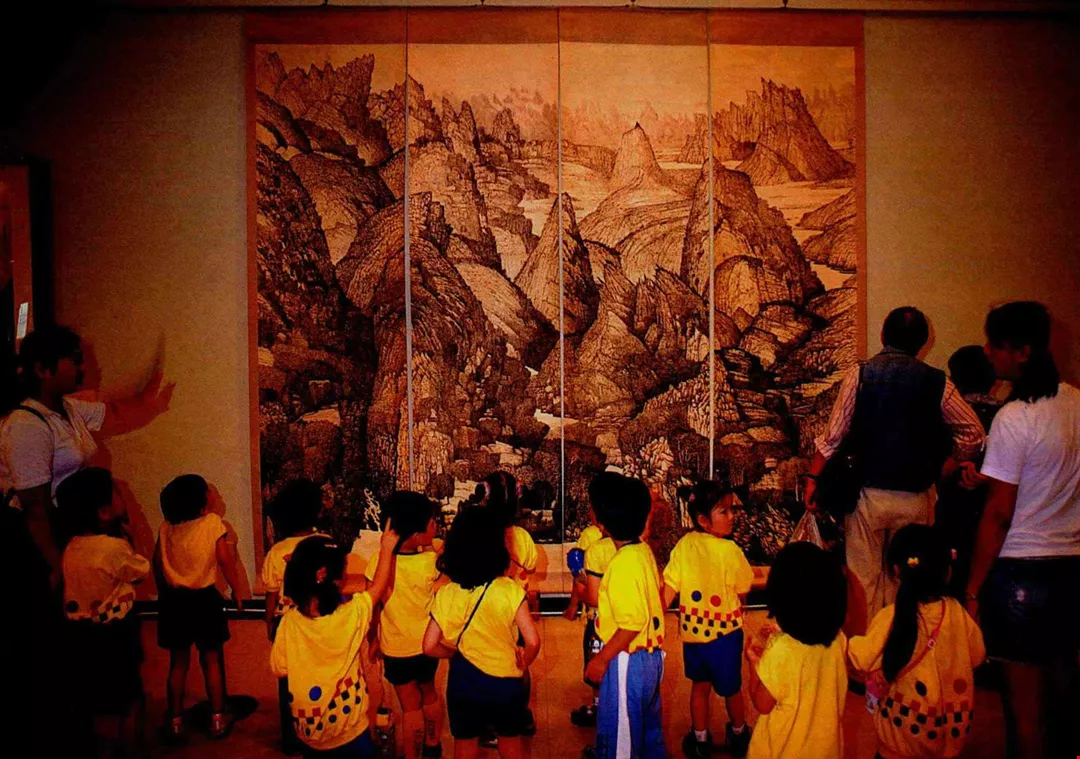
In addition to modern avant-garde art, many curators also focus on reinterpreting classical art. The picture shows an exhibit at the 100th anniversary retrospective of work by the ink and brush artist Yu Cheng-yao.
Ni Tsai-chin, who has hosted the International Conference of Curators for the past two years, says that in recent years the major international exhibitions have tended to place overall control in the hands of a chief curator, with a number of other curators from different countries and cultural backgrounds working together on the specifics. The exhibition becomes a web of different events, with the curators at its nodes. There is no doubt that being in touch with international exhibition curators can help artists to improve their international exposure. Expensive dreams
Funding is the question that causes exhibition curators the most headaches, and one which tests their ability to find sponsors. As Beatrice Gysen-Hsieh puts it: "Of course money is important. With money you don't have to compromise your ideas-dreams don't come cheap!" Many artists also admit that once there is a problem with funding, curators have to limit what the artists can do, and it ends up creating difficulties for everyone.
Another factor is that art comes in all forms these days, and the technical problems that a work may entail are unlike those encountered in the past. There are a handful of curators overseas who have huge technical teams at their disposal, including electricians, carpenters, metalworkers and lighting people, and can obtain all manner of material required by the artist. Sometimes, the artist simply needs to hand over a precise design diagram, and the curator will arrange all the rest. Taiwan's small-scale, newly formed curating firms are far below this level, whereas experienced international curators are often familiar with every detail of the trade, from the dimensions of goods doors on cargo planes in Europe to the temperature and humidity controls used in specific art museums.
In the "Power of the Word" at the Museum of Art, there was one work which involved a number of thread-bound volumes laid out on the ground. The curator was initially unaware that public museums switched their air-conditioning off in the evenings, which presented a threat for this exhibit as moisture from the stone floor could have affected the special paper in the volumes and blurred the writing. Luckily the exhibitors were alerted to the problem by museum staff, and a wooden floor-surface was specially installed to prevent possible damage. The artist's helpmate
A good film director gives actors the opportunity to perform and to display their abilities, and can develop new aspects of their art, while a poor director can ruin a top star by forcing an unsuitable role on him or her. Something similar applies in the relationship between curator and artist, as artist Hou Chun-ming illustrates with the example of his involvement in the "Post 89" exhibition in Hong Kong. Hou's project for the exhibition involved creating huge posters based on the depressed and troubled mood of the people of Hong Kong, and pasting these up in the streets and lanes of the city. After holding discussions with exhibition curator Li Xianting, Hou dropped his original plan of interviewing passers-by on the street, and instead decided to set up a "misery hotline" for people to call in on. Also, since it wasn't going to be possible to stick posters up everywhere as imagined, Hou was able, at Li's suggestion, to get the posters pasted to the steel shutters of banks. As Hou puts it: "A good curator can help an artist to extend the reach of his arms and legs, whereas a bad one may have to chop them off just to fit him into the exhibition." The skill of exhibition lay-out alone is enough to make or break a show, in that a poor arrangement interferes with the audience's appreciation of the exhibits, and can result in different works counteracting one another, to the detriment of all. The interaction between curator and artist is particularly important when the theme of the exhibition has been selected and is fully controlled by the curator. At this point, the question arises as to whether the nature of the artist's contribution is actually governed by the curator.
Yao Jui-chung, an artist who is frequently invited to take part in exhibitions by curators in Taiwan and overseas, thinks not-"unless the artist himself is not too clear about what to do, or is willing to be led for the sake of getting exhibited." Yao says that he simply doesn't accept invitations to exhibit on themes that he finds unsuitable. "The artist can accept the challenge of working to a curator's theme, but must also have the courage to refuse," says Yao.
The arena for art exhibitions is far wider now than it used to be, in addition to which Taiwan has experienced an upsurge in local arts events during recent years. Curators can on the one hand send artists off to distant lands, and on the other hand lead them out of art museums and into the city boulevards and the country lanes. But when art comes to a small town, and takes place in the audience's own back yard, the local people's interaction with and reaction to the work is something that a curator has to deal with delicately.
Two exhibitions of small-town installation art have generated discussion and controversy in recent months: "The Heart of History" in Lukang, at the beginning of this year, and "Art in March: Legend 99" in Nantou during the spring.
"The Heart of History" was designed to encourage people's interest in cultural preservation, using the space around a historical site in Lukang. The artist, Lien Pao-tsai, plastered a figure of Matsu in banknotes to satirize the materialist nature of religion today, but the people of Lukang, pious devotees of the goddess, viewed this as an act of blasphemy. In the case of "Art in March," the artist Hou Chun-ming set out a number of human figures wearing women's panties on their heads, to reflect the ubiquitous siren-call of pornography, but this incurred the wrath of a local schoolteacher who felt that the piece corrupted the minds of children.
Art often has the courage to do what people don't dare do, and say what they dare not say, and the notion of artistic freedom is therefore like an amulet for artists. But when art is introduced to a relatively conservative community and comes into conflict with traditional ideas, it is all the more important for the curator to sincerely address the concerns of the local people. J.J. Shih, who curated the show in Nantou, says: "When an artist oversteps the mark, the curator must of course take responsibility for keeping him within bounds. And when there is a misunderstanding about the work among the audience, or doubts arise, the curator should also take the initiative to communicate with them about the problem." Curators have it all stitched up
With curators now running the show, many exhibition contractors have now begun calling themselves curators too, regardless of whether or not much they put much research into planning the show, and even when all they have done is arrange for a group of artists to mount a joint show. But many people are also concerned that with so much depending on the curator, who has the funds at his disposal to recruit personnel and implement the kind of huge projects that an artist could not otherwise handle, and who also coordinates the media to generate fashions in art, then the curator not only decides who gets the exposure but also determines the tastes of the public.
Curators on today's exhibition circuit in Taiwan seem to best like artists working in a post-colonial, consumerist, folksy-but- contemporary vein, aged from around 35 to 45, and it is these artists who attract the most discussion and media interest-which will undoubtedly lure more emerging artists to do work along the same lines.
J.J. Shih, who is curating the Taiwan pavilion at this year's Venice Biennial, has grouped the three participating artists-Huang Pu-ching, Chen Chieh-jen and Hung Tung-lu, three generations of artists chosen to represent the blossoming diversity of art in Taiwan-under the title "Close to Open: Taiwanese Artists Exposed." On entering the Palazzo delle Prigioni, where the Taiwanese exhibits are to be housed, the first sight to greet visitors will be "Banquet," a richly Taiwanese work of installation art, followed by Chen Chieh-jen's "Revolt in Body and Soul," in which the artist has reworked archive photographs of scenes of beheading and dismemberment. Last comes the offering of the young artist Hung Tung-lu, who presents images of popular toy idols, like the Barbie doll, and the video-game character Chun-li, on the sides of a traditional colored lantern. It seems that contemporary works such as these, Western in form but Taiwanese in content, are the ones for which the most opportunities exist overseas, and which therefore come to represent Taiwanese art in general. Quiet appreciation
Wu Ma-li believes the situation is not actually as limiting as that, and cites a recent exhibition at the Museum of Art of work by the father of contemporary painting in Taiwan Li Chung-sheng and his students, for which the curator researched, over the course of several years, the entire genealogy of Li's antecedents, colleagues, followers and pupils in Japan and Taiwan. The show amounted to a rediscovery of the old artist. Similarly, the 100th anniversary retrospective of Yu Cheng-yao, which featured a comprehensive selection of his work, and included for the first time in exhibition Yu's ci poetry and calligraphic works, captured the spirit of Yu's approach to art: "Nankuan music first, ci poetry second, calligraphy third, and painting fourth." In fact overseas too, many curators are interested in rediscovering old artists and re-interpreting classical art.
Artist Hou Chun-ming describes an exhibition he once saw in the US that made a deep and long-lasting impression on him. It was not a large exhibition, and the featured artist was not part of the new avant-garde. In fact it was van Gogh, an artist with whom we are all fully familiar. Listening to the audio guide as he moved through the exhibition, Hou found that instead of some distracting discussion of trends and themes, there was simply a reading of letters between van Gogh and his brother Theo to accompany the paintings. "I think that what an exhibition like this tries to show is not art, but life itself!"
The emergence of curators is like an announcement that art exhibitions have entered a more professional era. From a top international director, you are likely to get a big movie featuring lots of stars, whereas from a more sensitive kind of director you are likely to get a carefully crafted art film. So long as we have a Hollywood, there will always be plenty of exciting new movies in the cinemas. As to what kind of a repertoire in art we can expect from the exhibition curators, that is something that we, as the audience, have the right to choose.


