Black Comedy and Rebellion: The Fiction of Kuo Cheng
David Wang / photos Vincent Chang / tr. by D.J. Toman
January 1994


Taiwan's fiction world is subject to the coming and going of numerous trends, which have made for a rather lively scene in recent years. Amidst all the hubbub, some authors who consistently produce work of quality to match quantity seem to have been overlooked. Kuo Cheng is one of those authors.
God's Dice is Kuo Cheng's second collection of short stories. In his first collection, A Good Day for Cutting Class, Kuo displayed his unwillingness to follow the crowd. His choice of material never strays from the people and events that inhabit the margins of society, and his matter-of-fact narrative style often yields unintended humorous effects. These characteristics are even stronger in God's Dice, where Kuo Cheng has taken pains to exhibit additional concern over the rapidly changing face of politics and history.
God's Dice collects eight of Kuo Cheng's recent stories together. Material ranges from the middle-class escapist rhapsody of "God's Dice," the hell bent for leather adolescent days of "Flying Sword," and the sordid circus antics of the political arena in "Put on a White Face," to the driven historical mission of "The Last Proclamation" and the deranged baby killing of "How to Execute an Infant." Most of Kuo's characters are born challengers of authority who attempt to bring extra-establishment possibilities to within the white picket fences of the establishment, but with Kuo at the controls their resistance usually results in black humor. The tension this lends his stories is what makes them notable.
In the first story of the collection, "God's Dice," Kuo handles with insouciance the haphazard plight of a middle-aged man who on a stopover in a small town happens to get sucked into a game of chance. His interest whetted, the protagonist soon finds himself beyond the point of no return, where suddenly he is ready to desert his wife and children. The absurdity of the story can well be imagined. We might be prompted to ask, is author Kuo Cheng demonstrating the random nature of chance or the inevitable provision of fate in this story? Is the protagonist's betting fervor a kind of heedless indulgence or a momentous choice of all choices? Lest we forget, too much emphasis on such sticky and unanswerable questions runs us the risk of overlooking the comic quality that runs through the entire piece. When the lead character puts his life on the line, the world around him meets him with snickers and jeers. There is no room for heroes in Kuo Cheng's world.
This style of writing becomes further accentuated in pieces such as "A History of Chinese Banditry" and "The Last Proclamation." In "A History of Chinese Banditry" Kuo Cheng the narrator recounts a loathsome clan history. This is a devious, scandalous family tree, but Kuo Cheng interweaves "his" family history together with official history, effectively underscoring the unrehearsed, arbitrary side of the march of history. The winners are crowned and the losers are vilified as official, orthodox histories invariably present the side of those who rule. But in the sanctioned narratives of history, how many shameful details have been expurgated? As far as Kuo Cheng is concerned, "moving" and "ludicrous" are complementary and interchange able adjectives. This view is brought to full light in the historical context of "The Final Proclamation: Prior to the communist takeover of the mainland, how did the KMT government release its final statement before retreating to Taiwan? Time has passed, but the statement tells us a different kind of story. Here, history and fiction, myth and humor are fused together. Thinking back, how did the author of the final proclamation go about his business given the circumstances?
We get an ample taste of Kuo Cheng's hostility and pessimism toward history and politics within these pages. Kuo, however, is not alone in pondering such sentiments, as have many an author on either side of the strait since the late 1980s. Mo Yan's Red Sorghum is but one example of a novel in which the history of a family of scoundrels is seen in the context of modern Chinese history. Taiwan author Chang Ta-chun's Ssu-hsi Worries for his Country uses the story of an old retired soldier who delivers new year's announcements everywhere to demonstrate the spurious relationship between political reality and political rhetoric. Knowing this takes the inventiveness out of Kuo Cheng's idea. Since the lifting of martial law, countless novels have competed for attention on the basis of bold breaks with stigma, and in time readers become desensitized.
Nevertheless, I find other aspects of Kuo Cheng's work recommend themselves to us. Lacking the majesty of Mo Yan and the mischievousness of Chang Ta-chun, the trivial subject matter and frivolity of his stories gives them a willful, adolescent quality. He may make himself out to be urbane ("God's Dice"), but he cannot hide the kind of "whatever floats my boat" attitude of a rebellious youth. Paradoxically, this attitude is usually no more than a facade. Similar proclivities can also be found in "A History of Chinese Banditry" and "The Final Proclamation." Kuo's collection of no-good ancestors comes out on paper not unlike the kid who takes off from class in "A Good Day for Cutting Class" - they want to show how "bad" they are, yet they really aren't all that bad. Perhaps an even better example can be found in "How to Execute an Infant," where the protagonist carefully plans the murder of his own nephew. He asserts assorted motives but in the end is unable to go through with the dirty deed. In typical black comedy fashion, the story shows the ugliest possibilities within human nature, yet all the ugliness only proves to be minor mischief in the end. What appears to us as a repugnant devil suddenly turns into no more than small-time bloke who talks a big line.
Judged strictly on the basis of structure and language, "How to Execute an Infant" is not well written, but the paranoid lead character created in this piece best exemplifies Kuo Cheng"s narrative style. From the rebellious youth of "A Good Day for Cutting Class" to the defiant middle-aged man of "How to Execute an Infant," Kuo Cheng's characters have grow up, but that unconvincing rebellious spirit remains. In this respect, another piece, "Flying Sword," can be viewed as Kuo Cheng's confession. The story is a plainly conventional "Where are they now?" tale, where a group of former high school baseball teammates try to rekindle old dreams years after graduation. Each of them has had his share of setbacks, but in searching for their former comrades, they become reacquainted with both the present and the past. The former backbone of the team has gone on to gain a notorious reputation for violence, yet he serves as the spiritual link between the players. And while this figure never appears, his transformations and consistencies as spoken in legend bring the former teammates back together at before. Kuo Cheng, mind you, is not ready to have "God's Dice" determine his characters’ fates. Their adolescent courage, under all circumstances, always seems to creep forward. Combining the qualities of detective and Chinese fantasy fiction, the story's narrative and action are instantly appealing. Then again, can a ball game really salvage the losses of growing up and the dulling of youthful dreams?
Two other stories in the collection, "Put on a White Face" and "World of Pirates" tell of the hypocrisy of political elections and the greed of the business world. One comes off as a rhapsody, the other as a farce, but neither is entirely successful. Kuo Cheng cannot resist the impulse to preach to his audience, a tendency which spoils the intent of both these works. Instead, it is "The Final Hour," with traditional story-telling as its backdrop and a bizarre robbery case in the forefront, which is an extremely successful portrait of the deception and trickery which pervades the world. The protagonist, chopped in half at the waist and left to die on the streets, sees through the injustice of the world in his final hour. Kuo Cheng's invention of a talking, thinking corpse is admittedly hair raising, but it also marks the high-point in the black humor that runs throughout the collection. The chivalry and gamesmanship of the rough and tumble world in the story is not without its grounding in reality. Our hero has perpetrated countless unspeakable deeds for which he deserves to pay with his life, but only at the moment before the dissolution of his soul do we witness his enlightenment. Regrettably, his "post-mortem" enlightenment elicits unnecessary self-mockery.
Whether in pseudo-existentialist moral plays or unbelievable science fiction rhapsodies, satire of great clan drama or chilling black comedy, Kuo Cheng cynically voices his insecurity and discontent with the world. Oddly, however, the mutinous stances of both the author and his characters, whether due to external pressure or patent cowardice, are incomplete and not entirely convincing. The self-mockery and satire of others that results from this bathes his works in a uniquely blithe atmosphere. This atmosphere brings not release, but rather discomfort, not order but further cacophony. With his highly personal style, Kuo Cheng records his impressions of contemporary Taiwan and his responses to what he sees.
[Picture Caption]
p.86
Einstein said, "The universe wasn't just created at the roll of God's dice."
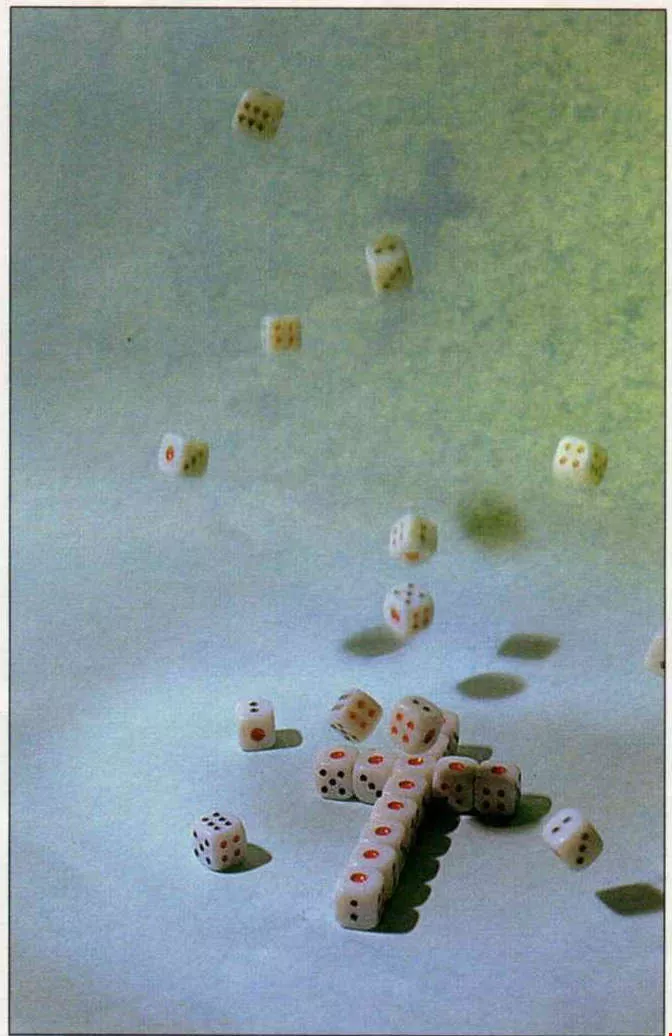
Einstein said, "The universe wasn't just created at the roll of God's dice.".

@List.jpg?w=522&h=410&mode=crop&format=webp&quality=80)

@List.jpg?w=522&h=410&mode=crop&format=webp&quality=80)


