Franz Blazes a Trail for Taiwan's Creative Industries
Kuo Li-chuan / photos courtesy of Franz / tr. by Jonathan Barnard
September 2009


In recent years, with the "creative economy" all the rage, a dark horse from Taiwan-Franz-has caught the world by storm. From running an OEM factory in Nantou's Puli to overseeing production of his company's own brand of high-quality porcelain, Franz's founder Francis Chen has successfully shaken off the long-held stereotype of Taiwan as a place that excels only at OEM work. Franz has put Taiwanese creativity onto the world stage, raising the nation's image and visibility.
When Francis Chen, the president of Franz Collections, was majoring in German at Fu Jen Catholic University, his mother backed him and his three brothers in an OEM venture that manufactured Christmas tree ornaments such as figurines and miniature pieces of wood furniture.
After Francis graduated from college, his brothers left for the United States, and the firm became his alone. Then in 1984 Chen established Seagull Decor in a factory in Nantou's Puli. Apart from producing Christmas ornaments as an OEM, the company also worked as an ODM (original design manufacturer) for some overseas clients, making teddy bears and the like. Seagull's reliability and quality has earned it a great reputation, and it has worked with giants in the gift industry, including the American companies Enesco and Lenox and the German firms Goebel and Kaiser, as well as famous British and Japanese brands.
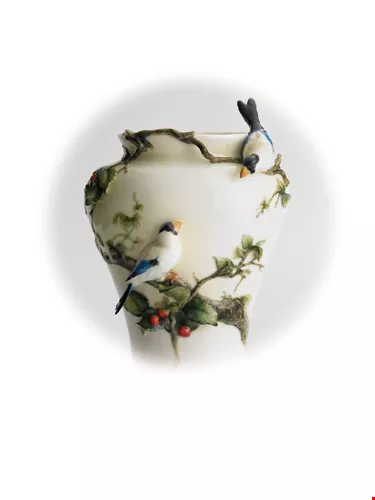
Franz worked with the National Palace Museum in Taipei to transfer an image of the museum's Cherry Tree and Grosbeaks, a Qing court painting by Giuseppe Castiglione (1688-1766). Franz presented it to Pope Benedict XVI during an audience with him in 2007.
Boldly building a brand
"When you'd see products that you designed and manufactured being marked up 10 times by the companies that hired you as an ODM, you'd always think: Why do we always have to help out other brands?" Yet companies in Taiwan back then regarded the notion of launching one's own international brand as the stuff of starry-eyed fantasy. And the rapid rise and fall of Pro Kennex, Taiwan's first big international brand, served as a cautionary tale. So Chen bided his time, gaining experience, building international connections and awaiting the right moment.
Chen's determination to create his own brand was pragmatic: An illegal numbers game (dajia le) swept through Taiwan in 1988, and it was followed by a speculation-fueled stock-market boom. With everyone's attention caught up in money games, the company found it hard to hire workers. That posed a crisis for management. The company fell behind on orders, and some of its products failed to meet standards. On the suggestion of some foreign customers, the company decided to establish a factory in mainland China. Things went smoothly there, and less than a decade later it was employing 8000 workers. In 1997 revenues broke US$100 million, making Seagull Decor one of the world's largest gift industry suppliers.
But despite enjoying prosperity, Chen, who has an acute market sense, felt that a crisis loomed for OEM manufacturers. "Factories in the same industry were springing up on the mainland like mushrooms after a downpour. The future looked bleak for companies without their own brands!"
At that moment Chen decided to change his business model and to move into the design realm. For their main product line, he chose porcelain, one of ancient China's five great inventions. Although customers didn't much care for their earliest designs, by 1999 Chen had developed an irrepressible thirst to develop his own brand. But he had to be practical: Enesco, the company's largest client, represented more than 60% of Seagull's business. Hence, there was the potential that Seagull's own brand would be perceived as competing with the companies it was manufacturing for and that Enesco might cancel its orders. And so Chen tried to be as upfront and levelheaded with Enesco as possible. He communicated frequently, explaining that Seagull's own porcelain would only occupy a small portion of the plant and that any new brand it launched would be high end, so that there would be a clear separation from the mass market collections that Enesco sold. Enesco's response: "If you've got the gumption to try, go for it!"
In 1999 Seagull sold Santa Claus vases in a single location in Chicago, but they were quite popular. Consequently, in 2001 Seagull introduced a series of porcelain butterflies, which it sold in Chicago gift shops. Their distributor said the butterflies deserved an "A+" both for quality and sales. Having taken that successful first step, Chen was brimming with confidence about creating his own brand.
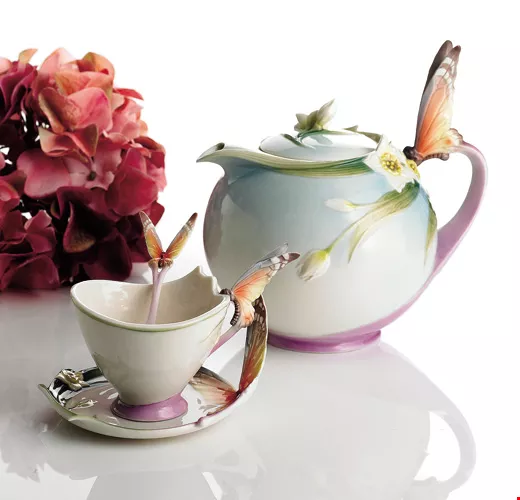
In 2002 Franz's "Butterfly" collection won "Best in Gift" at the New York International Gift Fair. It was also the company's first original product.
From scratch
From 1999, when Seagull decided to develop its own brand, until 2001, when its Franz brand unveiled its line of porcelain butterflies, the company poured NT$300-400 million into R&D and production equipment. It encountered all manner of frustrations and obstacles along the way.
"Back then we were groping our way forward from virtually nothing, aiming to produce exquisite porcelain as smooth and luminous as jade. To accomplish that, the company would need the absolute best glaze formulas, as well as dyes that could meet US FDA toxicity standards. Recalling those days, Chen laughs wryly: "You've got the physics involved in dealing with ceramic clays, the chemistry of glazes, and then you add problems with controlling the heat, which seem resistant to scientific control. Adjusting slightly the ingredients in the glazes or the heat and firing times-even only by a few seconds-can lead to entirely different coloration."
The company hired Sun Chao, who is famous for his "crystal glazes," as a consultant. That resolved the problems with the glaze formulas. And the company's R&D department continually experimented with different mixes of clays, eventually developing the company's own unique formulas.
With a history of more than 20 years in the field, Chen deeply understands the importance of controlling every step of the process. In order to assure quality, Franz prepares and mixes all of its own clay: it's one job that the company would never consider outsourcing. In order to protect the environment, they don't add any bone meal (the tricalcium phosphate in bone meal is often used to add luster). Via adjustments to the component clay proportions and to the glaze formulas, they were able to fire bone porcelain products that were luminous, shiny, smooth and beautiful.
Striving to turn two-dimensional art into three-dimensional pieces of porcelain, the team, apart from using underglaze techniques to ensure that the colors will look as vibrant 1000 years from now as they do today, also overcame the limitations of traditional molding techniques by developing a new method for molding complex ornamental features on the ceramic surface. This technique, for which the company now holds a world patent, fully conveys the intricate three-dimensional feel that is characteristic of Franz pieces. (See the mini glossary.)
In 2001 Chen named the brand Franz, the German name he was given by a college professor. The following year he established Franz Collection Inc. in the United States. Franz brings together Taiwanese design and R&D, mainland Chinese manufacturing, and foreign and domestic sales teams to offer a "new style of porcelain."
In June of 2002, the "Butterfly" collection of gracefully dancing butterflies won the "Best in Gift" prize at the New York International Gift Fair. Then in 2004 it was voted "Best Ceramic Gift" by the Guild of Specialist Gift Retailers in Britain. After earning these honors, Franz gave itself the mission of becoming a conveyer of "nature's charms." This intimacy with the myriad living things and this sense of embrace between heaven and earth is rooted in Chen's childhood memories of nature.
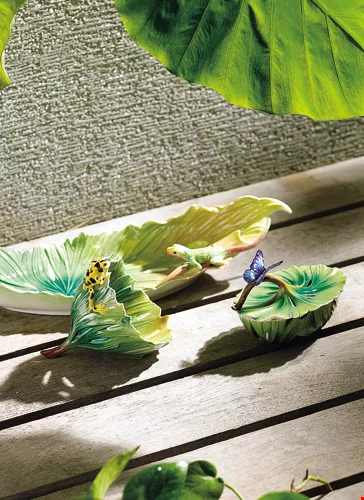
"The Rain Forest Little Dwellers" collection uses the teeming wildlife of a virgin rain forest to awaken people's love of nature. It won an Award of Excellence for Handicrafts from UNESCO in 2008.
At one with nature
Chen was born in the Taipei Botanical Garden staff housing in 1951, and he has always felt a special closeness to plants and bugs. Once he enters a park, he feels a sense of peace generated from his immersion in nature. When he was in junior high school, his father was transferred by his employer to Chiayi, and Francis likewise had to change schools. The move broadened his horizons; and the floating scent of rice amid the changing seasons on the Jianan Plain served as a form of aesthetic immersion.
"Nature wakes me up and makes me think. It calls to the spiritual side of my genes and reminds me how insignificant humanity is," Chen remarks. "Nature is also the source of my creative inspiration, a secret garden where I can consider my place in the world and my values."
Modestly looking to nature as his teacher, Chen takes the Chinese term ren ("benevolence") as the concept behind the Franz brand. "'Benevolence aims for connections with other social groups. With it, one aims to help others, as well as oneself, succeed." Citing the philosopher Zhuangzi-"Heaven, earth and I were born together, and I am at one with the myriad beasts"-he explains that people can, through their experience of nature, come to an intuitive understanding of the beauty of living things, attaining a kind of enlightenment.
"Confucian philosophy describes truth and goodness in the context of human interaction, so that people have a basis on which to know how to behave and gauge whether their behavior is proper. If you want to demonstrate benevolence in everyday life, more than demonstrating an elegant and tasteful style, you must show a concern for humanity that reflects inner cultivation."
This kind of realization is demonstrated in Franz's collections. Starting in 2006, Franz won a UN "Award of Excellence for Handicrafts" back to back for the "Bamboo Song Bird," "Island Beauty," and "Rain Forest Little Dwellers" collections.
The "Bamboo Song Bird" collection features the endangered "blue-winged pitta," a brightly colored, eye-catching jewel of the forest, which is known as the "eight-color bird" in Chinese. The species is not only one of Taiwan's precious summer migratory birds; it is also a major target of global protection efforts. With fragile porcelain, Chen has created an impression of the blue-winged pitta, both expressing the hope of future visits from the bird and also conveying a sense of the fragility of nature and the need to treasure and preserve it.
Hibiscus, which is often used for hedging, is the main theme of the "Island Beauty" series. From spring to fall, hibiscus adds romance to an ordinary hedge. It has even been selected as Korea's national flower. It constantly reminds us not to forget the fertile hopes that nature brings to people.
In addition to producing works that remind people to love and care for nature, Chen also established a 30-hectare Franz Park in Jiangxi Province's Jingdezhen in 2004. And in order to be in accord with the Eastern philosophical approaches of "going with the flow" and "sustainability," the company has planted a million high-value trees on nearby hillsides, and also changed its formulas in an effort to reduce the carbon footprint of its firing process. It is using natural gas or electricity instead of highly polluting heavy oil to fuel its kilns, and has reduced the temperature needed to fire the clay from 1350-1400°C to 1205°C. It is estimated that a reduction of 195°C is equivalent to saving 35 hectares of six-meter-tall trees from being cut. This cuts carbon dioxide emissions by 577 metric tons a year.
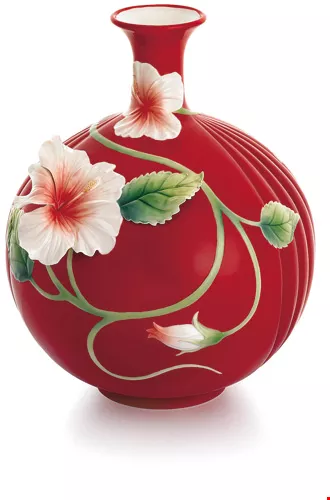
The main theme of the "Island Beauty" collection is the hibiscus, which has an especially lengthy period of bloom. Franz wanted to stimulate people's minds via the abundant hope demonstrated in nature's fertility. The collection earned Franz an Award of Excellence for Handicrafts from UNESCO in 2007.
High taste, high technology
The decision to go with Taiwanese design, mainland Chinese manufacturing, and global marketing has been a key to Franz's success. And Chen's many years of OEM experience have helped him make correct assessments about the international market. Moreover, the company's major investment in CAD/CAM and other software has allowed designers to design models directly on the computer. Then they precisely cut out intricate multilayered precision wax molds in the laboratory. These are then sent to the factory in Jingdezhen to be used in the manufacturing process. Various machines in the laboratory that are needed for this process cost more than US$1 million each. That level of expenditure is completely unheard of in Taiwan's gift industry and even quite rare in the USA or Europe.
The sleek handmade designs and the exquisitely intricate three-dimensional styling were key elements in Franz's campaign to conquer the European and American markets. As for marketing, Franz capitalized on a global fashion for things Oriental, by successfully "packaging" Chinese culture to satisfy European and Western yearnings for the glories of ancient China. And by relying on its own unique cost controls, it was able to price goods below their true value. Consequently, in just three years Franz was able to join the UK's Wedgwood and Japan's Noritake in the top ranks of leading international porcelain manufacturers.
In Chen's analysis, the European and American gift markets draw products from everywhere, and there is fierce competition. No firm can hold a position of dominance: "Although Franz doesn't have a glorious hundred-year history, it has boldly innovated, lacks baggage, and come out with more than 1000 new pieces every year!"
When then-ROC president Chen Shui-bian visited Panama, when Academia Sinica president Lee Yuan-Tseh attended an APEC meeting, and when current ROC president Ma Ying-jeou made a tour of ROC allies in Central and South America, they all came bearing Franz items as gifts. For an audience that Chen obtained with Pope Benedict XVI in December of 2007, Franz worked with the National Palace Museum in Taipei to transfer an image of Cherry Tree and Grosbeaks, a Qing court painting in the museum's collection by Giuseppe Castiglione (1688-1766), onto a vase, which was given to the pope. It was a successful instance of aesthetic diplomacy.
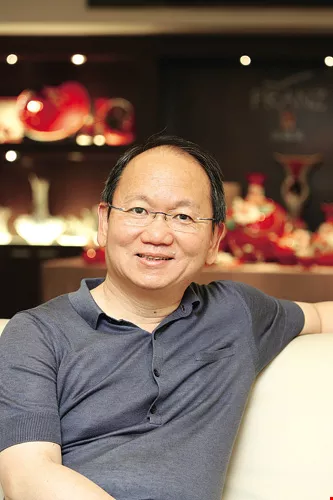
By founding Franz, Francis Chen has liberated porcelain from elegant simplicity. Franz's representations of nature-so realistic that one can almost hear the birds singing or see the flower buds unfolding-have dazzled the world.
Creative industries
Under the recently enacted Law for the Development of Cultural and Creative Industry, NT$21.2 billion is to be invested to help develop six "flagship industries," including television, film and digital content. The idea is to help Taiwan become a cultural and creative industry hub in the Asia-Pacific region. Chen says that in developing creative and industries, Taiwan ought to start by strengthening its cultural foundations. He suggests that the government transform its conceptual models. Only by taking a page from business and "respecting its customers and listening to what people have to say" will it be able to create effective policies.
To take Britain as an example, there are limits to industry's ability to cultivate cultural and creative talent. Consequently, the British government provides special treatment such as financing, incentives, and reduced taxation rates-so that various kinds of experimental startups have a chance to grow and flourish. On the other hand, while the ROC government has set aside funding to assist the development of cultural industries, there are so many conditions that few can benefit.
"Insufficient distribution channels is another problem." He stresses that when it comes to "creative industry," the operative word is "industry." One has to get off the artist's high horse and work hard at finding a market. Current policies are only concerned about the distribution and allocation of resources, but they overlook product sales channels. "It's like continually dumping food into a fish pool: the result is that an enormous amount of algae grows, and the eutrophication kills off much of what originally lived there."
In order to aid in the development of the nation's creative and cultural industries, in 2006 Chen established the Cultural Creative Industry Association, inviting luminaries from industry, government, and academia to brainstorm.
Chen, who once served as a spokesperson for vocational education, deeply understands the importance of cultivating skilled technicians and of providing education that emphasizes practical applications. He cites his own company as an example: From the teams that came up with Seagull's ODM designs to the teams that do design for Franz, all include many who received vocational educations. Johnny Ho, who has several times won design awards for his "Butterfly" series, studied graphic design at Taibei High School.
In order to strengthen the special qualities and competitiveness of Taiwan industry, Francis Chen began the Franz Awards in 2007. He aims to use this platform, which he hopes will grow into an international competition, to stimulate the cultivation of outstanding talent. The winning team will have an opportunity to go to France and represent Taiwan in Maison & Objet's "Show for Home Fashion."
Chen argues that Taiwan's creative industries should look first for opportunities in China, take the lead there, and then move onto the world stage.
"China has tremendous advantages, including abundant human resources, a rich cultural and historical foundation and an enormous market," he explains. "As Taiwan's cultural and creative industries start up, they should actively look to make connections with similar industries in mainland China. Then they can move on to the Chinese communities around the world and finally to international collaborations." At the same time he emphasizes the only way to "brainstorm" is to engage in exchange across industries, professions and nations.
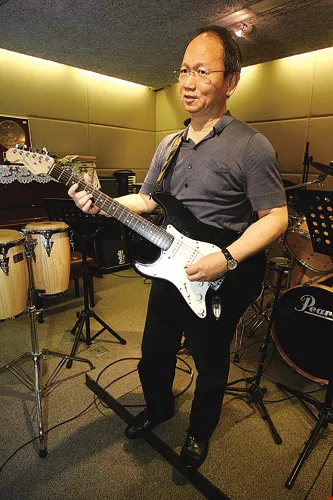
Francis Chen sang in a folk group when he was in college. Nearing 60, he still loves rock and roll. He finds inspiration as his mood moves with the changing beat.
His avocation: music
Having spent many years researching art, Chen is himself an entrepreneur who has crossed industries and is a man whose interests run far and wide. Apart from his enthusiasm for nature and art, he also enjoys listening to music. "Music is humanity's oldest creative force, and it's an important source of inspiration."
When Chen was in college, he formed a band. He started off playing guitar and bass. In order to write songs he also became acquainted with the piano, but at the time he was taking classes during the day, and then making money playing in Western-style restaurants and the American Club at night, so he had no time to find a teacher and study piano. And in addition, vanity-what with his being known as a "rock and roll genius" and all-reared its head, so he decided to hide away and study piano by himself.
"Back then the women's dormitory at Fu Jen Catholic University had a piano room. The dormitory supervisor saw that I was honest and willing to work hard to improve, so he agreed to let me in every day at noon to practice for an hour." Chen says proudly that he was probably the university's only male student who could just waltz into the women's dorm! In his junior year, he took over the lease on the Idea House Western restaurant in the commercial district around Taipei's Zhongxiao East Road Section 4. Apart from giving his own band a regular place to perform, he also invited many folk singers to come and perform. Many folk singers back in the day got their start there.
When he was a student, he performed Japanese and Western standards, whereas today in his late forties he loves rock and roll. His state of mind changes with the beat of the music, and inspiration strikes.
"Music allows me to understand better how to make use of creativity," says Chen, who has a piano room both at home and at the office. Lightly strumming an electric guitar, he adds, "I've never cast aside piano and guitar. Playing music gives me great joy."
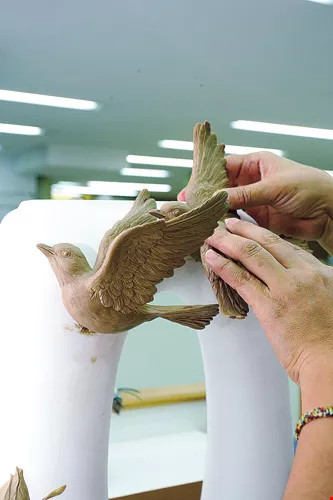
Master craftsmen carve and assemble pieces of a mold.
Porcelain's glory comes home
More than 200 years ago, before Western techniques for firing ceramics had matured, Chinese porcelain was valued as highly as gold in the US and Europe. The founders of later famous European porcelain manufacturers were major merchants who often rose into the ranks of the nobility. Their command of porcelain production techniques, apart from allowing them to accumulate wealth, also allowed this handicraft to reach the realm of art. They left glorious legacies.
Today, Francis Chen is spreading the legacy of ancient China around the world via the concept of ren (benevolence) and the idea of man being at peace with the universe. And from the standpoint of the fine arts, he is reinterpreting Chinese aesthetics. He expects the halo around "china" that so enraptured the West several hundred years ago to return home, fulfilling Franz's mission of "from China, back to China."

@List.jpg?w=522&h=410&mode=crop&format=webp&quality=80)


