Finding the Life Hidden Within--Sculptor Wu Jung-tzu
Kuo Li-chuan / photos Chuang Kung-ju / tr. by David Mayer
March 2004


On the campus of Tamkang University, a group of students sit around joking and chatting. Among them is 56-year-old sculptor Wu Jung-tzu. Wu is not their teacher, and none call him "Dad." He's a student himself, in the Graduate Institute of Chinese Literature. After a long education in the school of hard knocks, Wu only graduated from junior high school at the age of 45. In fact, almost every major venture in his life has followed a rocky road; he was already 23 when he took up his apprenticeship with a master sculptor, and courtship and marriage also generated great drama. Wu's story is basically a real-life version of Story of a Small Town. The tale begins at Mount Chichi, where Wu grew up as a farmer's son and a lover of painting.
Wu Jung-tzu was born in Nantou County in 1948, the son of a banana farmer. To be close to the fields, the family of ten moved to Mt. Chichi, an hour's drive from Chichi Train Station. An observant child with an excellent memory, Wu had a penchant for drawing fruits in sketch books and on calendars. His habit of doodling eventually grew into a serious talent, and teachers were amazed at his lifelike drawings-they looked practically good enough to eat!
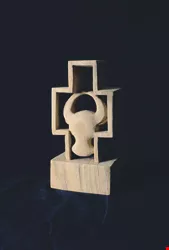
Dreaming into the future
His father, however, had more practical concerns: "How are your drawings gonna keep you in food?" Banana exports to Japan were subject to big market swings, and crops often went unsold. Seeing no future in banana farming, Wu's father wanted his son to pick up a practical skill. But Wu couldn't forget about his drawing. He had originally wanted to learn to draw movie posters, but his father figured blacksmithing was a more realistic choice. Later Wu thought he'd like to study wood sculpture, but as before, his father was opposed.
One night, however, Wu dreamt of himself sculpting a statue of Kuanyin, the goddess of mercy. The soft curve of her brow, the lines of her robes, and the fine grain of the wood all accentuated the mercy in her face. Just as he was proudly appraising the completed sculpture, Wu was awakened by the call of a rooster.
It was a most peculiar dream. Wu's village only had a shrine to the local Taoist god. The country boy had never even seen a Buddhist statue before or taken a sculptor's knife in hand, but the dream strengthened his resolve to learn sculpture. His older brother secretly slipped him some money to study wood sculpture in nearby Chushan with a man who had studied under Pan Te, a noted sculptor of Buddhist statues. In his zeal to learn wood sculpture, Wu boarded a train to Taipei to visit Pan himself.
Walking along Taipei's Tihua Street, Wu heard the sounds of chisel on wood coming from a shop called Seek Truth, a dealer in Buddhist implements. His heart in his throat, Wu paced back and forth outside the shop for a while before gathering the courage to go in. "I'm looking for Pan Te." The master sculptor looked him over and asked his age. "I'm 23," replied Wu. Pan Te told him that most apprentices started at age 14 or 15, and that Wu might not do well because at his age his bones were no longer so supple. Wu replied, "I'll work my tail off on it!" And so Pan Te accepted him as a student.
From morning to night, Wu watched his master's hands to see how he held the knives, how he cut into the wood, and how he followed through. After everyone else called it a day, Wu just kept sculpting away. After everyone went to bed, Wu still sculpted. He would keep right on going until dawn, and even then would not be ready to quit. Pan Te was astonished at Wu's quick progress and prodigious commitment.
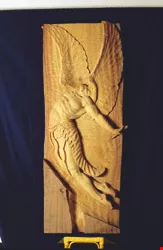
Storybook courtship
Pan Te once sculpted a statue depicting Shakyamuni in the period after his ascetic cultivation but prior to enlightenment. The sculpture depicted a figure of skin and bones sitting on the Vajrasana ("seat of enlightenment"), hunched over and pondering the mysteries of heaven and earth. After finishing the sculpture, Pan Te retired for the night. Wu decided to have a go at reproducing the sculpture to see how far he was from achieving Pan's level of mastery. While others slept, Wu worked away. Incense hung in the noiseless night, and the hours passed. Wu finished up just as the first cock crowed, and placed his work next to Pan's. The sight that awaited Pan as he walked into the studio at dawn was a stunner-he couldn't tell which statue he had done himself!
When the famed Hsiahai City God Temple in Taipei made plans in 1971 for renovation, Pan Te was put in charge of carving the statuary, and Wu was put to the task. There was an unwritten rule back then that no one was allowed to take photographs inside temples, or even make sketches, so the sculptors had to clearly remember the facial expressions, the animals on which the deities were seated, the mudra (hand symbols), and religiously symbolic accoutrements held by every single character. Wu's photographic memory came in handy, for his master had only to strike a pose for Wu to render a detailed reproduction of the facial expression and physical posture.
"The spirit and compassion of the Buddha are everywhere, but his visage must be beyond the five senses. At the same time, however, it must also be able to breathe together with ordinary people. The difficult task of making this happen falls upon the master sculptor." In just six months of apprenticeship, Wu made a deep impression on his master. Pan taught Wu everything he knew about wood sculpture, and even gave his daughter's hand in marriage, just like in the story books.
After marrying, Wu opened Tsanshan, a shop specializing in Buddhist paraphernalia, in Taipei's Shuanglien district in 1976. Two years later the shop saw a chance visit by Han Pao-te, then dean of the College of Science and Engineering at National Chung Hsing University, now head of the Museum of World Religions. Wu happened to be sculpting in the shop when Han dropped in.
"I saw a few half-finished statues sitting in the doorway, and though they were just your standard Buddhist sculpture, I could feel a certain life force in them," says Han. As a mainlander, Han spoke no Taiwanese. Wu spoke no Mandarin. The two nevertheless struck up a conversation, with Wu's wife acting as interpreter. Han encouraged Wu to break away from traditional sculpture, but Wu was self-conscious about his lack of education and didn't pursue the subject.
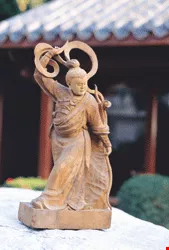
Wu the Wanderer
With a store of his own and an outstanding reputation, Wu had every reason to feel an unqualified success. But success is precisely what presents the opportunity for vanity and weakness to creep into the heart. In 1981 Wu was elected chairman of the Taipei County Buddhist Paraphernalia Association. The honor turned out to be a Pandora's box that would test his character. Social gatherings and personal ambition were suddenly very much a part of his life. In just a few years, gilded gatherings, expensive cars, and sumptuous banquets had taken the edge off Wu's sculpting and plunged him tens of millions of New Taiwan Dollars into debt.
Once the money was gone and the friends had scattered, the only ones that still remembered Wu were the buddhas lying hidden in the wood. They had been waiting there all the while for him to wake up and come out of the bright lights and glitter. To pay off his debts, Wu went back to sculpting. He traveled Taiwan knocking out half-finished statues for temples. Skilled sculptors capable of such work were few and far between back then, and when a temple wanted to make a large or especially difficult statue, they couldn't have asked for a better candidate than Wu to do the job. Wielding sculpting knives every day from eight o'clock in the morning until ten in the evening, he could hardly open his hands by the end of the day.
"Wood is inanimate. It takes a human being to give it form and spirit. When I'm in the dumps, I'm especially aware of how the wood is affected by the sculptor's mood as it takes on human form. When the sculptor is feeling up, the wood looks full of vitality; when the sculptor is down, the whole piece takes on a forlorn look."
Wu traveled around several years doing the rough work for sculptures. While at a temple working on a statue of a deity, he again ran across Han Pao-te. Han once more encouraged Wu to break free of tradition, and felt that even though Wu was working to pay off debts he could still inject some personal flair into his work. Wu's rough work was highly regarded, and he had even done many large-scale statues of deities for temples in Japan, thus when he got creative with commissioned works the customers generally reacted favorably. In the process, Wu was able to take advantage of his commissioned work to do some experimenting.
In 1986, a diffident Wu walked into Taipei's Springtime Gallery. With his rough physical features and country mannerisms, the staff there had a hard time thinking of him as an artist. Wu's rural roots always made him uncomfortable in urban settings. He had come to the gallery to set a time slot for his first personal exhibit, but he stuttered and stammered so badly that nothing definitive came of it. It was only with Han Pao-te's recommendation that he managed to get the exhibit scheduled.
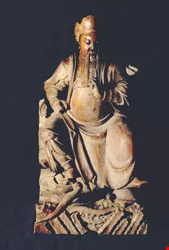
Wood in motion
Wu's first personal exhibit showed his tremendous talent, and how much work he had put into his art. Particularly interesting was his work No Holding Back, which depicted the famous trio of Liu Bei, Guan Yu, and Zhang Fei. Sworn blood brothers some 1800 years ago, the three became famous generals and have lived ever since as legendary heroes and religious icons. The time-honored method of presenting them in sculpture is to put Liu Bei in the center and Guan Yu and Zhang Fei in attendance on either flank, with the three figures facing the viewer straight on. But Wu dispensed with tradition by orienting the three heroes in all different directions and having them fight back to back, none outranking any of the others. Wu's emphasis was on the spirit of their pact of brotherhood.
Says Wu: "I've helped friends when I was young to get back at people who'd done them wrong, and I've gotten in fist fights on my own account too. Those experiences taught me that you have to be of one mind if you're going to stick together, and that you have to fight back-to-back in order to cover for each other and make sure the enemy doesn't have any chance to do you harm." For a work like No Holding Back, with the trio sculpted completely in the round, the posture and attitude of the three figures was a huge compositional challenge. In each stroke of the knife, there was little room for error. Every single angle had to be taken into consideration. Although the subject of the work was a traditional story, the piece nevertheless had a distinctly modern feel to it.
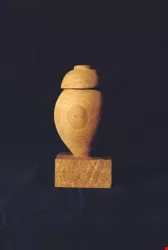
Expressing movement in a static piece of art is a special strength of Wu's. In God of the North, Wu implies stillness and motion by varying the thickness of the elements. Thinly executed decorative elements on the god's head, left shoulder, and left leg show the patterns on his headgear and armor and hint at time standing still. In the meantime, the clothing and beard are swept back in evidence of quick motion.
Wu hit upon a way to convey this sense of motion while watching martial characters bound about the stage in Peking Opera to the accompaniment of drums and cymbals. As soon as the music stopped, the actors instantly went stock still, their suddenly motionless poses designed the better to exaggerate their formidable power. Wu applied this same imagery to the beards on the men in his sculpture to give viewers the feeling that the characters had just brought their heads to a sudden halt in the middle of a violent motion.
The soul of wood
In 1987, noted cultural scholar Kao Hsin-chiang invited a group of 32 sculptors to design new Chinese chess sets in an effort to inject new life into a pastime that dates back to the Song dynasty.
Wu was one of the 32 sculptors to take part in the project. He based his chess set on the 12th-century wars between the Song and Jin dynasties. The "king" for the Jin side was depicted as the machete-wielding Jin general, Jin Wushu. His opposite number on the Song side of the board was the famed Song general Yue Fei. Wu relied on a friend at the Academia Sinica to advise him on the garments and weaponry in use at that time. He included on his board such items as hand-pushed chariots and rope-pulled cannon as used during the Song dynasty, and he used a unique new sculpting technique to show sabers and swords in motion.
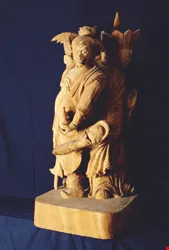
Wu believes that fate has half the say in what piece of wood will be used to carve what personage. He believes that every grotesquely gnarled piece has a living force inside that cries out, and that if the sculptor can listen to the cry and hear its message, the chisel will deliver the embodiment of that living force. Wu's skill at seeing what figure lies within the wood is unsurpassed. In his hands, an unremarkable chunk can morph into a swaggering swashbuckler, a mild-mannered scholar, or perhaps an arhat deep in meditative trance. Effecting such transmogrifications comes naturally to Wu, as if it were the figures themselves that had awoken from shapeless slumber.
Big dramatic tension
In 1993, Kuo Wei-fan (then director of the Council for Cultural Planning and Development) gave one of Wu's sculptures to Professor Jacques Pimpaneau of Universite Paris 7. The distinctly Chinese style and forceful prescence of the work exerted an irresistible pull on Pimpaneau, a long-time aficionado of Eastern art. He strongly urged Wu to do exhibits at the Musee Kwok On in France and the Musee de Mariemont in Belgium. It was a huge honor for Wu, and caused quite a stir in Taiwanese art circles.
Wu chose the Three Kingdoms period (3rd century AD) as the theme of his exhibit, carving the powerful rivals Liu Bei, Cao Cao, and Sun Quan from blocks of ancient cedar. Liu (leader of the Shu kingdom in the west) and Sun (his counterpart from the Wu kingdom in the east) are depicted standing back to back, fighting together against Cao of the Wei kingdom in the north even as rivalry between the two allies simmered just beneath the surface. Wu also carved a statue called Tiger Cage Pass, in which he re-created the famous battle where Lu Bu was pitted against Liu Bei, Guan Yu, and Zhang Fei. Lu is shown with a bow in one hand, an arrow on the string, poised for the release. It is a stirring pose, and you almost want to hold your breath in anticipation of the decisive moment in history that is about to unfold....
Chiu Kun-liang, president of Taipei National University of the Arts, has written in glowing praise of his friend's Three Kingdoms sculpture series: "Wu Jung-tzu captures the dramatic tension contained in a fleeting instant, as well as the mental state of his figures, bringing popular Chinese legends to life. At the same time, he also injects his own worldview into his works, giving them an imposing sense of living presence."
Knives and pens
With Wu's sculpting career back on track, something Han Pao-te once said came back to him: "An artist really needs to do something distinctive. Beyond technical mastery, he must also have deep and meaningful life experiences, and broad knowledge." Wu had always thought about going back to school, but didn't quite have that little extra bit of determination to actually put the thought into action. The exhibit at the Musee Kwok On provided the fillip he needed to overcome his inertia. He lost sleep over the address he had to deliver, and stumbled through it in just five minutes. The art critics, by contrast, just kept talking and talking, throwing out all sorts of jargon that Wu didn't understand. The exhibit proved an acutely discomfiting experience for Wu, whose studies had ended upon graduation from elementary school. After returning to Taiwan, Wu finally got in gear and enrolled in junior high. He was 45 years old.
Wu spent six years getting his junior and senior high school education, and during that time managed to maintain a perfect attendance record. He studied diligently, and absolutely nothing was more important to him than class attendance. In his third year of senior high, in connection with the inauguration of the president of Costa Rica, Wu accepted an invitation to put on a personal exhibit in Central America, but he promised to go only after the school granted him leave. While he was preparing that same academic year for graduation and the equivalency exam, his father fell seriously ill and had to go into the hospital. While at the hospital caring for his father, Wu kept worrying about failing the equivalency exam.
In 1998, at the age of 51, Wu showed up at Chengyuan Senior High School to take the university entrance exams along with a flock of 18-year-olds. The exam instructor said to Wu: "Parents aren't supposed to be in here." A surprising answer came back: "I'm here to take the test." As Wu gripped the 2B lead pencil that hot July day, his glasses kept slipping down his sweaty nose, and the circles to be filled in were so small he could hardly see them. But he got through the ordeal and tested into the Chinese Department at Tamkang University. To get to class more easily, he moved his workshop to Hsuehfu Road in Tanshui, just around the bend from the Tamkang campus.
Academics and art combine
During a casual conversation as a second-year undergraduate with Professor Lu Kuo-ping, Lu suggested that Wu do carvings of Chinese characters. Lu's idea was to do a seal script version of the character for "woman" (女), which could take the stylized sculptural form of a woman in a kneeling/sitting position. Lu further suggested that Wu could go on from there to create statues for a whole "family," i.e. the Chinese characters for "man" (男), "father" (父), and "mother" (母). Under Lu's leadership, Tamkang University's Graduate Institute of Chinese Linguistics and Documentation was then working on the Project for 21st-Century Visual Culture and Art. Phase one of the project called for the use of sculpture to "make the written character stand up."
Wu thought day and night about Lu's suggestion, and a few days later sculpted the figure of a lovely woman. Having found a way to make the Chinese character "stand up," Wu's graduate institute collected 52 oracle bone characters from the Shang dynasty (1765-1122 BC) and asked Wu to create wood sculptures based on the form and meaning of the oracle bone script.
The resulting sculptures, which went on display in November 2003, are fascinating. The kneeling position from which the character for "woman" (女) derives, for example, reflects a small detail of the lifestyle of the ancient Chinese. Archeological research has shown that up until the Tang dynasty, the Chinese people sat directly on the floor, and only began sitting on chairs thereafter. Some see the character for "man" (男) as an erect penis, but in fact it is composed of two separate elements; the top part is the character for "farm field" (田), while the bottom part is the character for "plow" (originally 耒 on the bottom, simplified now to 力). The etymology is clear enough: those who plow fields are men. Tamkang University and the University of California at Sacramento are currently discussing plans for possible academic cooperation aimed at creating Chinese characters that "stand up and take their place in the world" by combining the power of academics and art.
Wu explains his concept of art: "Art isn't about 'making something from nothing.' It's about 'making something new out of what's already there.' If art is to demonstrate the unique characteristics of the people from which it has sprung, and if inspiration is to be kept alive, artistic creation has to combine with culture. Abstract art that's devoid of cultural context and without a basis in anything at all is just a fraud."
It has taken the gutsy Wu over ten years of hard study to get into graduate school, where he is currently in his first year. On more than one occasion, he came close to flunking courses. Now he plans to go on for a PhD. He's enjoying student life, and is continually digesting his newly acquired knowledge and incorporating it into his sculpture. In both his academic career and sculpting, Wu Jung-tzu just keeps giving us new reasons to delight in his latest developments.

@List.jpg?w=522&h=410&mode=crop&format=webp&quality=80)


