

Chou Meng-tieh, "Uncle Chou," always cuts a familiar figure when he's out on the street.
No matter the season, he'll be wearing a woolen cap and a long robe, and carrying an umbrella and a big bag full of books and magazines. The only thing that varies is the thickness of the material. His look has been unchanged since he took up Buddhism more than 30 years ago, when he was in his 50s. Old and frail, but still sharp as a tack, Chou always takes his time, his pace as patient and measured as his development as a poet.
Chou Meng-tieh's friends like his robes, and say they give him a refined, elegant look. When the now deceased poet Mei Xin presented Chou with a long robe, he remarked: "This kind of clothing suits you, and you suit this kind of clothing." Nowadays, "Uncle Chou's" entire wardrobe consists of only five robes that vary in thickness with the season.
A retiree who lives by himself, Chou has always lived simply, but has become frail in recent years. Chou was quiet when Taiwan's literary circle feted him last year on the eve of his 90th birthday (by the Chinese method of counting age), exchanging smiles with long-time friend Chang To-wu, but otherwise saying little. (Chang and Chou have been spending their birthdays together for years.)
Chou, the king of the "Lonely Land," was among the first winners of the National Award for the Arts. A trailblazer who set the standard for Taiwanese contemporary poetry, he still regularly tills the fields of literary imagination, his poetic spirit inexhaustible.
Poets are prone to worrying about their nation and its people, and often can't help but be concerned with the inequities and injustices of the world. In Chou's case, he even sent President Ma Ying-jeou a poem that ran: "Who can keep the ripened rice from dipping its head? Who can calm the seas or keep the magpie from the branch? Who can stop ducks and geese from gossiping or the woodpecker's friendseeking claw from knocking on Jia Dao's moonlit door?" Chou's intent was to remind the president that successful social reformers must possess not just knowledge, humanity, and courage, but endurance, and that they must be prepared to accept long-term isolation. The president dropped by for a personal visit when Chou was bedridden early this spring, but Chou remained as reticent as ever, choosing to let his poems do his speaking.
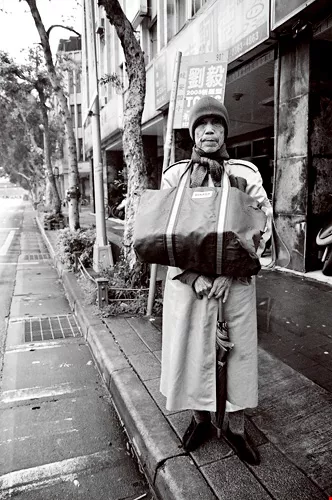
Chou's composed expression conceals a passionate heart. Back when he sold books on the street in front of the Astoria Cafe, his stall was a hot spot for discussion amongst readers and authors. Once he became a Buddhist, he wandered far and wide visiting friends. Though he listened more than he spoke, his profound and unaffected warmth got his message across.
Chou Meng-tieh was born Chou Chi-shu in 1921. Born after his father had passed away and subject to all manner of difficulties and constraints throughout the war years, the young Chou yearned for the freedom to act as he saw fit. In later years, Chou took to referring to himself as Meng-tieh ("dream of a butterfly"), referencing the philosopher Zhuangzi's dream of being a butterfly, though these days members of Taiwan's literary community generally call him "Uncle Chou," "Elder Meng," or "Elder Tieh." Living as a virtual ascetic, Chou has used "philosophy to refine and cast tragedy" and brought life and work together into a single unitary whole much admired within Taiwan's poetry circles.
On the opening page of his first collection of poetry, Lonely Land, Chou wrote that he was "using the sorrow of poetry to overcome the sorrow of life." But when life reaches a difficult pass, creative endeavors can offer a way out. Chou was 38 years old when he published Lonely Land. Having left the wartime misery of mainland China and come to Taiwan with the army, he ended up opening a bookstand. He had tasted life's bitterness and, seeking liberation, nurtured his poetic side for 20 years. Those poetic inclinations were a salve to his soul and the act of writing an escape. Through them, he found salvation and redemption.
Chou has now been writing for some 60 years and has produced more than 300 poems. But many talented individuals go unrecognized and much of his early work is no longer in print. Last year, Tseng Chin-feng, a friend who also happens to be an associate professor in Chinese literature at National Kaohsiung Normal University, edited a three-volume collection of Chou's work that is likely the most comprehensive yet produced.
Uncle Chou cherishes words. He frequently fusses over short 10-line pieces for as much as six months and has often been known to labor over single poems for a decade or more.
Quoting the English renaissance man Sir Francis Bacon, Chou remarks: "Reading maketh a full man, conference a ready man, and writing an exacting man." Yearning for precision, Chou has spent his life writing poetry. But this pursuit of precision also explains how 37 years passed between the publication of his early Lonely Land and Goddess Incarnate collections and his more recent Thirteen White Chrysanthemums and Rendezvous collections. In his introduction to Thirteen White Chrysanthemums, Chou uses a line from the Indian poet Rabindranath Tagore to describe his state of mind at the age of 83: "Release me from my unfulfilled past clinging to me from behind making death difficult."
.jpg?w=1080&mode=crop&format=webp&quality=80)
In 2005, Chio Ko published a short work on The Dream of the Red Chamber that highlights both Chou's script and his knowledge. Reading it is an eye-opening experience.
I've chatted with Uncle Chou several times, and always feel his responses are heartfelt and retain something of a childlike quality.
A friend of Chou's who isn't yet 50 lamented at a small gathering how hard it is to understand the mind of someone in their 80s. When Chou heard, he told him: "It's best that I don't talk, and best that you don't ask. Chickens don't understand ducks. Ducks don't understand geese. Geese don't understand the fish or the turtles...." That prompted the friend to exclaim, "Enough! Enough! I won't ask anymore."
I remember running into Chou out buying a paper one afternoon many years ago. While exchanging greetings, I mentioned that I wanted to chat with him about the good things that go along with being 80. Chou thought for a moment, then said he didn't think there were any good things to speak of about being 80 or 90, but then added, "Then again, talking about 'not good things,' is itself one kind of good thing."
As Chou got more into the conversation, I offered him a glass of hot water that he drank straight away in spite of my warning that it was hot. He said that when drinking water, he prefers it either hot or cold. "Drinking hot water is very stimulating; it has flavor. Warm water is bland and insipid!"
Casting his memory back to a time more than 70 years ago, Chou recalled that his formal education was "fragmentary." Living through the chaos of war, his family fallen on hard times and himself reticent from childhood, he argued that he was "born an old man." But he always had a passion for books and grew up memorizing the "Four Books and Five Classics." To this day, he can recite the Four Books from cover to cover.

Chou's rearkable "slender gold" calligraphy is as slowly and meticulously composed as his poems.
Chou attended middle school in Anyang, Henan Province. After graduating, he tested into Kaifeng's Shengli Normal High School. But, just six months later, the start of war and concerns about his mother prompted him to leave Kaifeng and return home to Yuanxi, where he enrolled at Xianglin Normal High School. When the Communists turned up just one week later, he ran away to join the army.
Betrothed at three, married at 15, and the father of two sons and a daughter while still very young himself, Chou fled from mainland China to Taiwan with the army at the age of 28. Discharged for poor health after serving seven more years, he received NT$450 in severance money and began traveling around the country. It wasn't until four years later, when he received a business license and opened a small bookstall in the arcade beneath Cafe Astoria on Taipei's Wuchang Street, that he finally had a corner to call his own.
Chou kept his stall for 21 years, until a 1980 stomach surgery compelled him to give it up. He went on to convalesce in Waishuangxi for six years, living contentedly on his NT$2,300-per-month military pension. His rent was just NT$1,500 per month, and the remainder of the pension covered his living expenses. In those days, he was "as skinny as a crane, and the days were as long as years." Chou spent his time annotating numerous classic works, including Memoirs of Eminent Monks, Master Eight Fingers, Strange Stories from a Chinese Studio, and even The Wonderful Wizard of Oz, and never felt bound by his straitened financial circumstances.
Chou continues to live alone today, and remains as poor as ever, with only enough for room and board and no family property. In fact, when he won a Central Daily News award for literary achievements several years ago, he donated the entire NT$100,000 prize to the Tzu Chi Foundation, much to the dismay of friends in the literary community. But Chou knows himself and his circumstances well. "I can't not live a simple life," he says. After all, you could become an emperor and still "suffer from the failure to be content with your lot in life."
.jpg?w=1080&mode=crop&format=webp&quality=80)
Chou is not a prolific writer, so every new book he puts out draws enormous attention. Hung Fan published Thirteen White Chrysanthemums (left) in 2002. Chio Ko Publishing released a new edition of Rendezvous (right) in 2006.
Uncle Chou says that his decisions to become a soldier and open a bookstall were, at their most basic level, based on not wanting to starve. Once starvation was no longer a threat, he discovered that his next desire was "freedom." Whether "bound for Heaven or Hell, I didn't want other people interfering," he says.
Bookselling represented a kind of freedom. His stall carried collections of poetry, which, being relatively unpopular, meant he had little business. But Chou thirsted for knowledge, not money. His passion for learning carried on into his 40s and then his 50s, and he read and reread everything from the Chinese classics to the novels, poetry, and myths of the West.
Sitting at a narrow intersection on Wuchang Street, Chou became a part of the human scenery, or, as one American journalist put it, the "Oracle on Amoy Street." Chou didn't care in the least if the poetry he carried didn't sell, nor did he pay any heed to the cars and people bustling by. His inner calm insulated him from his surroundings. He had a small bookshelf and a little stool, and, when not selling poems, wrote his own, composing one after another sitting at his "desk" on the street.
Once, when a friend asked Chou to inscribe a collection he'd just purchased, Chou gave the man something he'd just written in his notebook: "The things on which life depends determine life's nature or manner."
Chou explains that the goshawk uses its sharp beak and wolves, tigers, and panthers their razor claws to capture small animals. They maintain their existence by using the lives of others to nourish their own, which gives their lives a ruthless character. The earthworm, on the other hand, has neither beak nor claw and instead "eats the fertile soil and drinks the nether springs." Chou thinks himself more like the earthworm, passing his days with no property to his name. "It's not about happiness or unhappiness," he says. "People must be who they are, live the life appropriate for them. That's all."
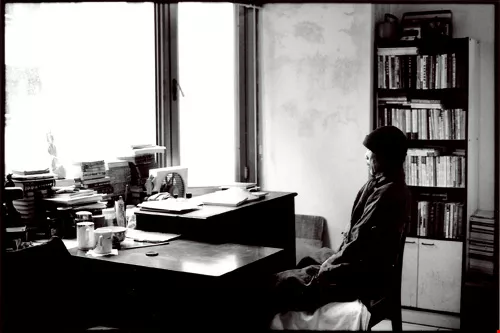
"His cultivation incomplete, an eminent monk reincarnated as a poet." "Poet-monk" Chou Meng-tieh hides himself on Earth, living a singular life, uncorrupted by the human world.
Whether content simply not to starve, hungry for knowledge, or honing lines of poetry, Chou has always followed his heart, choosing the most direct but also the most difficult path through life.
To maintain his freedom and write his poems, Chou has made do with solitude, missing out on family, romance, and friends. As his fellow poet Yu Kwang-chung put it: "No matter what page you turn to in Lonely Land or Goddess Incarnate, what you read is always lonely." Chou began with the smallest of desires, as unassuming as that of the grass-"give me a pile of dirt, and I'll put down roots." Time has tempered and honed him into a poetic giant.
Tseng Chin-feng sees Chou's poetry revolving around the "withered, thin, cold, and lonely." But Chou's cold and solitude aren't without feeling or flavor. Instead, the interplay between fire and ice, the tension between passion and transcendence that hide in the poems' depths are louder than the shouting of the crowd and more charming than the dance of flesh and spirit. In "Lonely Land," for example, he writes:
Here daytime is as quiet, serene and seductive as night / The night even more gorgeous, substantial, radiant than the day / And here the winter cold is like wine, stowing and bestowing poetry and beauty / Even the void converses, inviting over the silently communing stars that fill the sky...
Chou's work from the Goddess Incarnate period "is imbued with feeling, shot through with Buddhism, and even more exceptional." Tseng uses the line "withered into a stone, tears exhausted, weeping blood," from "Red Dragonfly" to show that while the poet may seem unfeeling and indifferent, he is in fact caught up in tragic emotions and suffering.
More and more of the reflected brilliance and vibrancy of Buddhism begins to emerge in Chou's later work. In the collection Rendezvous, he uses ordinary, everyday language to pass on the profound understanding gained through his clear-eyed take on worldly events. "The thoughts driving the poems are no longer Buddhist-style aphorisms, but the clear, sharp images of a comprehensive state of mind." The reader accompanies the poet as he journeys to this enlightened state.
Take "A Bird's Path" for example:
And lately Time carries a cane / no longer dreaming vast dreams / the grip and the cane equally tall / the Shadow drifts, content with circumstances / plodding, mumbling to himself / toward / the horizon most nearly before his eyes / white gulls dawdle / a boundless, beautiful sunset / place of return / returning
Wherever there's a tiny swell, there too will be / The azure sea!
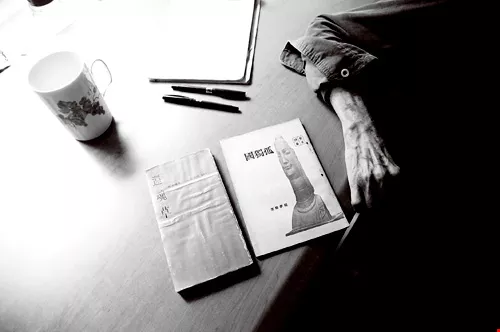
Chou's spare frame radiates tremendous energy that is manifest both in his poetry and in his exceptional philosophy and moral conduct.
Turning back to more mundane matters, many people wonder how someone who has suffered and been alone as much as Uncle Chou has managed to live such a long and vital life.
Chou, now in his 90s, doesn't have a particular method for maintaining his health. If you push, he'll say it's nothing more than "knowing one's limits and being content." But, if you listen carefully and observe his lifestyle, there actually is a "Chou approach to health maintenance" that is both environmentally friendly and practical.
Meeting Chou for breakfast one chilly morning, I noted he was only lightly dressed. He explained that he likes not wearing quite enough and feeling a little of the chill because he doesn't like indulging himself too much and instead prefers to feel a little "poor." Just as he finished speaking, our congee and side dishes arrived, and Chou immediately slurped down a bowl all in one gulp. "Watch out! You'll burn yourself!" I cried. Ignoring both me and the side dishes, he started right in on another bowl. About halfway through that one, he stopped and mumbled sheepishly to himself: "I wonder if I was a monk in a previous life. Otherwise, why would I love congee so much?" Then, covering his mouth and smiling, he added that his mother used to tell him, "When your teeth are ugly, you'd best not smile too often."
"Sometimes when I make congee at home," Chou admitted, "I finish it without eating even one peanut along with it." I asked him if he wanted another bowl. "Two's enough," he said. "I've already had too much today." He quipped, "To live a long life, stay 30% ill; to keep yourself young, eat seven parts of your fill." He then added, "To grow old at your leisure, don't partake of too much pleasure." Chou has thought long and deeply on maintaining his health, and doesn't indulge himself at all.
A mind at peaceChou has long adhered to a very simple diet. If he's feeling weak, he'll ride out to Danshui for a bowl of beef noodles with the meat cooked very soft, a dish that always serves to restore him.
He's weighed around 40 kilograms for decades, and offers up a funny story about his weight. One day Chou and a friend were leaving a restaurant after a meal and saw a coin-operated scale outside. When Chou stepped on it, the scale's computer told him: "Child, you are 163.4 centimeters tall and weigh 39 kilos. Best wishes." Chou laughs happily-he weighs so little that he's become a child again!
Speaking more seriously about his insights into staying healthy, Chou says that diet and lifestyle only touch the surface, and account for only a small portion of health maintenance. In his view, what's inside you counts for at least 70%. When all is said and done, "illnesses don't go looking for people who are at peace."
Chou cites himself as an example, and argues that inner health comes of cultivating the emotions. Having grown up on the Four Books and Five Classics, which trained him to be empathetic, and on Confucianism's admonition to be at peace in difficult circumstances by delighting in doing right, Chou used to think of himself as a latter-day Yan Hui, Confucius' favorite disciple. When he got a little older, he became a devoted student of Buddhism, but was drawn to the work of Zhuangzi and Tao Yuanming as well. His heart was filled with a naive romanticism while his behavior continued to be informed by a Confucian sense of moderation and adherence to rules.
Inner tranquility is also crucial to his health maintenance regimen. "I've found Buddhism to be invaluable since I turned to it in my 50s." Buddhism doesn't avoid talk of consequences. Instead, it views the outside and inside as one, and sees an individual's wealth or poverty, health or illness, and happiness or suffering as a sequence of cause, karma, and consequence. If you know the cause of something, you no longer need to complain about fate or people. This kind of knowledge leads to peace of mind, and greatness of spirit.
"Give me time..."Whether it is his fundamentally good constitution or his thinness, Chou enjoys robust good health. He says that he had just his third tooth pulled for cavities at around the age of 60, still has no false teeth, and eats everything. Chou also has exceptionally good eyesight that allows him to read small print without squinting or putting on glasses. He is accustomed to doing his writing in the "slender gold" calligraphic style, grinding out a few dozen characters an hour in a refined, powerful hand instantly recognizable to members of the literary community.
Chou's zest for activity has also helped keep him in good health. A very disciplined man, he always sets out early for appointments. "I love using the extra time to enjoy a quiet breakfast," he says. Chou has a few favorite coffeeshops for sitting quietly. He doesn't go to them for the atmosphere, but to "give a mind that's worked too hard a breather." He spends most of a typical day reading and thinking, and spends the hour it takes him to get to a coffeeshop emptying his head. Once he hops on a bus, his mind begins to revive. Chou is known to haunt the Chongqing South Road area, where you can often see him even after dark, hurrying down the sidewalk to catch the last bus back to Xindian.
Though he has the romantic nature of a poet, Chou laments the passage of time and has long pleaded: "Give me time to realize past aspirations and fulfill desires." Now that he's entered his 90s and feels his health is declining, he regretfully admits to having been a habitual procrastinator and says he was deeply moved by a passage from the eulogy that Pan Renmu wrote for Lin Hai-yin: "I thought there was still so much more [time], when in fact there was none."
Marching onwardIn spite of having developed into a poet like no other, Chou nonetheless laments that he has so many things he must do, should do, and likes to do, but so little time, energy, and strength to do them. "I often develop grand ambitions that I never act on," he says with annoyance. His high standards leave him dissatisfied with himself, and spur him to do better.
While Chou may often refer to himself as a "nitpicker" and "unbalanced," his friends say he's very forgiving. Pure of heart and relatively passive by nature, Chou still manages to surprise people sometimes. For example, if he thinks a name particularly pretty, or a speech particularly well delivered, he may well strike up a conversation. Though he is a rare bird even among other rare birds, the warmth he feels for others is readily apparent.
I still well remember the end of one of my earlier interviews with Chou. "There are only five months left in the year," he said emphatically. "I can't waste any more time." Clearly, Chou cuts himself no slack. Though getting well on in years, he continues to prefer writing to speaking, and to keep striding along the poet's path. The man in the long robes is still hurrying down the sidewalk, hard at work with no time to rest.


