The New and Improved Taipei Arts Festival
Wang Wan-chia / photos courtesy of the Taipei Arts Festival / tr. by Scott Williams
September 2010


The arrival of summer heralded the start of the Avignon and Edinburgh arts festivals-three-week-long events that attract the world's top performers and turn the otherwise sleepy cities that host them into noisy exuberant venues alive with round-the-clock activity. These 60-year-old festivals, renowned within the art world and without, draw tourists and art lovers from around the world to their annual celebrations.
The Taipei Arts Festival, also a summer event, has in recent years also begun to attract its own diehard following. How can this festival, which is still working out issues such as positioning, resources, scale and branding, shape itself into a marquee Taipei attraction?
Shakespeare's Wild Sisters Group performed Michael Jackson at Zhongshan Hall as part of this year's Taipei Arts Festival. In this meticulously rehearsed tribute to the one-time king of pop, the 15-year-old troupe drew on familiar elements of the 1980s, including the Li Shike robberies and Chiung Yao soap operas, to sketch the memories of those who were teenagers at the time. Commenting on the fascinating piece, director Wang Chia-ming says, "Its only significance is to make people feel high on life."
Director Robert Lepage, known for his superlative stage design and narrative technique, presented his epic Lipsynch, an eight-and-a-half hour extravaganza that eclipses Stan Lai's seven-and-a-half hour A Dream Like a Dream in length. The piece uses stagecraft and theatricality to vividly and realistically relate the stories of nine people whose lives are linked by their voices.
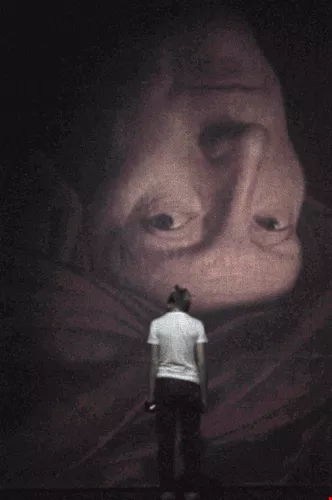
How do you create a performing arts festival that showcases the character of its city while also satisfying local audiences? That's the question Taipei's facing as it becomes a more culturally oriented city. The photo shows Romeo Castellucci's Hey Girl! performed at this year's Taipei Arts Festival.
Andy Yu, secretary-general of the Performing Arts Alliance, says that the Taipei Arts Festival has in recent years clearly been oriented towards "new ideas and new trends." The organizers have searched far and wide, seeking top-tier artists from around the world and cutting-edge artists from Taiwan to ensure that performances don't just entertain but, like pebbles thrown into a still lake, give rise to endless ripples of conversation and reflection.
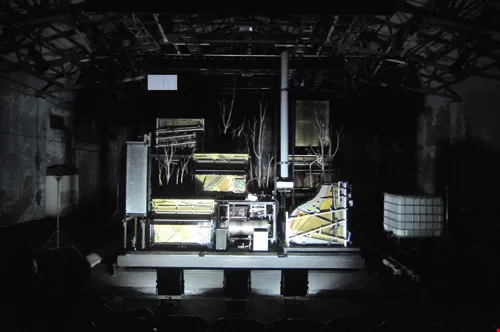
Since 2008, audiences have been presented with new works by important contemporary directors such as Peter Brook, Robert Wilson, and Robert Lepage, works such as Stifters Dinge, a musical that utilizes five automated pianos, their inner workings exposed, and three pools of water in a "no-man show." Sounds from the mechanical installation blend with those of Nature in a piece lacking both narrative and human performers that interleaves human works with desolation and investigates the relationship between the real and the questionable. Stifters Dinge defies convention to challenge and subvert the very meaning of "performance."
Given that the Taipei Arts Festival is in its 12th year, why has it only recently begun to develop its own distinctive identity? And why is the general public still only vaguely aware of its existence?
Huang Lan-kuei, an assistant professor in the Graduate Institute of Arts Administration and Management at the National Taipei University of the Arts, says that the main reason that the early Taipei Arts Festivals failed to stick in people's minds had to do with its use of competitive bidding to commission an organizer. With different management every year, the festival was unable to acquire any sort of institutional memory. Moreover, the Budget Act required that the bidding and the event take place in the same year. As a result, the organizer of any given year's festival usually had less than six months to book performers. Since popular companies, both local and international, tend to be booked one to two years in advance, organizers had little success attracting them to the festival.
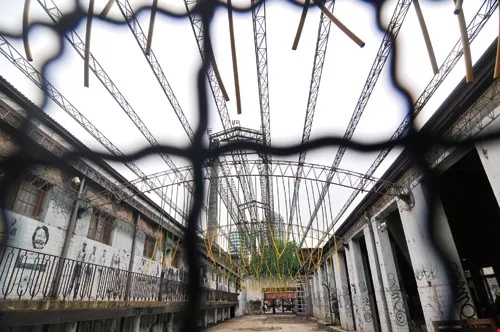
aThe use of alternative performance spaces has become crucial to alleviating Taiwan's dearth of performance venues. The photo above shows Huashan 1914 Creative Park, which was formerly the Taipei Winery. (facing page, upper photo:) Exhibits related to Hey Girl! on display outside the Taipei Winery. (facing page, lower photo:) Romeo Castellucci at Huashan 1914 explaining the concepts underlying his "Lo Penso" exhibition.
The problems with the festival's direction were often closely tied to changes in the city government. Every time a new staff took over, work had to start afresh, so that no clear style could emerge.
Huang notes that the Taipei Arts Festival was born in 1998, during Luo Wenjia's tenure as head of the Taipei City Department of Information. Luo's aim was to integrate the extant theater, music, and traditional-arts festivals into a larger arts festival with a distinctively Taipei flavor. The government then commissioned private organizations to organize the festival. Under the direction of Serina Chen, head of Taipei Arts International Association, the early festivals focused on the arts, performances, and parent-child education.
In 2000, during Lung Ying-tai's tenure as the first head of the Taipei City Department of Cultural Affairs (then known as the Cultural Affairs Bureau), the city government began using competitive tenders to select the festival's organizer. During this period, the festival emphasized community participation and local color. Utilizing themes that included "100 Years of Taiwanese Ballads," "Rediscovering Old Places," "The Arts, Temple Fairs, the Contemporary," the festival incorporated large free outdoor events and performances by local troupes.
Following poet Liao Hsien-hao's appointment to head the Department of Cultural Affairs (DCA), the festival in 2005 switched its orientation to Asia's avant-garde. It used new ideas to bring new life to tradition and extended invitations to greater numbers of professional performance troupes, both local and international. With Li Li-heng, who has deep roots in the theater, overseeing three consecutive festivals, it began to establish the relationship to the Asian avant-garde for which most people now know it.
To simplify the bidding process, the organizers combined content and marketing into a single bid, which gave media conglomerates an edge over professional arts management companies. The conglomerates' broadcast and print resources put them in a position to publicize the festival themselves, which the evaluation committees viewed as a positive. As a result, Era Communications, TTV, China Times, and Eastern Television all took a turn managing the event.
The festival's sponsorship model underwent a key change when Lee Yong-ping took over as head of the DCA in 2007. Borrowing from successful overseas festivals, Lee decided that beginning in 2008, the festival would be sponsored and supported by the DCA and managed by the Taipei Culture Foundation. This change finally enabled the festival to establish a long-term management team and engage in long-term planning.
(photo by Hsueh Chi-kuang)
Lee then invited Victoria Wang, who had previously worked for the National Theater and Concert Hall and Novel Hall, to oversee operations. Lee also created a core team of private-sector experts to provide the festival with the arts expertise and curating experience that the public-sector employees lacked.
When the new team took over the festival, it was given a dual mission: deliver excellent programming and rebuild the brand.
With regard to the programming, Wang noted that the National Theater and National Concert Hall had been bringing performers to Taiwan for more than 20 years and that their programming had been very influential in developing Taiwanese audiences' thinking and tastes. It was just that these performances had been heavily weighted towards music and dance. Feeling that there was room to do much more in theater, she made bringing internationally renowned writers and directors, particularly those whom Taiwanese audiences had yet to see, one of the festival's primary objectives.
The six-week-long 2008 festival, dubbed "Never Ending Bravo," featured performances by 10 theatrical troupes, including companies from Taiwan, Hong Kong, Chile, and France. Avant-garde American theater director Robert Wilson attracted the most attention, fulfilling the dreams of local theater lovers by directing I La Galigo, a piece adapted from Indonesian myth, on his first visit to Taiwan.
Among the domestic productions was the premier of Jimmy's musical Turn Left, Turn Right at the Taipei Arena, the first Taiwanese theatrical production at the venue. Wang says the festival made this bold move after considering Jimmy's immense popularity and the positive critical and popular response to director Michael Li's earlier adaptations of Jimmy's Sound of Colors and Mr. Wings, which were staged at the National Theater and National Concert Hall.
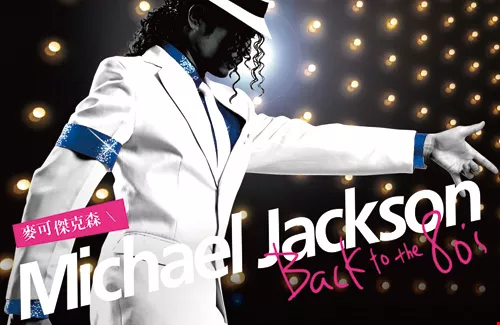
Shakespeare's Wild Sisters' Michael Jackson (left), Robert Lepage's Lipsynch (below), and the "no-man show" Stifters Dinge (right), respectively, represent cutting-edge local theater, the work of a heavyweight international director, and avant-garde theater. All were featured at this year's Taipei Arts Festival.
Though the foreign companies performing at the festival for the last several years have excited theater fans, the Taipei Arts Festival is supposed to represent Taipei. Local troupes have denounced the festival for its consistently unequal division of resources between foreign and domestic companies.
Wang is blunt: the festival's funding is limited. That means it can't invite more than a few premier troupes and makes it difficult to avoid giving preference to foreign troupes. And the organizers find it hard to ask the domestic companies they invite to premiere a work tailor-made for the festival; they feel it's an "extravagant request" to make. As a consequence, the festival's domestic productions tend to be new productions of established or well received works. Michael Jackson, for example, was performed as part of a National Theater and Concert Hall program in 2005. It has been revived this year to commemorate the first anniversary of Jackson's passing. On other occasions, the Taipei Arts Festival doesn't commission a new piece, but arranges for a troupe to premiere a work it already had in development. The Puppet and Its Double Theater's The Cutter of Happiness and All Music Theater Company's The Impossible Times are cases in point.
Hong Hong, an experienced director and writer, dislikes this approach. "The arts festival has to keep moving forward!" he says. These days, the festival is attracting high-quality foreign programs. But he argues that domestic companies shouldn't be reviving older pieces unless they plan to do something revolutionary with them. He recommends inviting foreign artists to Taiwan to cooperate with the local theater and dance communities and argues that the festival should be a catalyst for the creation of still more exciting work.
Hong Hong says that an art festival's success depends on both its programming and its ability to set itself up as a standard for others to aspire to. He sees programming produced through international cooperation as crucial to this endeavor.
The Hong Kong Arts Festival, Asia's 38-year-old leading art festival, is a case in point. In 1997, the festival's planning team invited Pina Bausch, a leading German modern-dance choreographer, to choreograph a piece for the city, which was then on the verge of returning to Chinese rule. The piece was Bausch's first for an Asian city.
Bausch was struck by Hong Kong's many skyscrapers and the window cleaners that scaled their exteriors to clean the windows. That impression gave rise to her piece The Window Washer, which became both the pride of Hong Kong and a part of her Tanztheater Wuppertal company's regular repertoire.
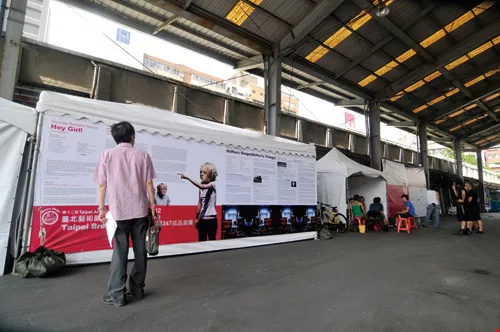
aThe use of alternative performance spaces has become crucial to alleviating Taiwan's dearth of performance venues. The photo above shows Huashan 1914 Creative Park, which was formerly the Taipei Winery. (facing page, upper photo:) Exhibits related to Hey Girl! on display outside the Taipei Winery. (facing page, lower photo:) Romeo Castellucci at Huashan 1914 explaining the concepts underlying his "Lo Penso" exhibition.
Lee Huey-mei, a former manager of the Programming Department of the National Theater and Concert Hall, believes that if local companies were to debut new works at the arts festival, the sponsor would find it difficult to control the content and quality of the pieces. It would be costly, as well. In other words, the risks are simply too great. For a Taipei Arts Festival working on developing its brand, the "safe and effective" approach is to begin by working with top foreign talent.
Lee says that the Taiwanese market remains relatively conservative with regard to foreign productions. Local curators tend to "play safe" by targeting popular international troupes for invitations because they don't have that much experience or that well developed an eye. This has had the effect of training local audiences to seek out "established brands." Lee wonders half-jokingly, where in the world besides Taiwan would you see the Three Tenors giving frequent free concerts in athletic stadiums?
Right now, Taiwan as a whole, from the management companies that book shows to the ticket-buying public, buys into the myth of the big-name artist. Audiences are willing to "take a chance" on a performance that features a marquee name, but once they've satisfied their curiosity (or vanity), they lose interest. Very few people are willing to make the effort to explore and study a great artist's style. Consequently, if a big name returns to Taiwan with a new work, there's no guarantee audiences will give the work a chance.
Take Italian director Romeo Castellucci, who brought his Hey Girl! to Taiwan this year, for example. Castellucci is a regular participant in the Avignon Arts Festival and premiered six works there between 1998 and 2005. In mature markets, theatergoers praise his work and event planners take pride in being able to bring him back year after year. Finding ways to enable a familiar face to evolve and do new things provides challenges and inspirations that are good for everyone-companies, festivals, and audiences alike.
Lee says that at some point in the future, after Taiwan has enjoyed visits from a number of important international artists, the festival's planners should show courage and vision by seeking out talented young artists who haven't yet made a name for themselves. This would help establish cooperative relationships early on, while also providing theatergoers in the 18-35 age range with more challenging theatrical experiences. Once local audiences have developed some confidence, they'll be more willing to trust the planners' selections, even if those selections lack the halo effect of a big name.
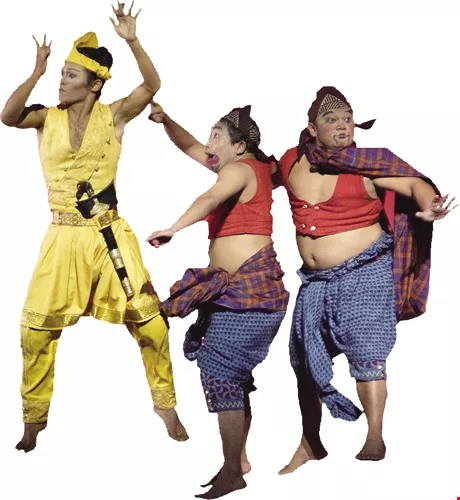
When the Taipei Culture Foundation took over management of the festival, it rebooted the programming, nature of performances, and venues. (from left to right:) Turn Left, Turn Right, I La Galigo, Macbeth: Who Is That Bloodied Man?, and Hey Girl!
Andy Yu says that, programming aside, the transformation and utilization of alternative spaces is a hallmark of the Taipei Arts Festival.
He says that Taiwan's theater community has long lamented its lack of professional theaters. Taiwan is particularly short of the kind of medium-sized 500- to 700-seat venues that foreign troupes need most.
The festival therefore makes do with alternative spaces, scouring every corner of the city for potential venues. Audiences must cast aside their preconceived impressions of these venues, which heightens their sense of adventure.
Last year, Poland's Teatr Biuro Podroz·y performed Macbeth: Who Is That Bloodied Man? outside the Taipei Public Transportation Office's derelict bus depot on Beiping East Road. This year, Castellucci staged Hey Girl! in the old warehouse of the Taipei Winery. These unusual venues represent a real challenge for the planners. In addition to cleaning and disinfecting the sites and clearing them of weeds, organizers must also provide them with stage lighting and air-conditioning, and set up changing rooms for the performers. In the case of Hey Girl!, which includes scenes in which performers spray paint all over their bodies, organizers had to go so far as to build a temporary water tower and a mobile shower.
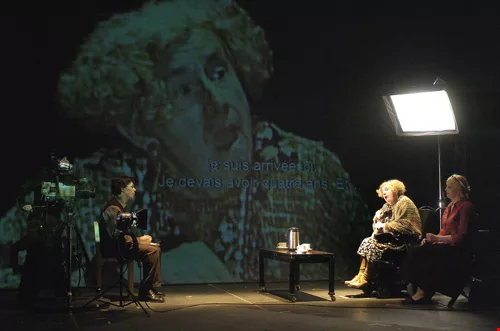
Shakespeare's Wild Sisters' Michael Jackson (left), Robert Lepage's Lipsynch (below), and the "no-man show" Stifters Dinge (right), respectively, represent cutting-edge local theater, the work of a heavyweight international director, and avant-garde theater. All were featured at this year's Taipei Arts Festival.
Setting aside the disquisitions on the significance of the Taipei Arts Festival and discussions about the direction of its evolution, how can the festival deliver a good show? Does the festival have any overarching aesthetic value?
"The 'Bravo Only!' theme refers to how the Taipei Arts Festival is positioning itself," says Wang. She says that this year's festival may only be offering nine programs and 50 performances, but its objective is to provide exciting theatrical experiences that leave audiences wanting to shout "Bravo!" at the end of performances. Speaking about how the programming was selected, she says that works had to be rich, refined, and dazzling. They had to suit the diverse and open attitudes of Taipei's people, and demonstrate a grasp of contemporary fashion and culture.
Wang argues that the reorientated and revamped Taipei Arts Festival has only just gotten started, that it is still learning to trust its audience and earning its audience's trust. She believes it will be another five years at least before this preliminary strategy begins to bear fruit.
Given these criteria, will the Taipei Arts Festival continue to grow and eventually achieve a standing comparable to that of the Hong Kong Arts Festival, and perhaps one day even develop into an Asian equivalent to the Edinburgh International Festival?
Huang Lan-kuei believes that the art business needs time to develop. But government-funded cultural events in Taiwan are often constrained by the political environment. Ultimately, whether the festival continues to develop will depend on the clarity of the organizers' vision. Sometimes, changes at the top mean changes in an event's organization, direction, and style, as well as in the kinds of troupes who are invited to participate, leaving everyone at loose ends.
Another key element in a festival's success is the relative abundance or paucity of funding available to it. For many years the Taipei City Government has funded the Arts Festival at a fixed level of NT$25 million, far short of the festival's needs. As a result, the festival has had to rely on corporate sponsorships and ticket sales to raise the additional NT$15 million it needs every year to make ends meet. And even with this NT$40-million budget, it has only about one-fifth of the funding of the Hong Kong Arts Festival. Wang says that if the festival were able to increase its income or turn a profit, she would like to see it follow the international practice of placing any surplus with a foundation supporting the festival rather than remitting it to the national treasury. As such a surplus accumulated, the festival's need for government support would decline.
Yu says that you can see evolution in action in the festival's shift from its earlier management model to its present-day efforts to carve out a distinctive image for itself. He looks forward to the festival attracting more attention and becoming more important. As for the festival's ultimate objective, Wang says that the festival is a success if it makes audience members feel that their attendance was worth it.
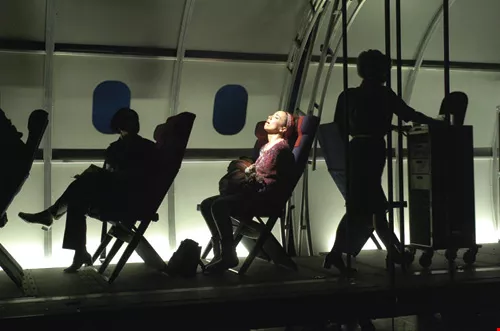
Shakespeare's Wild Sisters' Michael Jackson (left), Robert Lepage's Lipsynch (below), and the "no-man show" Stifters Dinge (right), respectively, represent cutting-edge local theater, the work of a heavyweight international director, and avant-garde theater. All were featured at this year's Taipei Arts Festival.
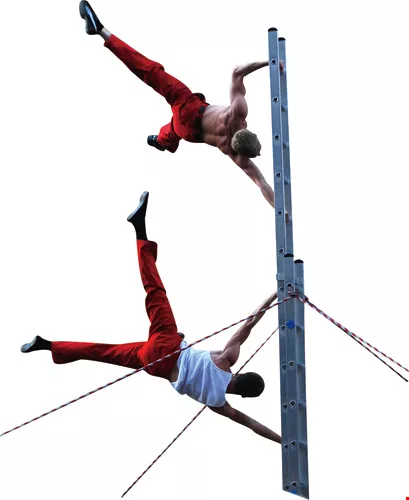
(facing page and below) A world-class arts festival, the Edinburgh Festival saturates the city with a performing atmosphere that draws visitors from around the world.
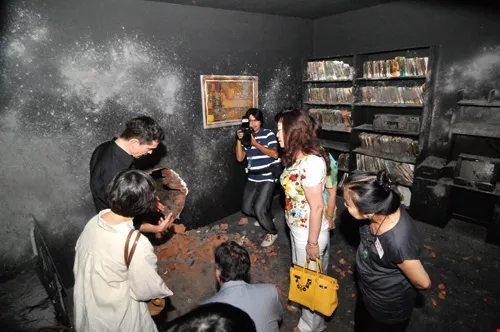
aThe use of alternative performance spaces has become crucial to alleviating Taiwan's dearth of performance venues. The photo above shows Huashan 1914 Creative Park, which was formerly the Taipei Winery. (facing page, upper photo:) Exhibits related to Hey Girl! on display outside the Taipei Winery. (facing page, lower photo:) Romeo Castellucci at Huashan 1914 explaining the concepts underlying his "Lo Penso" exhibition.
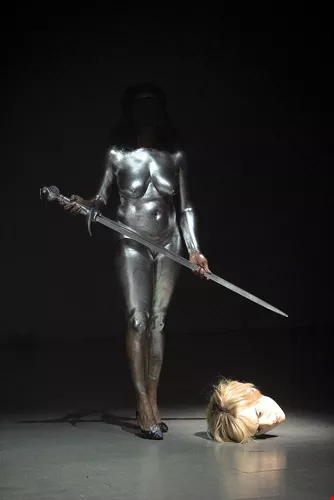
When the Taipei Culture Foundation took over management of the festival, it rebooted the programming, nature of performances, and venues. (from left to right:) Turn Left, Turn Right, I La Galigo, Macbeth: Who Is That Bloodied Man?, and Hey Girl!
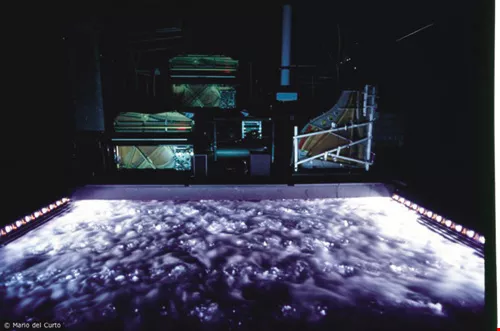
Shakespeare's Wild Sisters' Michael Jackson (left), Robert Lepage's Lipsynch (below), and the "no-man show" Stifters Dinge (right), respectively, represent cutting-edge local theater, the work of a heavyweight international director, and avant-garde theater. All were featured at this year's Taipei Arts Festival.
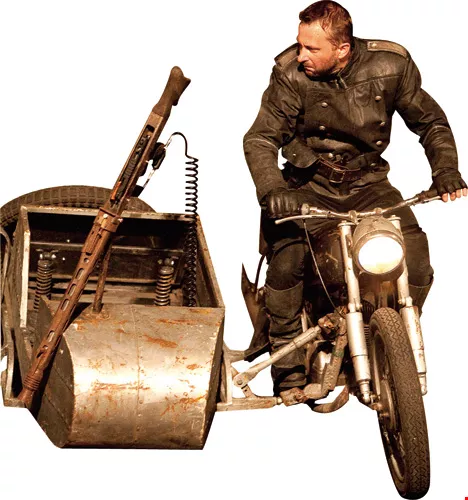
When the Taipei Culture Foundation took over management of the festival, it rebooted the programming, nature of performances, and venues. (from left to right:) Turn Left, Turn Right, I La Galigo, Macbeth: Who Is That Bloodied Man?, and Hey Girl!
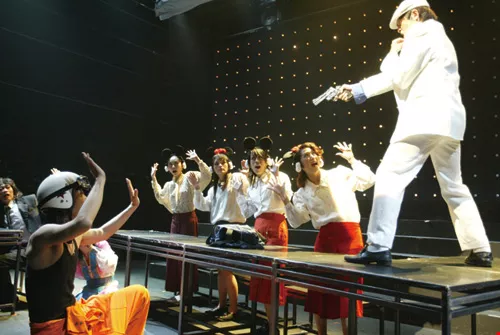
Shakespeare's Wild Sisters' Michael Jackson (left), Robert Lepage's Lipsynch (below), and the "no-man show" Stifters Dinge (right), respectively, represent cutting-edge local theater, the work of a heavyweight international director, and avant-garde theater. All were featured at this year's Taipei Arts Festival.
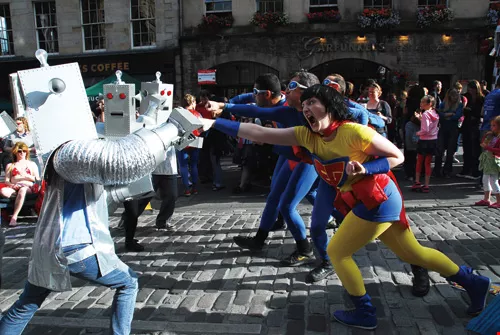
(facing page and below) A world-class arts festival, the Edinburgh Festival saturates the city with a performing atmosphere that draws visitors from around the world.

@List.jpg?w=522&h=410&mode=crop&format=webp&quality=80)

@List.jpg?w=522&h=410&mode=crop&format=webp&quality=80)


