Because this method of proceeding is rather unusual, and because of the media attention he has received, the monk attracts a crowd wherever he goes.
"Master, don't be so hard on yourself. Your faith is good enough," begs an old woman, bowing down, her eyes brimming with tears, who has thrust her way up to the front of the crowd.
A young tough on a motorcycle pats his chest and says, "Look, brother, if you've got a problem, just leave it to me. Why ask for all this grief?"
An old man reeking of liquor ambles over and confidingly asks, "Master, what's the number this time? I heard you guessed it right last time, didn't you?"
A Catholic nun tells him, "God loves you." The monk replies, "Buddha loves you and loves God, too."
These are not just empty words, either. When he passed by the Catholic Church's Telan Center for the Physically Handicapped in April, he contributed NT$100,000 (about US$2,500) in donations that he had received along the way to the financially strapped center, giving the nuns there quite a start.
The monk explained, "Once you've become a monk, you should be able to see through religious sects, shouldn't you? The people gave me that money out of charity. As long as I donate it to a worthwhile organization in need, I won't be going against their wishes."
This is no ordinary monk.
Before entering the monastery, he was a member of the criminal underworld for more than 10 years. Those hands now telling rosary beads had once held poker chips above and a knife below the table. Those feet carrying him on his arduous pilgrimage had once scaled a prison fence and run from the police.
Li Yu-ch'ing (his lay name) is now 34 years old. He grew up as the second of eight children in a poor family in a tough neighborhood of Taipei. His father was a soldier on the Ryukyu Islands for years, leaving his mother to raise the family by selling vegetables and picking through trash.
Li fell in with the wrong crowd at an early age. He used to play craps with little street urchins his age, a habit which later turned into a consuming passion for gambling. In the fifth grade, after being beaten by his father for bad grades and playing hookey, he ran away from home and began living a rootless, hand-to-mouth existence.
When he was 17 he was caught stealing from a worksite and sentenced to three years of reform school. He escaped the next year, still wearing handcuffs. To make money while on the lam, he run a gambling joint with two old friends.
When he was 20 he was drafted into the army, went AWOL, and was sentenced to eight months in the stockade. Bad behavior and attempts to escape kept him shuffling from prison to prison, until he wound up on the last one, on Orchid Island, when he was 26.
When he finally got out of the army, he went back to gambling, fighting drinking, and womanizing. Then suddenly, at age 30, he found himself out of money, with no friends or family, and sick in bed unable to rise. "Where's your life headed to?" he asked himself and broke out in a cold sweat. Where was the past? And what did the future hold?
Thinking like this over and over again he suddenly became clear and calm. He had found his direction--and in October 1982 he took his monastic vows at Haiming Temple. Li Yu-ch'ing had become Brother Chang-neng.
Just what caused this sudden conversion?
Brother Chang-neng folds his hands and says quietly, "The Buddha's mercy."
His father, Li Shu-mu, believes that "his mother's mercy" was even more important: "She worried over him so much and cried so many tears. Every time he ran back home from the police I'd shut the door in his face. But his mother is a devout Buddhist and always forgave him. She never gave up on her son. A man's heart is made of flesh. With time, he finally came to his senses."
As to the monastic discipline required to turn a foul-mouthed, gambling, and whoring hoodlum into a pious Buddhist ascetic, Brother Chang-neng only answers, "You've got to experience it to understand it."
As a form of repentance, he vowed two years ago to make his round-island pilgrimage and made several practice treks up Kuan-yin Mountain in preparation.
This year he set out to accomplish his vow, and he has already completed one-third of his journey. Impressed in his heart, he says, are the support of his parents, who have supplied him with food and drink, and the crowds who have shown him kindness and generosity along the way. His painful way of proceeding has also given him many rare and wonderful perceptions and increased his desire to follow Buddhism, he says.
Some experiences have been unhappy and some humorous. One person tossed a coin at his feet and shouted, "You must be nuts!" He just picked up the money and chanted, "Amitabha!"
And when the faithful demanded he sermonize on the Buddhist way, he came up with this rare analogy: "It's like hemorrhoids. If you cut them out completely, you'll enjoy eternal delight. But if you just sit and do nothing, there'll be no end to your trouble and pain." Brother Chang-neng admits he is not a preacher.
As he talks with other believers, the moon begins rising in the east. As the cool, clear light shines on Brother Chang-neng, those hands that once committed crimes and those feet that once went astray look more solemn and dignified.
Maybe Brother Chang-neng doesn't need to preach. His body, which has passed through such bitter repentance and mortification, is perhaps an even more enlightening sermon to the faithful.
[Picture Caption]
Brother Chang-neng bows to the ground to show repentance for past sins and to pray for blessings for all living things.
The procession has passed through bustling cities and empty wilds, attracting many spectators along the way.
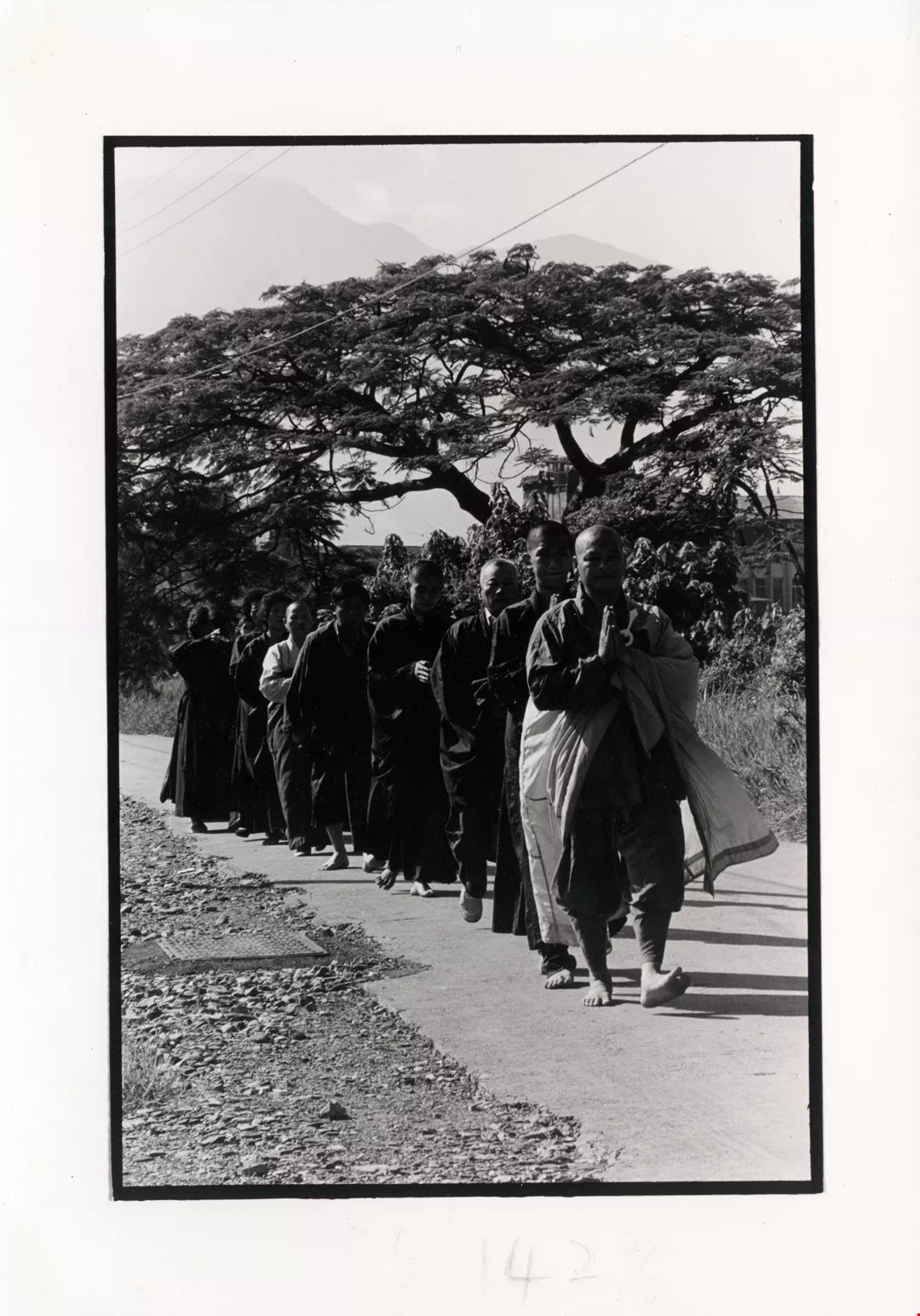
The procession has passed through bustling cities and empty wilds, attracting many spectators along the way.




@List.JPG?w=522&h=410&mode=crop&format=webp&quality=80)


