President Ma was elected with a huge mandate of almost 7.66 million votes, or 58.45% of the poll. But the other 42% of those who turned out to vote-5.44 million people-cannot be ignored, so Taiwan Panorama presents this special series of interviews with outgoing vice president Annette Lu of the Democratic Progressive Party, Jou Yi-cheng, chairperson of the Third Society Party, and Chien Hsi-chieh of the Pan-Purple Coalition, to give them a chance to air any misgivings about the incoming administration and give their recommendations.
A new government has taken the reins of power, and as President Ma noted at his inauguration, "absolute power corrupts absolutely." For starters, I would like to remind him of that.
The KMT has the presidency, the Executive Yuan, and three-fourths of the seats in the Legislative Yuan. To preserve some checks and balances, I hope that Mr. Ma can be trusted to keep his promise to choose people from outside the KMT to head the Examination Yuan and Control Yuan. Along with keeping Lai In-jaw, a Chen appointee with no party affiliation, as president of the Judicial Yuan, selecting people from outside the KMT to fill those two positions would bring some balance of power.
When it comes to policies on the people's livelihood and national infrastructure, be it in terms of the environment, labor or social welfare, the differences between the KMT and the DPP are not great. The salient and important difference remains on the matter of national status.
On May 21, the day after Ma's inauguration, I published some thoughts about stepping down. I specifically mentioned my "five concerns." These are the fears that Taiwan may drift toward conditions of "fictional sovereignty," "international orphanhood," and "social emptiness," and may acquire a polity like Hong Kong's and an economy like Penghu's.
With regard to my concerns over Taiwan moving toward "fictional sovereignty," I should note that in his inaugural speech Mr. Ma expressed a great degree of identification with Taiwan and also mentioned "the rebirth of the Republic of China on Taiwan." But I suggest a clearer way to phrase it: "There have been two Republics of China." The Republic of China that has had direct presidential elections since 1996 and the Republic of China that was created on the mainland are two wholly different creatures.
What is more problematic is that Ma and Vice President Vincent Siew believe that Taiwan and mainland China will take a path toward eventual reunification, whereas we believe that Taiwan should remain forever independent. That is a big difference.
Nevertheless, I disagree with those who say that nothing positive has happened in cross-strait relations over the past eight years. In fact, despite occasional volleys of heated words, there has been nothing like the Taiwan Strait Crisis of 1995-1996 when the PRC conducted missile tests. Moreover, private exchanges across the strait-both economic and otherwise-have grown more and more commonplace.
Furthermore, we have been totally successful in affirming Taiwan's sovereignty. Before the DPP took over as the ruling party, only about 30% of the population regarded themselves as "Taiwanese." Now some 70-80% of citizens do. And this probably isn't a trend that can be turned around.
Let us remember that Beijing will not relax its stance on matters of sovereignty. Whatever we do, we can't fool ourselves that they will just because we want them to. For instance, in the week after Ma and Siew were elected, Legislative Yuan speaker Wang Jin-pyng received an invitation to attend the inauguration of President Lee Myung Bak of South Korea. But then he was asked not to attend after the PRC strongly protested the invitation. At the May meeting of the World Health Assembly, the PRC blocked Taiwan's bid to gain observer status. And China still has 1,200 missiles pointed at Taiwan, does it not?
Recently, a person from a country with which we have formal relations told me, "You in the ROC used to request that we have no relations with the mainland. If the new government itself wants actively to establish friendship with China, then sorry, but we'll have to say goodbye." This is very dangerous. If at some point Taiwan lacks any formal diplomatic partners, then we will lack a basis to claim sovereignty. We will have an "undetermined" legal status, and if China or any other country wants to bully us, no-one will come to our aid. That scenario is too scary to imagine. Consequently, President Chen and I have worked hard traveling the globe to build personal relationships that would help up us to establish formal relations with other nations. President Ma should do the same, or else we may become an entity like Hong Kong, lacking all sovereignty. Then we won't need a diplomatic corps or a national defense structure.
Furthermore, I disagree with the emphasis on attracting mainland Chinese investment in Ma's 12 major infrastructure projects. China is so big and Taiwan so small, that it will be all too easy for China to swallow up Taiwan. I fear that Taiwan will end up with an economic relationship to the mainland like the outlying islands of Penghu have for many years had to Taiwan. Just as natives of Penghu have long come to pursue careers in Taiwan proper, if all of Taiwan's best businesspeople go to the mainland, and then we open up the doors to Chinese investment in Taiwan, won't we be willingly turning over Taiwan to the mainland? In particular, what if all goes smoothly in Ma and Siew's plans to warm up to China, but then one day we decide we want out? Might we not be too late-like the proverbial frog cooking to a slow, warm death in the hot spring?
Of course, the DPP's attitudes shouldn't be inflexible. There should be room for innovations in the cross-strait relationship. As Ma more pragmatically said, unification talks are highly unlikely to be held "within our lifetimes." As for the future, if Beijing would be willing to recognize our right to sovereignty, than some kind of arrangement-whether a confederation or something like the European Union-would be possible. We should let the next generation make the choice that's best for them-something that feels suited to their era.
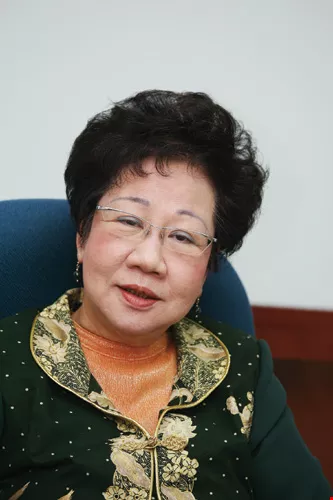
"Taking the happy medium is wishy-washy. The happy medium is not for me. I'd rather be the pain in the neck who speaks the truth." Former vice president Annette Lu has always spoken out in situations where others opt to bite their tongues. After leaving office she is devoting her energies to such issues as the women's movement, human rights and foreign affairs.




@List.jpg?w=522&h=410&mode=crop&format=webp&quality=80)

@List.jpg?w=522&h=410&mode=crop&format=webp&quality=80)


@List.jpg?w=522&h=410&mode=crop&format=webp&quality=80)

@List.jpg?w=522&h=410&mode=crop&format=webp&quality=80)