Guangxing Paper Mill and the Revival of Handmade Paper
Sam Ju / photos Chuang Kung-ju / tr. by Jonathan Barnard
October 2013


What brand of paper is so good that it makes the calligrapher Hou Chi-liang exclaim, “The best paper is from Taiwan”?
Crossing the Ailan Bridge, our car enters the Ailan Plateau, the gateway to Nantou County’s Puli Township and the only locale in Taiwan now producing handmade paper. Of the passing tour buses full of elementary or junior high school students, eight or nine out of ten are on fieldtrips bound for the Guangxing Paper Mill.
Seventeen years ago, the Guangxing Paper Mill became Taiwan’s first tourist factory making handmade paper. Today it attracts 200,000 visitors a year and has become Puli’s newest calling card.
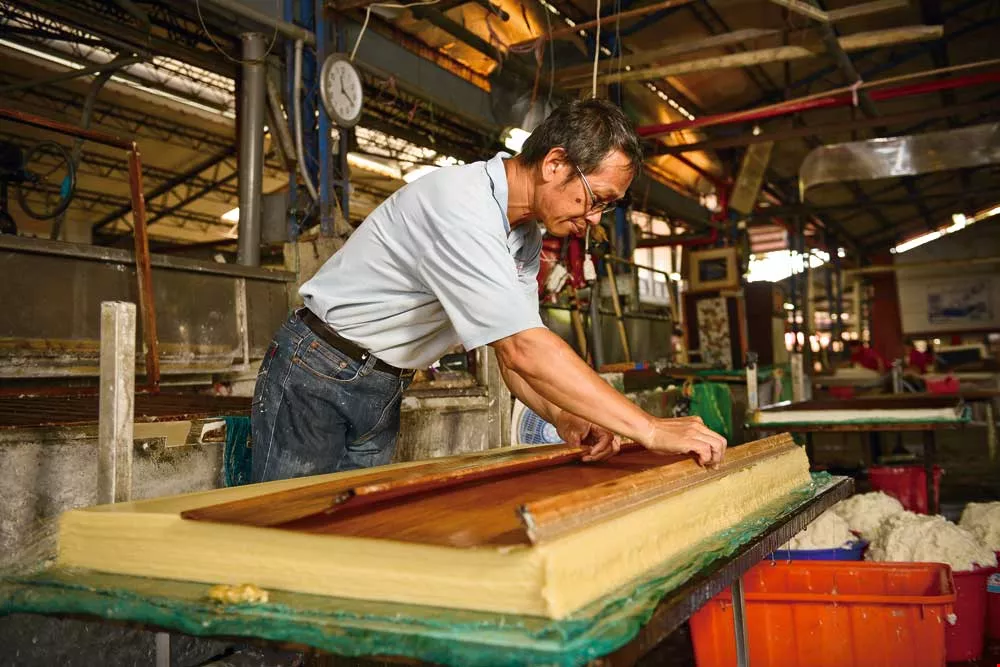
Tree bark fiber is often used as a material for paper. After cooking and steeping, and machine mixing of the pulp, the master papermaker lifts a screen covered with a thin layer of pulp to create a sheet of paper. Water is then squeezed out of the wet paper mechanically, before a master of the drying process sweeps off the vapor rising from it as it lies on a dryer. After that stage, the sheet of handmade paper is finished.
Paper, gunpowder, the compass and movable-type printing are regarded as ancient China’s four greatest inventions. Although the Chinese invented paper, Puli has inherited the improved tools and methods that were traditional to the Japanese. Here you often see paper made with boiled tree-bark fiber. After the pulp is placed into a trough and blended, a bamboo screen is used to lift out a thin layer of fibrous pulp. After drying over heat, the resulting sheet of paper is well suited for calligraphy or painting.
During Japanese rule, the colonial administration would import its paper from Japan. In the latter part of that era, the Japanese saw Puli’s natural advantages and built Taiwan’s first paper factory there. The plant successfully made traditional mino washi paper, laying a solid foundation for Puli’s handmade paper industry.
After retrocession, those Japanese paper-making techniques were passed down in Taiwan. When the island’s economy took off in the 1970s, more than 50 paper factories were operating here. Most focused on exports to Japan and Korea, where Taiwan paper had established quite a reputation among calligraphers and painters.
Yet in the 1990s, amid low-cost competition from mainland China and a sharp decline in the number of people learning calligraphy in Taiwan, factories began to move to Southeast Asia, and Puli’s handmade paper industry was declared to be in its sunset.
Currently only six paper mills remain in Puli. Among them, Guangxing has established a niche for itself as a maker of traditional, high-quality paper for painting and calligraphy. In recent years it has released papers of unusual design or texture for use in innovative “cultural and creative products,” edible paper of various flavors, and paper fabric that can be used as material for clothing. It has staked out a unique place in the paper industry, keeping the legacy and traditions of Taiwanese handmade paper alive while opening up new creative horizons.
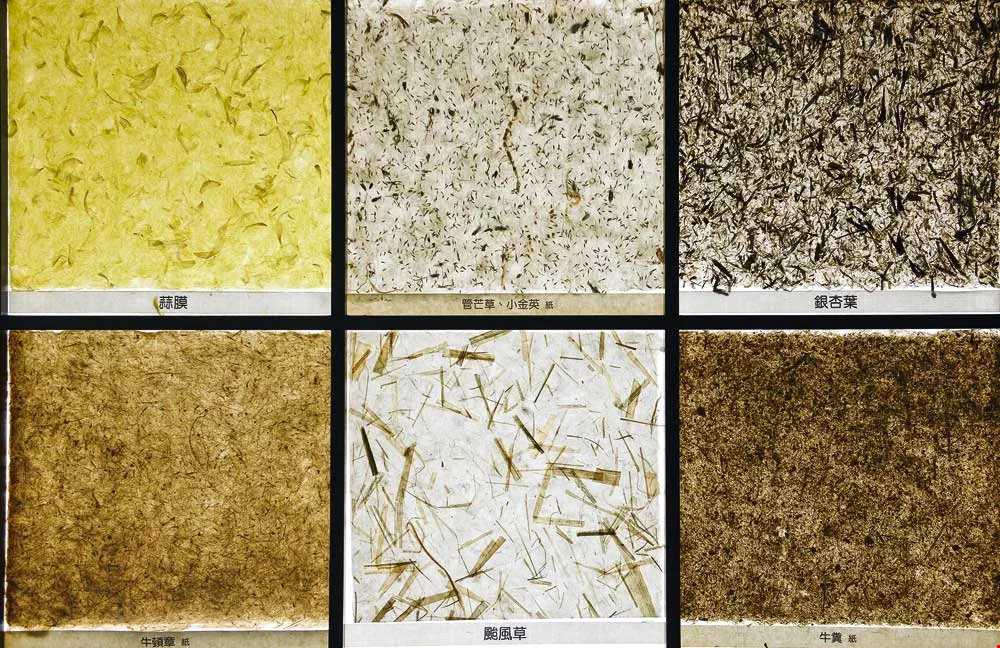
Plant fibers are the main material used to make handmade paper. A variety of plants are used to create different grains, textures and coloration.
In 1965 Huang Yaodong, then 35, opened the “Guangxing Paper Processing Facility” on the Ailan Plateau. As a contract manufacturer, it supplied major firms with high-quality paper stock for export, as well as small quantities of hair-perming paper, electrical insulation paper for batteries, and paper for firecrackers.
When Huang’s son Huanzhang was nine, he watched his father dip his hands into a vat of pulp and shake a screen before lifting it out to reveal a white layer of coagulated paste. Huanzhang didn’t realize it at the time, but this step of “screening” by hand is essential if paper is to be described as “handmade.”
In the early 1990s, Huang Yaodong wanted his son to take over the business. By then, the handmade paper industry was already in decline, but Huanzhang, over 30 and lacking any other work experience, summoned the courage to take over the family firm.
After taking the reins, Huanzhang found himself under great stress. Faced with the decline of the handmade paper industry, he acutely felt the pressure that his father had borne over the years managing a paper plant. He explains that even when exports were booming for the Taiwanese paper industry, Guangxing had very thin profit margins on small quantities, whereas the big firms were making money “hand over fist” by exporting their container loads.
Consequently, although he had taken over the family business, he still wasn’t at peace with the choice and wasn’t willing to let go of any opportunity to change fields. Among the other lines of business he tried without success was orchid cultivation.
He stayed with paper making, he explains today, “just to save a little face!”
In his first year as boss, Huang Huanzhang struggled every day with how to raise profit margins on the company’s handmade paper. At one point he established a trading firm so they could handle the exporting themselves, but it didn’t help the bottom line. Observing that the domestic market was contracting, his anxiety only grew.
One day, while visiting at a store selling calligraphy materials, he noticed they were selling Guangxing paper with a high markup. “We work so hard to make this paper,” he thought angrily, “but all the profits go to the retailers.” For all the effort that he, his father and their employees had put in, he felt aggrieved.
Raising his head, he noticed a calligraphy on the wall, as well as the signature of its calligrapher: Tai Jingnong. “Why don’t we just sell directly to the end user?” he thought. It was a turning point: He had transformed his frustration into single-minded determination to find a solution.
Huang Huanzhang says that those three characters—Tai Jingnong—were like a blow to the head that prompted a sudden understanding: Guangxing shouldn’t be concerned with paper dealers; it should focus on the needs of painters and calligraphers. From that moment on, Huang started to collect the names of painters and calligraphers to send them paper samples for free.
“I sent it everywhere—to calligraphers living and dead,” says Huang of his period of “shameless” and stubborn single-mindedness. “I asked them to tell me the strong and weak points of the paper.” He regarded the artists’ satisfaction with Guangxing’s products as the highest form of affirmation for the company.
What Huang didn’t expect back then was that by taking the initiative to contact painters and calligraphers he was taking the first step both to expanding sales and to putting Guangxing on the road toward developing ever higher-quality paper.
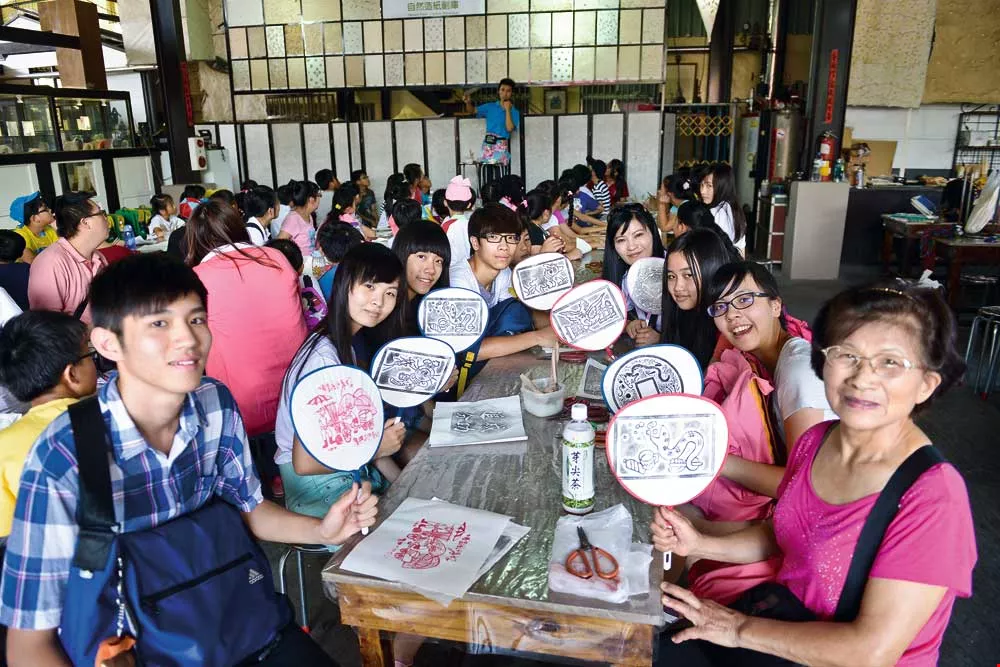
Visitors to the Guangxing Mill learn how to make paper themselves, which they then can use to make rubbings of their choice.
By supplying those artists with paper, Guangxing received a steady stream of suggestions, which guided improvements. From not having to think much about how to make paper the traditional way, Huang Huanzhang became focused on researching various kinds of plant fibers.
In 1996, Guangxing used fiber from the famous water bamboo produced in Puli to create a special line of handmade Xifu (“cherishing one’s good fortune”) paper. Painters and calligraphers lauded it. Li Yihong, a winner of a Wu San-lien Literature and Arts Award, used it for a painting he gave to Huang on which he wrote: “This paper is outstanding in terms of the speed at which a brush can move across it and its fibers’ ability to hold ink.”
Hou Chi-liang, a calligrapher who like Li Yihong was a disciple of Jiang Zhaoshen, former deputy director of the National Palace Museum, was bowled over by the quality of the Song-Dynasty-style paper that Guangxing made using fiber from the paper mulberry tree. He believed that in terms of its grain and thickness, it was equal to the Luowen paper that had been made to Jiang’s specifications by Japanese master papermakers (some of which Jiang left behind after his death). Jiang gave some of that paper to his good friend Chang Dai-chien (Zhang Daqian), the great painter of classical Chinese-style paintings.
“Jiang school disciples,” as well as other famous painters such as He Huaishuo and Su Fengnan, all contributed to pushing Guangxing to make paper of higher and higher quality. With luminaries’ praise, Guangxing’s paper earned an outstanding reputation in the art world.
In 2008, Huang recalled all the Guangxing paper then held by retailers and decided that the company would henceforth produce only the highest-quality paper, all of which it would sell itself. To put users’ minds at ease, each of its sheets would bear a watermark to prove its authenticity.
In particular, Huang has created a system whereby there is a “product résumé” for each lot of paper the company produces, clearly noting such information as the paper’s composition and specifications, as well as the name of the master papermaker responsible for it.
Huang explains that the product résumé is both an affirmation from the master papermaker of the quality and completion of the papermaking process, and also a way to convey a sense of respect for the papermaker to the paper user. What’s more, if users would like to use paper of the same material and specification at any time in the future, they have a record to consult.
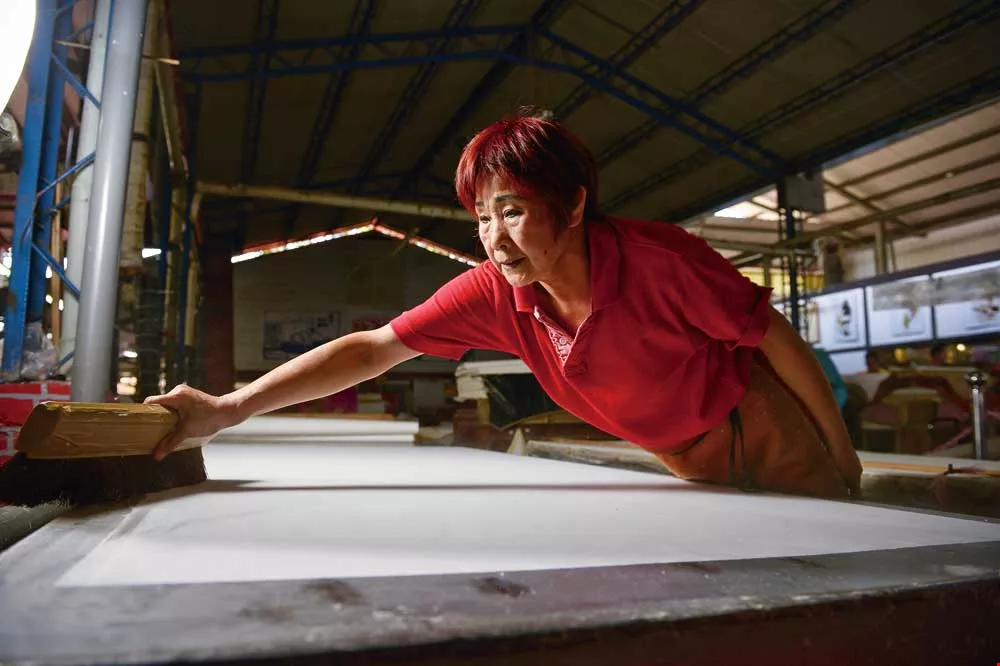
Tree bark fiber is often used as a material for paper. After cooking and steeping, and machine mixing of the pulp, the master papermaker lifts a screen covered with a thin layer of pulp to create a sheet of paper. Water is then squeezed out of the wet paper mechanically, before a master of the drying process sweeps off the vapor rising from it as it lies on a dryer. After that stage, the sheet of handmade paper is finished.
Apart from producing traditional paper for calligraphy and painting, Guangxing has in recent years achieved some notable successes with paper taking new “cultural and creative” directions. These achievements have largely been thanks to the behind-the-scenes work of Wu Shuli, Huang Huanzhang’s wife.
Wu had continued working as a keyboard music instructor in Puli after she married. But when Huang was considering changing industries after taking over the reins of the company and beginning to question if handmade paper had a future, she quit her job to offer her support. Bringing skills that her husband lacked, she drew from her years of experience teaching music to children to turn the mill into a “tourist factory” that accepted visits from tour groups. She personally handled the tour planning and the training of tour guides.
Creativity is Wu Shuli’s strong suit, and since joining Guangxing she has constantly wondered: “In what new ways can handmade paper be adapted?”
At vegetable markets she saw surplus vegetables that hadn’t sold being thrown away. In order to prevent waste, she came up with the idea of using those vegetables to make paper.
The quick-witted Wu asked her husband to install a papermaking station in her kitchen. Apart from taking special steps to ensure cleanliness, the process was exactly the same as at the factory. She tried a variety of vegetables including chayote shoots, water spinach, sweet potato leaves, sponge gourd, pumpkin, and chili pepper. Eventually, for the 100th anniversary of the ROC, the company released 100 kinds of edible paper that could be used for snacks or seasoning. They called these “vegetable papers.”
“Making paper is a lot like composing music; it requires variation,” says Wu, who is happy to share what she has learned.
In July of this year, she went on to release a waterproof paper fabric, which is suitable for use in theatrical costumes and rental clothing. But for this new line they went back to using wood pulp. “We returned to our ‘tree roots,’ as it were, in making handmade paper,” she says.
In addition to clothing designers who are interested in working with Wu, 28-year-old artist Huang Yuzhen, who studied fine arts at a British university, declared after visiting Guangxing: “I’ve discovered a treasure.” She brought various Guangxing handmade papers back to Britain to use in her installations.
Guangxing’s products—both its traditional art paper and its more innovative recent releases—charm and delight their users. The new diversity in its product line has attracted a lot of attention, further bolstering the company’s already strong foundations.
“Only by producing high-quality products in low quantities can we generate value,” says Huang Huanzhang. His 30-plus years of experience in making paper amid industrial decline has given Taiwan’s traditional handmade paper industry the shortest and clearest path toward enlightenment.
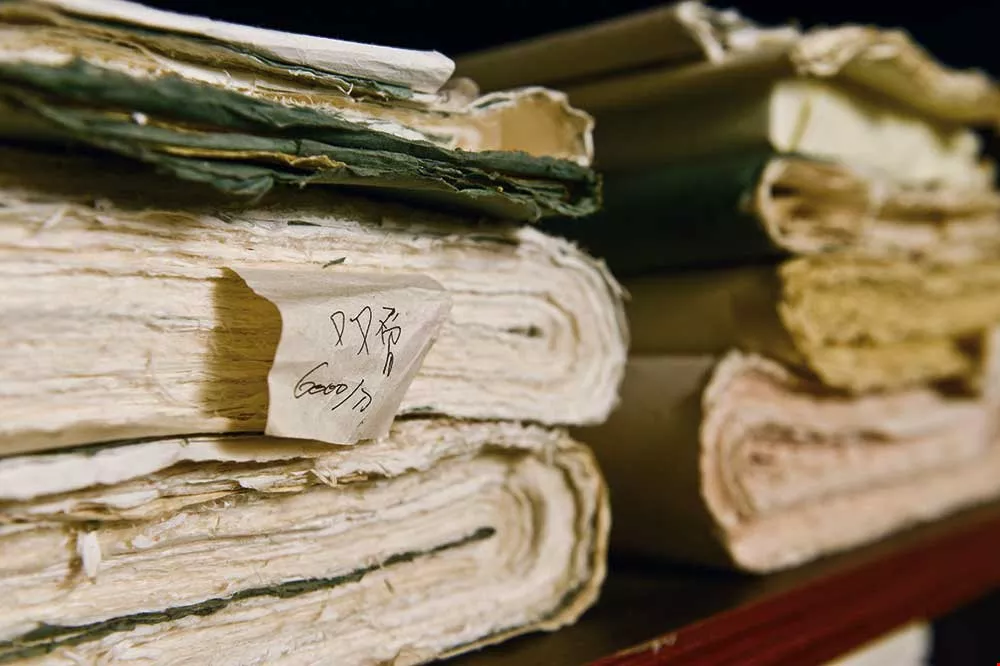
Tree bark fiber is often used as a material for paper. After cooking and steeping, and machine mixing of the pulp, the master papermaker lifts a screen covered with a thin layer of pulp to create a sheet of paper. Water is then squeezed out of the wet paper mechanically, before a master of the drying process sweeps off the vapor rising from it as it lies on a dryer. After that stage, the sheet of handmade paper is finished.
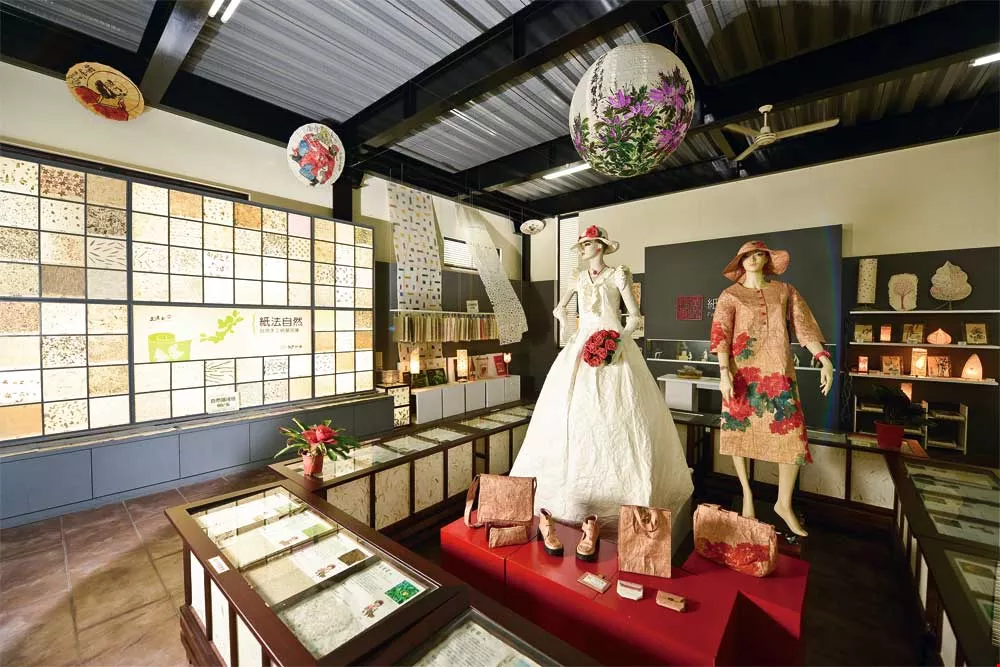
Guangxing has released edible “vegetable papers,” and more recently waterproof paper fabrics for clothing and accessories. These products have breathed new life into the handmade paper industry.
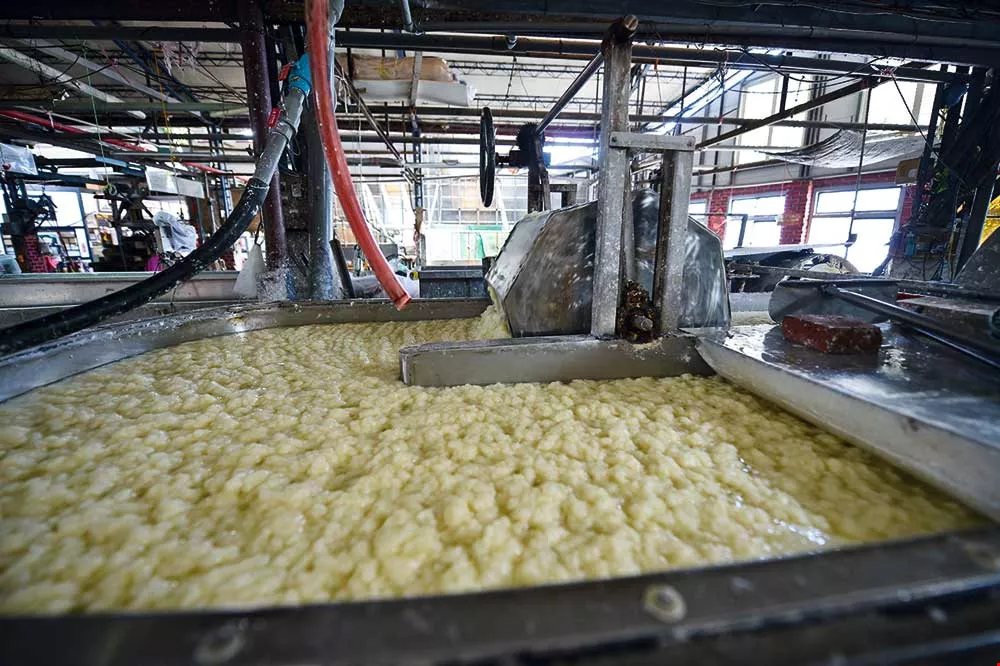
Tree bark fiber is often used as a material for paper. After cooking and steeping, and machine mixing of the pulp, the master papermaker lifts a screen covered with a thin layer of pulp to create a sheet of paper. Water is then squeezed out of the wet paper mechanically, before a master of the drying process sweeps off the vapor rising from it as it lies on a dryer. After that stage, the sheet of handmade paper is finished.
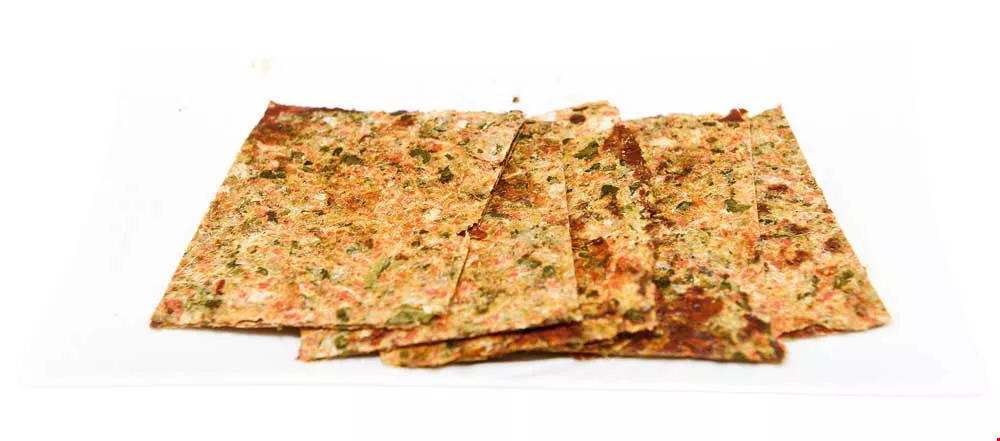
Guangxing has released edible “vegetable papers,” and more recently waterproof paper fabrics for clothing and accessories. These products have breathed new life into the handmade paper industry.
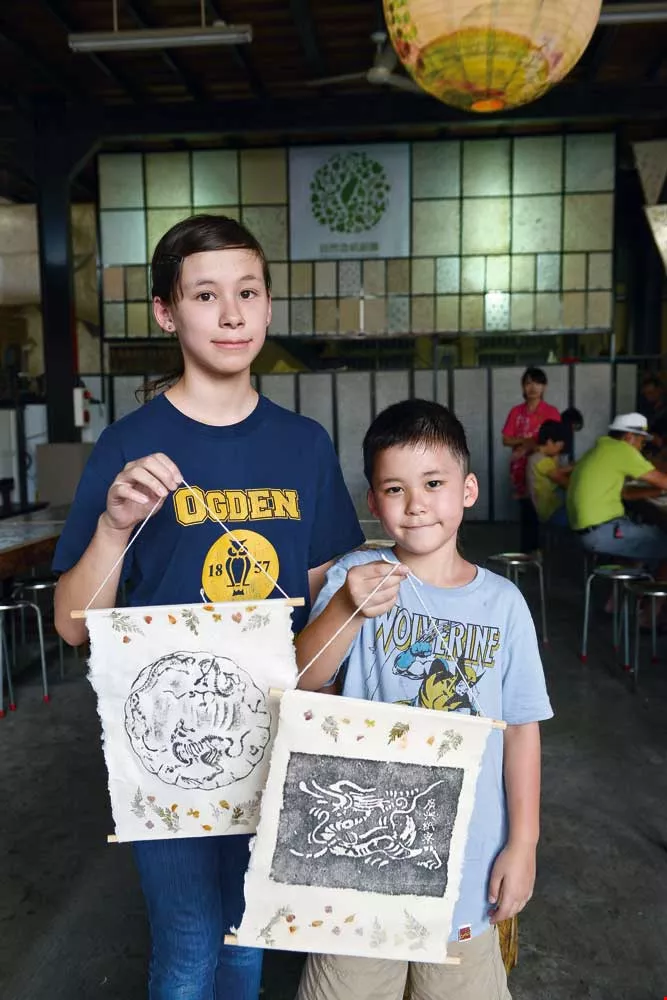
Visitors to the Guangxing Mill learn how to make paper themselves, which they then can use to make rubbings of their choice.
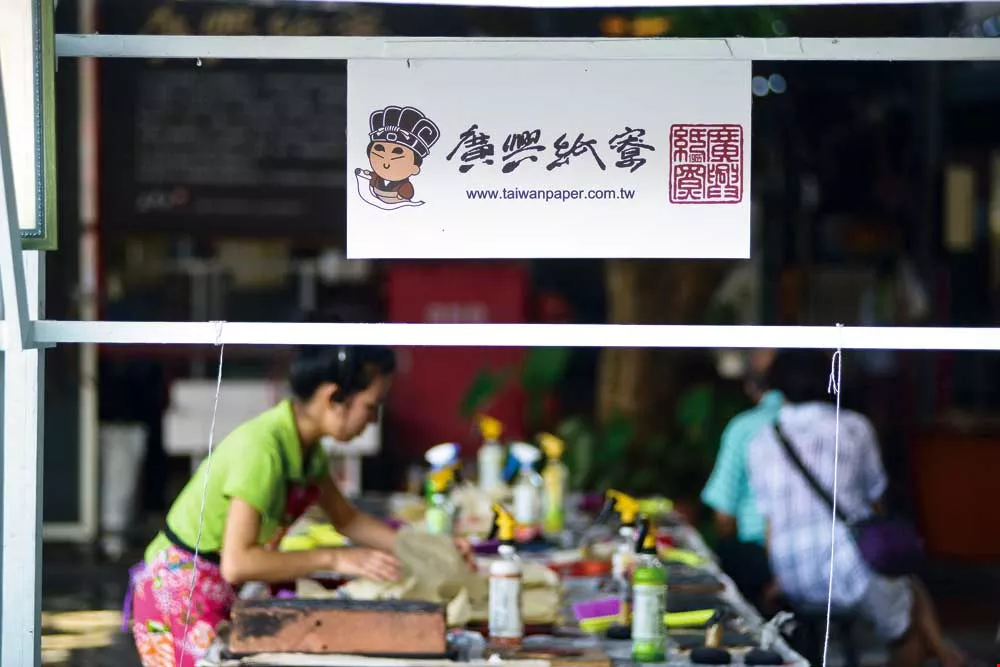
Apart from producing high-quality paper for calligraphy and painting, the Guangxing Paper Mill is Taiwan’s first such mill set up for tourist visitors. It attracts 200,000 visits a year.
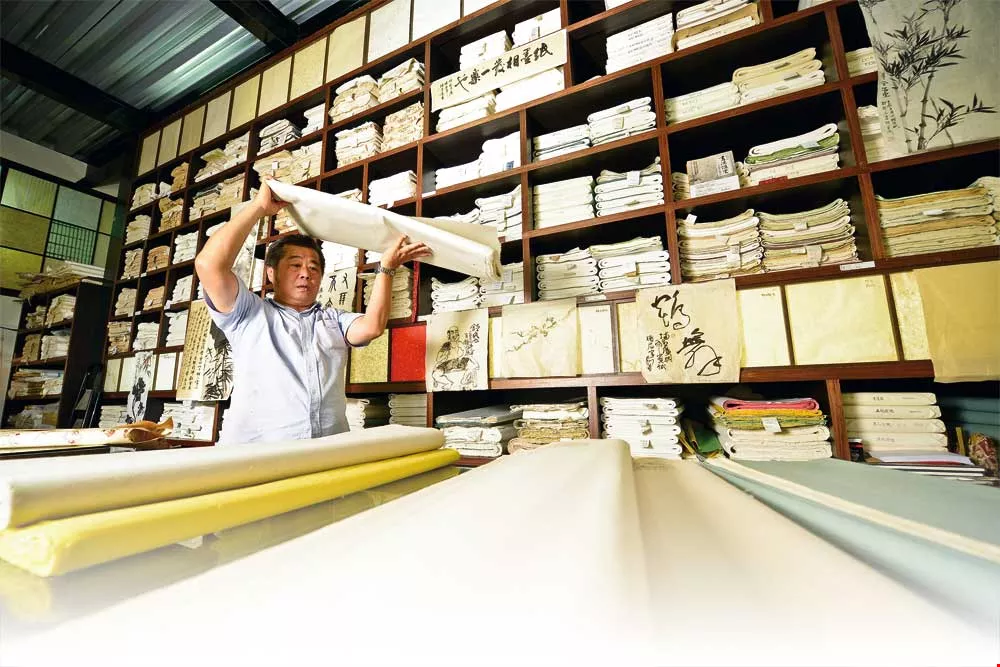
The Guangxing Paper Mill in Nantou’s Puli Township has been producing handmade paper for 50 years. Under the leadership of the second-generation owner Huang Huanzhang, the company has developed high-quality papers that have been big hits among calligraphers and painters.

@List.jpg?w=522&h=410&mode=crop&format=webp&quality=80)

@List.jpg?w=522&h=410&mode=crop&format=webp&quality=80)

@List.jpg?w=522&h=410&mode=crop&format=webp&quality=80)
@List.jpg?w=522&h=410&mode=crop&format=webp&quality=80)

