Finding Satisfaction in a Single-Parent Family
Coral Lee / photos Chin Hung-hao / tr. by Geoff Hegarty and Sophia Chen
October 2012


The number of single-parent families in Taiwan has increased from 370,000 to 560,000 in the past decade, quite striking growth. Although by definition a single-parent family lacks either a mother or a father, it’s still possible to embrace happiness as long as family members are prepared to work hard to maintain and develop relationships.
Ah Qing is a candid woman with a great sense of humor. She presents a radio program that is always full of fun, and with her dazzling personality, has been a regular winner of the Golden Bell Award. Her fans just adore her. When they’re facing issues like marriage problems or difficult parent-child relationships, they call Ah Qing for advice, many regarding her as a spiritual mentor.
A single mother who has raised her two children alone, Ah Qing is never seen in public without a smile, so many people don’t even know that she has an unhappy marriage behind her.
When Ah Qing was pregnant with her second child 19 years ago, she began to experience life as a virtual single mother. She was often unable to contact her husband, who was working for an insurance company after retiring from the military. He didn’t even show up at the hospital when her baby was born.
While Ah Qing was often hurt by her husband’s apparent coldness towards her and their children, she always believed it was a result of his background. He came from a single-parent family, his mother having left when he was very young. Left alone, his father raised four boys with a fair amount of violence. Because her husband had clearly suffered mental trauma, Ah Qing tried hard with love and tolerance to modify his behavior.
When he was unhappy with something, he often disappeared for a month or even longer, and when he returned, he tended to be very demanding. Once he became angry and rushed into the kitchen, grabbing a knife to threaten the children. Their daughter was so scared she hid in the bathroom.
“I was trying to be an angel, but I’m not God.” When Ah Qing finally realized that she was powerless to change her husband, she decided to get a divorce. He, however, had other ideas. He refused to give up custody of the children, so their unhappy marriage dragged on for several years. During this period of pending divorce, she often woke up at night crying. Looking at her children sleeping next to her, she didn’t care much about her own suffering, but felt so sad for her kids having such a dad.
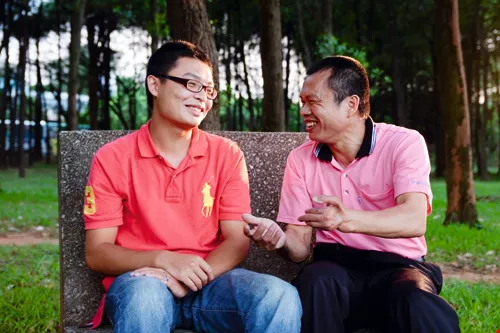
Fu Wenzhong, director of the Single Family Association Taiwan, has moved from strict disciplinarian to happy single father, and now has a healthy relationship with his son as friend and mentor. He also helps other single fathers get through the bad times that inevitably follow family breakdown.
Fortunately, Ah Qing had a good job. Once she was interviewing Lin Chien-ling, curator of the Children’s Art Museum in Taipei, who knew about Ah Qing’s marriage problems. He reminded her: “You shouldn’t wait for a better tomorrow; you should strive for a better now.” This was a wake-up call. Ah Qing put aside her worries and accepted the status quo: she couldn’t get a divorce, and this realization allowed her to relax a little.
At another interview with a respected Chinese traditional medicine practitioner, she took the opportunity to have her pulse checked. The doctor diagnosed problems with her blood and the energy of her internal organs and told her: “I’m afraid that your health isn’t as good as you thought; you’re keeping going mainly through willpower alone.” Ah Qing immediately burst into tears, and made an instant decision to look after herself and regain her health. She began to pay better attention to her diet, and started qigong and yoga classes.
Thanks to a number of people who helped, she made it through the difficult times, and this experience became an inspiration for her to help others in need although she isn’t well off. Ah Qing tries her best, spreading the love she has received.
Through her long-term involvement in making children’s programs, Ah Qing was able to gain some understanding of the various stages of child development and children’s psychological needs, so she was always extremely patient with her own two very demanding children. Her daughter, who was then in elementary school, was often up until midnight from grades one to three finishing her homework. Her son had sleeping problems, and refused to drink milk. But Ah Qing refused any form of physical punishment, insisting instead on coaxing them with logic and emotion, even when she was exhausted.
Ah Qing’s daughter was always very strong minded. When she was a senior elementary school student, she was often cold towards Ah Qing, sometimes refusing even to say hello when she came home or if they met on the street. One quite cold day, Ah Qing reminded her daughter to wear a jacket, but in spite, the daughter changed into just a T-shirt. It wasn’t until much later when she was a senior high school student that the reason for her rebellion became clear: “Dad treated you so badly, yet you were always good to him. You were so cowardly.” So eventually Ah Qing understood her daughter’s attitude.
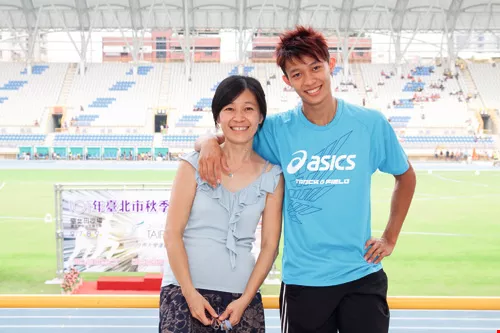
Ah Qing wants to watch her son’s high-jump comp at the athletic field, but he tells her: “No other moms are here. Please don’t come again!” But it doesn’t matter what he says—it won’t stop her wanting to cheer him on.
Her children are like chalk and cheese. Her son is quite capable of developing good relationships with others, but although he is very clever, he isn’t interested in study. He often came second last in his elementary school class, but Ah Qing never censured him. On the contrary, she told him to be nice to the student who ranked below him. “I have never been concerned about his academic performance. As long as he’s happy, he will be able to create his own future.”
Despite over two decades of hardship, Ah Qing has successfully educated her children to become mature and self-confident young people. Her daughter graduated from National Taiwan University this year and has already found a good job. Her son knew that he wouldn’t be able to test into a public high school, where tuition would be cheaper, so to lessen the financial burden on his mother, he tried very hard from junior high school to become good at sports. There are schools that provide full scholarships for athletes, and he made it. As an outstanding sportsman, he gained admission to Taipei Municipal Zhongzheng Senior High School, and with his remarkable results in the high jump, he has been admitted to Taipei Physical Education College this year. Ah Qing is thrilled with his achievements.
While financial security is the major concern for female single parents, according to recent studies, males in the same situation are more likely to suppress their feelings and suffer from the stress of raising children alone.
If a single father becomes depressed, he rarely seeks psychological support because of concern for maintaining self-esteem and “face.” But Fu Wenzhong, director of the Single Family Association Taiwan (SFAT), has taken a healthier path. Divorced four years ago, he was able to face the breakup of his troubled marriage and overcome many difficulties after his divorce.
Becoming a single fatherFu was born in 1962, and ran a business dealing in building materials, and a sand and gravel depot in Zhongli City. His wife was a lively and capable woman who dealt with the accounts, eventually becoming almost a partner in running the company. In two decades of hard work, they created a solid business with a steady income, allowing them to build a beautiful house of over 400 square meters in Zhongli. Many were envious of their prosperous business and apparently harmonious family life.
But issues surrounding an inheritance from Fu’s father led to divorce. Fu was quite well off compared to his siblings and didn’t like making a fuss about money. As the eldest child, in order to take care of his siblings he intended to take a lesser share of the legacy when his father passed away. His wife, however, was unhappy about the substantial loss they would suffer. On top of that, Fu had been spending a lot of time on further study, so he hadn’t had much time to spend with his wife.
Fu was suffering some depression after the loss of his father when his wife proposed a divorce. He actually didn’t regard divorce as a life-changing event, but he was very upset at his wife’s action. “I have contributed unstintingly to my wife and my family.” In a fit of pique, he signed the divorce papers, and rather generously gave his two companies and his house to his ex-wife. “It’s more difficult for a woman to build a career, whereas it will be easier for me because I’m better educated and qualified.” While his wife gained the custody of the elder daughter and son, their six-year-old boy stayed to live with Fu and his younger brother.
For several months after his divorce, Fu deeply regretted the destruction of his family. He felt extremely depressed and lethargic, as if trapped in quicksand. He wrote several letters of apology to his ex-wife, hoping to restore their relationship, but all came to nothing. But his ex-wife’s lack of response to his pleas made him realize that unless he regained control of his life, he would eventually destroy himself.
Ditching the painFu began to experience the life of a single father. He did all the housework, cooked dinner, and took his son to and from school every day. But he felt sorry that his son had had to grow up too quickly. His little boy had told the kindergarten principal: “Excuse me Miss, from now on if you need to contact my parents, you should call my dad—not my mom.”
Fu had to start a new career. He knew people in several construction companies, so he recommended himself as a site director for them. But the work didn’t come. They said it was due to an economic downturn. He mortgaged the land he had inherited from his father to get some cash to invest in stocks, but because of the financial turmoil of the time, he ended up losing nearly NT$4 million. Then he went to mainland China where a friend was running a waste tire recycling business, leaving his younger son with an aunt. In just a year, the business went bust and another several million NT dollars were lost.
After returning to Taiwan, he started in the construction business again, winning contract projects such as the repair of historic buildings in Taipei’s Dihua Street. But because he had taken up a position as director of the SFAT and handed over his company’s operation to managers, they didn’t make a lot of money.
“Men in general are taught and expected to be courageous, accountable and successful, so I actually felt ashamed of being divorced. I really didn’t have anyone that I could chat with.” Fu came across SFAT about one year after his divorce, and it brought home the realization that there were many people in the same situation. This understanding at least provided him some comfort.
Fu could take his little boy to take part in the family activities organized by SFAT, where there was no pressure and his kid could make friends. In some of their courses, he learned how to lay down his resentment and minimize stress. So a year after he joined the association, he was eventually able to ditch the pain of his divorce.
To thank SFAT for its support through the most vulnerable period of his life, he took over the voluntary position as director. Looking back on the collapse of his marriage and his life, from complaining about his situation to accepting the fact, now he is able to appreciate how it toughened him. “In my life before, I had never experienced failure. God granted me this suffering, giving me the opportunity to learn how to be humble.” Fu had enjoyed a life of luxury before the divorce. From the suffering he has undergone in recent years, he has learned how to look himself in the eye. He now has empathy for people in need, and enjoys enhanced relationships with his three children. These have all been valuable experiences in the course of his personal development.
Creating satisfactionAh Qing believes that a single-parent family that incorporates love and basic childrearing competence is more likely to produce a healthy and happy child than a malfunctioning two-parent family. She points out that single parents need first to accept the fact of their situations, then try to make the most of their lives.
The stories of single mother Ah Qing and single father Fu Wenzhong are instances of the many single-parent families in the community today. They demonstrate that as long as you understand the keys to happiness, living as a single-parent family can become a special and rewarding experience for both adults and children. With care, single-parent families have as great a potential for happiness as any.

@List.jpg?w=522&h=410&mode=crop&format=webp&quality=80)

@List.jpg?w=522&h=410&mode=crop&format=webp&quality=80)

@List.jpg?w=522&h=410&mode=crop&format=webp&quality=80)
@List.jpg?w=522&h=410&mode=crop&format=webp&quality=80)

