Liuhe Night Market: Voted Most Charming
Teng Sue-feng / photos Lan Chun-hsiao / tr. by Chris Nelson
November 2010


Kaohsiung's six-decade-old -Liuhe Night Market saw its origins in 1949 when the Nationalists moved to Taiwan, bringing with them a million soldiers and civilians. Because of its proximity to the train station, many vendors set up eateries in vacant spots in this area. At that time it was known as Dagangpu Market.
Within a few years, the vendors had spread out from Zhongshan 1st Road along Liuhe 2nd Road to the Zili Road intersection. Open dawn till midnight, the group of vendors gradually gave rise to the Liuhe Night Market.
In 1974, the city government took over management of the night market as part of an urban facelift effort. More recently, a series of improvement plans have been undertaken, such as laying sidewalks, improving the sewage system and boosting sanitation, as well as building Taiwan's first night-market visitor center complete with toilets. Thanks to these improvements, Liuhe Night Market has become the most popular tourist night market in southern Taiwan.
After the 2008 opening of the Kaohsiung MRT, Liuhe Night Market, located at the meeting point of the red and orange lines, saw a constant stream of people in the evenings, symbolizing Kaohsiung's reputation as a "city that never sleeps." The market also earned the title of "most charming" among the Tourism Bureau's top 10 night markets.
Just after 5:30 p.m., an SUV stops at the corner of Liuhe 2nd Road and Zili Road. A middle-aged woman in a green uniform opens the rear door, first lifting out a propane tank and then unloading plastic boxes filled with ingredients. She places them on her pushcart, upon which is written in big characters: "Candied Sweet Potatoes." The vendor facing her has already arranged slices of mullet roe, squid and sausage in neat rows on his cart.
Within half an hour, four big tour buses pull up to the corner, three filled with mainland Chinese tourists and the remainder with sight-seers from Hong Kong.
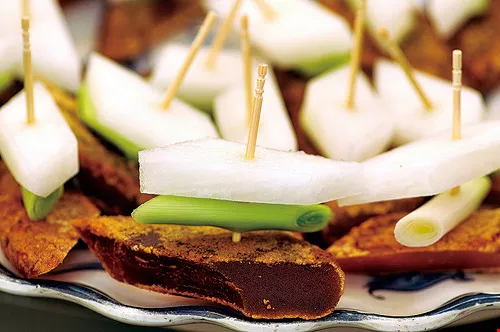
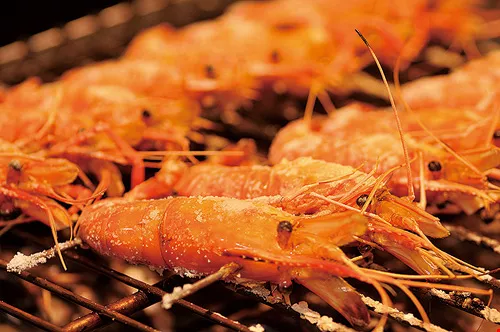
Liuhe Night Market is the most popular night market in Southern Taiwan among mainland Chinese tourists. Tantalizing seafood is lined up in neat rows: live crabs, barbecued shrimp and mullet roe tempt the palate.
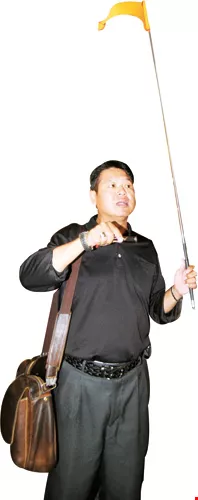
Waving a little flag, the tour guide leads a group of 30 or so tourists into the market. Some stop by the mullet roe stand, watching as slices of mullet roe, sandwiching small pieces of radish and garlic, are toasted until golden brown, each one selling for NT$50. Many of the visitors pull out some change and buy some. This may be the only night market stall in Taiwan to sell this gourmet dish, and what great value!
Walking ahead, one can hear a vendor shouting, "Patented Taiwan chopsticks! 100% unbleached wood! They won't mold or turn black! It's the perfect Taiwan gift!"
Many of the tourists' eyes light up when they notice shrimp being barbecued before their eyes. The shrimp, alive and kicking, are skewered on sharp bamboo sticks and placed on the grill. Two or three flips later, they turn bright pink, and with a sprinkle of salt and pepper they become tempting. The sweaty-browed owner barbecues as he fills six or seven plastic bags with skewered shrimp, which the tourists eat while browsing the market.
In the minds of the locals, the turning point in Liuhe Night Market's success came in 2005 when the street was designated a pedestrian zone. Previously, the night market management committee had placed barriers on either end of the street at 6 p.m. each evening, but many motorcycle riders ignored them and rode in as before. At that time the Kao-hsiung MRT hadn't opened yet, and with Kao-hsiung's motorcycle culture in power, the committee resorted to requiring riders to park in the middle of the street in orderly rows, but this created numerous problems.
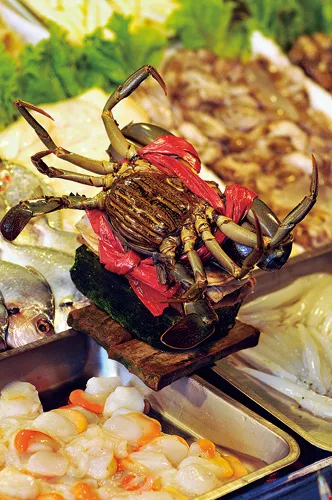
Liuhe Night Market is the most popular night market in Southern Taiwan among mainland Chinese tourists. Tantalizing seafood is lined up in neat rows: live crabs, barbecued shrimp and mullet roe tempt the palate.
"There were exhaust emissions, motorcycles carelessly bumped into visitors in the street, and a lot of women got burns on their legs from scalding exhaust pipes," says -Liuhe management committee consultant Zhan Jin-han. After negotiations, the committee decided to turn the area into a pedestrian zone, strictly forbidding motorcycles from entering. However, some vendors objected because the number of drive-up customers fell, causing a drop in revenues by about 15%.
"During six months of grumbling and growing pains, we had to convince everyone to be patient because this was the right thing to do. Otherwise there'd be no way for the night market to change for the better," says Zhan. Thankfully the reduced number of local consumers was more than offset by tourists. And the committee now places plastic chairs in the middle of the street, making it a great place for people to gather and eat. With this roomy layout, it's crowded but not too crowded, relaxing yet full of life.
An estimated 15-20,000 people visit -Liuhe Night Market each weekday, while on weekends and holidays the figure doubles to 30-50,000. Locals make up 30% of the night-market visitors, but 80% of visitors overnighting in Kao-hsiung visit a night market. In the two years since mainland Chinese tourists have been allowed to visit Taiwan, Liuhe Night Market has been one of southern Taiwan's top beneficiaries.
Liuhe Night Market is the most popular night market in Southern Taiwan among mainland Chinese tourists. Tantalizing seafood is lined up in neat rows: live crabs, barbecued shrimp and mullet roe tempt the palate.
Liuhe Night Market is the most popular night market in Southern Taiwan among mainland Chinese tourists. Tantalizing seafood is lined up in neat rows: live crabs, barbecued shrimp and mullet roe tempt the palate.

@List.jpg?w=522&h=410&mode=crop&format=webp&quality=80)
@List.jpg?w=522&h=410&mode=crop&format=webp&quality=80)


