A Traveler with NoRoad Home--Ha Jin
Su Hui-chao / photos courtesy of China Times Publishing / tr. by Scott Williams
May 2010


People who have interviewedHa Jin call him "a mystery."
But the man sitting in front of the long table for this interview doesn't seem mysterious at all. He doesn't even give off that sense of almost-divine brilliance common to great artists.
We're sitting at the Eslite Books across from National Taiwan University, where Ha Jin is diligently signing books for readers, smiling amiably from beneath a shock of curly but thin white hair. Our first impression of Jin is of a down-to-earth middle-aged man.
The many "legends" surrounding Ha Jin support that impression. Cultural workers and artists tend to be a bit flighty and have a kind of arrogant unconventionality. Not Ha Jin. When he was invited to Hong Kong for a book expo, the event's organizers reported that he made the fewest demands of any of the invited VIPs. Chinese author Hong Ying has called Jin "truly a humble gentleman." How is it that, as a reporter at a press conference during a German book tour wondered, "a Chinese man with indifferent English has been able to win two of America's most important literary prizes?"
Ha Jin is a plainspoken, down-to-earth middle-aged man who also happens to be a poet, an important novelist, and a master of realism. There are two sides to the Jin "mystery."
The first involves the legend of a man who became a successful Chinese writer in America while writing in his second language-English. The second concerns the gap between his two selves-the one who writes and the one who lives a workaday life.
Jin isn't all that well known in Taiwan, but loyal readers gave him a courteous reception nonetheless. The photo shows a section of a booth devoted to Ha Jin at the 2010 Taipei International Book Exhibition.
Jin made his second visit to Taiwan in January 2010 as a guest of the Taipei International Book Exhibition (TIBE).
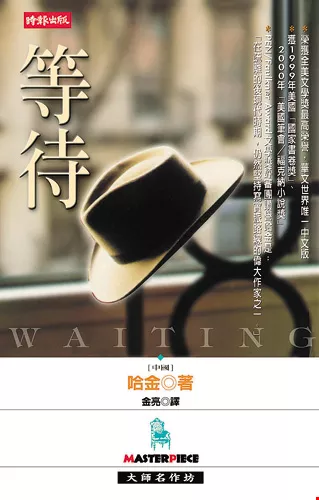
Jin's first visit was back in late November of 2001. China Times Publishing had released his novel Waiting, a US National Book Award winner, in 2000, and published his short story collections Under the Red Flag and The Bridegroom thereafter.
When The Bridegroom came out, the National Cultural Association invited him to Taiwan. The timing was a little awkward: the US was still under the black cloud of the 9-11 attacks and Taiwan had just been ravaged by Typhoon Nari. Nonetheless, President Chen Shui-bian greeted him on his arrival and stated that Taiwan's politicians had to create "an unfettered writing environment" for authors of literature. In so doing, the president was commenting on the constraints mainland China placed on its artists' work and spiritual freedom, and on how this state of affairs was reflected in the fact that Ha Jin himself had been compelled to live abroad and write in English.
The title of a China Times interview with the author read: "He Chose to Turn His Back on His Native Land."
Jin's second visit to Taiwan came nine years later, when he accepted the TIBE's invitation to participate in a "Chinese Writers' Summit." The visit coincided with release of his most recent collection of short stories A Good Fall (China Times Publishing) and a collection of lectures entitled The Writer as Migrant (Linking Books). Jin held a book signing at the Eslite across from NTU on January 27 and delivered a lecture on "Sino-American Literature from the Standpoint of the Immigrant Experience" on the 28th.
Jin has had little opportunity to look around on his two visits to Taiwan, spending so much time doing interviews and meeting with high-ranking officials for food and conversation that he has had no time even to get over his jet lag. "Your premier is very eloquent," he says.
Jin is keenly aware of Taiwan's democratic freedoms, and of the island's special significance to him: because mainland China continues to ban all his published work except Waiting, Taiwan's translations of everything from Ocean of Words, In the Pond, The Crazed, and War Trash to A Free Life provide mainland residents with their only opportunity to read his books in Chinese. That's important to him because he wants mainlanders to "read and examine" his work.
Jin regrets that the hectic pace of his visits has left him without an opportunity to "see how ordinary [Taiwanese] live." His only glimpses have been a stroll down Wenzhou Street and through the NTU area in the company of Maudlin Yeh, deputy editor-in-chief at China Times Publishing. But his strongest impressions are of the enthusiasm of his Taiwanese readers. Jin isn't a best-selling author, but the people who come to his book signings have read all of his works and are all fans of realism in this age of fantasy. The autograph seekers have even included an elementary-school student who had read War Trash.
Reality is ugly and grim, but this doughty writer and his readers never turn away from it.
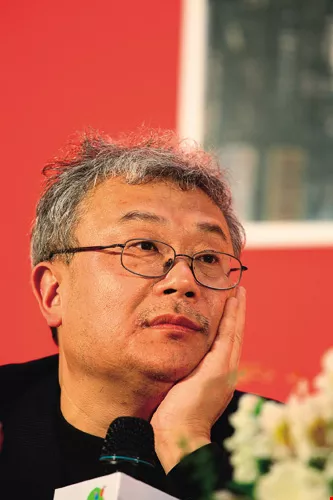
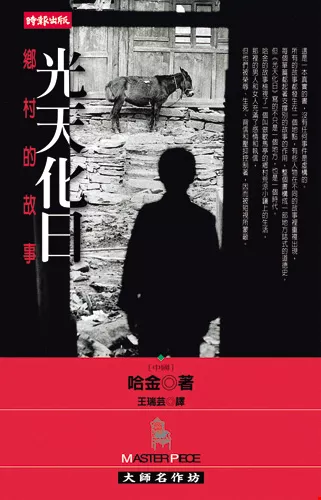
Unwilling to return to China after the Tian'anmen Massacre, Ha Jin chose to remain abroad. Though lonely, life abroad offered him the kind of autonomy and freedom to write the truth that creative individuals prize. The picture on the facing page shows his latest collection of short stories, A Good Fall.
Why does Jin write in English? It's a question he's asked in the US, Hong Kong and Taiwan, but never gets to answer in full. Most of the time, he responds with a brief and humble "to survive," but he's now written an entire book-The Writer as Migrant-addressing the question in full.
Jin hadn't planned to live overseas and write for a living. While life may well be a journey, it's a very long, slow one that never goes according to plan. And where most trips end when the traveler turns around and goes home, Jin has instead built a new home in another country.
Ha Jin was born in northeastern China during a major snowstorm. In fact, his given name is Jin Xuefei ("Flying Snow" Jin). In late 1969, the 13-year-old Jin lied about his age and joined the People's Liberation Army. He was assigned to a border defense unit and stationed in a village called Guanmenzui, where most of the residents were ethnically Korean. Jin wanted to continue his education when he left the military in early 1975, but with the Cultural Revolution having closed all the universities he worked for three years for the Jiamusi railway instead. When the universities reopened in 1977, he passed the entrance exams and became a student in Heilongjiang University's English department. After finishing his undergraduate degree, he became a graduate student in Anglo-American literature at Shandong University. On completing his MA in 1984, he received a scholarship to Brandeis University and traveled to the US to pursue a PhD.
Ha Jin's plan was to finish his PhD and return to Shandong to teach. A doctoral dissertation on Anglo-American poets like Ezra Pound, T.S. Eliot, W.H. Auden, and William Butler Yeats carried weight in the Chinese market, even if it wasn't worth much in the US.
So Jin studied and wrote poetry, unaware his future would be in fiction.
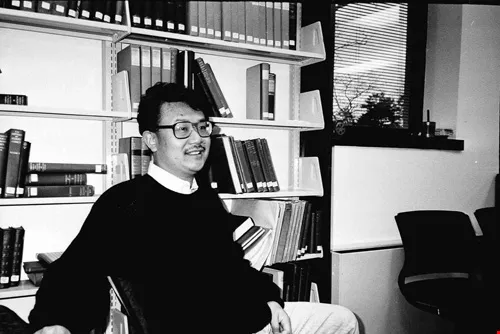
A soldier at 14 and a railway worker at 20, Jin hasn't been back to China since going to the US at age 29. Each twist and turn of his life has added depth to his work and to his character. As a writer, Jin excels at extracting meaning from ordinary people's ordinary experiences. The photo (facing page) was taken during an early interview in the US.
The Tian'anmen Massacre of 1989 made Jin's trip abroad interminable. It wasn't that he couldn't go home, it was that he didn't want to. He felt betrayed by his country, and didn't want to return to a nation that would do that kind of thing. He also took his son's future into account. He wanted him to be an American who didn't have to follow the same path as his own generation of Chinese. Jin's problem was that it's almost impossible to live as a poet in the United States. In an effort to give himself other options, Jin audited a writing course at nearby Boston University, and wrote both poems and fiction.
Jin completed his PhD in 1992, then won a teaching position at Emory University, beating out more than 200 other applicants through hard work and luck. The position required him to present work for evaluation every year. With fiction seeming like it would be a bit easier to produce, he began to seriously work at writing it. For Jin, fiction represented a means to survive in the English-speaking world. But, more than that, it was a means to survive in a meaningful manner. Prior to this time, he'd never really considered becoming a novelist.
The teacher of his writing class at BU had felt Jin had a talent for fiction writing, but Jin didn't believe him. He was a rational writer, rather than an expressive one, and didn't see himself as the genius type. But he believed that he could improve his writing skills if he continued to work at it. The key would be how well he got the basics down and whether he had the inner fortitude to stick it out.
Recognizing that mainstream Western literature still looks to old Russian models, Jin embraced Tolstoy, Dostoyevsky, Gogol, and Chekhov, and made them his teachers. He emulated and imitated, standing on the shoulders of giants to gain perspective, and came to believe that attention to minor characters, a vibrant sense of life, and the sacredness of human nature were the purview of the novelist. "Once a writer broadens his horizons, he loses interest in anything except his art and becomes willing to suffer for it," says Jin.
Unlike writers with natural genius, those who gain their skills through hard work have to learn to face frustration and hone their patience. Jin went through a period where he was receiving rejections almost daily. He and his wife got through it by agreeing never to read the mail before a meal.
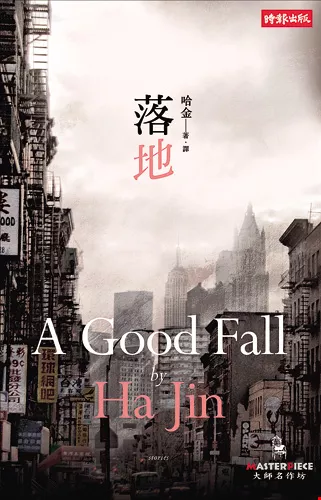
Unwilling to return to China after the Tian'anmen Massacre, Ha Jin chose to remain abroad. Though lonely, life abroad offered him the kind of autonomy and freedom to write the truth that creative individuals prize. The picture on the facing page shows his latest collection of short stories, A Good Fall.
Few people know that Jin's first book was a collection of poems entitled Between Silences: A Voice from China, drawn from his experiences in the People's Liberation Army. In writing the pieces in the collection, he drew on a variety of materials and coupled them with his own experiences. He would later look to the same sources for Ocean of Words.
When he published his first book, Jin saw himself as a representative of China's underclass, a Chinese writer working in English speaking for Chinese who had suffered misfortune. But his thinking changed when he read V.S. Naipaul's A Bend in the River.
Naipaul has written that a column of ants on the march doesn't wait for those that fall behind or get lost; it just keeps moving forward. Jin came to believe that Naipaul's metaphor aptly described the relationship between the individual and the group.
"People from mainland China of our generation have had this idea instilled in us," says Jin, "that there's a self-evident agreement between you and the nation." He ceased to be party to this agreement when he left China for the US, making his early view of himself as a "spokesperson for China's underclass" seem both arrogant and ignorant.
Regardless of whether he's fallen behind or gotten lost, Ha Jin is well aware that he's an author. As such, he must cultivate his independence and use his work to respond to everything he encounters. Recognizing that authors don't make good generals and aren't much use in a social revolution, Jin's literary faith is simply to express himself in his own voice.
Jin isn't all that well known in Taiwan, but loyal readers gave him a courteous reception nonetheless. The photo shows a section of a booth devoted to Ha Jin at the 2010 Taipei International Book Exhibition.
Jin says that his first reason for writing in English was that he had to. Jin had never published in Chinese prior to going to the US and had no readership. His wife, Bian Lisha, told him: "The only way you're going to get results is by writing in English. There are so many authors writing in Chinese that you'll never break in and will never stand out even if you do break in."
He also recognized that he wouldn't be the first to write in English as a second language. Conrad and Nabokov had already paved the way in grand style with Heart of Darkness and Pale Fire. The path had already been laid. He just had to have the courage to walk it and attempt to live up to standards set by those who had walked it before.
But Ha Jin faced an even bigger challenge than those writers. Conrad didn't write about Poland in English, and Nabokov had written both English and Russian as a child. Jin, on the other hand, was using his non-native English to write about Chinese subjects unfamiliar to Western readers. Responding to criticism of his limited English vocabulary, he explains: "They don't understand that authors like me aren't writing from within a dictionary. We're at the margins of English, writing in the gap between languages. You can't rate our skill or our achievements simply in terms of our grasp of standard English."
Jin also has to deal with criticism from China, the majority of which argues that he's "selling feudal China" in an attempt to appeal to Western readers, and that he's making the US look better than it is.
Jin isn't all that well known in Taiwan, but loyal readers gave him a courteous reception nonetheless. The photo shows a section of a booth devoted to Ha Jin at the 2010 Taipei International Book Exhibition.
Jin has struggled with the writing of each of his books.
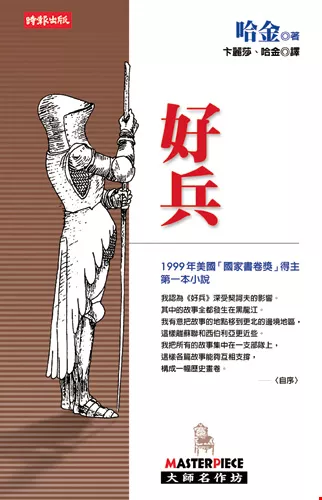
Jin's first book was Ocean of Words, which took five years of intermittent labor to produce and publish. The stories in the book, which he admits was strongly influenced by Chekhov, focus on a military unit stationed on China's borders and deal with the loves, hates, joys, and sorrows of both soldiers and ordinary citizens. Each story builds on the others to paint a small portrait of history.
Ocean of Words won the 1997 Hemingway Foundation/PEN Award for best work by a previously unpublished author. The judges praised Jin in their comments, stating that his detailed observations of the customs of the day and his firm grasp of technique had turned messy reality into pure art.
The key to Jin's fiction is the molding together of real people and real events, weaving all the bits and pieces into the kind of seamless fictional whole that elevates story into literature.
Jin's second collection of short stories was entitled Under the Red Flag. It was set in Dismount Fort, a village based on Liangjiadian in Jin County, Liaoning Province, where he'd lived as a child. The 12 village stories in the collection comprise "a local-gazetteer-like moral history." The Bridegroom followed. Similar in conception to Under the Red Flag, it was set in a fictitious city called Muji that is loosely based on Jiamusi with the addition of something of the atmosphere of Harbin. Jin went on to have the protagonists of his novel Waiting, Kong Lin and Wu Manna, fall in love in Muji.
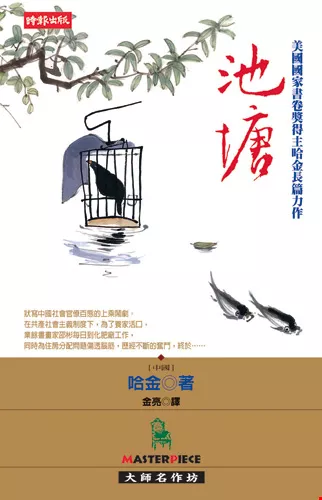
Jin's first novel, In the Pond, was also set in Dismount Fort. The novel centers on Shao Bin, an amateur calligrapher who works at a fertilizer plant, and tells of his hopes and struggles to move into a new "workers' compound."
Jin isn't all that well known in Taiwan, but loyal readers gave him a courteous reception nonetheless. The photo shows a section of a booth devoted to Ha Jin at the 2010 Taipei International Book Exhibition.
Chinese readers are probably most familiar with Waiting, which won both the 1999 National Book Award and the 2000 PEN/Faulkner Award and established Jin's reputation as a literary master.
Waiting dramatizes a story that Jin had heard while a graduate student at Shandong University. Set during the Cultural Revolution, the novel tells the story of a military doctor named Kong Lin who makes an annual pilgrimage to the countryside seeking a divorce from his wife from an arranged marriage. He continues to do so for 18 years without success. His lover, a woman named Wu Manna, waits for him until she's middle-aged and suffering from a terminal illness, until the sparkling love of their youths has dimmed and soured in the autumn of their lives.
What kind of system, legal framework, and society require such a cruel wait? Does revolution engender love or hate? Does it pare away some portion of our humanity? The novel offers answers.
For Waiting, an American critic praised Jin as "one of the great sturdy realists still writing in a postmodern age."
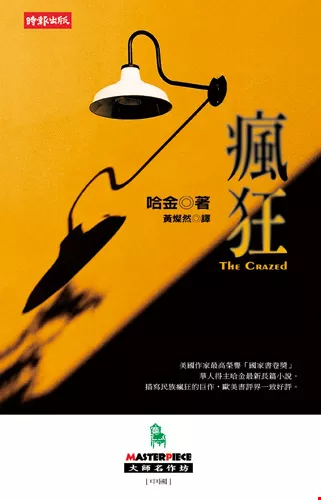
Jin's The Crazed concerns the Tian'anmen Massacre, narrated from the perspective of Wan Jian, a graduate student in literature with no interest in the student-led demonstrations. Wan has come to Beijing to take care of his professor and soon-to-be father-in-law, who has suffered a stroke. When he becomes involved with the Tian'anmen protests, he doesn't do so out of sense of idealism, dream of democracy, or desire to save the nation and its people, but to prove to his fiancee that he isn't a coward and to break free of the cocoon that binds him.
Jin isn't all that well known in Taiwan, but loyal readers gave him a courteous reception nonetheless. The photo shows a section of a booth devoted to Ha Jin at the 2010 Taipei International Book Exhibition.
Jin's next novel was War Trash, which deals with a prisoner of war during the Korean War.
Sometimes known as the "forgotten war" in the US and Europe, the Korean conflict also involved a forgotten group of "Chinese People's Volunteers" whose lives and fates became subject to heartless political whims. Jin's novel examines the infighting and conflicts within a group of these volunteers in a POW camp and was named a New York Times Notable Book in 2004.
When Jin visited Taiwan in 2001, he let it be known that he was planning to shift his subject matter to American topics. At the time, he said: "I haven't been back in so long. China has changed. I've changed, too. I'm slowly becoming a stranger to China."
He was also becoming less interested in the country of his birth. China was his past, and the past is the one land you can never escape, no matter how far you travel. "Perhaps one day I'll go back to have a look," said Jin, "but I'll never go back to live."
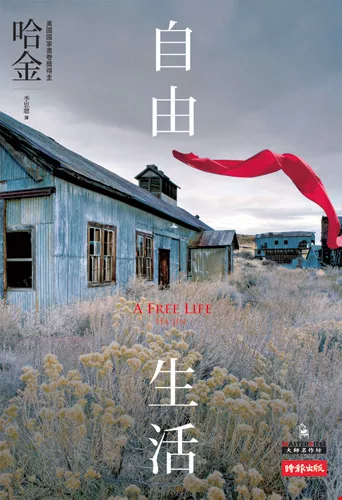
The 600-page A Free Life was his first novel involving the US. Though the work is fictional, readers can't help but imagine Jin as the protagonist. On one level, this is as it should be, even though the real Jin differs in obvious ways from the Wu Nan of the novel. For example, the real Jin is a professor of literature who has never run a restaurant and has yet to go back to China, while Wu Nan is a restaurateur who writes poems late at night and makes visits to his family in China.
Jin isn't all that well known in Taiwan, but loyal readers gave him a courteous reception nonetheless. The photo shows a section of a booth devoted to Ha Jin at the 2010 Taipei International Book Exhibition.
Jin has certainly written some of himself into Wu Nan. For example, Wu resists going back to China after Tian'anmen, works all kinds of jobs to support himself in the US, gets into verbal confrontations with Chinese studying in the US, and wishes more than anything to be a poet. The novel also begins with an anxious Wu and his wife in an airport after Tian'anmen, waiting for their not-yet-six-year-old son to arrive from China, something that Jin himself experienced.
Generally speaking, individual values hinge on the growth and development of the group. Both Jin and his protagonist have to cast aside the notion that the nation supersedes and is far more important than the individual. They are pursuing their individuality and free, meaningful, literary lives. But their freedom is a lonely thing.
Jin was unaware of the person-state contradiction or of the individual's standing vis-a-vis the nation for many years. But then, while working on a piece about the 1937-38 Nanjing Massacre, he looked back over the last 20 years of his oeuvre and realized that each of his books and each of the struggles he'd had writing his books had been connected to these issues. "Lung Ying-tai is doing the same thing in Big River, Big Sea, isn't she?" he asks.
Ha Jin believes that in this respect A Free Life epitomizes his work to date.
A Good Fall, a collection of immigrant stories published in English in November 2009 and in Chinese in January 2010, is the first collection that Jin himself has translated into Chinese. While the language came naturally to him and didn't require a lot of thought, he says that his use of it here in no way suggests a desire to return to the Chinese-speaking world. While not writing in his native tongue is, in some respects, "a personal tragedy," writing in English has allowed his work to be translated into more than 30 languages. Which is to say that one of the greatest benefits of not writing in Chinese has been the acquisition of many, many readers from other language backgrounds.
Jin owes it all to not being able to return home at the end of his journey.
@List.jpg?w=522&h=410&mode=crop&format=webp&quality=80)

@List.jpg?w=522&h=410&mode=crop&format=webp&quality=80)


@List.jpg?w=522&h=410&mode=crop&format=webp&quality=80)

@List.jpg?w=522&h=410&mode=crop&format=webp&quality=80)
