Dr. Dog Will See You Now!
Chang Chiung-fang / photos Chin Hung-hao / tr. by Scott Williams
December 2013


Dogs have long been human beings’ most loyal companions, furry little friends that add an extra measure of warmth and security to our lives. They are also able assistants long known for guiding the blind, uncovering contraband, and helping hunters track and retrieve prey. In more recent years, our canine companions have learned yet another new trick: providing therapy to people in need.
There are currently more than 100 active therapy dogs in Taiwan. Working in conjunction with their public-spirited owners, these animals are bringing warmth and healing to eldercare facilities, hospitals, early intervention facilities, and special education centers.
Volunteers from the Taiwan Charitable Service Dogs Association (TCSDA) arrive at the Jen-Ai Eldercare Foundation facility in Neihu at the crack of dawn accompanied by three doggie doctors.
Bank, an eight-year-old golden retriever, and Winner, a six-year-old giant schnauzer, have been service dogs for six years. Baobao, a four-year-old red poodle, has been a service dog for a year and a half.
Zheng Shaowen, a trainer with the TCSDA, dresses the black Winner in a yellow bow, a skirt, and a service-dog vest, instantly transforming a very large animal into a dignified lady and alert volunteer.
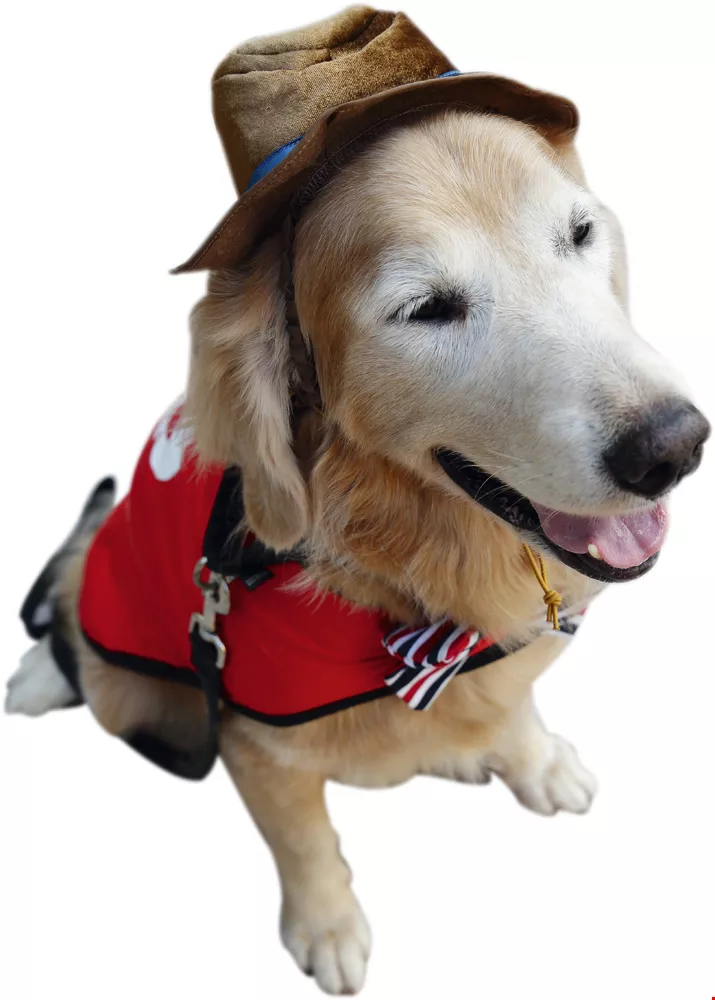
Lin Jiongyan, TCSDA’s founder and Bank’s owner, helps Bank into a hat and bowtie, preparing the easygoing old dog for work.
Baobao, the adorable little poodle, doesn’t need to be dressed up to make her less threatening. Her owner, Li Xingzhen, simply puts her into her service dog vest and sets her to work.
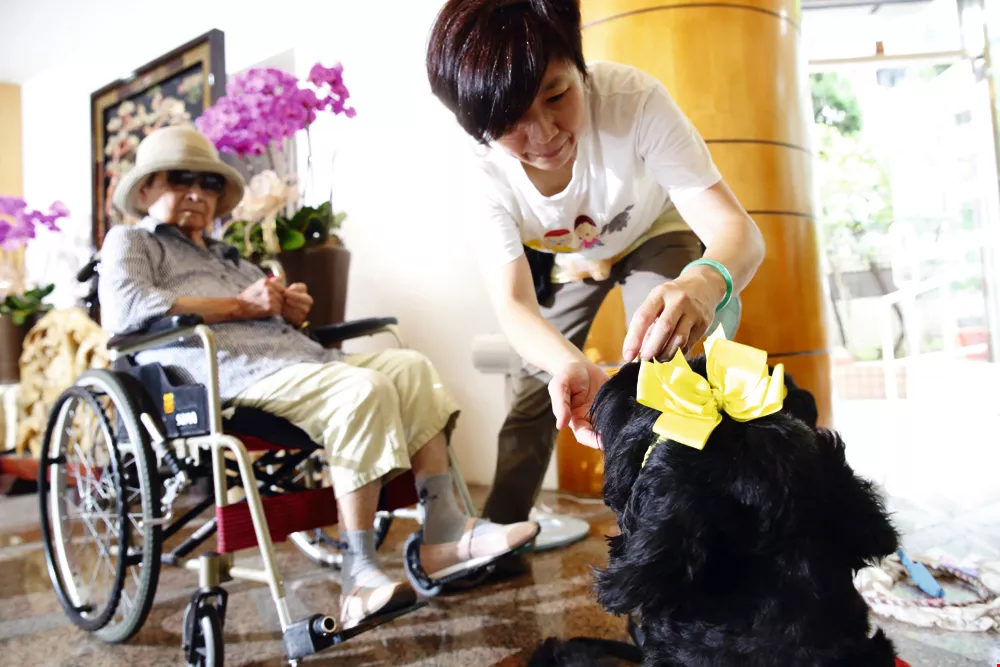
Dogs’ tricks are therapeutic for everyone around them.
Dressed up and ready to go, the human–canine teams enter the lounge looking very professional. The doggie doctors have been making regular visits to the Jen-Ai facility for nearly six months. “Their every visit brings smiles and laughter to our seniors,” say Xu Jinling, the foundation’s director.
The dogs begin their performance by sitting up, lying down, and balancing treats on their noses. Exceptionally calm and obedient, they quickly overcome their audience’s fear of being bitten. As the seniors begin to feel more at ease, the pups’ owners encourage them to feed, brush, and play with the dogs.
“Uncle Chen,” a 93-year-old resident, loves brushing Bank and even lets Baobao nap on his lap.
“Uncle Gao,” who is hard of hearing and extremely reticent, wants to feed Winner a bit of apple. Encouraged by Zheng, he struggles to articulate a quiet “O,” then slowly manages a “K.” After practicing a few times, he’s able to give Winner an “OK” command. Winner responds by sitting quietly, waiting, then taking the bit of apple Gao offers, bringing a smile to the old man’s face.
The “house calls” are scheduled to last one hour, but “patients” always want them to go on a bit longer. This is especially true of the children they see, who, once they overcome their wariness, want to run the dogs through all of their tricks themselves. TCSDA’s trainer Zheng Shaowen says that doggie doctors have to pay close attention to commands when on house calls. That’s tiring for them, and they run out of steam after about an hour. “When the visits are over and they climb back into the car, they’re beat. Once they’re back at home, they take a good, long nap.”
Off to make some house calls! From left to right: Abi, a longhaired dachshund; Xiao’ao, a poodle; Didi, a smooth dachshund; and Bank, a golden retriever.
Taiwan currently has roughly 100 licensed doggie doctors. All were trained by the Formosa Animal-Assisted Activity and Therapy Association (FAAATA, known informally as “the Taiwan Dr. Dog Program”), and all provide their services free of charge to 50–60 hospitals, eldercare centers, and schools around Taiwan.
Shirley Chen created FAAATA in 2001, inspired by the Animals Asia Foundation’s Dr. Dog program, which was itself established in Hong Kong in late 1999. A dog lover keenly aware of just how comforting canines can be to people in need and hoping to change Taiwanese attitudes towards dogs, Chen worked with AAF founder Jill Robinson to bring the Dr. Dog program to Taiwan.
Animal-assisted therapy is one of several forms of complementary medicine that has seen acceptance of its effectiveness grow in recent years. Gao Guoshu, director of social work at Yilan’s Lotung Poh-Ai Hospital, explains that animal-assisted therapy provides visual and tactile stimulation. Dogs, cats, horses, and dolphins are all used, but dogs are preferred for their predictable behavior and the relative ease with which they can be taken virtually anywhere.
Dr. Lin Wenyuan, the current president of FAAATA and director of the palliative care unit of the China Medical University Hospital, says that the doggie doctors generally assist with physical therapy and companionship.
Long-term care and early intervention facilities that use the dogs usually have them assist with physical therapy. Lin says that they help motivate the patients, increasing their agility and coordination during therapy and exercise. For example, children with cerebral palsy tend to have little interest in the inanimate devices used to treat their condition, but will extend their hands to pet a dog. Similarly, special education students with poor balance have an easier time with their balance board exercises when holding onto a dog. Even activities as basic as brushing a dog or walking with a hand on a dog can achieve some of the muscle training effects of exercise.

Off to make some house calls! From left to right: Abi, a longhaired dachshund; Xiao’ao, a poodle; Didi, a smooth dachshund; and Bank, a golden retriever.
Doggie doctors also provide companionship and consolation, and in this area are likely more effective than people.
In 2007, Dr. Lin joined hands with Gao Guoshu to bring doggie docs to the China Medical University Hospital’s hospice ward.
“When patients focus on the doggie doctors, they’re able to forget their pain for a time,” says Lin. He explains that because hospice patients are terminally ill, they are inclined to think of themselves as useless and withdraw into themselves. Interacting with dogs and giving them commands gives these patients a surprising sense of achievement. And those who already like dogs are just happy to have them around.
“The dogs open up a window for communication,” says Gao. Their performance serves as an ice breaker. Individuals who have raised dogs or are fond of them find warmth and comfort in their companionship. The interactions even cause some patients to open up and tell stories about their past.
Gao recalls one older woman in particular. She missed her family’s Formosan mountain dog very badly and was thrilled to interact with the doggie docs. As she told the hospital staff: “Having a dog around makes the place feel homey.”
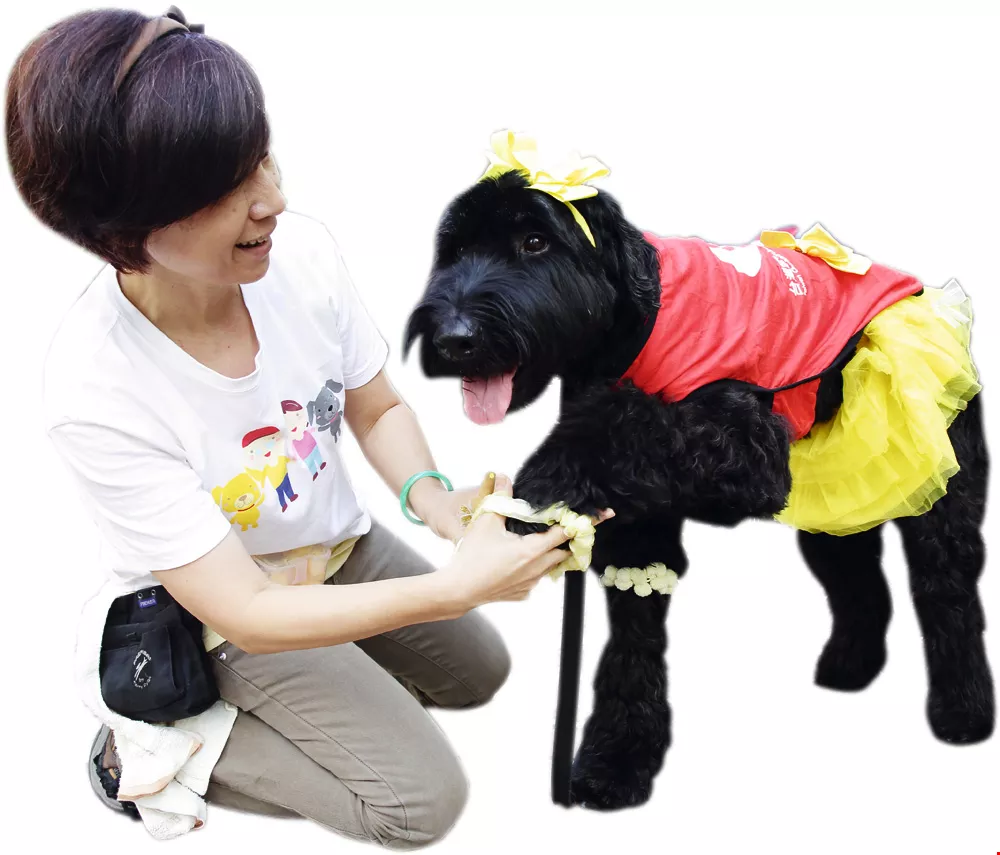
Zheng Shaowen helps Winner put on a work vest and skirt. Dressed up and ready to go, Winner clocks in for a volunteer shift.
Doggie docs have to be mentally and physically healthy, calm by nature, and highly obedient.
Lin says the dogs spend at least six months and an average of one and a half to two years completing the sequence of beginning, intermediate, and advanced classes required to become a doggie doctor. Once those are out of the way, the dogs must make six house calls as “interns” before being granted their license. These must then be renewed every year in a process involving a physical examination and vaccine boosters. The fact that getting a license and keeping it active is so very time consuming means that few dog owners bother.
FAAATA founder Lin Jiongyan says that even though he’s trained at least 500 dogs himself, FAAATA currently has only 10 licensed dogs on its active roster.
Most owners train their dogs simply to make them a bit more obedient. Lin adds that dogs need to be socialized as well to ensure that they won’t be startled, bite, or bolt when something surprises them.
At the most basic level, dogs are trained through the use of carrots and sticks. Ignoring a dog is a very effective “stick.” “A dog sees being ignored as a punishment,” says Lin, adding that owners who want to eliminate bad behaviors and reinforce good behaviors need to learn when and how to both ignore and encourage their pets.
Zhang Xiaofen is the owner of a former stray named Abi. Zhang says that when she first adopted Abi, the little dachshund would snap at everyone in the family. A stint in obedience school got Abi’s aggression under control, and led to him getting his doggie doctor license last year. Nowadays, Zhang, who has a day job in the Neihu Technology Park, has a ball spending her free time making house calls with Abi.
Li Xingzhen says that she originally enrolled her dog Baobao in obedience classes in hopes of giving the dog a bit of courage and stopping her barking. Two years later, Baobao was not only braver and more obedient, but had also earned a doggie doctor’s license. Li and Baobao soon put the license to use, making house calls to senior citizens and children in special education programs.
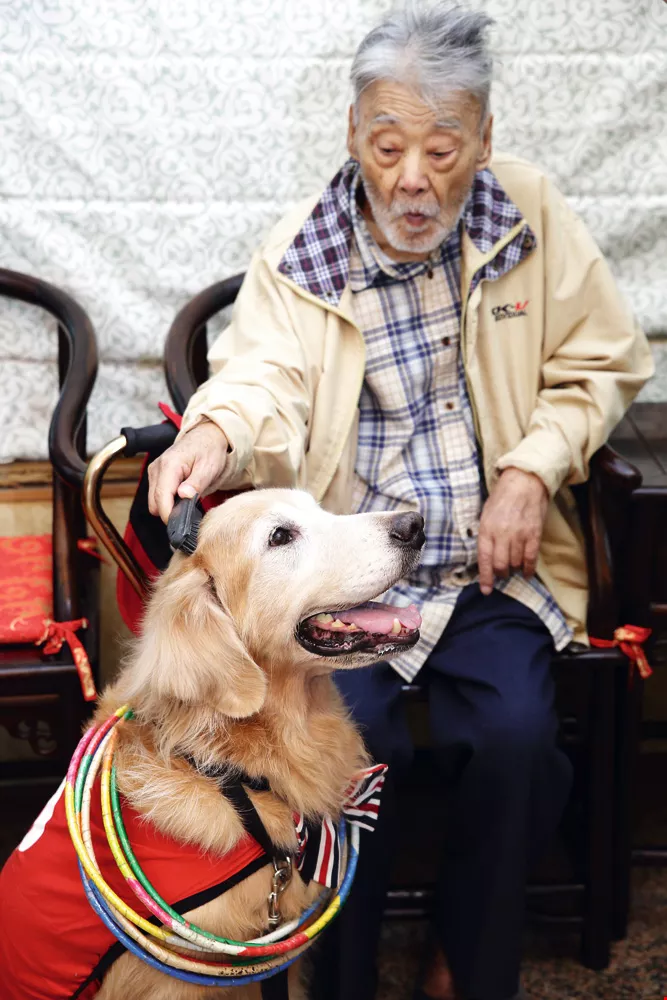
Bank, a doggie doctor for six years, is perfectly content to play with and be brushed by strangers. Calm and obedient, he is a model doggie doc.
Future doggie docs attend classes with their owners, then take up their medical practice in partnership with their owners. Since house calls are carried out on a volunteer basis with no compensation, owners determine when these charitable activities take place.
“The owners are key,” says Lin, explaining that they have to be interested in volunteering, and that they don’t get to “retire” until their dogs do.
Lin Wenhui, an elementary school teacher, brought Coffee, her golden retriever, to Linkou Chang Gung Memorial Hospital’s physical therapy department and an eldercare facility on a regular basis for five years, until blindness and old age forced the dog to retire.
“Dog owners are an important part of the process,” says Lin. For example, each time Coffee visited the department, Lin had to sit down with the therapists to design dog-assisted exercises appropriate to each patient’s needs. Dog owners planning to visit hospices or seniors suffering from dementia should first take classes (and possess a level of basic common sense) to ensure they don’t make patients uncomfortable with questions about whether they’re getting better or remember the dog’s name.
A doggie doc volunteer for more than five years, Lin uses “singing” dogs as a ringtone on her cellphone. “Seniors often have trouble getting out and about, so I made sure to take my dog over to visit no matter how tired I was,” says Lin. “I’m so grateful to have had the opportunity to do this kind of charitable work with Coffee.”
Though these doggy doctors are only practicing complementary medicine, their mission is important, and beyond the power of human beings to achieve on their own.
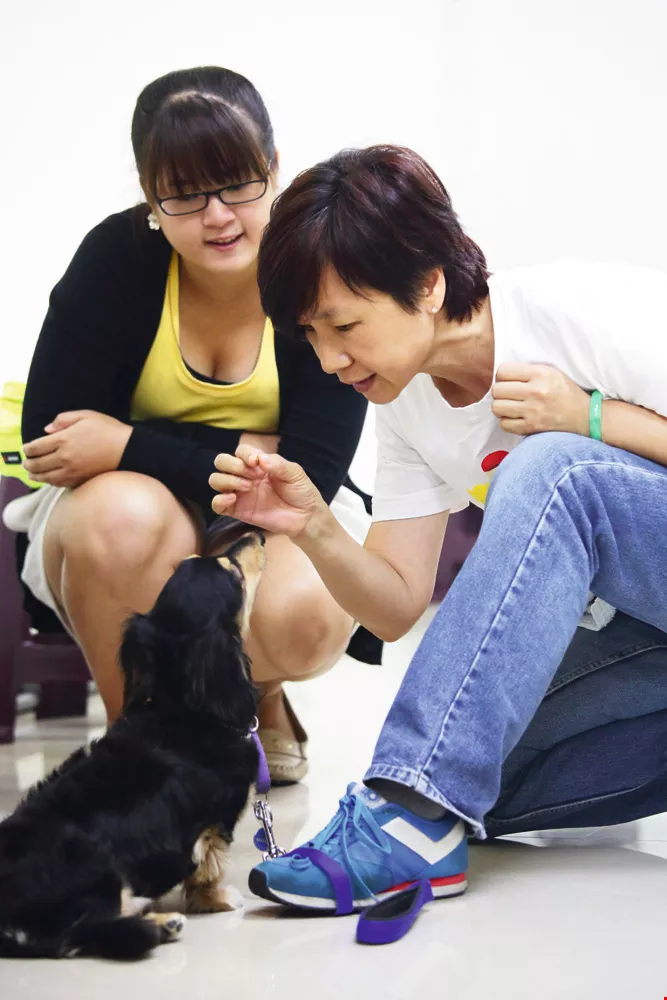
Every dog is capable of being socialized. Some just lack owners who know how to do it.

Off to make some house calls! From left to right: Abi, a longhaired dachshund; Xiao’ao, a poodle; Didi, a smooth dachshund; and Bank, a golden retriever.
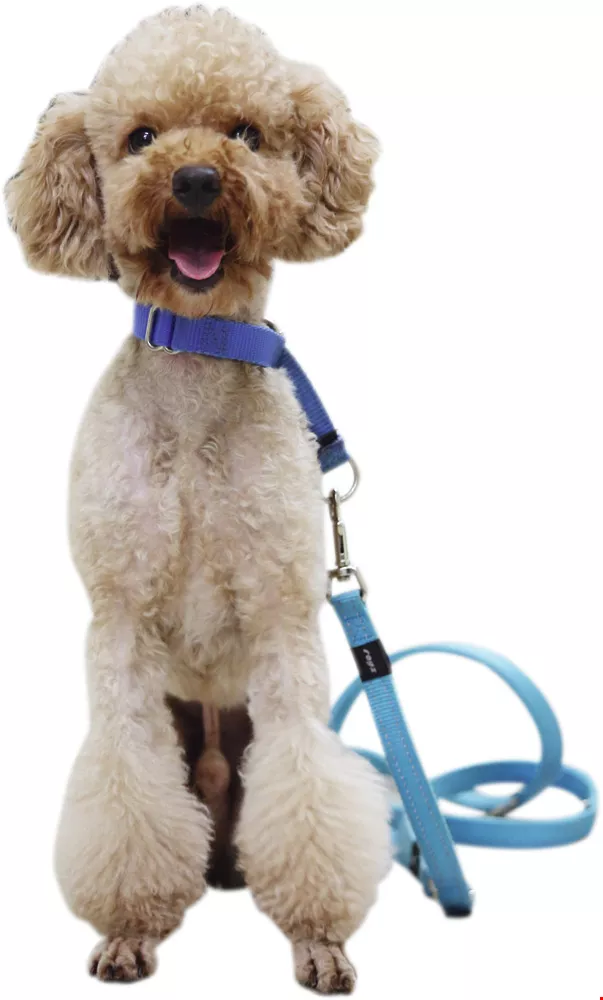
Off to make some house calls! From left to right: Abi, a longhaired dachshund; Xiao’ao, a poodle; Didi, a smooth dachshund; and Bank, a golden retriever.
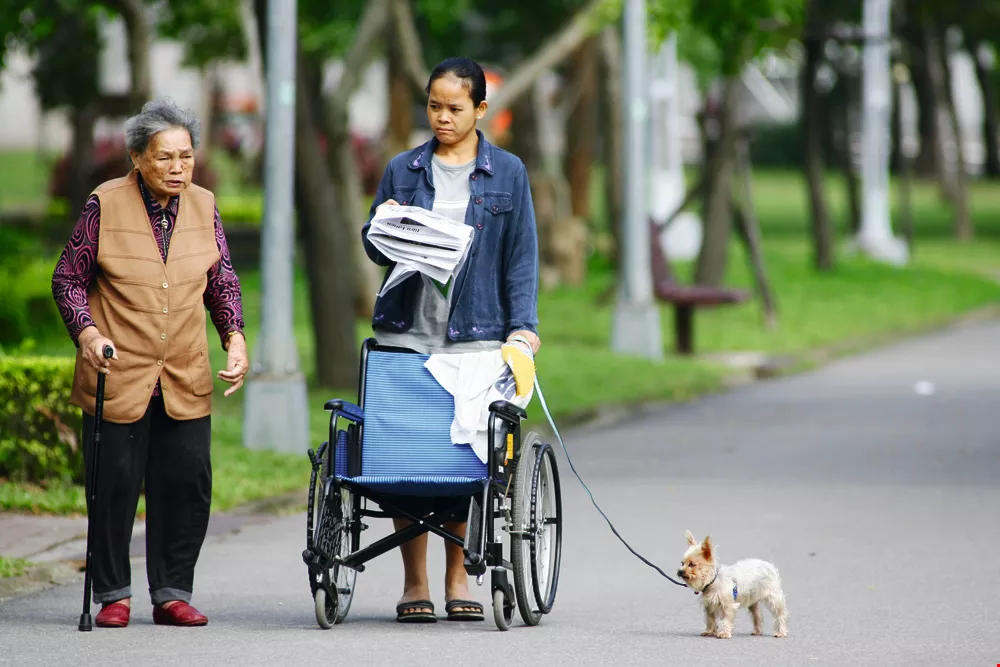
Dogs are a great source of quiet consolation. It’s not just licensed doggie doctors; even ordinary family dogs can be therapeutic.
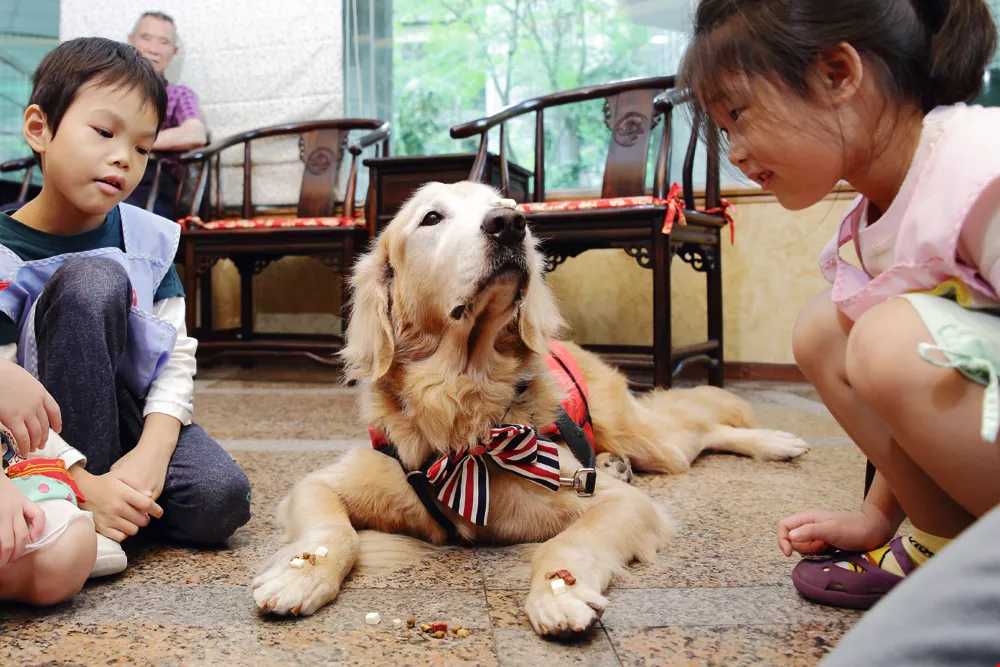
Bank is a big dog beloved of everyone. Small children are particularly quick to get over their fear and attach themselves to him.

@List.jpg?w=522&h=410&mode=crop&format=webp&quality=80)

@List.jpg?w=522&h=410&mode=crop&format=webp&quality=80)


