Money to Burn: Spirit Money Guru Zhang Yiming
Kuo Li-chuan / photos Jimmy Lin / tr. by Scott Williams
June 2011


Traditional Chinese festivals often include offerings of incense, food, and "spirit money" to the gods and one's ancestors. The currency, the "legal tender" of heaven and the underworld, comes in a variety of types and denominations. But, even though spirit money is a familiar part of folk cultural practices, few of us can divine the meaning of the obscure text with which it is inscribed.
Long considered nothing but superstition and "corpse money," spirit money remains in active circulation. Why are some individuals still collecting the currency and promoting this unusual industry?
"Spirit money's value derives not only from its practical applications, but also from the text, drawing, carving, printing, and ideas that constitute this folk art," states Zhang Yiming, a student of spirit money for over three decades. "Take the printing of the bills. Each image originates with an earthy, naturalistic woodblock print. The lines are complex but succinct, fluid and skilled, each stroke of the -carver's knife manifesting piety and respect."
Pulling a "Boy God" bill and a "Hua Gong and Hua Po" bill from his collection, Zhang points out the image of a child clutching a string of copper coins printed on the Boy God bill. He says this reflects the Boy God's obligation to care for one's hua-cong. (In folk religion, hua-cong encompasses one's health, good fortune, and descendents.) Individuals wanting to know the gender of an unborn child, or wishing to have a child of a particular gender, can, with the help of a priest, hold a ceremony intended to explore their hua-cong, seeking the guidance of the child god and asking for protection of their hua-cong.
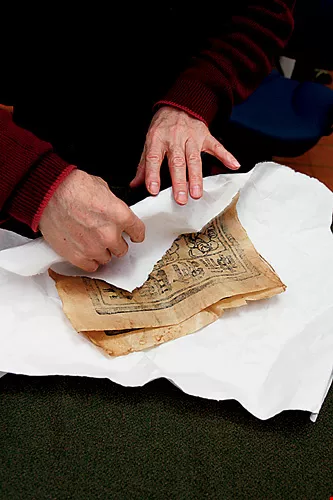
Preserving bamboo paper artifacts requires stripping them of their acid content. The process involves wrapping the bamboo paper in cotton paper, inserting it into a heat-resistant plastic bag, then placing it in a steamer basket. A certain amount of morpholino is added to the water, which is then boiled for 30 minutes.
The images on spirit money also reflect the world in which our ancestors lived.
Take "Tai Sui money," for example. Nowadays, people go to temples at the Lunar New Year to light candles and offer- spirit money to Tai Sui, the deity who oversees the current year, to appeal for a peaceful year. In the old days, our ancestors hung charms in the main hall of their homes as an offering to Tai Sui. Zhang's collection includes examples of Tai Sui money from the Ming and Qing Dynasties and the period of Japanese rule, each of which depicts Tai Sui in its own fashion.
"The Ming images depict Tai Sui as an official of the imperial secret police. The Qing portraits show him with the shaved head and queue typical of that period. In the Japanese era, burning spirit money was prohibited, so people changed "Tai Sui" to "Tai Shuai" and depicted him as a Japanese soldier in a cap.
The offerings made in front of the door to one's home on the first and 15th of each lunar month are called kao-jun and are dedicated to wandering spirits. Those made on the second and 16th are called -zuoya and are offered to the Earth God in hopes of receiving blessings on one's business. Zhang argues that while spirit money is burned during both ceremonies, it carries a different meaning in each. As he says, the kao-jun ceremony is for ordinary folk, while the -zuoya is for business people.
Whether an appeal for descendents in a hua-cong offering, a prayer for a safe year in a Tai Sui offering, or simply a monthly kao-jun or -zuoya ritual, spirit money is part and parcel of people's everyday lives. The veil of mystery surrounding the currency simply reflects a lack of knowledge. Zhang hopes to use education to lift that veil.
One of Taiwan's very few experts on spirit money, Zhang's life has been as rich and varied as his collection.
Born in Zhong-gang, Zhu-nan Township, -Miaoli County in 1953, Zhang graduated from Zhu-nan Junior High School, then tested into a private high school. But his family lacked the money for him to continue his education. Instead, he went north to Xin-zhuang at the age of 17 to learn to bake from his aunt's husband.
After completing his military service, Zhang opened his own bakery in Zhong-gang and went on to earn as much as NT$3 million in just one year. In 1978, he saw a Japanese man preparing to pay a local antiques dealer NT$5 million for 15 spirit money printing plates. Worried that local cultural artifacts were going to end up in Japanese hands, he urged against the sale. The shopkeeper responded, "I'll sell them to you for NT$3 million." Zhang bought them on the spot, and has been in love with collecting printing plates and spirit money ever since.
In the book The Art of Spirit Money, Li Feng-mao, a scholar of folk customs, writes: "Spirit money serves as an offering and a medium of communication during folk religious ceremonies. -Whether called xian-caibo or hua-zhi, spirit money is presented as an offering, burned so it may pass from the human world to that of the spirits, where it expresses the devotion of those making the offering."
Zhang says that spirit money isn't simply an object that represents respect for the supernatural and the unknown world; the process of burning it also facilitates the spiritual transformation of guilt and remorse into forgiveness and release, enabling participants to find peace. "Working from a basis in our hearts' desires and our material and spiritual needs, we use ceremonies and spirit money to seek consolation and hope from the unknown world. That's the real meaning of spirit money."
Flying on the wind
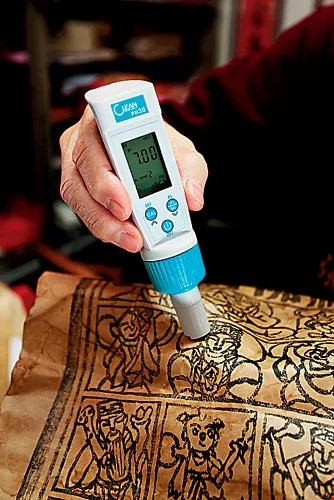
The removal of the acid leaves the bamboo paper pH neutral. The final step in the preservation process is to store it in a moisture- and fungus-resistant paulownia-wood box.
But the Wenzong Beiwen, a Tang-Dy-nasty document, reports that paper money dates to the Six Dynasties period, when the Southern Qi emperor Fei (Xiao Bao-juan) heeded the advice of the spirits and buried cut paper money with the dead instead of jade, coins, and silk. Another ancient source, the Feng-yan Wen-jian Ji, also states: "The ancients offered jade, coins, and silk to the spirits, and buried them afterwards. Since the Six Dynasties, paper money has been used."
Tang-Dynasty poetry also frequently describes the use of paper money. For example, a line in Bai -Juyi's "Cold Food Festival Lament" runs: "What family weeps by the tombs outside the outer gate during the Cold Food Festival? Spirit money blows through the wilds on the wind."
Zhang thinks that the use of spirit money was an early extension of the idea of using imitation money for burials and offerings that traces back to ritual use of imitation seashells and money.
The Chinese spirit world is hierarchical, consisting of heavenly spirits, earthly spirits, and human spirits. The basic premises are that everything has a soul, and that there are many fiends and ghosts, each with its particular standing, role, and attributes. These are manifested in ceremonies in any number of fashions.
Present-day spirit money comes in three varieties: gold, silver, and paper. Gold spirit money, used for gods, is made by applying gold paint to silver foil -pasted onto the paper, then stamping the front of the sheets and the sides of the stacks with a red seal. Silver spirit money, used for ancestors and for spirits of the underworld, is also made by pasting silver foil onto the paper, but is unpainted and stamped only on the side of the stacks.
Paper spirit money has neither foil nor paint, and is typically stamped with an image or text that states its purpose. It is most often used by priests for exorcisms, in rituals to help the spirits of the newly dead find their way to "the other side," or to bring luck and avert calamity.
In addition to being used for offerings and by priests, spirit money is sometimes used as a folk remedy. For example, "stinging insect and ant spirit money," made from bamboo paper inscribed with an image of a stinging bug or ant, was used in the old days to treat urticating caterpillar and bee stings when more conventional medical options were unavailable. One method involved burning the spirit money, then applying the ashes to the wound. Another involved grinding anti-inflammatory and painkilling herbs, wrapping them in spirit money, then applying the resulting bundle as a dressing.
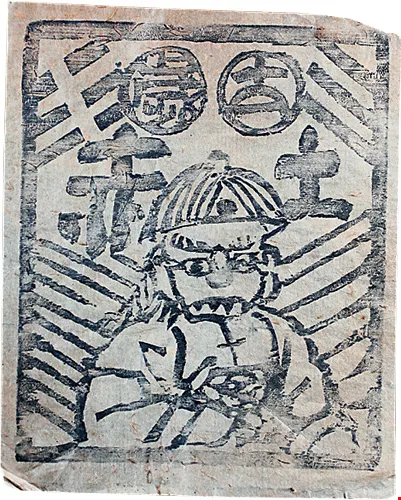
(below) The "Tai Sui money" of different eras depicts Tai Sui in different guises. The Ming-Dynasty portrait at left has Tai Sui dressed as an imperial bodyguard. The Qing-Dynasty image in the center shows him wearing a queue. When the Japanese banned the burning of spirit money, Taiwanese disguised Tai Sui as a Japanese soldier (right).
Gold spirit money originated in China and came to Taiwan around 350 years ago with early Han Chinese settlers, who brought with them the custom of burning spirit money as an offering to the gods. When Emperor -Kangxi lifted the em-bargo between Fu-jian, Guang-dong, and Taiwan in 1684, trade between Xia-men and Lu'er-men flourished. Tai-nan became a trade hub, goods poured into the city, immigration from China grew, and the use and manufacture of spirit money spread.
Zhong-gang in Miaoli County developed thanks to the spirit money industry. Known colloquially as the "Underworld Bank" and "Golden Zhong-gang," the town, like Dan-shui, Hong-mao, -Luzi and An-ping, possessed a fine natural harbor and it grew into a center for trade with mainland China. Zhong-gang's convenient location and comfortable climate also attracted a dozen-odd spirit money manufacturers during the Qing Dynasty.
The Dan-xin Archives records that in 1874, Qiu Hong-jiang, the education official for Taiwan Prefecture, reported to the government that the "long life" spirit paper used by the people featured a script so ugly that it profaned the sages. The prefectural government therefore banned the use of inscribed spirit paper in Taiwan.
"When the printing of characters was banned, companies switched to printing pictures representing good fortune and long life," says Zhang. He pulls an example of long-life spirit money from his collection, explaining that the image of the three sages on the front indicates that this bill promoted long life and good fortune. The bill also bears an image of a sage in an antlered hat riding a qi-lin with a bat flying beside him. "The Chinese word for 'bat' is a homonym of the word for 'good fortune,'" says Zhang. "Antlers recall another word for good fortune, and the qi-lin is a magical beast associated with long life."
During the period of Japanese rule, officials were initially very tolerant of folk customs and some local firms even im-ported paper from Tokyo and Osaka. Zhang shows us a card from the period written by a paper wholesaler which strongly suggests that firms were using imported Japanese printing presses to make spirit money by 1926 or so.
But the Japanese began to "Japanify" Taiwan after the start of the Second Sino-Japanese War, removing temple idols, banning folk customs and ceremonies, and prohibiting the production and use of spirit money. Despite the ban, firms continued to produce and sell the currency to a public that continued to use it.
Such prohibitions caused Zhong-gang's spirit-money manufacturers to take their business underground. While the number of firms increased from seven in 1912 to 47 in 1931 and 60 in 1940, the number of people working in the industry fell by one third. Zhang says that firms were likely concerned about a crackdown, and moved to protect themselves by reducing the scale of their operations and siting their production in multiple locations.
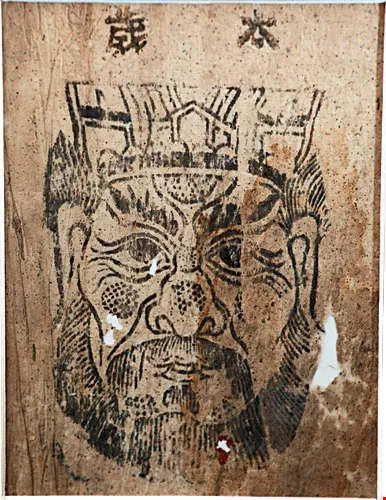
(below) The "Tai Sui money" of different eras depicts Tai Sui in different guises. The Ming-Dynasty portrait at left has Tai Sui dressed as an imperial bodyguard. The Qing-Dynasty image in the center shows him wearing a queue. When the Japanese banned the burning of spirit money, Taiwanese disguised Tai Sui as a Japanese soldier (right).
Following Retrocession, people again began organizing temple events and ceremonies. Demand for spirit paper, most of which was manufactured in Zhong-gang, soared.
In 1966, companies began seeking opportunities abroad, creating shortages in the domestic market. In 1967, nine Zhong-gang companies pooled their resources and established the -Jiuhe Spirit Money Corporation, specifically to export their products to Hong Kong, Thailand, and Malaysia, as well as to Chinese communities in the US and Japan.
The success of the export business led to the establishment of new firms. By 1977, Zhu-nan Township had some 385 registered manufacturers of spirit money. With one quarter of its populace working in the business, the township was the heart of Taiwan's spirit-money industry. "There were spirit-money shops every few feet," says Zhang. "During the industry's high season, which fell around the Ghost Festival, whole families would pitch in, filling the streets with paper flowers."
In the 1960s, the government advocated being more economical with prayers and rituals. As Taiwan's agrarian economy transformed into an industrial one and the population urbanized, labor became hard to come by. The 1984 promulgation of the Labor Standards Act made matters even worse by increasing labor costs.
But the industry recovered. The public fell in love with lotteries and other money games when lottery fever struck in 1988. Then the stock market began booming. The public's demand for "lucky numbers" revived Zhong-gang's flagging spirit money industry. "It was nothing for people hoping for a winning ticket to burn a truckload's worth of spirit money," remembers Zhang.
The tide turned again as lottery fever faded and environmental consciousness took hold. Spirit money came to be seen as a waste of forest resources, a product that created water pollution in its manufacture and air pollution in its use. Environmental groups and the government began advocating against the practice of burning it and urged manufacturers to produce a more environmentally friendly spirit money in larger denominations to reduce the amount used.
Zhang says that spirit money used to be made from bamboo and therefore didn't require the cutting of trees. Moving forward, some 32 of Zhu-nan's manufacturers have obtained CNS15095 and SGS environmental certifications and are moving towards the use of more natural, benzene-free manufacturing processes. These include using ethanol rather than toluene or methanol as a solvent in their gold paints. Zhang has also sought out senior citizens who know how to brew a "Chinese medicine" gold paint from the flowers of the pagoda tree, sodium carbonate, and alum. Manufacturers hope that such efforts will help them forge a more environmentally friendly image and differentiate their products from low-grade imports.
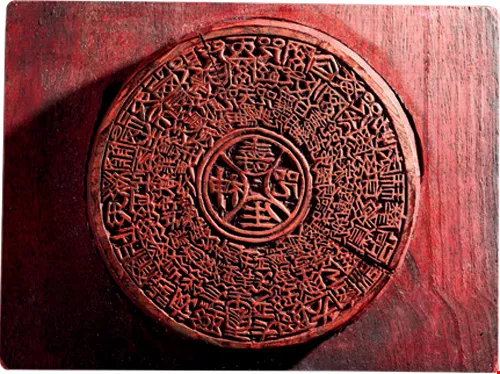
Zhang Yiming has spent more than 30 years and many millions of NT dollars collecting more than 2,000 printing blocks. "Long Life Money" of the sort printed with the block shown in the photo was originally used to establish relationships with the gods and offer them birthday wishes. In more recent times, it has been used to repay the "afterlife debts" incurred at birth.
Over the last 30 years, Zhang's collection has grown to fill more than 70 boxes, and includes many beautifully engraved, out-of-print items. Unfortunately, more than half were damaged by mold or insects and had to be discarded despite his using moisture-proof plastic boxes and a dehumidifier. Looking for a better way to preserve these precious artifacts, he sought instruction in conservation techniques from Wu Jer-ruey, formerly a restoration expert with National Taiwan University Library's Special Collections group.
"Bamboo-paper artifacts have to be stripped of their acids," says Zhang. The process involves wrapping the bamboo paper in cotton paper, inserting it into a heat-resistant plastic bag, and placing it into a bamboo steamer. A pot filled with water and morpholino at a 100:1 ratio is then brought to a boil, and the steamer placed over it for 30 minutes.
"Morpholino is a chemical used to modify genes," says Zhang. "Here, it absorbs moisture and changes the paper's pH. But it is highly alkaline and toxic, so you have to use it where there's good air circulation, wear a mask when opening the steamer, and refrain from reusing the steamer for anything else." Zhang says the process leaves you with pH-neutral paper. You then wrap that paper in cotton paper and store it in a paulownia-wood box, which is highly gas-permeable, but resistant to moisture and mold.
Zhang gave up the baking business for fortune telling in 1989 so he could better promote the making of spirit -money as an art form. He also established the Zhong-gang Spirit Money Exhibition Hall in one half of his former bakery, opening it to the public in 1990. Perhaps drawn by the gallery's unusual nature, many curious passersby drop in for a look around. Those visitors together with reports in the media have been helping spirit money take its first step towards recognition as an art.
In 1995, Zhang followed up by organizing the first Zhu-nan Culture Festival, attracting attention and creating something of a stir with his spirit money arts exhibition. In the wake of the event, invitations to exhibit his collection poured in from Kee-lung's Ghost Festival, Dong-gang's -Wangye Festival, Yi-lan's Center for Traditional Arts, Tai-pei's Lin An Tai Historical Home, and even the Presidential Office Art Gallery. In more recent years, Zhang has also taken up teaching brick carving and paper-lantern printing.
Zhang has retained an unparalleled passion for spirit money through changing times, rising environmental consciousness, and industrial decline. As determined as ever, he is now seeking to create a bamboo paper arts village in Zhu-nan that will ensure this traditional folk art lives on.
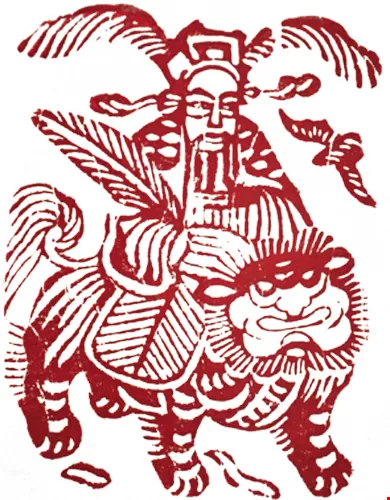
This example of gold spirit money features a sage in an antlered hat riding a qilin while a bat flies beside him. Each of these elements rep-resents either good fortune or long life
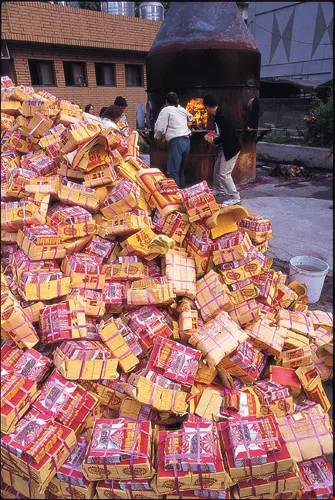
In Eastern Taiwan, "Composite Money" is used to communicate with and beg favors of Lord Handan.
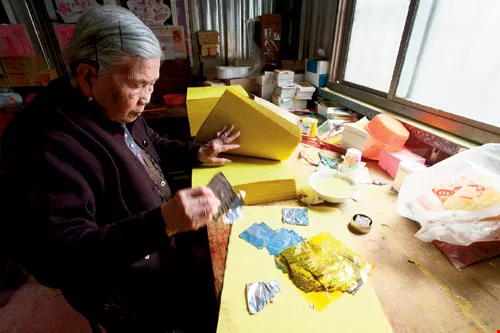
"Silver spirit money" made of paper with silver foil pasted on one side is used in ceremonies honoring the ancestors and spirits of the underworld.
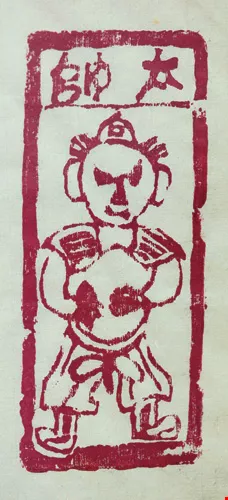
(below) The "Tai Sui money" of different eras depicts Tai Sui in different guises. The Ming-Dynasty portrait at left has Tai Sui dressed as an imperial bodyguard. The Qing-Dynasty image in the center shows him wearing a queue. When the Japanese banned the burning of spirit money, Taiwanese disguised Tai Sui as a Japanese soldier (right).
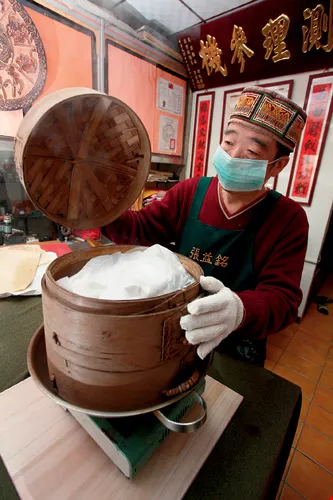
Preserving bamboo paper artifacts requires stripping them of their acid content. The process involves wrapping the bamboo paper in cotton paper, inserting it into a heat-resistant plastic bag, then placing it in a steamer basket. A certain amount of morpholino is added to the water, which is then boiled for 30 minutes.
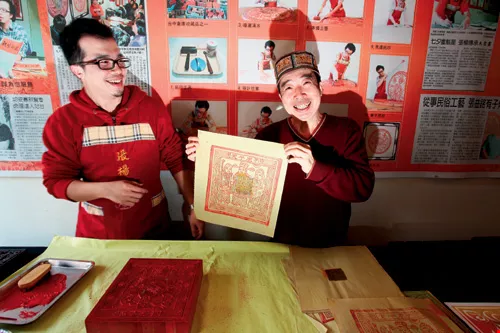
Zhang Yiming (right), an expert on spirit money, exhibits and talks about his collection of spirit money in an effort to lift the veil on this mysterious world. Zhang Yang (left), his only son, returned home to carry on the legacy in 2005. Father and son share the goal of creating a "bamboo paper arts village" in Zhonggang.
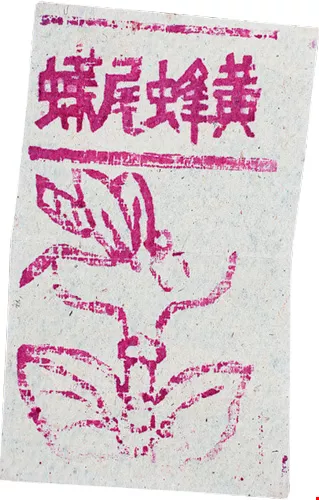
In the days before modern medicine, a common folk remedy for insect stings was burning "Bee and Butterfly Money," then applying the ashes to the wound.

@List.jpg?w=522&h=410&mode=crop&format=webp&quality=80)


