A Readers’ Convenience Store:The Innovative Kaohsiung Public Library
Su Shih-ya / photos Su Shih-ya / tr. by Jonathan Barnard
April 2014


April 23 is World Reading Day, an opportunity to share international experiences and creative approaches to promote reading. It’s a time when the public libraries of nations around the world exchange wisdom gleaned from their efforts to turn around print’s decline amid a rising tide of digitalization.
Taiwan enjoys both the highest density of convenience stories in the world and also the greatest variety of services offered within those stores. But down south the Kaohsiung Public Library (KPL) is giving the island’s convenience stores a run for their money when it comes to convenience!
Reading has experienced a vigorous upsurge of popularity in Kaohsiung. The crowds going to libraries now rival those going to department stores. Even typhoons won’t keep them away. Automatic book dispensers at Kaohsiung Mass Rapid Transit stations offer rush-hour throngs a chance to borrow and return books with their metro cards.
If there’s a particular book you want to read, just go online to reserve it. No matter how distant the local library holding it, the book will be delivered to any requested library branch an average of 2.33 days later!
Born an industrial city, Kaohsiung used to be regarded as a cultural desert, but in recent years the city has transformed itself into an oasis for Taiwanese readers. Thanks to various innovative approaches adopted by the KPL, reading has become a favorite leisure activity here, and the city has also become a bright spot for the print industry in Taiwan amid a general collapse.
At an entrance to the Central Park station of the Kaohsiung Mass Rapid Transit, an automatic book dispenser that resembles a soda vending machine displays a glorious array of books. At the evening rush hour, commuters line up, pull out their KMRT metro cards, and enter a book’s numbers on a keypad. An internal arm then pulls the selection out for the borrower.
“It makes things really convenient,” says a Ms. Li. “There’s no need to make a special trip to the library or bookstore. Every day you can borrow a novel on your regular commute.” She borrows at least one book per week. “So that’s at least 52 books a year!”

The Zuoxin Branch Library in Zuoying has integrated design elements that are representative of its locale, including water chestnut paddies, as well as lotus ponds, leaves and flowers. When the lights go on in the evening, the library looks simply gorgeous from the outside.
Cut to the Zuoxin Branch Library on a weekend. The branch shares its building with the Zuoying Junior High School. The work of green architecture is adorned with images representative of Zuoying, including water chestnut paddies, as well as lotus ponds with their luxuriant leaves and flowers. On an early spring day there, it already feels like summer. Located prominently in the building’s main hall, the children’s reading area is packed with families from the neighborhood. An endless parade of people streams through, and the cool air and books prompt many to linger.
“Our family seems to visit this library as often as our own kitchen,” says a Mr. Lin, who lives nearby. A special emphasis of the Zuoxin Branch collection is books on popular science. It’s been fostering children’s interest in natural science topics. The works on insects are particularly popular.
No cultural activity is cheaper or more cost efficient than reading, and rates of reading are often used internationally as a measure of a city’s cultural development. Take Seattle, Washington, which launched the “If All Seattle Read the Same Book” program in 1998. The “One City One Book” movement spread in whirlwind fashion throughout the United States before being enthusiastically copied around the world. Today Seattle has become known as “the city that reads.”
In Japan in 1995 the education community and publishers united to promote a “morning reading” movement, whereby every morning students spend ten minutes to settle their minds by reading. The program has had the effect of training students’ powers of concentration and fostering greater consideration in their dealings with others. It has been heralded as a “miracle” by the international community and inspired many similar programs in various Asian nations.
In effect for over a decade, the campaign to reinvigorate Kaohsiung’s libraries has engendered many unique local solutions, which are making Kaohsiung a new star among reading cities. At the end of 2013, the number of volumes in the Kaohsiung Public Library’s collections surpassed 4.03 million. For the year, people borrowed books a total of 15.36 million times, achieving growth of 84% over seven years, and 41% in terms of the total number of volumes borrowed. The city library system has 63 locations, which give the whole city a bookish air. Another seven will open this year, including the KPL’s new main library.
“Libraries are one of the most important indicators of a modern city,” says Shi Chunfu, KPL director. “If you want to cultivate a deep-thinking city, then a key to success is instilling reading habits among the populace.” To be sure, the physical infrastructure is important, notes Shi. But the city’s overall cultural atmosphere will only rise if members of the public actively go to the library and know how to make best use of its resources.

Aiming to spread wide the reach of knowledge, the city of Kaohsiung has turned trucks into “traveling libraries” that bring books to remote areas and to institutions serving the disadvantaged.
To bring books closer to the people, the library aims to promote reading among people of all ages, as well as activities such as designated story times, parent–child reading hours, and multicultural exchange. KPL has also joined the international “Bookstart” campaign, which encourages parents to enjoy books with their children at an early age. All of these steps are aimed at getting more people to come to the library. What’s more, KPL has raised convenience and efficiency by implementing a “rapid-response book lending network” and by putting the library catalog online, so that borrowers can order books to borrow without leaving their homes and have those books delivered to their local branches for pick-up within three days.
Shi explains that the library’s ambitions don’t stop here. The KPL hopes to expand its collection’s “travel range” so as to turn hospitals, military bases and prisons into reading paradises as well.
In 2012 the library began to cooperate with local prisons (Kaohsiung Prison, Kaohsiung Second Prison, Kaohsiung Women’s Prison, and the Kaohsiung Drug Abuser Treatment Center) to establish special reading areas. Local library branches are responsible for regularly rotating and replenishing the prison collections.
The Alian Branch was the first library branch in all of Taiwan to lend books to the military. In 2009 the Zuoying Branch set up a book dispenser at the Zuoying Station, a major travel hub that combines access to conventional trains, high-speed rail and the KMRT. Travelers are free to take books from the dispensers and don’t have to return them. Instead they are encouraged to give the books to other people who would like to read them. More and more of these dispensers have been set up, and not just in train stations. You also can find them in many hospitals and clinics, where they bring comfort to the ill.

Libraries aren’t just used for reading any more. They are also places for visually impaired people to take classes on knitting or computers.
These various innovations have made the Kaohsiung Public Library a model for county and city libraries throughout Taiwan. KPL has also opened many specialized branches, which have attracted visits of delegations from other cities and counties eager to learn from Kaohsiung’s example. Tourists from other cities even go so far as specially planning walking tours that include stops at some of these libraries.
In 2007 KPL launched a plan to give each branch library a special character. A branch’s collection is designed to suit the particulars of its locale. The approach allows the library to cluster types of materials together, resolving problems of excess capacity and content overlap. Of course, regardless of which branch is closest, the public retains access to any volume in KPL’s entire collection.
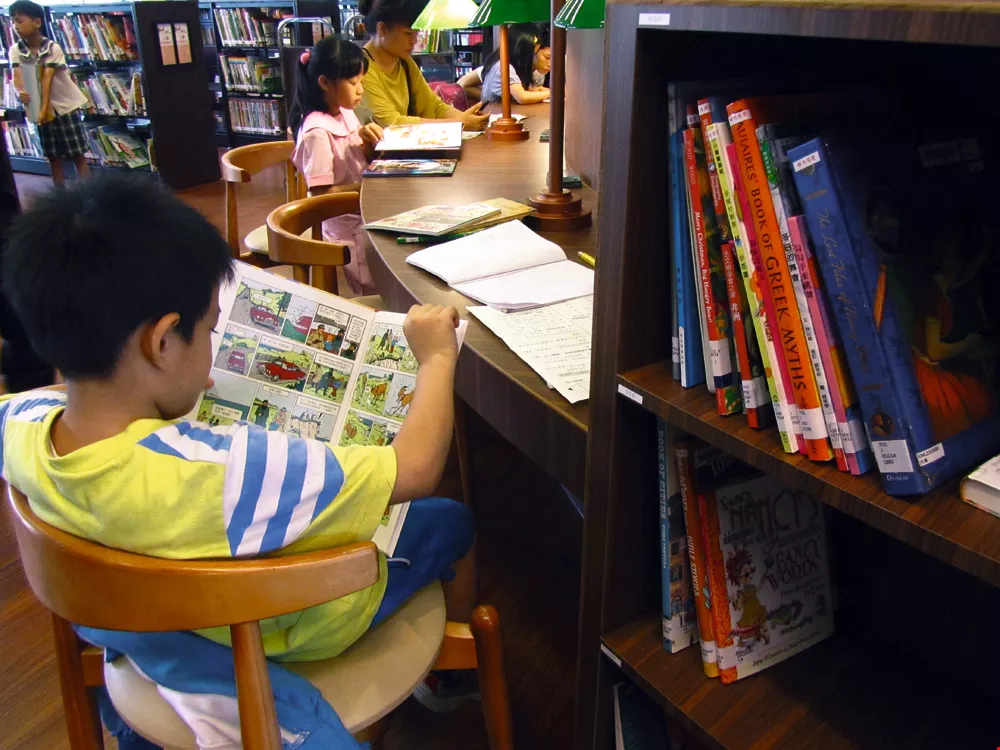
Illustrated books invite young children to enter the realm of reading and to take pleasure in learning.
Back when leisure activities in Taiwan were limited, comics were a much-loved part of childhood. With economic development and the rise of television, the comic-book industry hit hard times. Then in the 1990s Japan’s manga craze spread to Taiwan, and a new generation of Taiwanese cartoonists and graphic novelists emerged. The Yancheng Branch Library has latched ahold of this historical background to focus its collection on comics and graphic novels.
Since the opening of the KMRT and the Pier-2 Art Center, Yancheng has been reviving from many years of hard times. Now, not only do local residents regularly visit the library, but tourists also come on weekends and holidays. In order to serve these visitors, the Yancheng Branch has specially installed a stand offering “light fare” in the library, to make it easy for hungry visitors to purchase some simply prepared food.

Special books are displayed on a library wall. A refined sense of contemporary design has come to Kaohsiung’s libraries.
The Cuiping Branch Library, located in the Nanzi District, where many immigrants live, specializes in books devoted to food, drink and cooking. Aiming to promote cultural exchange, the branch holds books on Taiwanese, Vietnamese, Thai, Indonesian, and Filipino cuisine.
The branch sends out volunteers to read with people in their homes, and it even offers a free computer curriculum, so that “foreign spouses” can learn how to navigate the Internet. The speed at which these immigrants have learned computer skills has exceeded expectations, to the point where they are launching their own blogs full of the flavor of their homelands. These women also learn how to monitor the appropriateness of their children’s surfing. The library’s efforts are helping them develop great pride and confidence in their roles as mothers.
Qijin: Marine biologyThe island of Qijin lies across Kaohsiung Harbor from downtown Kaohsiung, and its residents mostly work at sea. Consequently, the branch library there has put its focus on marine biology.
The Qijin Branch Library has assigned itself the mission of making up for the locale’s lack of bookstores and other limitations engendered by the geography. After a series of renovations, the branch has taken on a special look. In an al fresco reading area along the shore, one can enjoy the therapeutic benefits of soft ocean breezes. More and more local residents have grown to love this space, and people have even started having their wedding photos taken here, letting the books and the sea serve as witnesses to their eternal devotion.
Royalties: From the cloud to the authorsIn recent years, media have reported widely on the city’s passion for reading. It has become a point of much pride among Kaohsiung’s citizens. One of them, the author Mo Shangchen, can’t help but brag: “Our library delivers faster than the website books.com.tw, and it boasts more kinds of services than you’ll find in a convenience store. And best of all, you don’t have to pay to borrow books from a public library!”
But so as not to harm to the publishing industry, in September of 2013 KPL began to work with ebookservice.tw, providing funding to allow Kaohsiung residents to enjoy 60 titles a year on the website, whether books, magazines or audio books. The website then passes on the royalties to publishers and authors.
“With the strategy of employing both the cloud-based virtual holdings of ebookservice.tw and the physical holdings of the libraries,” says Shi Chunfu, “our city’s readers have a bright future ahead of them!” He explains that KPL in the future will no longer be satisfied with merely serving as a “convenience store for readers.” It will go a step further and resemble online retailers, “offering everything imaginable under the sun and viewing no request as too unusual!”

@List.jpg?w=522&h=410&mode=crop&format=webp&quality=80)

@List.jpg?w=522&h=410&mode=crop&format=webp&quality=80)

@List.jpg?w=522&h=410&mode=crop&format=webp&quality=80)
@List.jpg?w=522&h=410&mode=crop&format=webp&quality=80)

