Yonglin Organic Farm: Providing the Net as Well as the Fish
Coral Lee / photos Jimmy Lin / tr. by Geoff Hegarty and Sophia Chen
August 2012


In August 2009, when the Kaohsiung region was hit hard by Typhoon Morakot, many of the Aboriginal people living in mountain areas lost their homes to landslides, forcing a move into new permanent housing on the plains. To help them to put down roots in their new homes, an organic farm next to “Tzu Chi Great Love Village” was created by sponsor Foxconn Technology Group’s Yonglin Foundation, who engaged the same team that earlier built Tainan’s Tenha Organic Farm.
Yonglin Organic Farm (YOF) sits on 64 hectares of land in Shanlin District, Kaohsiung. The past three years has seen the implementation of an experimental program to reconstruct the Aboriginal people’s lives through sustainable agriculture.
With large areas of green grass, an extensive range of herb gardens and several stylish buildings standing elegantly in the sunshine, YOF is Taiwan’s largest producer of organic vegetables.
The farm has an area 3.3 times larger than the National Stadium in Kaohsiung, and features impressive office and restaurant facilities. The buildings housing the nursery garden and the processing and distribution centers look like Aboriginal-style barns, and not far away are the greenhouses and the “open-air” fields, which at 30 hectares take the greatest proportion of the land.
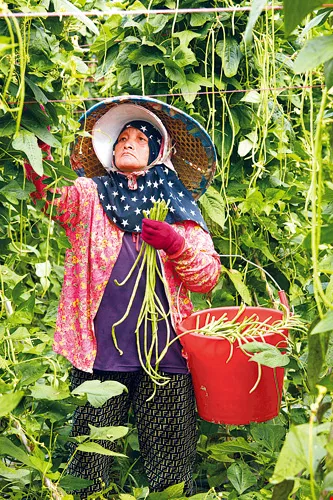
Organic vegetables are harvested, packaged and shipped without delay. These fresh, sweet-tasting beans are quality guaranteed.
Touring the facilities on a hot sunny day, farm director Lee Wei-yu points out an area of harvested land, where a trainee is covering the soil with a straw mulch to inhibit weed growth. Growing vegetables in summer is difficult, so ginger lilies are an alternative crop planted in a large adjacent field. Ginger lilies are heat tolerant, and with about seven buds per plant, their flowers can be used either for cooking (like daylilies), or as cut flowers for sale, generating a healthy profit.
Not too far away are lotus root and water caltrop fields, other alternative crops that can reduce the damage from strong winds and heavy rainfall during the typhoon season. These varieties of plants can easily handle temporary immersion when a typhoon sweeps across the land, suffering only minor damage. After the typhoon season, the fields are drained and other types of vegetables are planted, with the regular rotation of crops maintaining soil fertility.
With more than 40 summers behind him, Lee Wei-yu has rich experience of farming and farm management. He was one of the founders of Tainan’s Tenha Organic Farm (TOF), and winner of a 2009 Shennong Award. Three years ago, Foxconn chairman Terry Gou happened to visit the Tainan facility just before Typhoon Morakot hit. He was deeply impressed by TOF’s use of biotechnology that had transformed what had been a sandy, barren region into fertile farmland. After Morakot, when the then Kaohsiung County Government was working with the Yonglin Foundation to launch an organic farm in Great Love Village, Gou decided to commission the TOF team to manage the new farm—three times the size of TOF. Lee was transferred from Tainan to manage the new facility.
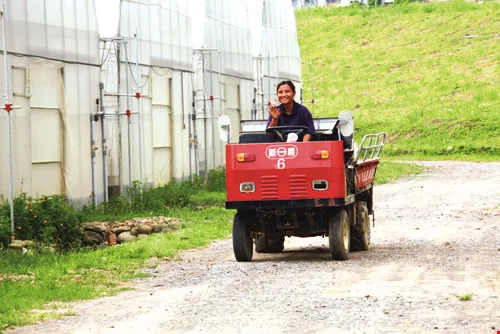
The residents of Great Love Village have gradually adapted to their new life on the farm.
“When I first came here two years ago, the land was so stony that it would have been impossible to grow vegetables.” And there was absolutely nothing here, says Lee, so he had several containers shipped to the farm to serve as temporary offices. The land belonged to the Taiwan Sugar Corporation (TSC), and was originally a flat-topped rocky hill, so cultivators digging the soil came across stones everywhere. However, the farm had its advantages: it was a large area close to Great Love Village where most of their potential workers lived. And with all the difficulties of finding an alternative, they had to bite the bullet and go ahead with cultivation.
“The only effective way of dealing with the stones was to remove them by hand,” explains Lee. A cultivator would only make the situation worse by burying the stones deeper into the soil. So all the stones had to be picked up by hand. Workers loaded stones into buckets, and then unloaded them onto the road to be used as roadbed. The villagers working on the farm were wondering: “Why do we come here every day to pick up stones? Aren’t we here to do farming?”
The villagers had just moved into their new community from their mountain homes, so they were feeling anxious about their then uncertain future. Some compared their work on the farm to the temporary government jobs provided to others displaced by Morakot, both earning the same wages of NT$800 a day. But the temporary government work looked much easier than what they were doing on the farm, so there was some discontent.
After the task of removing stones was completed, they used machines to plow the fields and spread organic fertilizer onto the soil. If they found stones under the soil, they had to remove them, and then, plowing and fertilizing, repeated the process again and again. Eventually, they were able to transform the rocky land into fertile ground. But some areas still have countless stones that are impossible to remove completely, so they are used for growing fruit trees.
Soil and water are the two basic requirements of organic agriculture.
“Composting is the most efficient way to improve the land,” says Lee. To enrich the soil, they first grew sesbania and rapeseed, then knocked the plants down and turned them into the soil. This was followed by an application of cow dung compost. Producing the cow dung compost is done by mixing dung that is free of antibiotics and heavy metals with organic plant matter. Molasses is added, and the mixture is continually turned over while it ferments. It’s the best way of providing nutrients to nourish and enhance the soil.
Water supply was also a tricky issue to solve. The farm was originally a sugarcane field belonging to TSC, with water drawn from the Qishan River. Although the water was clean and uncontaminated, the supply system had been lying abandoned for nearly three decades. So they had to dig out the old waterway map, and repair the pumping stations, underground pipelines, and reservoirs.
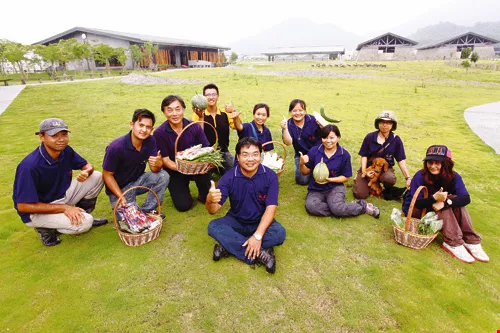
With the efforts of farm director Lee Wei-yu (front, center) and its employees, Yongling has been transformed from a virtual wasteland into Taiwan’s leading organic vegetable farm.
To get the villagers ready to run the farm by themselves, the first year (2010) was spent, apart from soil preparation, in training the workers. A total of 113 people were employed by YOF that year, 80% of whom were from Great Love Village. Team leaders were also recruited from among the villagers.
However, Lee found that there was a significant gap between the expertise that recruits had claimed in their interviews, and the actuality. It was a slow task for him to discover individual talents so work could be better allocated. If someone was good at operating an excavator, they would be assigned to the agricultural machinery team; if they had experience in cultivation, they went to work in the greenhouse or the fields.
Agriculture depends enormously on the weather. The heat and humidity of summer, for example, tends to produce vegetable blight, so heat-tolerant vegetables like water spinach and amaranth are more suitable for warmer weather. Being able to grow different types and varieties of crops can to some extent overcome the limitations imposed by the weather, so to accomplish frequent changes in crop variety, plant propagation is a key technique.
Inside the nursery garden, a spacious, high-ceilinged facility, an operator is working a linear planter that picks up seeds and plants them into small pots. Then they are sent to the greenhouse to germinate. In another area, seedlings are kept inside waiting for the weather to cool down before being planted outdoors.
Although the nursery team is only a small group—three to four people—it’s the core of the farm. The quality of seedlings growing in the fields depends largely on the work done in the nursery. Numbers of seedlings delivered to a particular greenhouse or field are carefully recorded, so that they are able to maintain stable and diverse seedling production, which will in turn affect production levels.
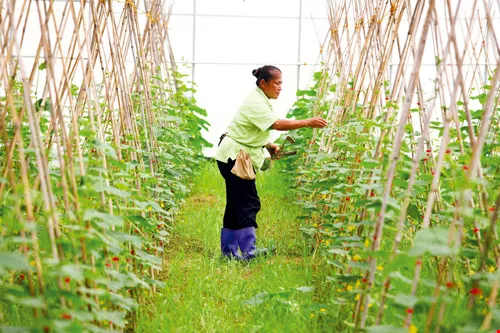
The greenhouses provide seedlings with space to flourish, so that they can grow into plump, healthy vegetables.
Lee says that to attract distributors, a farm must plant and harvest daily so as to maintain stable production. In the past, a farmer could work very hard for little gain due to a lack of management skills. They depended on their experience to know what to plant at particular times. But when they had a bumper crop, the produce had to be sold off at low prices to attract buyers. Sustainable agriculture must be sensitive to the market: farmers need to be able to predict market conditions three weeks or two months into the future. Only comprehensive planning of the growing schedule and crop selection will enable YOF to turn the tables.
In order to gain the trust of distributors and maintain high prices, the farm has been going through the process of organic product certification for the past year. Items to be assessed include water, soil, and fertilizers, and until the farm is granted full certification, its products are termed “organic transition” vegetables.
This means that a farm has adopted organic or natural farming methods for less than two years, so before its cultivation environment meets the strict organic standards, a transition status is granted. Under the Organic Agricultural Product Management Regulations, transition-period crops require at least two to three years of consecutive assessment to become fully certified organic products. TOF is expecting to gain full certification in September this year.
Currently the farm produces 30 to 40 varieties of vegetables monthly and 300-odd yearly, with annual production running at over 300 tons. The products are sold mainly to supply Foxconn’s canteens, and also to supermarkets like RT-MART in Tainan and Matsusei in Taipei. However, in this initial period, monthly production of approximately 30-odd tons isn’t sufficient to cover costs of around NT$4 million a month.
Maximizing yields is currently the biggest challenge, and people play the key role in achieving this. According to Lee, many of the farm employees are simply happy to be doing what they’re currently doing: working at a relatively easy and stable job. So whether the farm will be able to increase productivity and improve quality remains to be seen.
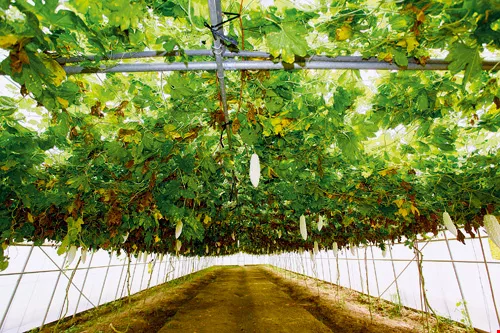
In Taiwan’s hot and humid summer, leafy vegetables are difficult to cultivate, but the warmer seasons are well suited for growing a wide variety of melons and fruits. The picture shows the upcoming harvest of bitter melons.
As the farm progresses toward becoming a center of sustainable agriculture, it must be asked whether YOF’s initial goal to create a new enterprise and new homes for villagers displaced by Morakot has been achieved.
Li Conghe, head of the packaging team and a member of the Bunun tribe, lived on the outskirts of Nangisalu Village where there were some terrible landslides, so his family was fortunate to escape the catastrophe. But the area’s infrastructure was entirely destroyed, leaving them unable to continue farming. For the sake of their children’s education, they decided to follow the majority of the tribe and move off the mountain.
Li is in his 40s, and as head of the team, he has to supervise eight others. Their work includes selecting, cutting, grading, and packaging produce, and dealing with issues as they arise. For instance, there may not be enough vegetables, or they may be mixed with weeds, or bruised or damaged.
Gao Huimei manages the farm’s canteen. She and her husband were away working in Taoyuan Township when their home village of Xiaolin was buried by a landslide, so they escaped the disaster. But unfortunately her daughter and six relatives of her husband’s became victims of the catastrophe. “In the face of tragedy, I have to be strong,” says Gao. For the first two years Gao felt heartbroken whenever she saw someone’s daughter, but the pain has gradually diminished. With her husband, who operates an excavator on the farm, and their youngest son, they can now live a normal life.
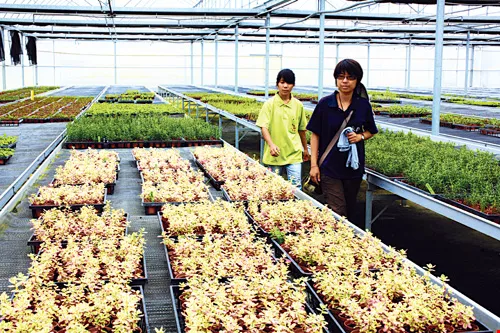
With a streamlined management process that takes in plant propagation, harvesting and packaging, the farm is able to provide a stable supply of produce to the market. The picture shows the plant nursery.
Through the reconstruction of the past three years, the villagers’ lives are now back on track. However, the goal of reconstruction is not only to resettle the villagers, but also to establish further local employment opportunities and a self-sufficient community.
Yonglin Foundation’s plan is to invest several hundred million NT dollars in the project for its first six years. In accordance with a “build, operate, transfer” model, the farm will assist the villagers to learn organic agricultural techniques in the first three years, then agricultural management in the next three, and will finally transfer responsibility to the Kaohsiung City Government. The program has reached a turning point that will dramatically affect the future development of the farm: Lee Wei-yu admits that a lack of management training is the major concern. Most employees just want a stable income, but tend to lack ambition, so very few are capable of taking on the heavy responsibility of managing the farm.
In any case, through the cooperation of the public and private sectors, the villagers have been given both the fish, and the net. With their training and new skills, will they be able to catch fish into the future? Aside from their continuing efforts to master the skills of organic farming, it will depend equally on the employees’ dedication to the future of the farm—and to themselves!
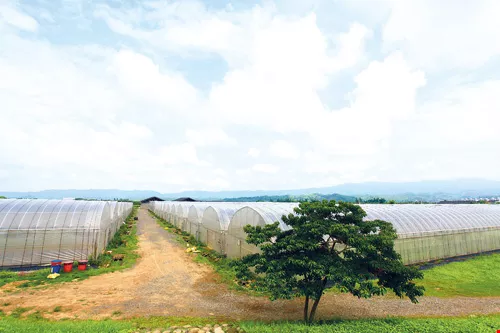
With the efforts of farm director Lee Wei-yu (front, center) and its employees, Yongling has been transformed from a virtual wasteland into Taiwan’s leading organic vegetable farm.
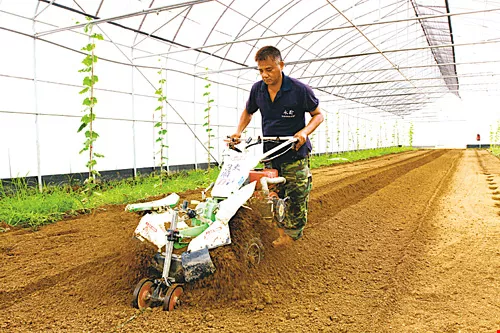
This formerly stony ground has been transformed into fertile farmland through continuous working of the soil and the use of organic fertilizer.
@List.jpg?w=522&h=410&mode=crop&format=webp&quality=80)

@List.jpg?w=522&h=410&mode=crop&format=webp&quality=80)
@List.jpg?w=522&h=410&mode=crop&format=webp&quality=80)


