Everlight Chemical-Blazing a High-Tech Trail
Coral Lee / photos courtesy of Everlight Chemical / tr. by Jonathan Barnard
December 2010


In 1972 Everlight Chemical was founded with a focus on textiles dyeing. Starting as a small, unremarkable company, it has accumulated experience and technological mastery, turning itself into a global leader in dye production and a company with a growing presence in the high-tech realm of specialty chemicals. The ultraviolet absorbers it has developed from its own R&D work are the equal of those produced by European and American manufacturers. In recent years it has also successfully developed chemicals for the electronics industry, becoming Taiwan's only manufacturer of IC photoresists. Furthermore, Everlight has continued to diversify its range of chemical products, moving into biotechnology and nanomaterials.
D.C. Chen, the founder of the Everlight Group, was born into a mining family. After working his way through college, he built the firm up from nothing. A mover and shaker behind several waves of remarkable industrial upgrading in Taiwan, his tale epitomizes the success of many firms that now serve as the pillars of the island's economy.
Do you recall that large wave of plant closures that battered Taiwan in the early 1990s? Textile dye plants, regarded as major polluters, were among the first dominos to fall. Their numbers have dropped steeply, from over 1000 in 1990 to a mere 300-odd survivors today. Reflecting on that drop prompts a question: Why has Everlight, which grew with a focus on textile dyes, been able to stand taller and grow stronger?
There are in fact many applications for dyes. In addition to the textile industry, the leather, metals, paper, food, cosmetis, optical-disc and even solar-panel industries all use dyes as raw materials. New manufacturing techniques that use dyes are being created all the time. Having laid a strong foundation in Taiwan, Everlight has used innovations gained from its R&D to lead the island's manufacturing sector into exciting new realms.
Take, for instance, Everlight's core product: textile dyes. Because dyeing cotton fabrics requires high temperatures (80°C), it leads to tremendous inputs of energy, a staggering carbon footprint and vast quantities of wastewater. Over the last decade, Everlight has been developing dyes that offer superior performance at lower process temperatures of 40-60°C, while reducing the quantity of effluent generated.
"The human eye is very sensitive to color, and a textile's color is often the key to its commercial success or failure," says Chen Wei-wang, Everlight's general manager and the second son of founder D.C. Chen. Rich, highly saturated colors are very popular but also the hardest to dye and very damaging to the environment. Likewise, light colors such as khaki, which people find pleasing and which may evoke eco-friendly feelings, actually cause huge headaches for dyers and create a great deal of pollution. To deal with the many pitfalls involved in dyeing these kinds of colors, Everlight has developed its Everzol ED and LX/LF product ranges, which are suitable for light and dark shades respectively.
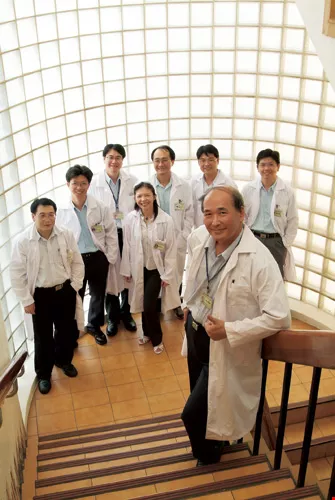
"Success in R&D is our greatest honor!" So proclaims Everlight's corporate motto. That sense of mission is also the secret to Everlight's success as a medium-sized business tackling daunting high-tech challenges.
One might think that the amount of dye used would be roughly proportional to the amount of dye absorbed by a textile-the more dye added, the more saturated the color. But after a certain point, explains Chen Wei-wang, the uptake rates of traditional dyes plummet, and dyeing plants have to use extraordinarily large amounts of dye (as much as two or three times what is normal) to achieve the desired level of saturation. In addition to requiring massive quantities of dye, achieving those levels of saturation also leads to higher costs due to greater water consumption and waste-water treatment. Apart from increasing saturation and uptake, the innovative chemical structure of Everzol ED -simultaneously reduces the amount of scouring required after dyeing (to remove non-adhered dye). What's more, using Everzol increases tolerance for the variations in machinery, personnel, temperature and process time that can lead to color differences between different batches of dyed fabric.
While deep dyeing is difficult, the process for dyeing light colors is even harder to control. Everzol LX/LF's innovative chemical structure greatly reduces the frequency of having to wash out light colors and start over. Although the Everzol dyes are substantially more expensive than traditional dyes, they result in savings over the whole process, as well as lower carbon footprints. What's more, they are well suited to dyeing high-difficulty colors. Consequently, they've consistently been leaders on the international market.
"In recent years print dyeing techniques have generated the most industry excitement," Chen says. Fabric dyeing is moving in the direction of digital inkjet printing, he explains, with computer programs strictly calculating color matches. An entire pattern can be applied via a digital printer, eliminating both the need for multiple screens and their succession of high-temperature dyeings along with the problem of inaccurate color positioning. One can produce exquisitely colored and complexly patterned fabric in large quantities quickly.
But the process also poses many challenges. The digital printer head must be extremely precise, and dyes have to be reformulated to prevent impurities (such as unreacted raw materials or isomeric reaction products) from damaging or clogging the head. The process also demands a new control over the pH of the dyes. Everlight continually experimented for more than 10 years to develop highly stable dyes for digital printing of cotton fabrics. Currently, it is supplying samples to designers to try out. Once machine speeds can be improved and costs brought down, print dyeing of textiles will gradually start to replace conventional dyeing.
Everlight's current success is the culmination of a long journey of many steps. Luck has nothing to do with it.
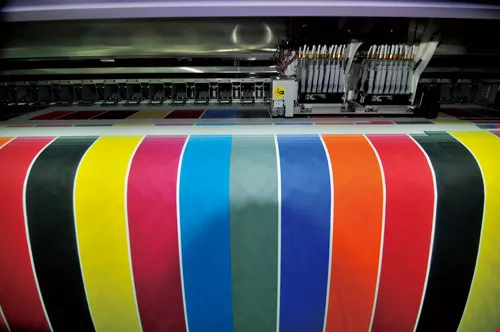
Everlight is currently testing the stability of dyes when they are used by this digital printer.
Back in the 1970s, D.C. Chen, who had worked as a janitor to pay his way through Tamkang University, was at Chunghwa Chemical Industrial Works, which produced sulfuric acid. Chen moved through the departments of general affairs, sales and manufacturing to become a high-ranking executive there. Also a manager at the recently founded Baoyuan Chemicals, he was making a good income.
In 1972, his brother Chen Dingji, who worked in export-import, got to know the president of Japan's Eko Corporation, which was involved in the manufacture of dyes. Dingji came to think that dye manufacture represented a good business opportunity and invited his older brother D.C. Chen to invest with him. Textiles were Taiwan's biggest industry and dyes were mostly imported, so D.C. thought that prospects were good and consented. The two brothers and other investors established Everlight Chemical Industrial Corporation, which agreed to a technology transfer arrangement with Eko.
The company had tough luck for the first few years, as Taiwan was rocked by the oil crisis of 1972 and the severing of diplomatic relations with the United States in 1979. Suffering from a lack of confidence, domestic shareholders pulled out one after another. Eventually even the Eko president, who had promised to provide technical support, withdrew. Fortunately, D.C. Chen had always treated people well, and he was a skilled manager who had earned the trust of the Chung-hwa president and of Chung-hwa's clients. Consequently, with his higher-ups at Chung-hwa and other old acquaintances continuing to invest, he was able to smoothly take over the chairman's duties at Everlight.
Yet in the 1970s, Taiwan's dye industry-whether in terms of investment, skills, marketing, raw materials or pollution control-was a national embarrassment. Everlight's capital investment amounted to only NT$7.5 million, with a staff of 50. What's more, dyeing was a technology-intensive industry. Up against Huakuo Chemicals, then Taiwan's largest chemicals firm, and international powerhouses such as Germany's Bayer and BASF, a fledgling firm like Everlight was certain to have a tough time competing.
Knowing that the situation was perilous, D.C. Chen pulled back to plan tactics. He came up with a "spare tire" strategy-urging clients to treat Everlight like a spare tire, buying dyes from them when their regular suppliers were out of imported dyes. And in order to get a footing in the industry, he begged his fellow suppliers not to cut prices too fiercely. Once, facing severe cash-flow problems that threatened to bankrupt the company, as well as plant explosions caused by chemical reactions, he grew psychologically and physically exhausted and showed symptoms of a mild stroke despite still being in the prime of his life in his forties.

Digital printing of textiles is replacing the traditional dyeing process. The printing dyes that Everlight has developed, which are used with highly adaptable and sensitive printer heads, boast high stability and high quality.
With his company facing internal and external difficulties, D.C. Chen realized that technological upgrading was the key to the company's survival. He hired Guo Kuntu, a professor of chemical engineering at National Central University who had studied in Japan, as a consultant. He also actively sought foreign technical support. Once, when visiting Japan, he unexpectedly obtained the strong support of Ta-da-shi Wa-ka-ma-tsu, president of the Chugai Kasei company, who had previously retired from working at a major chemical manufacturer in Japan. Wa-ka-ma-tsu expressed a willingness to help Chen overcome technical bottlenecks. The following year Wa-ka-ma-tsu visited Ever-light in Taiwan and declared that he had taken it upon himself "to make Everlight No. 1 in Taiwan." Over the course of 15 years he sent four technical consultants to Taiwan to provide their assistance free of charge.
Many people couldn't understand why Wa-ka-ma-tsu was making Everlight's success his personal responsibility. Even the heavyweight Japanese experts who were sent to Taiwan couldn't provide an answer to that. An observant Christian, D.C. Chen believed, "God must have moved him to help me!"
In fact, there was nothing miraculous about it. Later D.C. Chen would learn that Wa-ka-ma-tsu's generosity could be traced to the experiences of an Osakan dye manufacturer who had once come to Taiwan to negotiate with Chen and had hoped to be taken to a girlie bar. Chen explained that he wouldn't act in ways that "would displease God" and refused the request even though it could mean losing the man's business. Later, the Osakan laughingly retold the story at a Japanese industry event, and Wa-ka-ma-tsu overheard it. Like Chen, he had long frowned upon the practice of going to girlie bars when doing business in Taiwan, and had consequently grown less willing to go to Taiwan. Admiring the young D.C. Chen for taking his stand, Wakamatsu didn't hesitate in providing assistance when Chen visited him in 1978.

Everlight had its start with textile dyes and has led development of the international colorant industry with its innovative technology. In recent years it has shifted to specialty chemicals, chemicals for the electronics industry and pharmaceutical raw materials. It has reaped success with this multifaceted approach.
With Chugai Kasei's technical support, Everlight made continual strides in its manufacturing techniques, launching the first "reactive dyes" produced in Taiwan in 1983. (Unlike lower-tech "direct dyes," reactive dyes react chemically with textile fibers, creating new chemical bonds that make for better color fastness.) The first high-priced dyes made in Taiwan, they enabled Everlight to dominate the domestic market. The company built one factory after another. In 1988 it was valued at NT$500 million and listed on the Taiex.
After the company was listed, and revenues and profits grew, D.C. Chen asked himself: "Do my life goals end here? What's the next step for Everlight?"
The 1990s were an era when the information technology industry took off in Taiwan. The government was forcefully urging industrial innovation and transformation of traditional industries, with the aim of turning Taiwan into a technology island. Chen considered the situation and consulted with the company's shareholders. Together they set "high-technology chemical products" as the company's first-stage goal.
Chen realized that moving upwards from conventional dyes to specialty chemicals (such as ultraviolet absorbers) would involve stepping into completely new realms, including electronics and pharmaceuticals. It would not be easy. But because the science behind dyes relates to the optical properties of materials, and ultraviolet absorbers, electronic photoresists and nanomaterials are also related to optics, the core skills are similar. Everlight would have to be prepared to burn lots of money, but prospects were good, so it was a gamble worth taking. But once Everlight actually started down that path, it turned out that the going was much tougher than expected. The company spent 20 years working on ultraviolet agents before finally turning a profit with them in 2009.
Ultraviolet absorbers (UVAs) and light stabilizers are added to various polymer materials (such as coatings and plastics) to protect against damage from the ultraviolet rays in natural and artificial light and thereby extend product life. They have a wide range of applications in products affecting every aspect of modern life-from sun-blocking cosmetics and contact lenses, to textiles, curtains, furnishings, building materials, and paints for automobiles, planes and ships, all the way to photovoltaic panels and engineered plastics. UVAs used to be the exclusive preserve of major European, American and Japanese manufacturers, but the ROC government was continually pushing to raise Taiwan's industrial self-reliance, and Everlight set off down the path of developing high-tech products. In 1989, it launched its own R&D efforts and began to build a factory. But after commencing production in 1996, it ran into one obstacle after another.
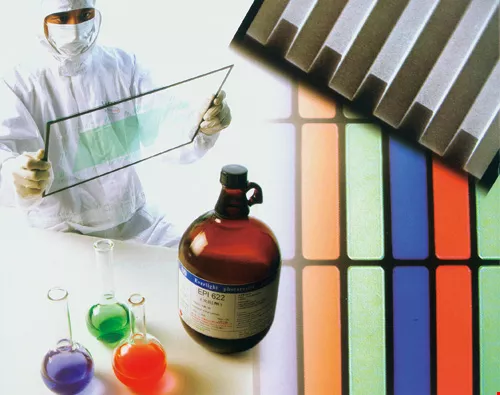
Everlight's electronic chemical products include contrast agents, electroplating agents and grinding agents, as well as photoresists.
First of all, patent rights were under the firm grip of manufacturers in advanced nations. Everlight's technical skills were insufficient, and it was only able to manufacture low-level products. Secondly, Ciba-Geigy of Switzerland, the first company to develop UVAs, had high-quality products and dominated the global market. It did its best to squeeze out new players. And with the rise of manufacturing in mainland China, "The price fell from US$25 per kilo to US$10, and with price wars all the way to US$6!"
D.C. Chen recalls that absorbing these blows, Everlight's UVA department lost money year after year despite the all-out efforts of factory managers. After the company had invested a total of NT$1.5 billion, consultants worried that continued mounting losses would impact the company's financial stability and drag down its share price. They recommended that Everlight spin off the UVA division, letting it stand on its own two feet as an independent company. But D.C. Chen never wavered in his refusal to push this beloved child of his out the door. To the contrary, he only lavished it with more support.
Sure enough, this "late-blooming" child ended up surpassing Chen's expectations, making huge strides in recent years in both its production processes and its management record. "It used to be that the UVA division's annual sales never exceeded NT$700-800 million, and breakthroughs were needed- to improve production capacity," says Everlight's deputy general manager Tsai Ray-an. "But over the past few years, it has been averaging more than NT$1 billion." Furthermore, Ciba-Geigy's specialty chemicals division was spun off following a merger and eventually purchased by the German company BASF. These upheavals couldn't help but weaken customer service, presenting Everlight with business opportunities. In 2009, its international orders rapidly grew, and the UVA division finally moved into the black, becoming one of Everlight's most profitable divisions.
Currently, Everlight has 7% of the global UVA market, lagging far behind BASF, which has about 60%. But Chen Wei-wang points out that explosive growth is expected for the solar energy market in Asia, and UVAs are a key additive in polymer materials for photovoltaic panels, which generate electricity from sunlight. With Taiwan's favorable location and other advantages, UVA has unlimited potential here.

Adding UVAs extends the life of a wide variety of products, from bicycling helmets and clothing to sunglasses.
"Everlight has about 1500 workers, with sales of only several billion NT dollars a year," notes D.C. Chen. "That we can handle the challenges of high-tech products is in fact a testament to our corporate culture." Everlight's operating goal isn't to make money. What's more important than that is allowing every employee to develop his or her own potential, so that their lives continually improve. Consequently, the company emphasizes R&D and staff training, with the goal of engendering a sense of mission about making products that "contribute to humanity."
"If being colleagues means simply giving or following orders, then employees won't be able to innovate and attain breakthroughs!" exclaims D.C. Chen. Everlight's corporate motto is "Success in R&D is our greatest honor!" From top to bottom, it drives them to throw themselves into achieving their all without regard to cost and sacrifice.
The special character of the Everlight team was a key reason that the Industrial Technology Research Institute transferred the technology for a photoresist agent to Everlight in 1995. It had taken the ITRI eight years to develop.
Taiwan's integrated circuit industry leads the world, but photoresists, which determine the width of circuit elements in ICs and also the relative quality of IC chips, all had to be imported. "The government hoped to make up for this lack. For many years, large amounts of financial resources had been poured into research and development, and back in 1995 suitable manufacturers were being sought to proceed with commercialization and mass production." Chen Wei-wang recalls that in 1995 Everlight earned an award for manufacturing development from the Ministry of Economic Affairs, and as a result he met Liu Jong-min, then the chair of the ministry's photoresist planning effort and currently an executive vice president at the ITRI. When inquiring about Everlight's willingness to develop photoresists, Liu specially emphasized the difficulty of the manufacturing process and the need for determination and willpower when confronting the tight grip that major international firms had on photoresist production.
Because the IC production cycle is long and complex, involving many dozen- individual processes, producing one IC can require three weeks to a month. Imperfections in any link in the chain can cause tremendous losses. Moreover, since the money spent on photoresists is only a small part of what is required to produce ICs, most IC factories aren't willing to assume the risks of changing their source of this kind of chemical product. As a result, there is very little scope for new manufacturers to enter the market. Take IBM. Although it created a division to manufacture photoresists, IBM's own IC factories didn't dare use them. Even the chemicals giant BASF failed in its attempt to enter the photoresist field. These examples demonstrate the difficulty involved in entering the photoresist market.
Yet with a "dumb" persistence and sense of mission, Everlight took on the development of photoresists, and with the help of senior members of international industry, it marched toward breakthroughs, first creating photo-resists for ICs in consumer products, and then, over the past few years, developing a 0.17-micron photoresist for a local DRAM manufacturer. Frustratingly, after Everlight had successfully developed that photoresist, the manufacturer announced that it had already advanced to the 0.14 micron process and would be unable to make any purchases from Everlight. Instead, it requested that Everlight work with it once again-this time to create a 0.12 micron photoresist. Unwilling to put out such great effort for naught again, Everlight painfully ended the cooperation.
But expertise should not go to waste. In recent years Taiwan's LED industry has grown by leaps and bounds. In the past the big European and American manufacturers looked down their noses at the small size of the market for LED photoresist. Everlight, on the other hand, took a strategy of "encircling the cities from the countryside," and provided consistently good service to LED manufacturers. In 2009, the market heated up, and Everlight made hay. It now controls more than 70% of the LED photoresist market in Taiwan. What's more, in the realm of photoresists for LCD touch screens, which is a very hot field right now, Everlight's technologies are highly competitive.
Looking back on nearly 40 years of history, what comes to mind is the title of D.C. Chen's biography: Aiming High. Making steady strides in the fiercely competitive high-tech realm, Everlight has continually moved onwards and upwards. Its story bears witness to the notion that one can find ultimate success by moving diligently in the directions of one's dreams.
Just the Facts: Everlight Chemical
| Date of founding: | 1972年 |
| Capitalization: | NT$7.39 billion (2009) |
| Revenues: | NT$5.07 billion (2009) |
| Five major lines of business: | Colorants: reactive dyes, direct dyes, acid dyes, disperse dyes, leather dyes, anodizing dyes, dyes for inkjet inks, optical disk dyes, and other functional coloring agents Specialty chemicals: UV absorbers, light stabilizers, and formulated products Electronic chemicals: including photoresists (for ICs, LCDs, PCBs and LEDs), contrast agents, and polishing-grinding liquids Pharmaceuticals: prostaglandin derivatives, cardiovascular APIs (active pharmaceutical ingredients), intermediatesNanomaterials: sol-gels and UV-curable hybrids |
| Global staff: | 約1,520 |
| Recent honors: | 2006: Industrial Innovation Achievement Award from the Ministry of Economic Affairs (MOEA) 2007-2009: CommonWealth Magazine's corporate citizenship award, three years in a row 2009: National Invention and Creation Award from the MOEA 2009: Designated as a model of industrial safety by the MOEA |
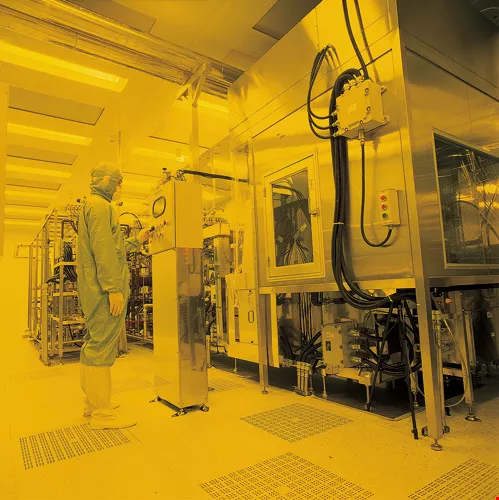
Everlight's photoresist production line. In 1995 the Industrial Technology Research Institute transferred IC photoresist technology to Everlight, which is the only domestic supplier of photoresists for IC wafers.
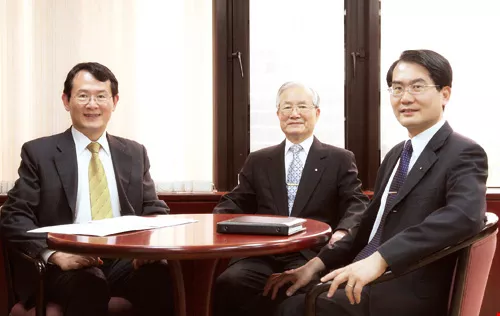
Father and sons: Everlight founder D.C. Chen (middle), chairman C.H. Chen (right), and general manager Chen Wei-wang (left) are committed to making products that "add to human welfare."

@List.jpg?w=522&h=410&mode=crop&format=webp&quality=80)


