Spreading the Love-United Way 2.0
Kim Chen / photos courtesy of UWT / tr. by Scott Williams
September 2011


Taiwan has been called "the compassionate island." When the huge tsunami of 2004 struck Southeast Asia, Taiwan was the world's eighth most generous donor. In the aftermath of the 2008 Sichuan and the 2011 Tohoku earthquakes, it was the world's most generous. Taiwanese also tend to follow an unostentatious model of giving. Chen Shu-chu, a Taitung vegetable vendor, lives on less than NT$100 per day but has donated more than NT$10 million to charity over the years and in 2010 was named one of the world's 100 most influential people by Time magazine.
Taiwan's vigorous social engagement has made it a testing ground for new ideas for international charitable organizations. Over the last few years, representatives from 41 United Way organizations around the world have come to Taiwan to study ideas developed by the United Way of Taiwan.
Taiwan's charities took an historic step at the start of this summer. The United Way of Taiwan (UWT) and Yang Li-chou, a Golden Horse-winning documentary filmmaker, jointly released Young at Heart: Grandma Cheerleaders, a film that earned NT$5.5 million in just one month at the box office. The film was a form of "story-telling marketing" trhough which charities were able to cast social issues related to aging in a new light.
In early June, we step inside the Public Television Service studio in Neihu where five miniskirt-clad cheerleaders are shaking it like "kids." Pom-poms flying, smiles sparkling, the team moves in perfect synch.
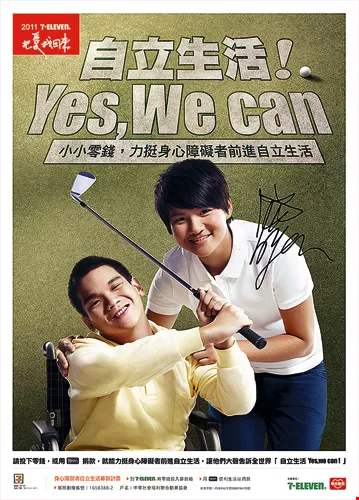
UWT invited pro athletes Tseng Ya-ni and Rendy Lu to serve as spokespeople to encourage the public to donate their time and money to charity.
The film's promotional materials highlight its lack of big-name stars; instead, its protagonists are a group of seniors from Kaohsiung who rehearsed hard for the chance to perform as cheerleaders at the World Games 2009 in Kaohsiung.
The group is comprised of 40-some seniors who average more than 70 years of age-and have lived a collective 3,000 years. They describe themselves as being as happy and noisy as little kids, and say they are resisting aging by returning to childhood.
Young at Heart was released around Mother's Day in early May. But getting it onto the big screen had required behind the scenes help from UWT.
"The moment I heard Yang Li-chou was planning on making a movie, I said, 'We have to work together,'" recalls UWT secretary-general Chou Wen-chen. "Promoting successful aging has become the focus of our services and educational activities." Chou says that UWT and Yang clicked immediately, and decided to make Young at Heart in such a way that it would spread the concept of successful aging, encouraging seniors to move beyond simply caring for grandchildren, watching TV and napping to getting out of the house and seeking their own "stage."
When UWT began inviting major corporations such as Canbran International, the GreTai Securities Market, and MetLife to test screenings a year ago, the response was very positive. UWT realized that a moving documentary was a far more effective tool than any number of written appeals, educational events, or marches.
In May 2011, Kaohsiung's Hanshin Group sponsored a special screening of Young at Heart in Kaohsiung, custom building an 800-inch screen and squeezing 10,000 people into the Hanshin Arena for the event. Once the film finished its theatrical run, it began making the rounds of schools and communities around Taiwan, where audiences frequently came away from it saying: "I'm going to do more to encourage the seniors in my life to exercise and make friends, and start creating a different kind of old age for myself."
Generally speaking, Taiwanese documentaries have had a hard time getting theatrical runs. But the 1990s lull in feature film ticket sales provided documentaries with an opening that permitted films such as Life to earn tens of millions at the box office. Now, UWT is using documentaries as a means to advocate for issues.
UWT and Yang donated 80% of Young at Heart's box-office earnings to UWT's Successful Aging 360 program, 10% to childcare, and the final 10% to helping interested young people film their own documentaries. By coat-tailing one issue on to another, UWT is getting more of its message out to the public.
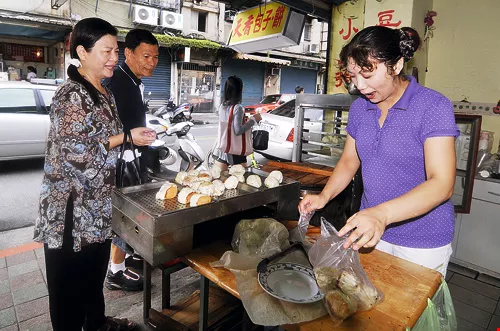
UWT is using micro-loans to help single parents learn skills and start businesses. Xiao Yu (left) received housekeeping training. Ms. Xu (right, photo by Hsueh Chi-kuang) founded Tianxiang Buns.
UWT is a member of the global United Way organization.
The United Way originated in Liverpool, UK, in 1873 when 20-some charities banded together to raise funds and their collective profile. Working with a dedicated fundraising group that efficiently gathers social resources and distributes them appropriately enables charities to focus on the delivery of services. It also allows the public to avoid the aggravation of repeated fundraising pitches.
UWT was established in 1988. In its early days, it featured high-profile women such as TV host Chang Hsiao-yen and fashion designer Rosalie Huang in its TV ads, promoted the notion of "donating a day," and put itself on a solid footing by tapping into the generosity of white collar women.
Having spent more than 20 years tending the soil, UWT now harvests an average of about NT$400 million per year in donations, making it Taiwan's fourth-largest charitable organization.
In 2005, the international United Way recognized that it needed to more actively use its influence, take the lead on social issues, and direct charitable urges to those most in need.
UWT studied the issue for two years, explains Chou, and in 2007, the year that Taiwan's disabled population hit one million, they introduced a three-year program aimed at teaching organizations how to conceptualize, plan, and assess the results of their work. As a result, charities can show donors what real impact their money is having. Chou says that donors will discover that they are not merely engaging in an act of altruism, they are actually investing in the future.
When UWT began its research underlying the "Successful Aging 360" program, it was especially struck by the fact that aging has been so closely connected to a rapid increase in Taiwan's disabled population. As people age, their health deteriorates and they eventually reach the point that they need special medical care. For example, advanced diabetes can result in peripheral neuropathy and necessitate dialysis. By helping people maintain good health into old age, we can slow the growth of our disabled population and alleviate other age-related issues.
UWT expects its Successful Aging 360 program to run for three to five years. Program elements include providing companionship for seniors, delivering meals to those who live alone, and encouraging health maintenance and disease prevention. The program's NT$47-million 2011 budget will provide services to some 61,000 seniors, benefiting more than 40,000 families.

Taiwan is a world leader in charitable giving. UWT distributes donations to more than 400 social welfare organizations, allowing those groups to focus on serving people in need. The photo shows UWT staffers.
In 2008, UWT created the world's first logistics center for the distribution of corporate donations, applying the concept of the fundraising platform to the donation of goods.
Sweating workers at an HTC Logistics warehouse arrange boxes of goods, preparing to send them to the First Social Welfare Foundation's (FSWF) group home on Taipei's Wuxing Street.
Charity comes in many forms, the more traditional being donations of cash and labor. The logistics center, on the other hand, appeals to corporations for donations of perishables approaching their expiry dates, goods that are still fresh, but no longer readily saleable. This allows companies to help the needy at no additional cost to themselves, while also providing charities with a steady supply of perishable goods.
The 2008 global financial tsunami created fundraising difficulties, but also made the logistics center that much more effective. Though cash donations were scarce that year, contributions of perishable goods helped take up the slack: major manufacturers of everyday items, companies such as Johnson & Johnson, Quaker, and Unilever, all pitched in, getting the center rolling.
"Residents of the group homes get corn to eat and scented lotions to use," says Luo Youjun, a section leader with FSWF. "Social welfare organizations used to see these kinds of things as luxuries."
"The matching process takes both UWT's inventory and donors' capacities into consideration," says Chou. "Careful calculation enables us to deliver goods into the hands of institutions that provide for a stable number of clients." Chou says that over the last year and a bit, the logistics center has provided donated goods worth NT$16 million to some 33 organizations that help children and the handicapped.
When UWT presented the logistics center concept to United Way's Asia-Pacific Regional Conference in 2010, the Japanese immediately jumped on board and began working with Johnson & Johnson in Japan. India and Korea also showed interest, and hope to develop versions of the model appropriate to their own circumstances.

UWT invited pro athletes Tseng Ya-ni and Rendy Lu to serve as spokespeople to encourage the public to donate their time and money to charity.
Following the establishment of the logistics center, UWT integrated fundraising, entrepreneurship and housekeeping services in its "Charity 2.0" program, which aims to help low-income individuals become more independent and improve their lives.
The Charity 2.0 model actually has two parts, the "entrepreneurial" and the "housekeeping," intended to embody the slogan, "give her wings and watch her fly." Charity 2.0 seeks to further the Grameen Bank model of the Bangladeshi Nobel Laureate Muhammad Yunus by not just putting resources into the hands of the needy, but also providing them with guidance.
In Taipei's Wenshan District, the owner of the Tianxiang Bun Shop never stops working her rolling pin as she offers up Henan-accented welcomes to the endless stream of patrons pouring in to buy her popular tofu and meat buns.
Ms. Xu, the shop's owner, is from mainland China, but came to Taiwan when she married a Taiwanese man. Originally an art teacher, Xu had bright visions of the future when she arrived here 13 years ago, but when her marriage turned bad, she had to find a way to support herself and her two children. With no assistance from her natal family and no savings, she eventually turned to UWT, which showed her how to provide for herself. Under the guidance of a social worker, Xu developed a Charity 2.0 business plan, got training from the Soho Creative Management Consultancy, which has a lot of experience with small businesses, and opened a shop selling buns in the style of her Henan hometown.
UWT estimates that the Charity 2.0 model has a 50% success rate. But barriers to entry and the pressures associated with running a small business mean entrepreneurship isn't always the right choice for disadvantaged women. UWT therefore looked into using labor and services to create economic benefits, and in 2009 created an in-home services team.
Xiao Yu (not her real name) is a petite mainland bride from a Guangxi Province minority group who married her Taiwanese husband and came to Taiwan a decade ago. Like Xu, her marriage went bad and she was left to raise a child on her own. UWT provided her with more than 100 hours of training and she began cleaning homes. Yu now earns an average of about NT$25,000 per month from steady work at regular hours and locations, which has put her on a much sounder financial footing than the NT$80 per hour she used to earn from part-time restaurant work.
"A woman represents a family," says Hong Qiuyan, president of the Taiwan Household Services Cooperative. "By rescuing an at-risk family today, we can prevent a tragedy tomorrow." Hong says that women are tough, but lack opportunities. By training them and enabling them to earn money, UWT is truly helping them stand on their own two feet.

The Charity 2.0 program has helped 40-some women establish small businesses and better their economic situations since its August 2008 inception. Over the last three years, UWT has injected NT$8.1 million into the program, which has helped its students generate NT$8.5 million in income. The average incomes of graduates may not look like much, but they provide them with the means to support themselves, freeing them from their dependence on aid from charities. Another plus is that graduates whose businesses make money donate money back into the program. When sufficient donations accumulate, UWT helps the next person, spreading on the love.
As Taiwan's social problems have become more complex over the last 20 years, UWT has played the role of manager of our social resources, helping valuable assistance plans come to fruition. While harnessing and directing these resources, the group has also enabled individuals to share their love and compassion with others.
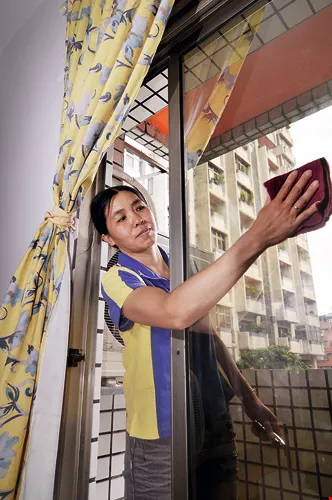
UWT is using micro-loans to help single parents learn skills and start businesses. Xiao Yu (left) received housekeeping training. Ms. Xu (right, photo by Hsueh Chi-kuang) founded Tianxiang Buns.

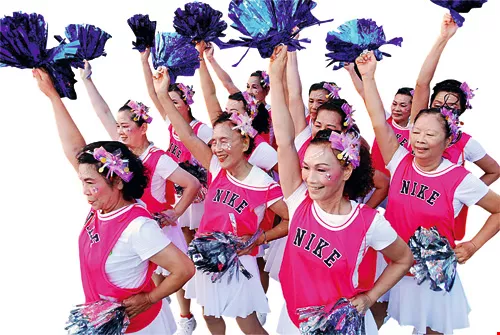
Young at Heart: Grandma Cheerleaders is a documentary film about 40-some seniors from the Kaohsiung area. Marketed with the help of UWT, it placed the issue of "successful aging" in the limelight.

@List.jpg?w=522&h=410&mode=crop&format=webp&quality=80)


