Lit From Within Terry Lee, Taiwan's First Blind Attorney
Chen Hui-yin / photos Jimmy Lin / tr. by Phil Newell
February 2011


"What has frustrated me most in my life has not been that I was cast into the classes for students with learning disabilities because I lost my sight, or that I have never had the chance to see the beauties of this world. It is that I worked so hard to get into law school, but haven't been able to find a job," says Terry Lee. He only asks: "Society should make maximum use of our intelligence, not just focus on what we are lacking."
November, 2009. The Taipei District Court is hearing an environmental case that has been going through the legal process for many years-the lawsuit brought against the American corporation RCA alleging that its dumping of toxic waste in Taoyuan caused soil and water pollution and led to cancer among employees.
In the court, among the impressive looking team of attorneys for RCA, there is a "computer typing speedster" whose clicking keys cut through the air like the iron-shod hooves of a troop of cavalry. Among the six or seven lawyers of the Legal Aid Foundation representing the employee-victims on a pro bono basis, there is one lawyer, attired like his colleagues in a black robe, white cane by his side, entering the main points of the proceedings into a computer for the blind.
The attorney is listening to Ah Yao, a former RCA employee who is dying of nasopharyngeal cancer. Ah Yao, who is very weak and whose life is hanging by a thread, is accusing RCA of making the employees use cleaning fluids containing trichloroethylene, which has been classified by many national- and international-level health research and regulatory agencies as a probable or even certain carcinogenic. Although he cannot see Ah Yao's tears, the attorney feels deeply moved: "One day, without fail, I will stand in the courtroom and speak up on behalf of people like you!"
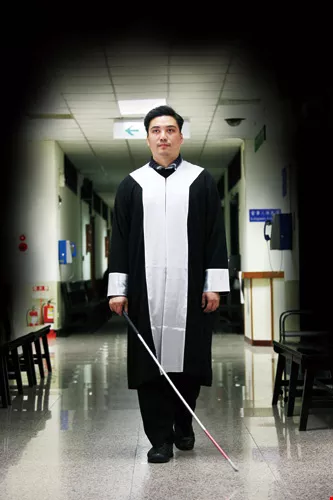
This lawyer's name is Terry Lee. Born nearly completely blind, he overcame the barrier posed by written texts and earned a law degree, becoming Taiwan's first sightless attorney.
Lee, now 30, was born prematurely, and his eyes were incompletely developed, leaving him virtually totally blind. But his parents did not for this reason shelter him from the world, but treated him as a normal child, punishing him duly when he did wrong. He didn't much like studying when he was young, and his grades were always at the bottom of the class, but he could do arts, music, and all kinds of sports. Despite never having seen a depiction of a dinosaur, he figured out how to shape them in clay just by running his hands over models of the creatures. "The one that stands on four legs, has a long head and neck, a round body, and a long tail is called a brontosaurus; the one with short front legs, claws, and sharp teeth is a raptor."
His grandmother, who doted on him and was always there for him, hoped that Lee would one day become a teacher. In his second year of junior high school, he decided to shoot for better grades in hopes of impressing a girl in his school who he had a crush on. Little did he expect that well before he got to the point of telling her his feelings, he would start getting top grades, and once he got a taste of being first in his class, it was onward and upward from there.
As he proceeded along his path toward becoming a special-education teacher, his father recommended to him that he study law, and test out his possibilities in life.
"My reaction was, 'No way!' I thought about how dry, boring, and complicated legal texts are, and about how much time I would have to devote to nothing but rote memorization. I wanted to party at university just like everybody else does, or at least I didn't want to suffer for four years." But his father insisted, though even after Lee tested into the Department of Law at National Taipei University, he still felt resistant to the idea of going there, and he and his father went through several months of a mutual "cold war."
Fortunately, after getting to law school he found out that law wasn't as tedious as he had feared. Sure, plenty of memorization was needed (and even sighted people had problems with that!), but it was also necessary to grasp the logic of each legal provision and use deduction to extrapolate from cases, skills without which the memorization would have been meaningless.
Unlike his classmates, Lee could learn only through listening, which required bringing a recorder to each class to make each lecture into "audio text." If the professor failed to provide enough detail in the lecture, Lee would have to do research (using computer tools and resources for the blind) on his own to fill in the gaps, which was not easy at first, but over the course of four years he smoothly mastered learning the law "by ear."
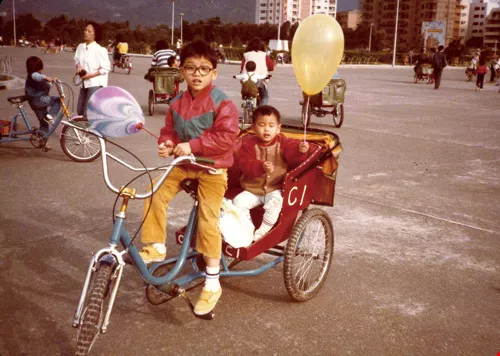
(1) Terry Lee's first job after graduation, landed thanks to a government program to find more employment for the visually challenged, was making telephone calls on behalf of the Bureau of Labor Insurance to get people to pay their back bills. This picture was taken at work with the dog of a colleague. (2) This picture was taken when Terry was small, and his mother took him and his three-year-old younger brother to Sun Yat-sen Memorial Hall, where they rode around on a tricycle. (3) From eighth through 12th grade, Lee was the first trombone in the band at the Taipei School for the Visually Impaired. (4) Though sightless, Terry Lee has been far from friendless. The photo was taken at a pottery class he attended in Nantou County during his junior year in university.
University life meant more to Terry Lee than just learning the law. It made him more independent and capable of integrating himself into the sighted world. In the process, he confirmed to himself that he was merely lacking eyes that could see, but otherwise he was perfectly capable of establishing himself in the sighted world based on his own abilities.
Having been blind from birth, Lee was heavily dependent on his family, and his mother took care of everything for him. In order to develop his self-reliance, when Lee was to enter sixth grade his father enrolled him in the Taipei School for the Visually Impaired (offering complete primary through high school education). "The first day that I moved into the dorm, my classmates laughed at me because I couldn't even sweep the floor-they said I was spoiled!"
Considering that he was being ridiculed not by sighted persons but by "my own group," Lee responded with a determination to prove himself to the others. At the school he learned how to handle a variety of chores like sweeping up and doing laundry, and when he went home he stunned his family by taking the initiative to help with the housework. In university, Lee impressed classmates by showing them how to reserve train tickets and take the train, and even played poker with them using a deck of Braille cards.
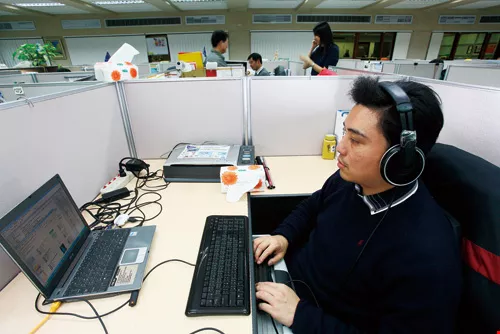
With Braille touch-sensitive computer gear, Terry Lee can work independently to do research and write legal briefs.
However, while his academic life went quite smoothly, he ran into a brick wall when he entered the job market.
Lee made his first try at passing the bar exam the year he graduated from university, and on his third attempt (during his second year after graduation) he finished at number 128 among nearly 5000 people taking the test, thereby winning his professional credentials and becoming the first blind lawyer in Taiwan.
At that time the president of the Examination Yuan, Yao Chia-wen, and the head of the Ministry of Examination, Lin Chia-cheng, sent congratulatory gifts to Lee in recognition of his exceptional achievement. They were very proud that Taiwan was to have its first sightless attorney.
When Lee began looking for work, he knew full well that the appearance of the term "visually impaired" on his resume would lead to immediate rejection, so he wrote only that he graduated with a degree in law, and, as hoped, got several interviews.
But every time he met his interlocutor, that person would relentlessly ask, "What's the story with your eyes?" There were even some who, hearing before the interview that Lee was blind, callously cancelled with a simple phone call.
One disappointment after another left him frustrated and depressed, and he began to wonder how he could have been so foolish as to study law, leaving him with professional knowledge but unable to find a job. "Why did I study law back then? If I knew how things would turn out, I would have studied massage [a common occupation for the blind in Taiwan] or joined an 'orchestra of the dead' playing brass instruments at people's funerals." Lee had in fact been a member of the school band, and played trombone quite well, and he even seriously considered becoming a full-time musician. But when he passed the bar exam, this rekindled his passion to "test out his possibilities." Sadly, he was rejected by law firms in his attempt to get an internship, and only eventually found one through the intercession of the Bar Association, finally getting his license to practice law.
In 2005, Terry Lee was invited to work at the Legal Aid Foundation (LAF). The foundation's purpose is to provide systematic assistance in handling legal problems for persons unable to afford an attorney. To make things easier for Lee, the LAF installed a voice-operated system in their elevators and software for the sight-impaired on their computers.
At first he worked on studying legislation and drafting proposed amendments. In particular, he participated in work to redefine the term "economically disadvantaged" to expand the focus beyond the lowest stratum in society to also include persons saddled with crippling credit-card debt. He learned a lot in the process about the inequalities in society, but for him, the whole process was "purely academic." "As a lawyer, ultimately you have to solve problems for people. I really wanted to get involved in an actual case. This was not only part of my career plan, but would also be a meaningful personal milestone."
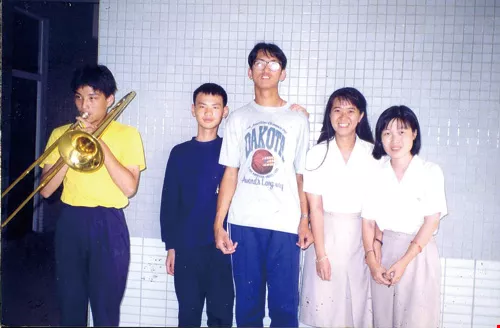
(1) Terry Lee's first job after graduation, landed thanks to a government program to find more employment for the visually challenged, was making telephone calls on behalf of the Bureau of Labor Insurance to get people to pay their back bills. This picture was taken at work with the dog of a colleague. (2) This picture was taken when Terry was small, and his mother took him and his three-year-old younger brother to Sun Yat-sen Memorial Hall, where they rode around on a tricycle. (3) From eighth through 12th grade, Lee was the first trombone in the band at the Taipei School for the Visually Impaired. (4) Though sightless, Terry Lee has been far from friendless. The photo was taken at a pottery class he attended in Nantou County during his junior year in university.
His passionate desire to move forward eventually brought Lee from the "diagnostic clinic" stage of his career to the much more high-tension "operating room." In 2008, with the support of Joseph Lin, the director of the Taipei branch of the LAF, he formally joined a team of attorneys working on an actual lawsuit. And not just any lawsuit! It turned out to be the RCA toxic-waste case, a very complex and sensitive international lawsuit.
Writing briefs, appearing in court, and meeting with clients are core capabilities required for every lawyer, and Lee was determined to try his hand. But at his first meeting with RCA employee-victims, when he heard them describing how the underground water around the plant carried toxic chemicals, his brain was in a fog, and he couldn't imagine such a situation. So he did a thorough search for materials to understand the full circumstances, and before going to trial he practiced posing questions to his clients. This led ultimately to his being formally engaged by a client for the first time in his life.
But the difficulties were only beginning. Once in court, how could he flip through dossiers? Even if the text could be transformed into audio mode, what about charts and tables? What about written or physical evidence for which "you've got to see this to believe it"? How could he replace his eyes in accessing these materials? His inability to read written documents has prevented him from standing directly on the firing line-i.e. speaking directly with a witness-in any of his seven court appearances thus far.
Lee sighs that inability to read written documents is an obstacle shared by all visually challenged people. In the future, there will surely be more and more blind people entering the mainstream employment market in all kinds of fields, so the government should act early to develop recognition software that will convert data so that the sightless can enjoy equal access to information.
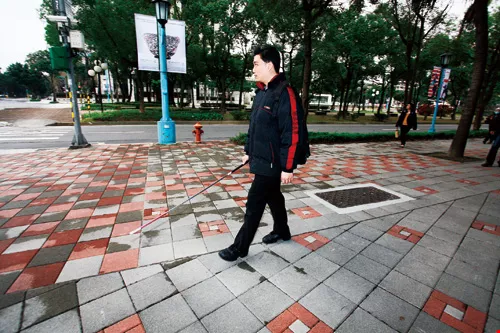
Terry Lee takes the MRT to and from work every day, and is grateful for Taipei's obstacle-free environment. He suggests that it could be made even more safe for the blind by converting the concrete pillars put up to keep cars from entering pedestrian areas to some softer material.
Lee has many visually impaired friends pursuing successful careers in a variety of fields, living with dignity and feeling comfortable in their roles. For example, one person who graduated from the Taipei School for the Visually Impaired ahead of Lee is now a manager in the insurance industry, another serves as a licensed social worker, and a third works at the Industrial Technology Research Institute. But they all face the same problem of "data conversion" into an accessible mode. He wants to encourage blind people to be more ambitious, but the main problem is that the government has yet to pave the way for them.
Lin Zhewei is a perfect example of someone who could benefit directly from better data accessibility. Inspired by Terry Lee's story, Lin, a visually impaired young person about to graduate from the Department of Law at Tunghai University, wants to become Taiwan's first blind judge.
Lee says that compared to the past, the current generation of the visually challenged are very fortunate. From Braille books to computers for the blind, "there's been a tremendous amount of progress. We can do research, keep in touch with friends through email and MSN." These advances have per-suaded him that one day the technology will exist for data conversion.
The biggest obstacle to communications between the sighted and the blind, he argues, is not in making oneself verbally understood, but in that persons with sight disabilities have access to much less data than the sighted, creating an enormous gap in knowledge between the two parties. The absence of a level informational playing field forces the visually challenged to the margins of the job market and their professional careers. Technology can close the gap.
Other things can also be done to ease the entry of the blind into the sighted professional world. For example, because the congenitally blind cannot conceptualize written text, when typing they often end up with incorrect Chinese characters. This is because in Chinese there are many homophones. Sighted people usually enter text by phonetically typing in the sound of the word they want, then choosing the correct character among the homophonous options offered by the computer. A blind person who cannot know what the correct character should look like cannot possibly make such a choice, and the automatic default characters in the computer often turn out to be incorrect, especially when unusual characters are needed to type highly specialized terminology such as that used in the law. Lee has therefore created his own database of more than 5000 terms, including idiomatic expressions and common legal jargon, which he wants to share with other visually challenged people. But he is only one man, and hopes that the government will create a "data management center" for the blind which would collect databases of commonly used terms in various fields, thereby enabling blind persons in these fields to produce documents with the degree of professionalism required for career success.
Lee argues that in a healthy society, there should be more and more visually challenged people entering a wider variety of occupations. Indeed, though they may not have functioning eyes, they often develop other abilities that are neglected by the sighted. For example, lawyers often judge the truthfulness of a witness by that person's facial expressions. "Though it isn't possible for me to judge people's faces, I can develop the ability to discern truth from lies by listening to tone of voice!"
People's true thoughts can indeed be revealed through their voices, and they cannot hide whether they are being frank or deceitful. Since sighted lawyers are used to focusing on people's faces, they neglect the information revealed by intonation. "The idiom 'the face is the mirror of the mind' could also be 'the tone of voice is the echo of the mind.' Lawyers with sight disabilities should work on their listening skills-the effort will certainly pay off," Lee advises.
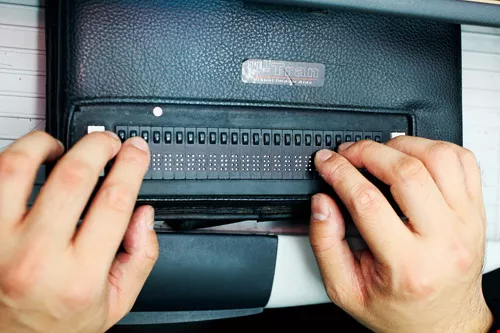
With Braille touch-sensitive computer gear, Terry Lee can work independently to do research and write legal briefs.
In the West it is not that unusual to hear of a blind attorney. This is not only because they are individually capable, but also because they live in supportive societies, where blind lawyers have every possibility of exercising their profession successfully. In contrast, Asians are more likely to be skeptical that the blind can really handle the job. This negativity greatly pares down career opportunities for the visually challenged.
But even in Asia, Lee relates, there are other examples of successful blind lawyers. A visually disabled person passed the bar exam in Malaysia 20 years ago now, and set up his own private practice; there is also a blind attorney in Japan. "They must have had it even tougher than me," says Lee, because technology for the blind was so much less developed in those days. So how did they build their professional careers? How did they solve the problems of reading documents and looking at evidence? What incentives, assistance, and mechanisms were provided by their governments? Lee is very curious, and plans to write soon to both of these pioneering figures in hopes of learning the secrets to their success.
Having met with frustration in the job market, Lee has sometimes regretted his decision to become a lawyer, and after years of struggling against obstacles, to most sighted people his aspirations are still an impossible dream. He now wants only to prove one thing: "What an ordinary person can do, I can do too!" He now has a more thought-out career plan, and hopes to accumulate case experience while continuing to study further at the same time, eventually hoping to offer law classes in a community college or the non-degree studies program of a university. He wants to come up with a feasible employment model that other visually challenged people can consult.
The most interesting thing about the law is solving problems for people, and the RCA case has given Terry Lee a wonderful opportunity to do just this. He says that when he thinks about Ah Yao, the employee-victim in the terminal stage of nasopharyngeal cancer, standing in court for four hours at a time, testifying against a global corporation in a blurred, weak voice, and having to endure questioning by the judge and cross-examination by a team of attorneys, he says: "I see in her the real meaning of courage and determination-this is a war, cruel and with very real casualties!" He now feels that he has no right to complain about how tired or frustrated he gets. "One day, I will stand in the firing line, and fight on their behalf!"
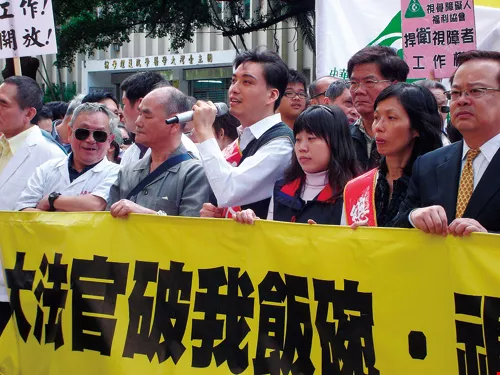
Lee took to the streets in 2008 alongside the National Alliance of Professional Masseurs to protest a constitutional interpretation by the Justices of the Constitutional Court that gave more people the right to enter the massage industry, which until that ruling had long been a secure source of jobs for the blind.
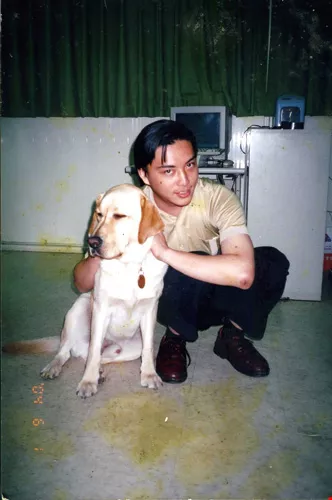
(1) Terry Lee's first job after graduation, landed thanks to a government program to find more employment for the visually challenged, was making telephone calls on behalf of the Bureau of Labor Insurance to get people to pay their back bills. This picture was taken at work with the dog of a colleague. (2) This picture was taken when Terry was small, and his mother took him and his three-year-old younger brother to Sun Yat-sen Memorial Hall, where they rode around on a tricycle. (3) From eighth through 12th grade, Lee was the first trombone in the band at the Taipei School for the Visually Impaired. (4) Though sightless, Terry Lee has been far from friendless. The photo was taken at a pottery class he attended in Nantou County during his junior year in university.

@List.jpg?w=522&h=410&mode=crop&format=webp&quality=80)
@List.jpg?w=522&h=410&mode=crop&format=webp&quality=80)


