Spinning Wheels
Explore Taipei with YouBike
Kobe Chen / photos Chuang Kung-ju / tr. by Scott Williams
January 2013


Taipei’s streets are being taken over... by yellow-orange YouBike bicycles and the grinning individuals riding them. Affectionately referred to as “Little Yellows,” the bikes are transforming our city with every spin of their wheels.
The public wasn’t especially positive about YouBike when it was established in 2009, but city residents have slowly become more receptive to the idea of bike sharing as a form of “green” transport. YouBike’s bicycles also happen to be convenient to use, and are also helping promote Taipei tourism.
How great would it be if the Metro went straight to your door? That’s a fantasy, of course. Instead, we have Metro stations that often sit at an awkward distance from our homes: too near to drive to and too far to walk.
Xiao Hui used to ride a motorcycle from her home near National Taiwan Normal University to her office in Neihu. Now, she says, YouBike allows her to rent a bicycle at the gates of NTNU, cycle 10 minutes to the Technology Building station, then ride the Metro straight to work. It saves her both time and money, and means she no longer has to worry about her motorcycle helmet squishing her hair.
YouBike may be Taipei’s new darling, but for much of the last three years, it was on the verge of being shut down.
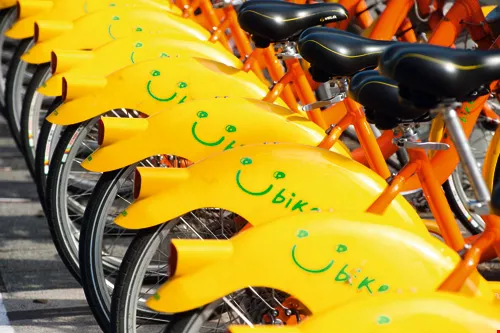
YouBike’s bicycles are great whether commuting to work or just exploring.
Paris started building a bicycle-sharing system in 2007, and other major international metropolises followed suit soon after. Taipei established its YouBike service in 2009, with the city government enlisting Giant Bicycles, Taiwan’s leading bike maker, to run the program. Giant would also be responsible for any profits or losses arising from its operation.
Giant chose to model the YouBike system on that of Paris, establishing 24-hour automated rental stations that allow residents to check out bikes using an EasyCard, the smart payment card used for public transport systems around Taipei. When the rider is done with a bike, it can be returned to any YouBike station in the city, regardless of where it was originally rented.
Unfortunately, the system launched with too few locations. Paris’ initial rollout involved 10,000 bikes at 750 rental stations, and London initiated the first stage of its program with 6,000 bikes at 400 “docking stations.” Taipei, in contrast, provided only 500 bikes at 11 rental points in the Xinyi District.
Bike-sharing systems are designed to serve the “last mile” of public transportation. But a lack of coordination between transit routes and rental stations impaired the functionality of and public interest in the first stage of Taipei’s system.
Initially, Giant required people who wanted to use the YouBike system to become a member of the system by registering a credit card in advance. The idea was that if a bike were lost, its cost could be charged to the member’s credit card. However, this pre-registration requirement precluded spur-of-the-moment use of the system and made it much less convenient.
In 2010, Europeans were saying that there were two kinds of mayors: those that had established a bike sharing system, and those that were about to. That was not at all the case in Taipei, where residents were showing little interest in YouBike. But Giant chairman King Liu wasn’t willing to give up. He argued that it would be ridiculous for Taiwan, a global supplier of bicycles, to abandon bike sharing. However, his company clearly needed to make the system more user-friendly.
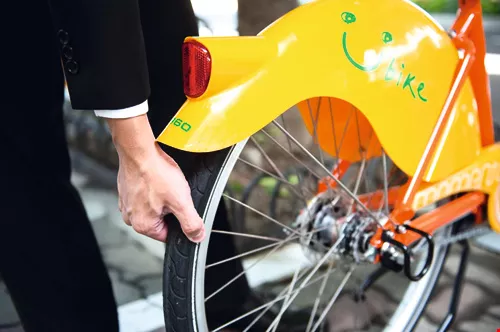
You can release a bike from its stand by swiping a registered EasyCard across the card reader. But remember to first check the brakes, tire pressure, and seat to be sure it’s safe to ride.
After an extensive review, the Taipei City Department of Transportation decided to expand the system. YouBike launched 30 more rental stations in August 2012, finally extending the service beyond the Xinyi District. The operators decided at the same time to ease the registration requirements, enabling users to register with a cell phone number. Giant even went so far as to make the first 30 minutes of use free of charge for registered users. This three-pronged approach has proved effective.
Over the three-month period from August to November 2012, the system was used 670,000 times, or more than double the number of uses throughout the previous three years. Through November 2012, Taipei’s system has been used a total of more than 1 million times.
Vicky Yang, currently spokesperson for Giant’s YouBike division, says: “Price and registration hassles are secondary issues. The key is to have enough stations.” Yang led a group to Europe during a stint as president of YouBike and was profoundly impressed by the Parisian system, which made her realize just how carefree urban transport could be.
One aspect of the Parisian system that YouBike has emulated since its inception is the integration of card sensors with bike stands. This not only saves space, but also allows riders to make sure their bike is problem-free before renting it. Giant has even gone Paris one better, maximizing the efficient use of space with stands that hold two bikes instead of just one.
YouBike’s systems are advanced, and its bikes are of good quality. In fact, its NT$9,000 bikes include a number of features that enhance their safety and comfort.
For example, YouBike’s bicycles use a “step-through” frame design without a high horizontal crossbar. Moderate shock absorption and a well made drivetrain make them comfortable and easy for both men and women to ride on city streets. The bikes have all-weather taillights that light up when the rider pedals and include a small battery to keep them lit for up to 90 seconds when the rider has stopped. The bikes’ headlights are also pedal-powered and turn on automatically at twilight. The bikes even come with locks so riders won’t lose them if they have to park for a moment.
In fact, the bikes are so well built that the company has received numerous inquiries from people interested in buying them for their personal use.
Currently, YouBike bicycles are each used an average of seven to eight times per day. At busier stations, such as the one by the Taipei City Government Metro station, the average rises to 10 times per day. In other words, usage rates are high, complicating bike maintenance and deployment.
Yang says that Giant currently has four dispatch vehicles transporting bicycles between rental stations day and night in order to match availability with demand. As the number of stations increases, YouBike will increase the number of personnel. This will be expensive for the company, which right now is losing NT$1.2 million per month.
To support the introduction and use of low-carbon modes of transportation, the Environmental Protection Administration has allocated NT$18 million from the air pollution fund to enable YouBike to continue to offer riders the first 30 minutes for free through the end of 2013.
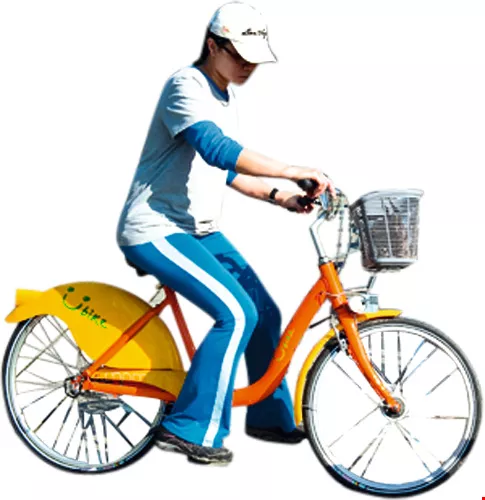
You can release a bike from its stand by swiping a registered EasyCard across the card reader. But remember to first check the brakes, tire pressure, and seat to be sure it’s safe to ride.
Looking ahead, the city government’s plans for a low-carbon transportation network call for utilizing the Metro for major arteries and buses for minor routes. YouBike is intended to help the public cover the “last mile” between their homes and the larger network.
This year, the government expects to open 10 new locations every month to achieve its goal of having a rental station every 300 meters. It will complete construction of 162 stations before year’s end, bringing the total number of bikes up to 5,350.
But increasing numbers of bicycles will inevitably mean greater competition for space on our streets. Moving forward, we’re going to have to address the right of bicycles to the road.
According to Jason Lin, commissioner of the Taipei City Department of Transportation, building a cyclist-friendly environment is a top priority. As construction wraps up on the Xinyi Road and Nanjing East Road Metro lines, the city will build dedicated bicycle lanes, signals, and signage along these key thoroughfares to help make cycling safer.
The department is also planning changes along older, narrower streets that lack the space for bike lanes, such as those in the Datong and Wanhua Districts.
Its approach will be to first reduce the number of streetside parking spaces, freeing up space for pedestrians and cyclists. The department will begin with parking spaces located near underground parking lots, while also lowering parking fees in those lots to encourage car owners to use them.
Lin says that the old streets in these districts have a backstreet culture all their own. If the city were to insist on turning over some of the existing right-of-way to bikes, the effect would likely be the opposite of what it intended. The better approach is to exploit the streets’ own distinctive character. By smoothing streets, removing parked cars, and adding appropriate signage, the city will be creating natural bike lanes and making it easier to explore and become familiar with Taipei’s backstreet culture on a bicycle.
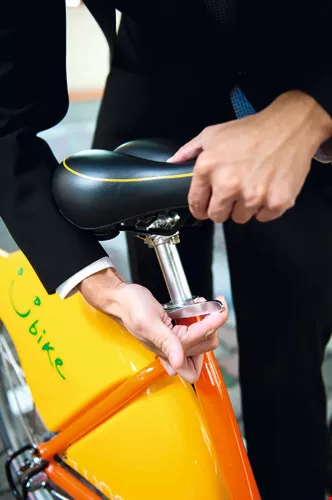
You can release a bike from its stand by swiping a registered EasyCard across the card reader. But remember to first check the brakes, tire pressure, and seat to be sure it’s safe to ride.
As Taipei seeks to make itself into a great city, two of its key challenges will be the implementation of green transportation and the achievement of harmony on the roads.
Taipei’s many motorcycles and intricate roadways have complicated the promotion of cycling in the city. The city government and Giant are addressing the problem with a strategy that focuses first on getting bicycles onto the streets, then improving the traffic situation. As they expand their bicycling plans, they are hoping to gradually change the habits of other road users.
Taipei City will be presenting the world a fresh new face in 2013, with an even more extensive Metro system, less construction on its streets, more bicycles, fewer motorized vehicles, more electric buses, and more pedestrian-friendly spaces. These efforts are sure to provide citizens with cleaner air and a more pleasant living environment. So, pick a clear day, whip out your EasyCard, and give a YouBike a spin!
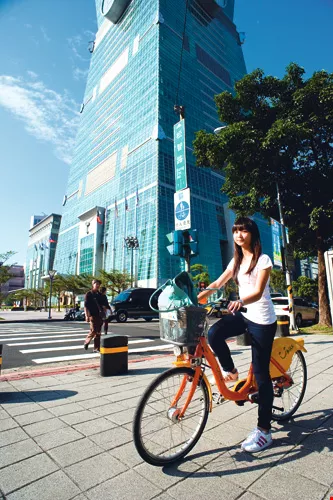
YouBike’s bicycles are great whether commuting to work or just exploring.
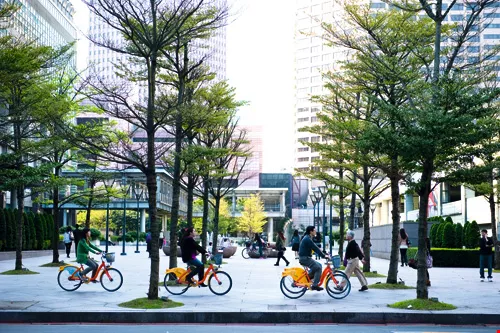
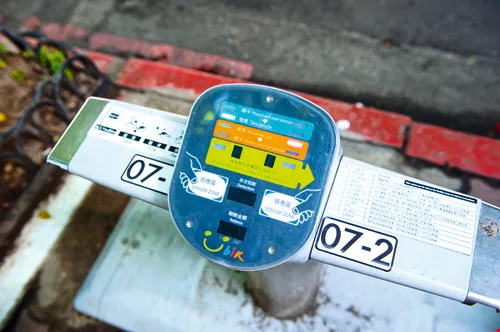
You can release a bike from its stand by swiping a registered EasyCard across the card reader. But remember to first check the brakes, tire pressure, and seat to be sure it’s safe to ride.
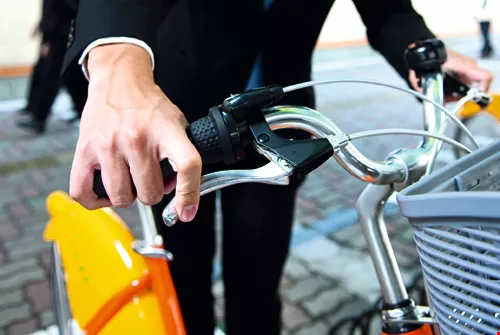
You can release a bike from its stand by swiping a registered EasyCard across the card reader. But remember to first check the brakes, tire pressure, and seat to be sure it’s safe to ride.
@List.jpg?w=522&h=410&mode=crop&format=webp&quality=80)

@List.jpg?w=522&h=410&mode=crop&format=webp&quality=80)


@List.jpg?w=522&h=410&mode=crop&format=webp&quality=80)

@List.jpg?w=522&h=410&mode=crop&format=webp&quality=80)
