Tuvalu: King-Hit by the Tides
Chen Hsin-yi / photos Chuang Kung-ju / tr. by Geoff Hegarty and Sophia Chen
October 2010


Tuvalu is made up of nine atolls, a chain of volcanic islands stretching 560 kilometers through the Pacific. The nation voted for its independence in 1974 and adopted the name "Tuvalu," which means "eight standing together," as the smallest and most distant of the islands remained uninhabited until 1949 and was considered insignificant.
An archipelago nation with a population of just over 12,000, Tuvalu is the fourth smallest country in the world. While suffering complete obscurity for most of its existence, in the past 10 years it has become symbolic of a future shaped by climate change. As a result of sea level rises due to increasing global temperatures, scientists predict that Tuvalu will be completely inundated within the next 50 years. Hence Tuvalu's leader has become devoted to arousing international attention to the crises affecting small island nations, and massive media coverage has brought the potential tragedy of the "submerging" islands to public attention around the world.
In the early morning of February 28 this year, the South American nation of Chile suffered an earthquake at magnitude 8.8. Immediately afterwards, all Pacific island countries received a warning from the Pacific Tsunami Warning Center on the US island of Hawaii.
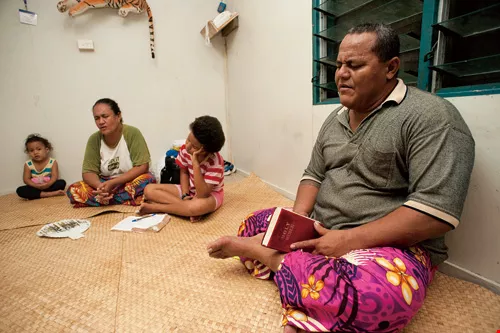
On Tuvalu, 97% of the population are Christian. Family members gather together for hymns and prayers every night.
Wu Yu-chuan, a Taiwanese overseas volunteer, has worked in Tuvalu for over a year and has experienced three tsunami alarms. She describes the situation on one occasion when the alarm sounded. The islanders were relaxed, while foreigners became anxious, grabbing their luggage and putting on their lifejackets ready to run (but still taking photos). "The majority of islanders stayed at home to listen to the radio or continued to work. A small number of people strolled leisurely down to the tsunami shelter, where they sat chatting, eating or dozing. The alarm was lifted after about four hours, and the islanders returned to their easygoing lives."
Visitors tend to have a preconceived image of the suffering Tuvalu people, so the appearance of islanders being so relaxed during tsunami alarms often causes some perplexity.
In 2008, a BBC journalist chose deliberately to visit Tuvalu during the "Time of King Tides" at the end of February, a period so named by the Tuvalu people for the unusually high tides from January to March every year. During this period the surrounding seas are affected by tropical lows and cyclones, generating rough seas and higher-than-normal sea levels. Huge waves can reach up to 30 meters inshore, lapping homes and occasionally flooding houses.
Another phenomenon of the king tides is that seawater bubbles up through the porous coral rock, inundating low-lying coastal areas.
Despite the partially flooded landscape, the journalist witnessed amazing scenes: on the airfield runway, a national football comp was under way, players having come from the other eight islands to participate. Although seawater had spread into the oval, people were not at all concerned. One woman was carrying a live tuna that she had just caught on the roadside, heading home to make the most of her catch. Another woman was lamenting her fruitless labor because her vegetable garden had been destroyed by the flood. But her mood changed quickly and quite happily she remarked "At least my coconut trees are still standing. I'm going to brew some coconut wine (kao) to drink."
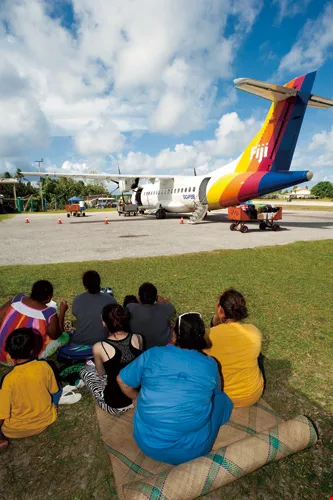
Watching the Fiji flight go over is a twice-a-week recreation in Tuvalu. Run by Fiji Airlines, the service is often unreliable but nobody cares. The airplane is a small dual-purpose passenger and cargo aircraft with only 40 seats. Even with a full tank, it can't make it back to Fiji carrying its maximum load of people and freight. And if the ship to Funafuti is late, there may be no gas for the plane, so up to half of the passengers will miss out on a seat. Getting back to Fiji on time is often just a matter of luck.
For islanders needing to coexist with the sea, their ability to bear unexpected disasters perhaps comes from experience of such a harsh environment. Recalling the past, "Our ancestors were used to coexisting with disaster. They were able to observe nature and to see the signs of a coming storm, so they could respond quickly to avoid disaster. They also knew where the fish were gathering and how to avoid running into the reef," says Tataua Pese, a climate change and disaster management officer of the Tuvalu Red Cross, currently conducting a program to collect and record the traditional wisdom of the elders.
However, with civilization, the nature and definition of disaster has changed. The issue of climate change for the Tuvalu government is indeed a new and very difficult challenge.
Hon Tavau Teii, until recently deputy prime minister and head of the Ministry of Natural Resources and Environment, points to the fact that because of climate change, tides have risen significantly in the past 10 years. "This is why the Tuvalu people gave a new name: "Time of King Tides" to describe this situation. Seawater bubbling up through the land is an unprecedented and terrible development!"
As a leader and tribal elder, Teii outlines current policy: "We hope that some countries can help us build sea walls and protect the reefs to ensure that our existing lands will remain free from seawater erosion." Apisai Ielemia, Tuvalu's prospective prime minister, speaking in a press interview on a visit to Taiwan in April this year, claimed that building sea walls "will require tens of billions of US dollars." Tuvalu has put forward a plan and will continue to seek assistance for the work.
Facing predictions of rising sea levels, the former deputy prime minister also explains the psychological struggle of his people: "The predictions of the scientific community are very pessimistic, but we deeply believe that with the blessing of God these islands will never disappear. Moreover, we do not want to abandon this land because the land is our culture and tradition."
Thus, although the king tides are already a reality, "only time will tell what the situation will be in 50 years. We don't want to encourage our people to migrate, and only if the worst comes to the worst will we seek asylum from the international community," says Tavau firmly.
It is worth mentioning that at present the residents of Tuvalu have not received any commitment of asylum from any country. "Though New Zealand has so far taken nearly 3,000 immigrants from Tuvalu, they have been accepted for either economic or family reasons." While New Zealand has an annual quota of 75 immigrants from each Pacific island nation, these are admitted on the basis of their skills profile, and are not "environmental refugees" as many have mistakenly reported.
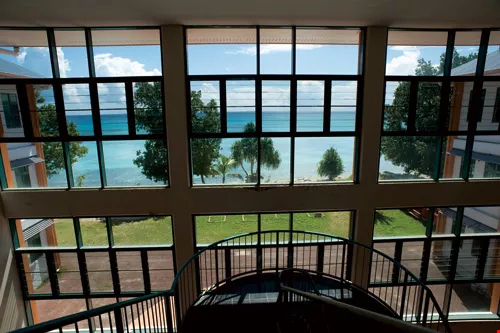
The government building on Funafuti is also the tsunami shelter, located only 20 meters from the coastline.
However, a number of foreign aid organizations in Tuvalu point out that if Tuvalu wants to move towards sustainable development, apart from gaining environmental justice and technical assistance as well as funds from international communities, it needs to deal more actively with local pollution issues and damage caused by human activity, especially in the capital.
Perhaps because of foreign aid or the relatively small size of the nation, the first impression of Funafuti is of a neat and modern community: there are bright streetlights at night, and a brand new government building built with the assistance of Taiwan. Most households have changed their traditional thatched cottages for brick structures (some using sea sand), and with the assistance of Australia and the EU, in the last four years each household has received rainwater collection devices and high-capacity storage tanks. (Tuvalu is too small to have underground water sources, so there are no wells to be tapped)
However, after some in-depth research, it has been found that Funafuti has already reached its environmental limits.
First of all, let's look back to an old account of the environment about 60 years ago: during World War II, US forces landed in Funafuti to build an airfield and port facilities, so it was necessary to cut down around half of the lush coconut palms and mangroves in Fongafale (the current political and economic center), which took up most of Funafuti. The loss of vegetation damaged the fragile atoll foundation, and a number of gaping holes were left after extensive reef mining. These later became rubbish dumps that regularly flooded with seawater, increasing soil salinity.
Second, Funafuti's population is overloading the environment: Funafuti offers relatively rich educational resources and employment opportunities, so it has always attracted immigrants from other islands. The population has increased dramatically from less than 1,000 to 5,000 since 1978, 80% of these people settling on Fongafale. Large areas of coastal reefs have been mined for material to build housing for the influx, increasing the risk of shoreline erosion.
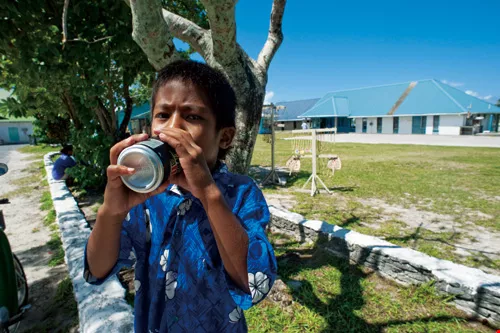
The sugary carbonated drinks manufactured by multinational beverage companies are very addictive-once you drink one, it's very hard to stop. Waste soft-drink containers make up a substantial portion of the nation's garbage.
Wu Yu-chuan, who advises on waste management in Tuvalu, points out that Tuvalu uses open disposal of waste. The garbage dump in the north of Funafuti is already overflowing, and unrestricted garbage disposal is the norm. "I would not say that Tuvalu people are uncivilized, but there are conflicts in their lifestyle between the traditional and modern."
Wu explains that Funafuti has been more affected by overseas influences than the other islands. Increasing numbers of people (especially the young) want motorcycles, cars and electronic products, and lots of consumer goods have flowed into the island with the foreign aid. "Tuvalu people are the same as those in other countries: they want the American lifestyle, but unfortunately the local environment cannot bear it!"
A foreign worker, who asked not to be named, says that the deepest impression he has gained over the four years he has been in Tuvalu is that the original simplicity and harmony of this traditional society has changed dramatically. In the past two years there has been one case of rape and murder with no arrest so far, and a case of suicide by hanging. In addition, a number of robberies have taken place. "The increasing crime rate is a sign that people have changed."
He laments that the island's garbage problem is expanding exponentially, while rich people enjoy their luxurious cars and stereos, "turning up their music very loudly at late night parties to add noise pollution to the list of problems."
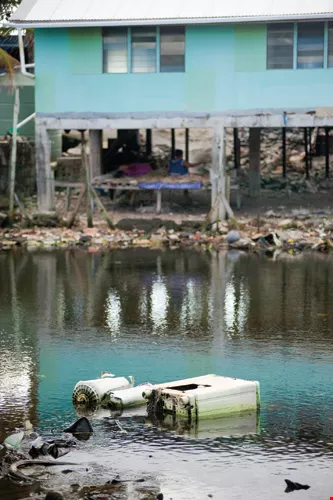
Several enormous craters made by the US military during World War II to mine coral for the airfield have held seawater for many years, resulting in increased salinity of the surrounding soil-a disaster for the environment.
Seve Lausaveve, secretary of the Ministry of Natural Resource and Environment, admits that the government has lacked resolve in responding to the problems: the issue of protecting the reefs, for example. Although the government has realized for a long time that the coral reefs act as natural barriers to protect the land from the sea, and are also the foundation of the nation's fisheries, because of limited funding and capacity, only this year has Tuvalu begun a two-year program to improve coral reef management, planned and organized by the University of the South Pacific. At present it is still at the stage of collecting data and training staff.
Lausaeve also notes that in the future the government may be required to restrict the use of destructive fishing methods, and to build sewage treatment facilities. However, "if the government wants to do these things, then we need to have discussions with the relevant departments and the communities. Integrating all the views of everyone involved could take three to five years."
The management of waste is an even more difficult challenge. The Ministry of Home Affairs and the Funafuti City Hall are responsible for this task, and the European Union, Australia and Taiwan have been providing technical assistance since 2000.
Jou Jiunn-shyan, technical team leader in Tuvalu for Taiwan's International Cooperation and Development Fund, says that Taiwan began helping Tuvalu deal with waste last year, the main tasks being to introduce garbage separation, reduce overall levels and demonstrate methods of composting. This includes collecting organic waste from households and public bodies, using machines to crush the waste, and establishing a compost production plant to transform garbage into compost that can be reused. Because the trial has been quite effective, the European Union has been attracted by the results and is actively negotiating with the technical team to expand the scale of production.
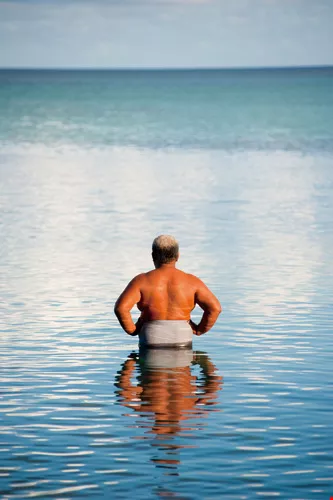
The islands of the Pacific will be the first victims of global warming. But at the same time, they are challenged by the dilemma of maintaining environmental sustainability while adopting the doctrine of development.
However, coping with waste from large appliances, computers, and vehicles is still an environmental hot potato. The Royal New Zealand Navy College in August this year made a conditional offer to Tuvalu. If the college could use Tuvalu as a base for maneuvers, they would assist the nation to clean up the towering mountains of garbage that are already spreading into the streets, and provide equipment to compact metal waste. While this scheme may provide a palliative, it doesn't solve the fundamental problem.
Wu cites an example: Taiwan and South Korea donated a large number of computers to Tuvalu, and South Korea provided a number of motorbikes to Tuvalu's Ministry of Fisheries. These actions were perhaps intended to improve the efficiency of the government, but the products became rusty in under two years and have had to be scrapped. She suggests: "Foreigners perhaps should think carefully about how to manage follow-up problems before they donate any goods, and even think twice about donating that sort of material to avoid causing further problems."
Tien Chung-kwang, Taiwan's ambassador to Tuvalu, notes that in recent years Australia and New Zealand have changed the way aid is delivered to Pacific island nations; they now focus on efforts to train people and cultivate their understanding. In the last two years, Taiwan has moved away from "money diplomacy" and has implemented a "sustainable development" policy as their guiding principle in Tuvalu. Thus, as well as continuing to assist in training fishermen and providing scholarships for students to study in Taiwan, it will more actively provide help in areas that Taiwan is good at, such as agriculture, composting and alternative energy generation. "The issue of environmental protection and sustainable resources should be considered as the first priority for the development of Pacific island nations."
Research into foraminiferaLet's go back to the most concerning issue of the slowly disappearing Pacific islands. While research teams have been collecting data and debating the issue of sea-level rise in the Pacific Ocean, the Japan International Cooperation Agency (JICA) has taken a different tack. The agency is studying the degree to which Funafuti's coastline ecology is being damaged by human activity, and is seeking specific remedies.
Fumiko Matsudate, coordinator of JICA's Tuvalu operation, explains that they have completed a full study on the Funafuti coastline, and discovered that pollution due to human activities has caused a sharp decrease in numbers of foraminifera (hole bearers), which are very tiny shelled creatures whose shells make up 80% of the material of Funafuti's beaches. As a result, the coastline is continually subsiding, reducing the effectiveness of this natural barrier. The JICA program uses biotechnology to revive foraminifera and so restore the beaches.
In the next four years, they will conduct the process in three gradual stages: production, transportation and accretion. The program is regarded as a trailblazer for other Pacific islands.
Matsudate, who has been in Tuvalu for over a year, says, "Tuvalu's environment and society have changed dramatically, so people's environmental awareness and the government's environmental management capabilities must improve quickly in order to avoid the double yoke of becoming both victims and perpetrators of environmental disaster."
A festival wishFunafuti was bustling from February 26 to March 1 this year as the first Tuvalu King Tide Festival got under way, organized by Tuvalu's Ministry of Transportation and Tourism and a number of foreign aid organizations. The festival aims to improve people's awareness of the impact of climate change and to arouse their interest in Tuvalu's cultural heritage. These thoughts, inspired perhaps by long-term discussions between the Tuvalu government and foreign aid organizations, provide the opportunity for joint reflection on critical environmental issues.
During the festival, teachers and students from the other eight islands were invited to participate. Kids were divided into groups and participated in the environmental program conducted by the Ministry of Environment and representatives from other countries. Activities were steeped in environmental concepts: the highlight of the opening ceremony was a cycling race, symbolic of a low-carbon lifestyle, and with the twist that the slowest won the race; a canoe race, which retrained and reinvigorated people's rowing skills, as people have become too used to motor boats; a race to climb a coconut palm, to remind people to cherish what they possess and to reduce consumption of imported canned soft drinks, and so on.
On the third day of the festival, the tsunami alarm mentioned at the beginning of this article sounded. This gave foreign journalists a shocking lesson in reality: "You can see for yourselves. We really have no place to run!" says the organizer.
However, the festival ended happily. The open minds of this land have injected new energy into the battle for Tuvalu. They are facing a future filled with enormous opportunities, but also great challenges.

@List.jpg?w=522&h=410&mode=crop&format=webp&quality=80)
@List.jpg?w=522&h=410&mode=crop&format=webp&quality=80)


