The Way of "Loving Discipline"
Coral Lee / photos Chuang Kung-ju / tr. by Jonathan Barnard
January 2011


In an era when corporal punishment has been banned, maintaining discipline in school is challenging. Among potential solutions, structural reform and social change are not things that teachers can achieve by their own efforts alone. Fortunately, in recent years numerous compassionate teachers and citizens' groups have reevaluated the position of teachers in education. Casting off approaches to discipline rooted in beating and scolding students, they have developed strategies and methods of discipline suited to the new era.
In schools throughout Taiwan, experiments in new forms of discipline have been sprouting like mushrooms after rain.
In Yilan a group of elementary and secondary teachers, influenced by the "consciousness conversation method" promoted by Chen Yi'an, an expert on communication and consulting, formed a book club to practice "effective conversational strategies" long term. First they changed themselves, and then, after practicing with similarly inclined fellow teachers, they adopted a methodology to interact with students. Several teachers are now sowing seeds of "the conversation of life" in their own schools.
Taichung's 21st Century Education Association is an advocacy group that focuses on promoting ideas. Early in its history, it promoted a ban on corporal punishment in schools and a series of activities on "loving schools." It then put on a series of seminars on the theme of "A Triple Win for Parents, Teachers and Students." These earned widespread praise, and pushed many teachers and parents to reconsider the way they thought about education and to work for change.
Li Zhibin, a full-time mother, personally resolved to change the cycle of "losing control of her emotions, then hitting and scolding her children, and then feeling bad about it." She sought out various kinds of counseling and educational methods, even going so far as dabbling in courses on spiritual healing and qigong. After many years of searching and experimenting, she finally turned over a new leaf. Combining some of the essences of what she gleaned from others' ideas as well as her own experiences, she wrote a book of teaching materials entitled What to Do Without Hitting and Scolding. And she has promoted the book through a series of courses. Many teachers have recognized that "hitting and scolding don't get children to think and don't solve problems." After learning the various communicative methods she outlines in the book, they "never hit children again."
What's more, Hsia Hui-wen, principal of Kai-Ping Culinary School in Taipei, has developed a curriculum in his school for "changing teachers' conceptions," and the National Alliance of Parents Organizations has created the "Love You for a Lifetime Protection Squad." The various conceptions and methods promoted by all of the aforementioned could be described as falling under the following disciplinary principles:
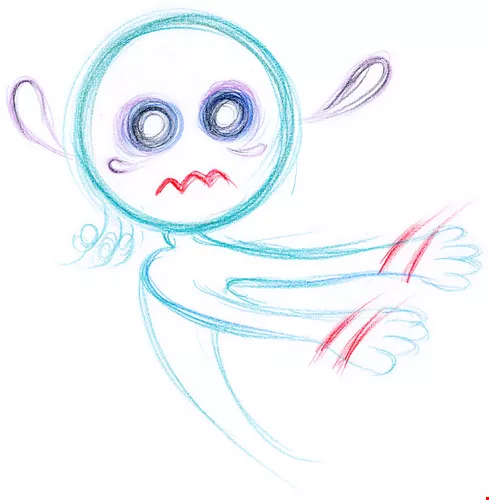
If you look at notorious incidents involving corporal punishment over the years, you discover that they all occurred when teachers lost their temper. For instance, after the "nine slaps" incident, Zhang Yongqin, the principal of the Taipei Mandarin Experimental Education School, repeatedly asked the teacher (who was surnamed Lu) why he beat the child. Lu's answer: "I don't understand myself." The teacher deeply regretted his actions, but the child was left with deep physical and psychological bruises, and the teacher's career was destroyed.
"When we scold and beat a child, we've got to think whether we're helping a child or merely releasing some of our own anger and frustration at the child not obeying us." Li says that if you deem that it's more aimed at releasing anger than helping, then you need to engage in self-examination and delve into your subconscious.
"People who can't control their emotions aren't suited to become teachers," says Zhang Lihua, who taught elementary school for 30 years and is now a part-time teacher at a university. She believes that teaching is a very special occupation: Students are like a blank slate, and they spend most of the day with their teachers, whose potential influence, whether negative or positive, cannot be overstated. When teachers lose control of their emotions, their every move and word can influence a child for a lifetime. After the "nine slaps" incident, Taipei mayor Hau Lung-pin said that when he was a child he was slapped six times by his teacher for no good reason after his music class performed "Whistle of -Zephyr." It made him fear singing for many decades.
First of all, teachers need to control their own emotions. Moreover, when teachers are aware that a student is becoming emotional, they should first let him release his emotions before getting him to consider things rationally and adjust his ways of thinking.
In her book, Li Zhibin points out that when children get emotional (frustrated, worried or angry) and parents or teachers blame, lecture, threaten, criticize or insult them, in the long run that will only cause the children to rebel and talk back, or recoil and lose confidence. On the other hand, when adults make suggestions, praise or preach, children don't necessarily listen, or they'll know something in the abstract but not be able to put it into practice. Even if children accept adults' opinions, that approach deprives children of opportunities to think things through for themselves.
Li advocates listening attentively as the best strategy when letting children release their emotions.
"If you understand how to listen attentively, then children will naturally tell you what they are thinking. They will feel that they are being understood, accepted, and their emotions can be released through talking. If parents and teachers can continue to respectfully listen to children and respond to what they say, a deeper level of emotions can be released." Li says that when adults listen without revealing any of their own opinions, children, once their emotional state passes, will become rational and think up their own way to resolve the problem.
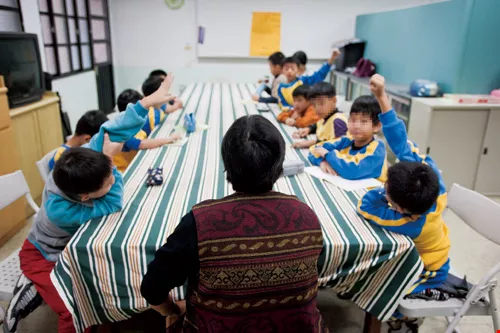
During the midday recess, the counseling room fills with students from various classes who suffer from hyperactivity or emotional disordersa. An adjunct counselor is using "The Emperor's New Clothes" as a launching pad for a discussion on how best to express one's opinions.
While the first step toward successful discipline is controlling emotions and preventing conflicts between students and teachers from boiling over, the purpose of education is to get students on the right track. If there is no effective strategy for counseling and discipline, then all the hard work will be for naught.
In accordance with the guidelines on counseling and disciplining of students issued by the Ministry of Education, teachers currently have 16 methods at their disposal, including forcing students to stand in one place and consider their actions or to sit quietly and think, correcting their behavior verbally, giving them additional school work, or ordering them to change seats. All of these actions are regarded as negative kinds of punishment, and they lack any impetus to get children to reflect on their actions and improve their behavior on their own.
Song Huici, who retired from teaching at Yilan's Zhulin Elementary School, explains that the best approach to guiding and disciplining students is "using questions to prompt a student's reflection." This is much more important than reprimanding or directly supplying answers. Unfortunately, many teachers' method of dealing with defiance, lying and fighting is to "correct" or "curb" such behavior. If a teacher sends children to the counselor's office when they get too hard to deal with or she needs to temporarily establish some distance, that usually results in a standing timeout or reprimand, and the children still don't learn anything.
Song cites the example of how she often teaches children to be more sensitive in what they say. She notes that it's not effective for a teacher to say, "The way you put things isn't good." Instead, she uses the story "The Emperor's New Clothes" to prompt a discussion that gets children to think. If you see something that bothers you, and you want to complain but you don't want to hurt someone else or say something that will get you in trouble, she asks, what should you say? This leads children to ponder such questions as how can you say something helpful or understanding, what is sarcasm, and when is saying something too late to be of any help. Using playacting and games, she introduces these concepts into their young lives.
Once the easy avenue of beating children is blocked, determined teachers will naturally look for new avenues, and various methods will thus arise to meet demand. For instance, some teachers use the sharing of life experiences and values to substitute for the hectoring and lecturing they formerly employed.
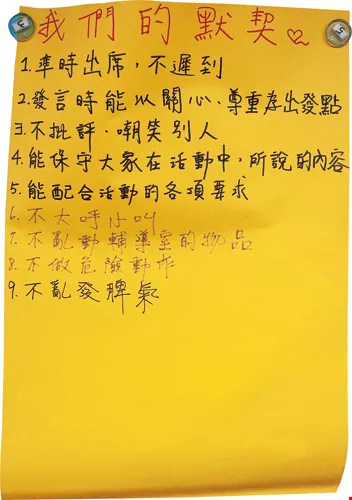
Having students draw up classroom rules and agree in writing to uphold them is a good way of fostering self-control.
Yu Mingcun, a famous math teacher at the private Yan Ping High School in Tai-pei, who is renowned for being strict in the classroom, says that several years ago, he participated in the "Love You for a Lifetime" curriculum put on by the National Alliance of Parents Organizations in order to resolve the conflicts he was having with his son. It was through that course that he suddenly realized the true meaning of education. He started to see his son's good points, and decided no longer to take the rod to him when he performed poorly at school. As a consequence, he moved from an authoritarian "high and mighty" approach to his students to being both their teacher and their friend. He often shared his philosophy that "joy was the purpose of life" with his students, teaching them effective study techniques and secrets about how to woo a girl. To a student that scored 15 on a math test, he took off his math teacher's hat and encouraged the child to forge ahead with history, a subject he loved.
As a result, the students opened their hearts to him. They pay attention in class, and his example and treatment of them has had an effect on the way they treat people in their daily lives. A few graduated students have even come back when encountering difficulties in their lives and asked for advice. This kind of feedback has brought him much more joy than he ever experienced receiving teaching awards.
Rule No. 4: Get parents and teachers on sideMany teachers explain that poor behavior among students in school typically reflects deficiencies in the home environment, such as a lack of love, understanding and affirmation. If teachers could make up for this, so that children know that someone cares about them and affirms their value, they will bring down their mental defenses, and these problems will all be much easier to deal with.
Li Zhibin, on the other hand, suggests that if teachers don't have enough time to give, they can invite a team of compassionate mothers with counseling or life-coach skills. If they come in and listen to what children are thinking once a week, typically they will prompt a great change in the children before even the passage of a single semester. Moreover, these sessions will produce much greater real effects than beating and scolding, which may cause children to say the right things but don't really change how they think.
How should teachers handle the many "monster parents" that interfere in how teachers teach or discipline kids? "When meeting with these kinds of parents, I don't respond to their assertiveness in kind," says Lin Xinghong, a teacher at Muzha Junior High School in Taipei City. "Instead I let them know that I love their child and I try to build a relationship of trust with them." Via parent-teacher meetings and home visits, she is able to meet and communicate with every parent, letting parents feel her sincerity. And every day she uses "contact books" and "housework schedules" to understand each child's situation at home. She stresses that if parents and teachers are on the same side, then the three years of junior high school can be sufficient to correct a child's bad attitudes or behaviors.
Back to the basics"In truth, concerns about the ineffectiveness of corporal punishment or other disciplinary measures are just scratching the surface," says Ni Xianguang, director of the 21st Century Education Association. "The root of the problem lies in our overlooking the true meaning of education." Ni says that teachers need to truly understand that each child is unique, and that the point of education is not merely academic advancement and the inculcation of social norms, but rather helping children to develop their potential and learn skills to resolve problems and deal with their futures. The controversy surrounding discipline really involves an educational imbalance.
"With the rapid changes we are facing in the 21st century, what core capabilities do children need to develop?" she asks. In a decade or two, when children get hired doing jobs that don't even exist right now, using technology that hasn't yet been invented, and confronting now-unforeseen problems, will they have a positive attitude and the ability to actively learn? Will they be able to creatively apply knowledge, communicate and cooperate, and solve problems? These are issues of far greater importance than discipline.
Discipline just represents the first essential door that teachers need to pass through. Some teachers can be found pacing outside it, nervously avoiding making a move. Others slip and fall before they get across the threshold. And some teachers make good use of various methods to dextrously get through and enter the palace of education. Courageous teachers of Taiwan, take on this challenge and come on in!


@List.JPG?w=522&h=410&mode=crop&format=webp&quality=80)


