

In early 2011, the Australian state of Queensland suffered severe flooding. In the city of Brisbane, which is home to many Taiwanese expats, this experience led to changes and unity both within the Taiwanese community and across ethnic boundaries.
The rains poured down relentlessly, turning Brisbane into a veritable ocean, damaging some 30,000 homes and forcing thousands to evacuate. Fortunately, the Taiwanese-heavy southern suburb of Sunnybank is located on higher ground, helping them avoid much of the disaster. "Australians love to live by the sea or by rivers, but Taiwanese prefer to live higher up. You could say our historical tendency to try and keep out of trouble served us well," says president of the Australian Taiwanese Chamber of Commerce Wilson Lu.
While this flood did not bring any direct harm to Taiwanese residents, it did bring benefits, in the form of greater unity within the Taiwanese expat community and new opportunities to connect with the local community.
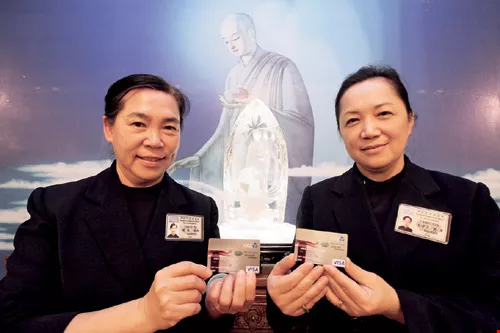
The empathy shown by Tzu Chi members like Carol Su (left) and Anna Chu as the organization handed out cash-cards pre-loaded with A$500 warmed the hearts of victims of the Queensland floods.
In Taiwan, the volunteer work of the Tzu Chi Foundation is known to all and sundry, but when working abroad, they may not be as familiar to the locals.
Tzu Chi's Brisbane chapter is 20 years old and has thousands of members. Even the local Taiwanese who don't volunteer have some degree of contact with the -organization.
Not only does Tzu Chi Brisbane organize volunteer clinics, they also regularly collect recyclable cans from local restaurants, a service the local government doesn't provide. They also provide food packages twice a month for low-income families. But disaster relief, something Tzu Chi is particularly known for in Taiwan, had long been something with which they had had little to do.
When the Queensland floods hit, though, Tzu Chi coordinated with the Red Cross to provide blankets and other necessities to people in Brisbane's two evacuation centers, as well as providing emergency funds of A$60 per person. "We had one person who arrived with just an empty suitcase-they hadn't had time to rescue anything to bring with them," says Carol Su, liaison officer of Tzu Chi's Brisbane chapter.
Once rescue supplies arrived from Taiwan, Tzu Chi volunteers headed out into the affected area, conducting relief operations in 13 locations, including providing households with one blanket per person, first-aid kits, and cash cards pre-loaded with A$500 (approx. NT$15,000). (The cards were provided in cooperation with ANZ Bank, and could not be used to buy tobacco or alcohol.)
"This unreserved support and concern helped break down ethnic barriers here," says Su, who now gets greeted warmly by some of the older members of the community as she walks the streets in her Tzu Chi uniform.
Tzu Chi's efforts touched many Australians, not only getting the organization recognition as a disaster relief organization from the Australian government, but also greatly raising the profile of Taiwanese expats in the country. Councillor Victor Att-wood of the city of Ipswich, just outside Brtisbane, even praised the organization in the council chamber, saying he was grateful for the help this Taiwanese Buddhist organization had provided, and that he hoped he could one day become Buddhist too.
A very new yearThis disaster also helped create greater interethnic unity in Queensland. Australians donated A$260 million in response to the floods, with Taiwanese donations accounting for A$3 million. The state government was moved by this show of generosity, immediately expressing its gratitude.
Although the Taipei Economic and Cultural Office in Brisbane has been in existence for six years, this year marked the first time the state premier formally introduced Sung Wen-cheng, the office's director general, to other government officials at a formal occasion such as the Chinese New Year celebration.
"In the two decades Taiwanese have been living here, this year was the first time the prime minister formally wrote to wish us a happy Chinese New Year," says Sung. Upon seeing the letter, expats were over the moon, translating it into Chinese and spreading it around the community.
Not long after Chinese New Year's Day, on February 18 over 100 members of the city, state, and federal governments from both major parties attended the Taiwanese Friendship Association of Queensland's Chinese New Year's celebrations, leaving local Taiwanese feeling tremendously honored.
"Now we need to strike while the iron's hot," says association president Anthony Lin. In the past, language problems have meant Taiwanese expat organizations have been hesitant to interact with government at all levels. Now, with the formation of a federation of such organizations, they have a source of encouragement and assistance, and will be better able to integrate with and contribute to their community.
@List.jpg?w=522&h=410&mode=crop&format=webp&quality=80)

@List.jpg?w=522&h=410&mode=crop&format=webp&quality=80)
@List.jpg?w=522&h=410&mode=crop&format=webp&quality=80)


