

Goodbye to the Year of the Tiger, say hey to the Year of the Dragon. What revelations did we get from 2011? What will consumer trends be in the coming year? These are the kinds of questions that come to mind every year at this time. By looking at and interpreting the numbers produced through the annual Eastern Integrated Consumer Profile (E-ICP) survey done by lifestyle and consumer market research consultants Eastern Online Company, we can perhaps shed some light on these questions.
“Uncertainty about the future has become the normal state of affairs; traditional boundaries are being blurred.” These are the words with which Jan Hung-tze, chairman of Eastern Online and an expert trend-spotter, described the revelations from 2011 as discussed at the Lifestyle Joint Conference held by Eastern Online and the Industrial Technology Research Institute in late December of 2011.
Jan started off his remarks with an analysis of economic trends over the past three years. From late 2008 through early 2009 there was a deep freeze in global consumer demand, and a sense of crisis permeated society. It got so bad that the government set a new precedent by issuing consumer vouchers to spur demand. The production and supply chain was severely impacted, and even at some of the best-run corporations in the country, operating revenues were poor. However, this also produced a “survival of the fittest” effect, and “natural selection” has uncovered survivors who have been able to gradually rebound. The economy steadily recovered in 2010, when the economic growth rate was a sparkling 10%.
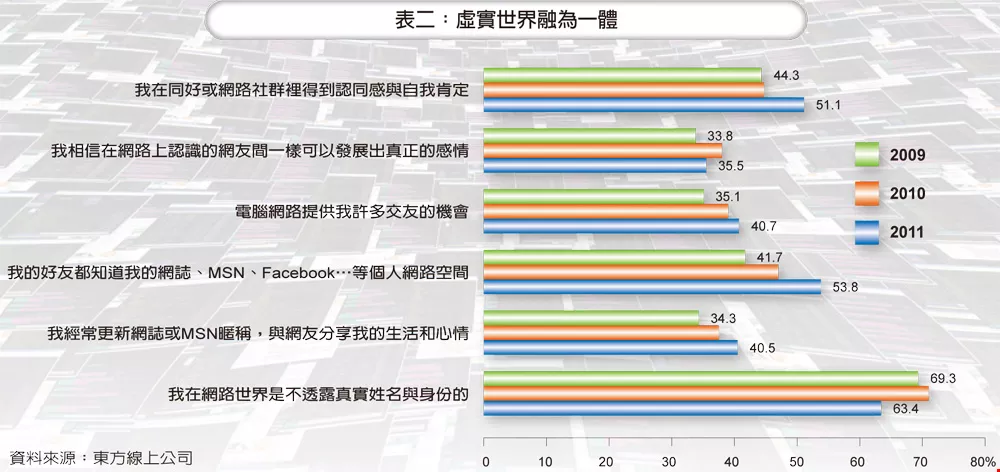
表二:虛實世界融為一體/資料來源:東方線上公司
“Following the 2010 recovery, listed companies in Taiwan had after-tax earnings of NT$1.5 trillion, and share profits of more than NT$1 trillion were expected to flow into the consumer market in the second half of 2011, so it was natural for people to have high expectations for the second half of the year. Unfortunately the global economic environment was thrown into chaos by the Euro crisis and the double-dip recession in the US, obscuring the future for most people and creating a sense of uncertainty that seems to have become the status quo,” said Jan.
It is not only economic conditions that are subject to volatility; technology can also bring rapid change at any moment.
Jan pointed out that technology can blur the boundaries between generations, the sexes, and various professions and industries. The Internet is Exhibit A. The meaning of the Internet lies in “linkages” and bringing together “computing power.” “There has been a ‘melting of boundaries’ effect toward the nature of work as we used to know it.”
Take for example the publishing industry, which is the one that Jan is most familiar with. The definition of publishing as he first knew it was to use a physical medium or carrier of some kind to transmit information, knowledge, or data to a given group. However, after he crossed over into e-commerce, he discovered that there is little difference between selling information and selling products over the Internet.
Moreover, e-commerce requires the delivery of both products and payments, and if you want to provide cash payment services over the Internet you need permission from the Financial Supervisory Commission. This means that the industries that also operate online now overlap, at least in regulatory terms, with the financial industry, giving industries that used to have very different identities something in common.
Eastern Online’s annual consumer survey reveals that Taiwan has two especially intriguing trends that are worth keeping an eye on, which are blurring the lines between industries and may even change the life trajectories of many industries.
Trend 1: Convenience store relianceBesides selling goods, convenience stores in Taiwan offer many services that we have come to increasingly rely on. For example, using the iBon portal in 7-Eleven stores, one can do anything from buy train tickets to print documents. In 2011, 11% of the survey respondents said that they use iBon-type services, compared to only 3.9% in 2009. An even higher figure, 30%, said that they use the ATM machines in convenience stores to get cash or pay bills, double the figure of preceding years. The percentage using the dining areas (small areas with seating where you can eat microwaved products or food off the shelf) also has risen sharply, from 8.8% in 2010 to 23% in 2011.
Right now there are nearly 10,000 convenience stores in Taiwan, or about one per 2000 persons, the highest density in the world. Consumers who shop at convenience stores go into one an average of 2.3 times per day, which is also the highest frequency in the world.
Special attention should be drawn to the fact that Taiwan’s convenience stores offer a greater variety of services than anywhere else in the world. For example, noticing that many websites find it problematic to collect money online, Jan decided that his own e-commerce platform, PC Home, could collect payment through 7-Eleven. Today an average of over 16,000 online transactions are completed at 7-Eleven stores each day, earning the chain NT$6.4 billion in transaction fees. This kind of service is unique to Taiwan.
Convenience stores are also “seasonal whistle-blowers.” They generally proceed along two main lines: special events and seasons. For example, when Apple founder Steve Jobs died, convenience stores did a booming business selling Jobs biographies. Another example is Lunar New Year’s foods, of which it is estimated that 7-Eleven alone sells about 500,000 units per year. Convenience stores have even generated their own “seasonal consumption” activities, such as cakes for Mother’s Day, store-bought zongzi for Dragon Boat Festival, and Beaujolais in November. These forms of seasonal commercial behavior did not exist in the past.
“The fact that services are still expanding in this mature market reflects the penetration of convenience stores into daily life,” said Jan. These chain stores now serve as post offices, telephone company offices, school registrars, restaurants, coffee shops, Internet cafes, and neighborhood social centers, offering public rest rooms and Wi-Fi access. Recently a service has even been launched that allows clothes for dry-cleaning to be handed in at Point A and picked up at Point B! How many more possibilities are there for making modern life even easier? What will the next generation of convenience stores be like?
Trend 2: Mobile online lifestylesThe annual Eastern Online survey also revealed that mobile Internet devices have become common, with people increasingly habituated to and reliant on the web. The survey showed that in 2011 each respondent spent an average of 4.4 hours per day online, compared to four hours in 2010. When you compare this figure to the average time that citizens spend reading printed material—only 17 minutes per day—it is clear just how caught up we have become in the web.
“The average amount of time that people spend online had remained steady for many years in Taiwan. The reason for the increase in 2011 is probably because of the spread of portable devices for accessing the web. Ever since the discovery of the mobile online world, people have been moving away from being tied down to desktop computers and land lines in their Internet activities,” Jan observed.
The percentage of respondents in the most recent survey who own netbook computers rose from 31% to 42%, while the percentage owning smartphones rose from 11% to 17%. This shift will change demand.
Jan emphasized that Apple’s integration of “hardware + Internet + services” has reshaped the mobile environment. All content and services will form “clouds.” “The days of the one-off ‘killer app’ are over: what we’ve got now are collective clouds of apps that are ‘killers’ as a whole.”
Jan cited a low-price online clothing retailer from Japan as a case in point. For most people, scrolling through 20 or more web pages on a mobile phone would be annoying to say the least. But Japan’s Magaseek, offering 1500 clothing products online, gets an incredible 70% of its orders from mobile phones. It turns out that many young women in Japan have no computers at the family home or where they live (this may be exceptional), and can only link up with the world and shop through their phones.
Faced with new media, new content, and a new commercial environment, Jan’s conclusion was: “All kinds of businesses will be able to start over from square one, and those that rely on fixed sales points will be able to come up with mobile formats.” The future will be an era of grand integration of content, but the rhythm and forms might differ greatly. The bad news is that it won’t be possible any longer to use the formulas for success that worked in the past; the good news is that others’ success could be your inspiration!


