Namasia:Rebuilding the Old Life in a Changed Environment
Coral Lee / photos Jimmy Lin / tr. by Scott Williams
August 2010


One year after Typhoon Morakot, streets in Namasia Township, Kaohsiung County, which were filled with rubble after the storm, now look brand new. Shops in Minquan Village are again open for business, the new retaining walls have been painted with colorful Aboriginal symbols, and trucks carrying gravel and culvert pipes stream past on Provincial Highway 21. The typhoon devastated Minzu Village, killing 26 people. But by now a dozen-odd families have returned and the village has been reborn.
While many former residents of Namasia have relocated to Great Love Village in Shanlin Township and begun to adapt to new lives, over 600 people chose to stay and rebuild Minzu and Minquan. These individuals are still struggling with issues such as building temporary shelters or permanent housing. Meanwhile, residents of nearby Minsheng Village are coping with severed transportation links that prevent them from selling their agricultural products during the flood season. Now that Provincial Highway 21, the villages' most direct connection to the outside world, has been downgraded to use for "necessities only," the area's 2,000-plus residents face a difficult choice every time it rains: stay in the mountains, or travel three hours out of their way to get out of them.
But the tremendous challenges and inconvenience that these Bunun tribespeople are facing seem to have in no way affected their attachment to their villages and their mountains, making the finding of a balance between the law, reason, and feelings a very difficult task.
We arrive in Minzu Village (Nansalu) in a trepidatious mood as evening falls, still remembering the desolation of 10 months ago. The Minsheng Village (Takanua) residents who were guiding us then urged us to leave as soon as the sky began to darken, and pressed us to accept shellflower leaves to remove any ill fortune. This time around, a group of people approaches us laughing and chatting as we get out of the car in Minzu. It seems that all of the returnees are eating dinner together in front of a former shop facing the street, and they invite us to join them. Village resident Lin Meique says that the women take turns cooking, though the pastor's wife cooks most often. Illustrating the forces that help hold the community together is a poster adorned with the names of people who have contributed money to help buy food. Looking out from this now empty structure in the middle of Minzu, we see tidy streets and sparkling clean homes. But nightfall still shrouds the area in a dark, silent solitude.
"We like to say that 20 households have come back," says Li Huimin, a township representative whose nickname is A-nu. "It sounds better that way." The actual number is 17 households totaling about 120 people. The returnees don't regret their choice, even though the government has left them to fend for themselves. In fact, they seem to be having a good time. But when the conversation moves to what they've been through to get to this point, Li has bitter tales to tell.
Minzu Village had been virtually leveled by the storm. When the villagers pulled out, Kaohsiung County Magistrate Yang Chiu-hsing persuaded them to move into permanent housing that the Tzu Chi Foundation was building in the plains. But then the villagers learned that accepting this housing meant signing waivers barring their return to their original residences. Li Changrong and the other elders pointed out the high cost of such an agreement to their fellow tribespeople, but those who advocated relocating insisted that the government wouldn't enforce the lockout from their mountain land and homes. Later, the special act on post-Morakot reconstruction explicitly stated that once the government had obtained indigenous residents' agreement, their former villages would be designated "restricted areas" in which reconstruction would not be permitted. Some tribespeople remained unconcerned and reacted with hostility to the desires of others to return. They argued that the pro-return camp's insistence on returning would deprive others in the tribe of their right to claim permanent housing.
"The government was in too much of a rush to build permanent housing," says A-nu. And once the waivers were signed, there was no turning back. He argues that if the government had given tribespeople six months or a year to think about the offer and see for themselves whether they could adapt to living and looking for work in the plains, the results would have been different.
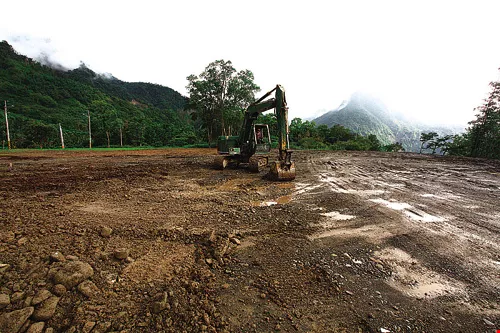
More than a dozen families pooled their resources to buy this piece of land on the Minzu Plateau. World Vision Taiwan plans to help them construct six shelters, each roughly 130 square meters in area.
"When we came back" says A-nu, "we did it to protect our tribespeople's rights." He wonders, if the mountain villages really are turned into "restricted areas" without any people, will the government maintain the roads? Will it provide power and water? If that's the case, Minzu will be effectively wiped from the map. When people ask A-nu how they'll get by without shops and without Highway 21 to link them to the lowlands, he says that though circumstances will change, "we can't let our people's lives change." If they no longer have the highway, they can make trips to the lowlands every month or two. "It'd be like a vacation," he says, and suggests that it might even be more enjoyable.
"If you live in the mountains, you can support a family on just NT$20,000 a month and still have NT$5,000 left over for a lending club," says A-nu. "Out on the plains, my little brother can't support himself on NT$30,000 per month." The government is currently providing temporary work to those in the lowlands, but A-nu notes that when that runs out, there's no land in Shanlin to farm and no work to be had nearby. He doesn't know how tribespeople are going to get by in the lowlands.
"Living in the mountains is the only way we can protect our culture and our lives," says Li Changrong, who heads the Minzu reconstruction committee. He says that in the old days, when someone passed away, the whole village would console the bereaved family and pitch in to help with the funeral arrangements. Things are different now. When a man who had relocated to Great Love Village recently passed away from cirrhosis of the liver, his mother asked whether he could still be laid to rest in his ancestral village. The villagers who remained in the mountains not only agreed, but also, as in the old days, pitched in to help dig the grave. But when the day of the funeral came, none of the tribespeople who had relocated to the lowlands came up to pay their respects. "They probably couldn't get time off from work," says Li.
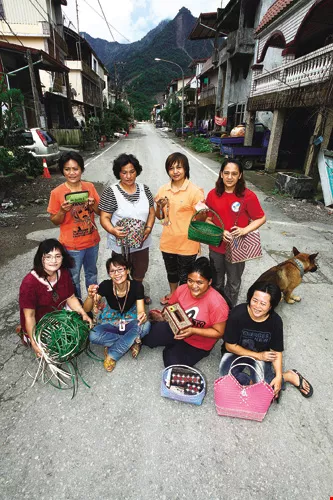
The Taiwan Fund for Children and Families offers classes in Namasia on traditional indigenous handicrafts such as leatherworking and weaving. In addition to learning new skills, villagers who attend the classes receive an NT$800-per-day allowance. The lower photo shows a Minzu street restored to its original likeness.
But how will those who have returned to their villages weather typhoons? Though scholars and experts found the Minzu Plateau, where the villagers wanted to relocate after Morakot, to be unsafe, the villagers rejected their findings. Instead, drawing on the spirit of the Morakot Special Act, which calls for "respect for the desires of indigenous peoples," they went their own way. They argued that the barrier lakes that were likely to give way had already done so and that only rock masses now remained from the landslides, limiting the risks from further heavy rains. After more studies and meetings and negotiations, they succeeded in getting the plateau removed from the blacklist, which allowed them to rebuild there legally. "But the government is worried that if we rebuild our homes too well, more tribespeople will want to return to the mountains," says A-nu. "It has therefore only permitted the NGOs to build us temporary shelters." A-nu says that the villagers agreed to this compromise in the interest of getting back into the mountains as soon as possible.
The villagers raised NT$1.5 million to buy roughly 6,300 square meters of land on the Minzu Plateau. The Presbyterian Church then provided the NT$2 million needed to level the loose, uneven surface of the plateau and World Vision Taiwan undertook the task of building the villagers six shelters, each about 130 square meters in area, free of charge. Unfortunately, work has stalled since heavy rains in late May washed out Highway 21, making it impossible for large cement trucks to deliver materials into the mountains.
And there's another problem: county regulations require that shelters be taken down after two and a half years. What are the villagers to do then? A-nu says that they don't want to have to rely on NGOs and the government forever, so they're using this opportunity to save money to build their own homes.
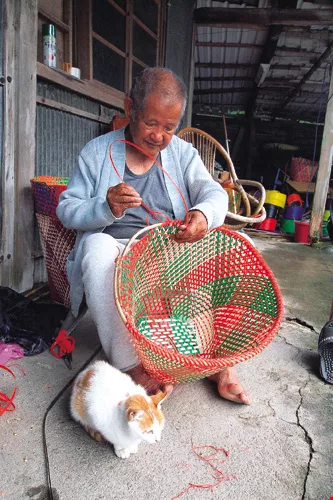
This Minsheng Village elder is weaving a traditional Bunun bamboo basket. His daughter-in-law originally ran a bed-and-breakfast. When she closed it after Typhoon Morakot, she began teaching dance and begged her father-in-law to teach bamboo weaving.
Neighboring Minquan Village (Maya) has been designated a "high-risk area." Therefore, under the Typhoon Morakot statute, the majority of residents are entitled to permanent housing in Shanlin's Great Love Village. It wasn't until three months after the storm that Minquan's villagers, who had been scattered by the storm, began gathering to discuss whether to relocate their community to the lowlands. Since most of their homes had weathered the typhoon in good shape, 90% decided to remain on their ancestral lands. Nonetheless, they resolved to collectively relocate to the Minquan Plateau, an area judged safe located just 15 minutes' drive from the original site of their village. Only a small number of individuals, those who were already earning their living in the lowlands or who had elderly family members needing medical care, left the mountains.
Sun Ronggui, chair of the Minquan reconstruction committee, says that rebuilding their homes turned out to be far from a straightforward process. According to the principle of "moving people out of danger but not out of their villages," the Minquan Plateau could have been bought up by the government and homes built there by an NGO at no cost to the villagers (under the same model as at Great Love Village). But because the villagers were not willing to accept the condition that they must give up their old homes, they couldn't make use of the funds the Morakot Special Act specifically allocated for relocation. But Sun is thankful that the Post-Morakot Disaster Reconstruction Council worked diligently on the villagers' behalf. It helped them find a way forward and connect with others who had the resources they needed for everything from constructing shelters and building temporary housing to rebuilding an agricultural community. The council ultimately recommended the NGO's "build it yourself" model, which provides funds to disaster victims that the government can't reach, then has them rebuild their homes themselves. In this case, the Red Cross (along with a little funding from World Vision Taiwan) donated housing to 116 households who already owned land on the plateau. Though 50-some families who own no land on the plateau continue to reside at Minquan's original site, the community has resolved to stick together through thick and thin. When typhoons strike in the future, the households on the plateau will take them in until the danger passes.
Because the Red Cross utilizes donations to support reconstruction, it has to be able to explain to donors why it has helped victims who fall outside the scope of the Morakot Special Act. It therefore asks the government to provide documents substantiating the need. But, being responsible for enforcing the law, the government was in this case reluctant to set a precedent for fear that other villages would attempt to follow in Minquan's footsteps. In mid-July, the county government finally relented and the long-stalled reconstruction work moved forward.
"For nearly a year, each time heavy rains have washed out the road, a few people have applied for permanent housing in the lowlands," says Shi Ciping, pastor of Minquan's church. He says that in spite of the danger and unpredictability of Nature, some 60% of the villagers have resolved to stay, though they respect those who've decided to leave and wish the best for them.
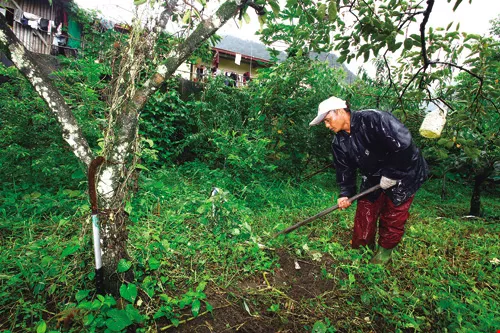
Namisia's peaches are grown at relatively low altitude and therefore ripen in April and May, well ahead of Lishan's July harvest, which gives them a natural advantage in the market. But with tourists and merchants no longer traveling into the mountains, growers have had to change their business model. In the photo at far left, a Minsheng resident fertilizes his peach orchard.
On top of its reconstruction troubles, Namasia Township is still suffering from frequent landslides and the silting up of its rivers. The mountainside behind Minsheng is a case in point. It has collapsed and no one has been able to put up a retaining wall. As a result, there's a risk of fresh landslides every time it rains heavily. Other concerns include washed-out bridges that have been replaced by makeshift crossings and gravel-filled creek beds in the Nanzixian River system. Even those in which channels have been cleared with backhoes are likely to become obstructed again in the flood season, potentially resulting in village-threatening flash floods.
Chern Jenn-chuan, deputy CEO of the Post-Morakot Disaster Reconstruction Council, says the massive amounts of earth and rock that the Chichi earthquake and Typhoon Morakot displaced in the mountainous parts of southern Taiwan have destabilized slopes and carried away bridges and embankments. To ensure the effective use of reconstruction resources, Chern's council is giving priority to repairs of infrastructure situated on stable terrain. This prevents resources being wasted on projects that are likely to be washed away just as they are approaching completion. "Restricted" or "high-risk" areas will be treated as national conservation zones, breaking the cycle of repairing structures, losing them to natural disasters, and repairing them again. In areas where people continue to reside, the council will give priority to transportation links and maintain other infrastructure at only very basic levels.
Take, for example, the repair of Highway 21, which the residents of Namasia Township are eagerly anticipating. Travelers are currently using makeshift paths along streambeds to get through collapsed sections of the road, paths that are washed away every time there's a heavy rain. Several hastily repaired sections of the road are winding and precipitous, and a recent traffic accident along one such stretch cost four lives. Chern says that a thorough repair of Highway 21 will require the construction of bridges and tunnels. It would be a major project and cost more than NT$10 billion. He notes that in addition to the funding question, the government must also evaluate the stability of the terrain before deciding whether to move forward with the project.

In recent years, Namasia has begun growing coffee and tea in addition to peaches. The township's coffee is rich and fragrant but its boutique growers have little name recognition and need to bolster their marketing efforts.
Highway 21 isn't just Namasia's link to the outside world; it's what keeps local famers in business.
"We were very worried at first," says Zhou Yongtai, head of the Minsheng Village Peach Sales Office. "We didn't know how we were going to sell the tens of thousands of boxes of peaches we grow." Zhou says that Namasia has had a flourishing tourism industry for many years. During the April-May peach season, the township administration always arranges events to attract visitors, enabling growers to sell off their entire crop from roadside stands. The township administration hasn't been able to attract any visitors since Typhoon Morakot. Even the popular firefly festival flopped. The county government and township administration have responded with a new approach. "If tourists and fruit merchants aren't willing to come into the mountains, we need another way to get our produce out to consumers," says township chief Istanda Husong, who explains that the township administration is helping farmers get to Kaohsiung to sell their fruit from stalls in department stores and hospitals.
Minsheng Village has also been making its own first attempts at opening up markets.
"We went to see Kaohsiung City Councilor Lin Guoquan," says Zhou, "who held a small press conference on our behalf to explain the difficulties that Namasia growers are facing." He says that the press conference resulted in large numbers of people making group purchases, and the Kaohsiung City Economic Development Bureau helped the growers build a website to sell their produce, while Gloria Tours approached the Kaohsiung Association of Travel Agents and secured the village a stall at their travel expo free of charge. The early-May date of the expo exactly coincided with the township's peak peach harvest season. With government agencies and the public at large promoting sales, demand outstripped supply throughout the harvest. Thus the growers did far better than they had expected, selling more than 60,000 boxes of peaches!
But the township's joy lasted only a few days. On May 23, heavy monsoonal rains washed out Highway 21 and left farmers with no choice other than to let thousands of kilograms of red-flesh plums fall to the ground and rot. And no one is certain that they'll be able to harvest, transport, and sell the crops that ripen during typhoon season-Asian pears in July, ma bamboo in August, and persimmons in September and October.
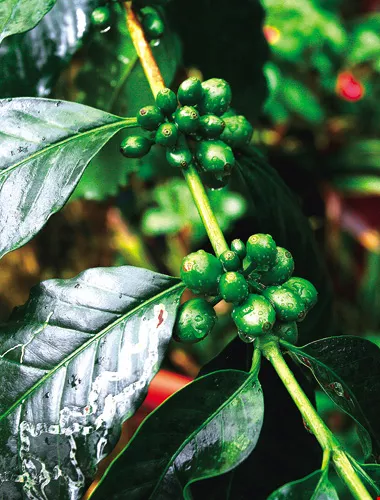
In recent years, Namasia has begun growing coffee and tea in addition to peaches. The township's coffee is rich and fragrant but its boutique growers have little name recognition and need to bolster their marketing efforts.
The Executive Yuan's Council of Indigenous Peoples is engaged in a three-year program aimed at promoting industries unique to indigenous communities to help rebuild businesses in indigenous communities struck by natural disasters. The program has a budget of NT$240 million, some NT$37 million of which will go to build infrastructure, plan and develop services, and sponsor sales promotions in three Kaohsiung townships (Namasia, Taoyuan, and Maolin) over three years.
"Funding is limited," says Qusung Qalavangan, director of Kaohsiung County's Indigenous Peoples Department, "so I've focused on developing one workshop per township." He says that they've already established sales platforms for all three townships and are shipping agricultural goods and handicrafts down to the lowlands. Namasia's "distinctive local industry workshop," located in Jiaxian, opened in early June. Meanwhile, the government is developing a "holiday market" in Shanlin's Great Love Village to promote sales of produce from the mountains. The government will guide the initial development of the market, then turn it over to villagers once its operations get on track.
The problem is that Namasia doesn't yet have many distinctive agricultural products. With the exception of plum vinegar and plum nectar, the township has never attempted to process local crops such as bamboo shoots, red-flesh plums, and peaches into distinctive local products because they sold just fine without any processing. Faced with the problem of intermittent transportation links, the township must quickly learn to transform primary agricultural products into processed products such as enzymes, jams, and fruit vinegars.
As part of the effort to transform and revive agriculture in indigenous villages battered by natural disasters, the government and private sector have also begun promoting organic farming.
Bukun Ismahasan Islituan, a member of the Council of Indigenous Peoples and a retired Namasia teacher, says that indigenous townships are devoting less and less land to agriculture. As restrictions on the use of forestland grow more stringent, one feasible approach to the issue of how to produce the most value from the least land is to switch to organic farming. The CIP is therefore aggressively importing technology and methodologies, and planning to encourage villagers to abandon their old, relatively crude approach to farming in favor of higher-value organic farming. The CIP further proposes to have each farmer responsible for 3,000-4,000 square meters of land on small, scattered plots and plateaus around Namasia. These measures will help maintain the land's productivity, and enable the farmers to get better prices for their crops. Moreover, since indigenous farmers are accustomed to farming for their own needs rather than for profit, they tend to grow on small scales that have little impact on the conservation of mountain forests. Aiming to further its plan, the CIP has invited a team of experts to come up with a list of organic crops suitable to the latitude and altitude, and root crops capable of withstanding the typhoon season.
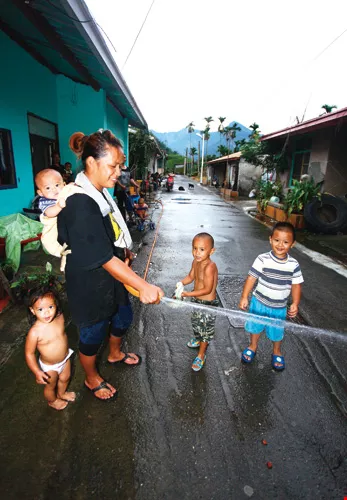
Three villages in Namasia Township have been designated "high-risk areas." Residents of these villages are eligible to apply for permanent housing in Great Love Village down in the lowlands, but most remain deeply attached to life in the mountains and have chosen to stay.
Hsing Sheng-te, a consultant on farm-based tourism with the Council of Agriculture who has worked with Minsheng Village for many years on the development of its tourism industry, says that his understanding of the objective conditions in Namasia leads him to believe that the farmers cannot simply sit waiting for tourists to come to them. He therefore recommends that they switch to growing organics and processing agricultural products, and is actively working to bring in academic and governmental resources.
Twenty-some households gather in the cool of the evening, brimming with confidence gained from the big sales of their peaches and discussing how to transform local agriculture.
"Right now, we feed all our blemished peaches to the pigs," says Hsing. "That's a real shame. They could be used to make smoothies! And if we could make our red-flesh plums into preserves, we wouldn't have to leave them to rot when the road gets washed out." He tosses out a number of other possibilities for transforming local agriculture, including applying to the Council of Agriculture for machinery; inviting experts to come teach villagers how to make organic fertilizers, package their fruit in a more appealing manner, and establish a division of labor for a collective assault on the market; and setting up "working vacations" for college students who could come help them with the harvest.
It's dark and raining when we leave Namasia. A number of Minsheng villagers had moved the car to the other bank of the river early that morning to make sure that I'd have a way out if rising waters made the makeshift bridge across the riverbed impassable. (These days, when that bridge is closed, residents cross the suspension bridge on their motorcycles or in narrow-bodied trucks to get to the larger vehicles they keep on the other side.) "When things don't feel right," they say, "we pack up food and water and get ready to flee to a safer location." They say they've had to learn how to survive with Nature, and that it's become their responsibility to protect themselves, to not waste valuable resources that could be used to rescue others.
On the way back, we traverse several makeshift bridges in the rain, seeing up close the roiling rivers tumbling across lands left bare by landslides and coming to a clearer understanding of just what it costs to live deep in the mountains. The tribespeople choosing to remain in their ancestral villages in spite of the myriad challenges such a decision entails may be mentally prepared, but still need the help and good wishes of those of us living in the lowlands.
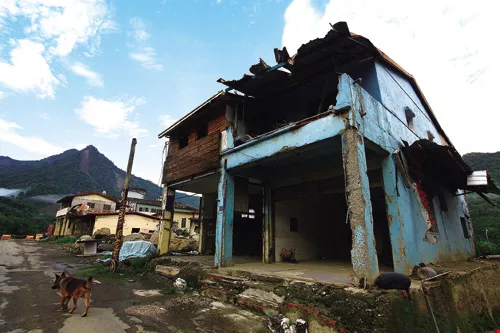
The debris from collapsed barrier lakes that had filled Minzu's roads and homes has been cleared, but the remains of ruined buildings still hint at the scale of the disaster.
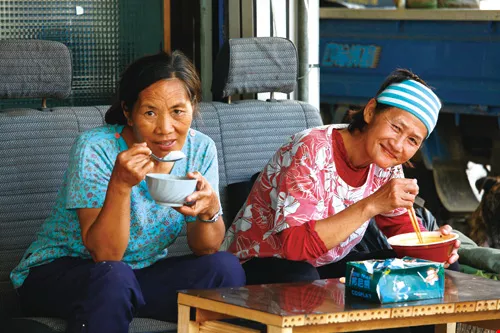
The road back was filled with twists and turns, but Minzu's residents are home at last and smiling again.
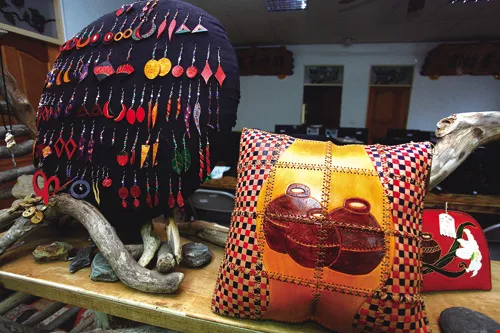
The Taiwan Fund for Children and Families offers classes in Namasia on traditional indigenous handicrafts such as leatherworking and weaving. In addition to learning new skills, villagers who attend the classes receive an NT$800-per-day allowance. The lower photo shows a Minzu street restored to its original likeness.
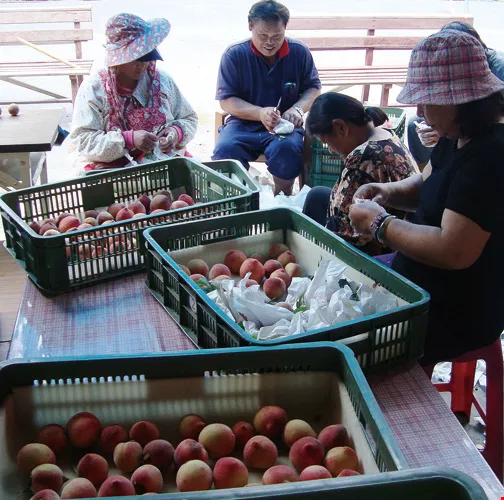
Thanks to an all-out effort by people throughout the township, this year Namasia achieved sales of 60,000 boxes of peaches.

@List.jpg?w=522&h=410&mode=crop&format=webp&quality=80)

@List.jpg?w=522&h=410&mode=crop&format=webp&quality=80)


