

What item of clothing is the best seller? Scarves? Skirts? Shoes? Nope. It’s the unassuming T-shirt. Affordable, easy to accessorize, and suitable for people of all ages, this simple garment is at the heart of a billion-NT-dollar industry.
T-shirts also readily draw crowds online; when displayed on screens, the shirts’ colors seem more radiant and their patterns more vivid than when on display in brick-and-mortar stores. As a result, the T-shirt market has become one of the most competitive markets online in recent years, with dozens of brands entering the fray. These proudly Taiwan-made original designs, done in runs limited in time and number, have transformed the ordinary cotton T-shirt into a must-have fashion item.
Websites sport eye-catching countdown timers, seemingly mocking the hesitant; as each second ticks down, the once-strong determination to not buy another shirt begins to waver, until all of a sudden you somehow find yourself at the checkout screen again, clicking the button to buy just one more.

Using design competitions as a means of bringing in more creative talent, 101.com.tw has made a name for itself with its wide range of colorful designs.
At the forefront of this kind of “just one more” selling is Buy365, a clothing website that has become the big kahuna in Taiwan’s online T-shirt market.
Despite having just a small range of products and being a newcomer to the market, in the seven short months since its June 2012 launch, Buy365 has already sold more than 80,000 shirts, bringing in over NT$40 million.
With so many other sellers and stores already well established online, achieving such a level as a new face is far from easy, but the minds behind Buy365 have carved out a place with blood, sweat, and tears. Ultimately, the biggest contributor to their success is their unique “quick turnaround” system, bolstered by the “now or never” feeling created by the on-screen countdown.
So what is this “quick turnaround system”? Other clothing sellers operate on a process of “design, produce, stock, sell,” but Buy365 has turned that on its ear, instead pursuing a process of “design, stock, sell, produce.” What this means is that when a customer places an order, they will have to wait for 14 days while their order is being made and fulfilled before they can get their hands on it.
The key to making customers happy to wait isn’t engaging in price wars like many other online sellers, but rather selling shirts in time-limited runs, with the subsequent rarity of those shirts giving them extra value to customers. In their early days, Buy365 sold just one shirt design a day, limiting each sale to just 24 hours. Today, responding to the clamor from their customers, they run each sale for five days, but Buy365 remains adamant that once a sale is over, that design will never be sold again.
The T-shirt designs offered by SOFU are creative products of the highest order. The designs pictured here are the work of (from top to bottom) architect Andy Lin, artist Suzy, graphic designer Jier, and drummer Chen Jindong.
The names behind Buy365 are fairly familiar ones, having previously founded social networking site Atlaspost several years ago. With Jerry and Andy Kuo having become Internet golden boys once, what made them want to strike out in another direction?
Jerry Kuo, a 37-year-old graduate from National Chung Hsing University’s business school, rose to attention in the online startup space in 2008, when Atlaspost took on 76 other startups at the DEMO conference and walked away with the People’s Choice Award. However, despite international support, a strong reputation, and a user base of over 1 million, Atlaspost simply couldn’t find a stable, profitable business model.
“Running a social networking site is too much stress, especially when you don’t know where the money’s going to be coming from,” says Kuo, forcing a smile.
And so when the brothers were ready for another challenge, they chose this time to focus on something everyone buys, and the first thing that came to mind was T-shirts.
However, the two were well aware that while they had the technical knowhow, they didn’t have anything like the same level of ability when it came to selecting and designing clothes. As a result, if they went the traditional route, they didn’t stand a chance.
On top of that, regardless whether they made their own clothes or sold retail-ready ones, they would still have to deal with the problem of inventory, which is a major test for any aspiring entrepreneur with limited funds and resources.
After thinking long and hard about the challenges they faced, the brothers decided to subvert the standard approach for online clothing sellers, letting their customers decide how many of each design would be made and in what sizes, then entering production once the orders were in. This way, they would be operating with zero inventory and without the worry of leftover stock that would have to be discounted come the end of the season.

The Kuos chose to make T-shirts their big focus after having seen the online market for designer T-shirts gradually become part of the mainstream over the previous few years.
The real pioneer in the market is SOFU (a play on the Mandarin shufu, meaning “comfortable”), a site that launched in April 2008. Founder Eric Wang was previously a senior manager in an advertising firm, but stepped down from his high-paying position to spend more time with his developmentally disabled eldest son, and to try his hand at doing business online.
Some stores, including the popular Mayuki and GoToBuy, had already set up shop on the Yahoo!Kimo sales platform, selling shirts through preorders.
“The first independent online clothing brand was lativ in 2007, which is still making billions of NT dollars a year. SOFU is second,” says the bright-eyed Wang. Although the first few steps in setting up an independent website can be hard going, independence also leaves them free of the rules and restrictions of working with large-scale online platforms, as well as avoiding having to pay said platforms a cut of the profits. In the long run, these independent sites actually stand a better chance of earning their customers’ loyalty and have more room to grow than their larger cousins.
Of course, with startup capital of just under NT$1.8 million there was no way Wang could completely take on lativ’s comprehensive top-to-toe clothing options. Instead, he chose to focus on a safe bet—T-shirts.
“T-shirts are simple to design and easy to manage quality-wise,” says Wang. “And each design is a single product, so that can make the site look even more rich with content.”

Betcha can’t buy just one! With so many people eager to enjoy clothes shopping from the comfort of home, new sellers are being constantly drawn to the market.
Wang also came to the business with a secret weapon—the connections with artists and designers he’d made during his time in advertising. In order to boost both the artistry and the variety of his T-shirts, Wang solicited designs both from the industry and through his website, as well as insisting all the shirts be designed by Taiwanese designers and made in Taiwan.
“Writers have publishers, singers have labels, but Taiwan’s designers still don’t really have a good avenue to get their own creativity out there. I want SOFU to be more than just a T-shirt store—I want it to be a way for Taiwan’s designers to get noticed.”
Andy Lin, an architect well known for work like the Sinchen Kindergarten in Hualien and a past Far Eastern Outstanding Architectural Design Award nominee, is a long-time design collaborator at SOFU. Amongst his contributions is a shirt bearing the famous quote from American modernist architect Louis Isadore Kahn, “Even a brick wants to be something.” He also created a shirt highlighting Taipei City’s paucity of green spaces with an environmentally aware design entitled “Urban Heart,” a design that was well received by like-minded customers.
“T-shirts with designs can be an easy, uncomplicated way to get a message across, and to do it in a way that can be almost viral. And with more people being able to appreciate T-shirt designs than architecture, being able to design these has been an absolute pleasure. I couldn’t quit this even if I wanted to,” says Lin.

ADDCN general manager Wu Congxian (right) is at the head of a number of Taiwan’s biggest online services platforms. Building on his previous successful experiences, Wu set up 101.com.tw, hoping to make it the number-one brand for online sales of fashionable T-shirts.
In November 2011, as the market was heating up, 101.com.tw launched with a marketing campaign involving a T-shirt design competition offering big prizes.
101.com.tw was the brainchild of tech company ADDCN, which operates a range of websites well known in Taiwan in areas as diverse as real-estate rental listings, car sales, and online-game time sales. Unlike the other sites, though, 101.com.tw sells directly to consumers rather than matching buyers and sellers.
Wu Congxian, general manager of ADDCN, admits that the success of lativ was what got them thinking about the feasibility of online clothing sales. “We basically already had a potential customer base in the form of the 3-million-plus members of our websites.”
To avoid going head to head with the already well-established lativ, ADDCN decided to focus on T-shirts specifically, something popular with the younger people who make up the bulk of their user base.
Despite breaking into the market relatively late, it already had the capability and financial strength to stand toe to toe with its more established competitors, and by making use of its network of sites to promote the competition, ADDCN enjoyed a long reach both in marketing and in its ability to bring on board more designers.
When the site was ready to go live, it already had gained tremendous exposure through advertising on online portals, on primetime television, on the sides of buses, and in busy pedestrian areas. To maintain freshness and variety, every two months they hold another large-scale competition to get submissions, with the winning designer receiving between NT$60,000 and NT$200,000.
Currently, 101.com.tw’s T-shirt design competition is in its fifth iteration and has received over 10,000 submissions so far. However, once the designs have been assessed by professionals, only 10% of them will actually become products, although every finalist is paid between NT$3,000 and NT$5,000 for the copyright to their designs.

The T-shirt designs offered by SOFU are creative products of the highest order. The designs pictured here are the work of (from top to bottom) architect Andy Lin, artist Suzy, graphic designer Jier, and drummer Chen Jindong.
So what kind of design is it that attracts the most attention? As Wu Congxian explains, market acceptance is a crucial consideration. “Most customers don’t want to wear overly complex patterns,” says Wu. “It’s the simple, almost childlike designs that make people smile which go down best.”
Take, for example, “Capture,” the first-placed design from the third competition, which was a sketched, captioned image of a camera just as the shutter is about to be pressed. The simple design earned praise online as being particularly well suited to travel, and more than 6000 shirts sporting the design were shipped.
Through skilled marketing and tactics, 101.com.tw was able to rake in over NT$150 million in 2012, and this year they plan to expand into other items, moving from just affordable and trendy T-shirts to a full range of affordable and trendy clothing.
Even with so many newcomers entering the industry in this competitive boom, and even though the shirts may sell for under NT$400 apiece, they’re still more than worth the price. Given the creativity and quality of the work, is it any wonder so many customers are leaping at opportunities to add a little uniqueness to their wardrobes?
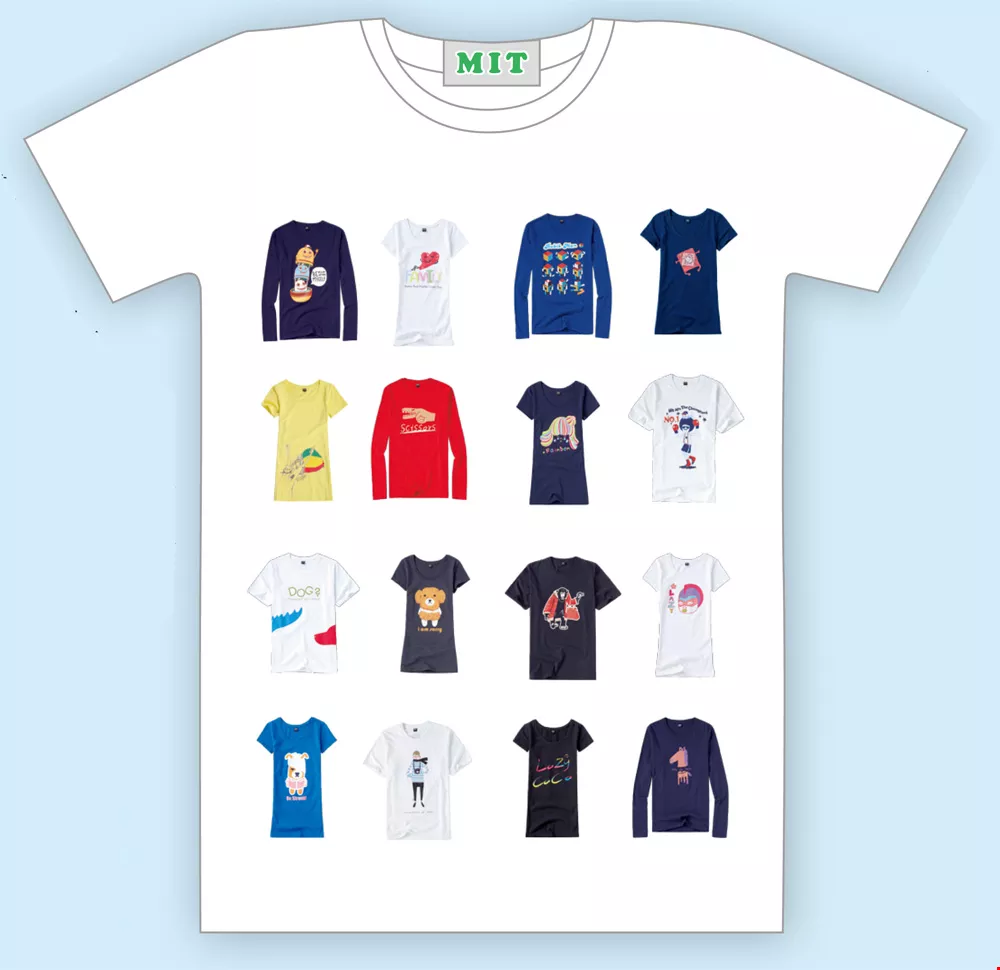
T-shirt designs courtesy of 101.com.tw.
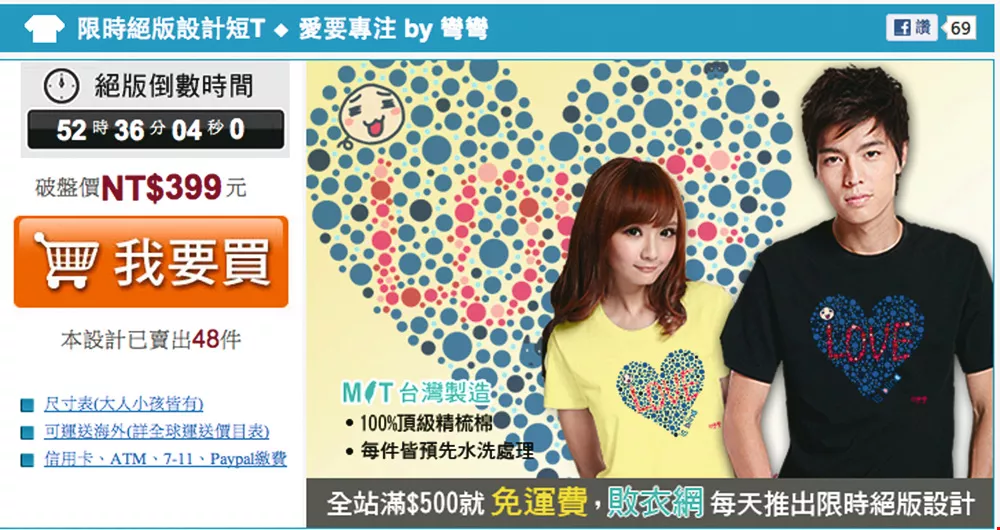
Buy365 emphasizes designs that are available only once, for a limited time, and in limited quantities. This has made the site a favorite with fashion-conscious younger consumers who dread the idea of running into someone else wearing the exact same thing as them.

With little more than a good idea, this pair of brothers transformed themselves from tech-sector darlings to kings of fashion. Jerry (left) and Andy Kuo’s creative marketing tactic of offering limited product runs has been a big hit with consumers.

The T-shirt designs offered by SOFU are creative products of the highest order. The designs pictured here are the work of (from top to bottom) architect Andy Lin, artist Suzy, graphic designer Jier, and drummer Chen Jindong.

Eric Wang and his wife are the founders of SOFU, which aims to provide a means for more Taiwanese designers to get exposure through their T-shirt designs.

@List.jpg?w=522&h=410&mode=crop&format=webp&quality=80)
@List.jpg?w=522&h=410&mode=crop&format=webp&quality=80)


