Going All Out for Olympic Baseball Success
Vito Lee / photos Chuang kung-ju / tr. by Michael Hill
July 2004


Held once every four years, the Olym-pics are the ultimate test of human physical abilities. As contestants strive to come out on top, the games are also the perfect stage for every country to show off its national strength.
In this comprehensive test of national strength, the Chinese Taipei baseball team, working with support from government and business alike, will draw on a three-level system for building talent.
The difference from previous years, however, is that information specialists are pitching in, too. They are using computer databases to gather and organize intelligence about opponents, making it possible for players and coaches to be armed with extensive knowledge when they reach the battlefield.
The efforts continue outside of Taiwan, with scouts in Europe, the United States, and Asia actively gathering information. Meanwhile, communication and coordination has intensified with the professional leagues in the US and Japan, with efforts underway to bring Taiwanese players living abroad back home to serve their country.
While the baseball competition at the Athens Olympics does not begin until mid-August, the fires of battle have been burning for a long time!
The baseball scene in Taiwan is really worth watching this year, as players are inspired by hopes of donning a Chinese Taipei uniform to do battle for their country.
To form a squad of 24 baseball players, a preliminary list of 42 professional and amateur candidates living in Taiwan and abroad was announced at the end of March.
Spurred on by the prospect of competing in the Olympics, the candidates on the list battled for the top positions. Even some candidates who were not on the list did not give up on their chances, hoping to gain the favor of the selection committee at the last minute. Competition brings progress, and in the recently completed first half of the professional baseball season, many players have been like Peng Cheng-min, who has been doing better than any other batter from Taiwan in history, chalking up a .420 batting average. The big leagues' two superstar pitchers, Yang Chien-fu of the Sinon Bulls and Uni-President Lions' Pan Wei-lun, have been locked in a "speed battle," with Yang Chien-fu setting a record with his 150-km/h pitches and Pan Wei-lun edging up to that mark. The revered veteran Wang Fu-chia, who was relegated to pinch hitting for a time, has heated up again, swinging the bat well in several top-notch performances. Two other players who previously were not well known to fans, Huang Lung-i and Chen Feng-min, have also made a name for themselves through their strong chances of making the national team.
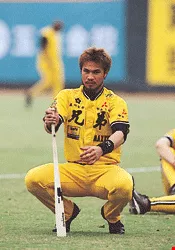
Almost guaranteed a spot on the Olympic team, in recent years Chen Chih-yuan have been major figures in the pro baseball world.
Absolute strength
When the first pitch in the Olympic baseball competition is thrown on August 15, eight teams will be battling for the title: Cuba, Canada, Australia, Italy, the Netherlands, Japan, Chinese Taipei, and the hosts, Greece. The tournament will begin with round-robin play between the teams, with the top four competing in a playoff for the gold medal.
Among the favorites to win, the strength of the team from Cuba, where "amateur" has always meant "professional," is clear to everyone. The level of the Japanese team is second only to that of the US. Since its team is made up of professional players, Japan, along with Cuba, is in the top level of strong teams. Other countries with no professional baseball leagues have been looking to attract pro players who play in the US. Even Greece, the host country, which is relatively unknown in the baseball world, has decided to look abroad for professional players. As long as either their grandparents or parents were of Greek lineage, players can return to Greece to battle for the glory of this ancient country.
"Players living in Taiwan have always been pretty keen to represent their country," says Chinese Taipei head coach Hsu Sheng-ming. "Players who take the top three spots on the team can earn exemption from military service and a substantial award from the central government. In addition to these practical matters, in every stage of training the players are instilled with strong ideas about pursuing honor for their country."
As well as the professional players, the amateur candidates are also working hard. Chang Chih-chia, for example, was red-hot in 2001 and was picked up by a Japanese professional team. Other players like Lin Yueh-ping, Kao Chih-kang, and Tu Chang-wei also have high hopes that they can use the Olympics as a way to up their market value.
Since the Athens Olympics will be taking place during the professional baseball season in Taiwan, the Chinese Professional Baseball League and the individual baseball clubs made the unprecedented decision to postpone competition for four weeks in August. Aside from the time needed to bring the team together and travel to Athens to become familiar with the venue, however, the whole team will not have adequate time to get finely attuned to each other. Furthermore, when the time for the Olympics arrives, some players living abroad may be traveling to Athens from other locations. Adapting themselves to individual players' situations, then, will be a major test for the coaching staff. According to Hsu Sheng-ming, "After the roster is set at the end of June, in July we will have to take advantage of Mondays (when there are no games scheduled) to have practices with the entire team. As for the rest, we will have to make adjustments right before play starts."

Almost guaranteed a spot on the Olympic team, in recent years Peng Cheng-min have been major figures in the pro baseball world.
Relying on players from abroad
Looking back on major international competitions for the past few years, players residing abroad have always been a force that the Chinese Taipei team has relied on heavily. Among players living in US, the most famous are Tsao Chin-hui and Chen Chin-feng. While these two players only have a small amount of experience in the US big leagues, they remain an important force for the baseball world in Taiwan. Yeh Chun-chang, who has sat in the catcher's position in recent years for the Chinese Taipei team, made this observation: "Just last year, at the Asian Games, almost none of the hitters from the Chinese Taipei team could touch the fastballs being thrown by Japan's star pitcher Daisuke Matsuzaka. But Chen Chin-feng was able to get three base hits easily. You can tell that these players are just on different levels."
In fact, players who can attract attention from American and Japanese clubs were already outstanding players as amateurs, and over a long period of time have been the main force of the Chinese Taipei team at every level. Looking at the players on the preliminary Olympic roster, five of them were major amateur players on the 1997 Chinese Taipei team: Chen Chin-feng, Chen Chih-yuan, Hsu Sheng-chieh, Hsu Ming-chieh, and Ho Chi-hsien. While their performance in the Asian Cup was not ideal, over the long term they have built up first-rate skills through their experience in international competitions.
Considering the understanding and degree of familiarity with one another that they have built up over time, the lineup for the infield and outfield squads on this year's team is made up mostly of players living in Taiwan. In addition to the three Sinon Bulls stars Huang Chung-i, Chang Tai-shan, and Cheng Chao-hsing, catcher Yeh Chun-chang is virtually guaranteed to be on the squad. As for the three outfield positions, Chen Chih-yuan and Peng Cheng-min, both of the Brother Elephants team, will certainly take up two spots.
As for the crucial spot on the pitcher's mound, the team will continue to rely on the strength of players living abroad. For many years, the average speed of pitchers playing in Taiwan has topped out at around 140 km/h, but Wang Chien-min, Tsao Chin-hui, and Kuo Hung-chih, who play in the US, can all throw at around 155 km/h. Especially important will be the help of Kuo Hung-chih, once considered Taiwan's best left-handed pitcher. As he has gradually put the problems of surgery for a hand injury behind him, many hope that he can help solve the Chinese Taipei team's troubling lack of a high-quality left-handed pitcher.
For these reasons, the Chinese Taipei Baseball Association (CTBA) long ago began actively contacting players living abroad to get them to come back to Taiwan to serve their country. A change in regulations in the US major league baseball players' union, however, kept Tsao Chin-hui from playing on the Chinese Taipei team in the Asian Championships last year. It has also come out recently that the New York Yankees are not willing to allow Wang Chien-min to play for Chinese Taipei. Only the Seibu team from Japan, which has always had strong relations with the baseball world in Taiwan, has promised that Chang Chih-chia and Hsu Ming-chieh will be able to play. Hsu Ming-chieh, however, whose performance for Seibu has been unremarkable in recent years, announced in the middle of June that he would not compete for a spot on the Chinese Taipei team. "This year it has been very tough, with the coaches putting more trust in me. I want to use this opportunity to get on a more solid footing," he said. After many years of answering the call to play on the Chinese Taipei team, Hsu hopes that his fellow countrymen will forgive him. It appears, then, that with so many factors affecting players and teams, the team will have to wait until the very last minute before it knows how many players who live abroad will be able to play.
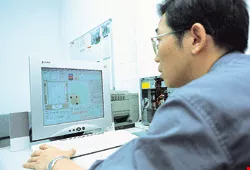
It's one small step for IT, one giant leap for baseball. With a few clicks of the mouse, players on the Chinese Taipei team can gain all the knowledge they need to get up to date on their opponents. Pictured is Chang Chueh-wei with a page from the database he designed.
Worldwide "Spy vs. Spy"
While the players are working up a sweat at practices, Liu Chih-sheng and Yang Ching-lung, two coaches on the Chinese Taipei baseball team's intelligence-gathering squad, as well as CTBA employees, circulate through a cramped laboratory at National Taipei University of Technology (NTUT). Here, Chang Chueh-wei, associate professor at NTUT's Department of Computer Science and Information Engineering, is leading a team of information specialists to build an "intelligence database" one piece of data at a time.
In this secret war room, filled with videotapes, wide-screen LCD televisions, computer components, and photographic equipment, information gathered over the last few months on individual players and games is being entered into a media database. According to Chang, "Basically, this information includes players' offensive and defensive stats, the characteristics of their pitching and hitting, as well as visual materials."
For the Asian Championships last year, the National Council on Physical Fitness and Sports and the CTBA hired Chang to create an intelligence database that covered players from China, Japan, and South Korea. This allowed coaches and players to become thoroughly familiar with their opponents before they faced them on the field. Chinese Taipei team took second place, and the detailed information provided by the database can be said to have played a large role in that success.
Since the database scored such an important success on its first outing, the CTBA is preparing to use it again this year for the Olympics. Since the end of last year, every night the lights in the tiny lab have been on late as researchers work to bring baseball into a new era of information warfare.
"Bringing technology into sports is a natural trend. In addition to information technology, physics, sports psychology, and other sciences can help coaches to make better decisions and help athletes perform better," says Chang Chueh-wei, who is an expert in image processing.
Chang Chueh-wei points out that the application of high technology will bring rapid progress to the baseball world. "In the past," he says, "the Chinese Taipei team would gather intelligence, but when they used the old paper-and-pencil methods, they often made mistakes. There is no comparison to the ease and speed computers offer for searching, organizing, and comparing information."
In last year's Asian Championships, the team burned a couple thousand CDs that held information on past performance by Japanese and South Korean players, which made it possible for coaches to immediately grasp their opponents' situation before the games. "This was especially true for the South Korean teams, who were unknowns to us-it really helped set our minds at ease," says one coach. The same coach also admits, however, that now the players are no longer required to analyze the strategies themselves, and it is difficult to tell how frequently they use the database, making its real effect hard to estimate.
In order to help players with less-than-stellar computer skills, the intelligence team emphasized simplicity and clarity when they designed the system's interface. Upon entering the system, just by entering a pitcher's or batter's name you can get a list of detailed information about the player's performance against various opponents. For every pitch a pitcher throws, it will provide information on the type of pitch, pitch speed, and a grid map of the ball's path. In addition to static information such as text and images, the system can also play clips of the duel between pitcher and batter. "This design is especially helpful for players to study the way a pitcher combines his pitches," says Hsu Sheng-ming.
However, in contrast to the geographic proximity and similar baseball styles shared by Taiwan, Japan, and South Korea-the "three powerhouses" of baseball in Asia-opponents in the Olympics will come from every corner of the globe, a fact that presents clear difficulties for building a database as complete as the one used last year. "Factors such as language barriers, degrees of familiarity with these countries, and the number of channels for obtaining information will all influence how complete the final database will be," says intelligence team member Chen Hsin-liang.
According to information from the intelligence team, the team from the Dominican Republic has a pitcher who, while only 16 years old, can already throw at speeds of up to 163 km/h. There is very little relevant information on this type of unusual player, and thus no way to completely prepare to face him.
Because of this, the intelligence team is also working through the CTBA and the sports TV station ESPN in the hope of reviewing and copying images of players from other countries to fill out their database.
Athens often reaches temperatures of 38oC in August, but the sun there is not as dazzling as in Taiwan, though the air is quite humid. Because of this, when players and coaches wear hats they need to be particularly careful about cooling off. The intelligence team's reports also include such factors as weather, wind direction, and venue for the each game that it indexes.
In their on-stage work recruiting players and behind-the-scenes work at intelligence gathering, the Chinese Taipei team is thoroughly prepared. Now they are just waiting for the trumpet to sound.
"After 12 years, people in Taiwan have high expectations for the baseball competition in these Olympics," says Hsu Sheng-ming. At last year's Asian Championships, the Chinese Taipei team found strength in unity, defeating the South Korean team despite the low estimate many people had of them. The successful adjustments made by Hsu Sheng-ming have been a major factor.
This middle-aged coach, who puts great emphasis on discipline in everyday life, is skilled at observing player's situations, and gives them plenty of room to make use of their talents on the field. In Hsu, you can always see the tenacity that Taiwan baseball has always been proud of.
"If you have mental power, then you have absolute power," he says.
Roll on August!

Almost guaranteed a spot on the Olympic team, in recent years Pan Wei-lun have been major figures in the pro baseball world.
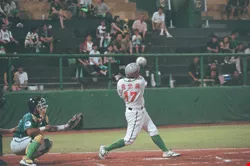
Almost guaranteed a spot on the Olympic team, in recent years Huang Chung-I have been major figures in the pro baseball world.

Almost guaranteed a spot on the Olympic team, in recent years Chang Tai-shan have been major figures in the pro baseball world.


