Expo Dome: Riot of Colors
Chang Chiung-fang / photos -Chuang Kung-ju / tr. by Chris Nelson
January 2011


If you wish to experience the interface between man and machine, go visit the Pavilion of Dreams. But if you want to commune with real flowers and enjoy the majesty of floriculture, don't miss the Expo Dome.
The Expo Dome is located in the Yuan-shan Park Area; it's the first pavilion you come to after entering the main gate. The 6,000-square-meter exhibition hall is divided into three major areas: Sections A, B, and C. In Section C are the booths of preserved flower manufacturers, seed and seedling importers, potted plant sellers and other horticultural businesses. Sections A and B are reserved for flower competitions, and during the six months of the Flora Expo there will be 16 different themed exhibits and contests, like an exciting, never-ending floral carnival.

Sixteen different themed exhibitions and competitions are scheduled to take place at the Expo Dome, the pavilion into which the most manpower and flower power have been invested.
Unlike the natural beauty of the Flora Rainbows outside, the interior of the Expo Dome showcases the art of floriculture. Here, the public can learn about floricultural innovations and appreciate the well-thought-out garden landscapes. More flowers are displayed at the Expo Dome than at any other of the Flora Expo's 14 pavilions. Huang Li-chuan, host of the Expo Dome and vice president of the Taiwan Floriculture Development Association (TFDA), estimates that more than 2,000 flower cultivars will be displayed at the Expo Dome, totaling nearly 900,000 in-di-vid-ual plants. The TFDA has incorporated a total of 33 floriculture teams, each day employing 200-300 people to decorate and maintain the pavilion, a major undertaking.
The preparation period for the Waltz of the Flowers flowering plants exhibition that opened on November 27 took no less than five days, with workers busy day and night. Dismantling the previous event and laying out the basic designs alone took two full working days. The theme of the event is Waltz of the Flowers from Tchaikovsky's Nutcracker Suite, and after a 3D animation facility was installed and the supporting structures in the shape of giant gift boxes, music boxes, musical notes, pianos, harps and trumpets were in place, the various teams immediately moved in to lay out their floral displays.
Zhao Gao Shuying, winner of the Shennong Prize and consultant for the Potted Plant Promotion Committee, was busy transplanting bromeliads into large trumpet shaped installations. For the best display, Zhao went to the plantations of Puli to select five different colored bromeliad species, including the rare silver vase bromeliad (Aech-mea fas-ci-ata 'Variegata').
Not only must the flowers be carefully selected; she is even fastidious about the greenery on the floor. To attain the ideal 10-centimeter height and achieve a soft texture, Zhao abandons the usual grassy lawn in favor of rice seedlings. She had 1.5 centimeters of topsoil placed onto non-woven fabric and planted the rice on the surface. The rice seedlings take about 28 days to grow to the right height, turning the entire area into an expanse of soft, lush greenery.

Sixteen different themed exhibitions and competitions are scheduled to take place at the Expo Dome, the pavilion into which the most manpower and flower power have been invested.
The first show to be seen at the Expo Dome in January is the Exhibition of Agricultural Science and Technology, which will showcase the results of the agri-tech research conducted by the Council of Agriculture (COA) into flowers, paddy rice, vegetables, fruit, grains, tea and livestock products.
The flower wall at the entrance, shaped like the numeral 100 for the 100th year of the ROC, is a highlight of the venue.
A map of Taiwan forms a figure "one," with each region on the map made of flowers grown there. The entrance cleverly serves as the first zero; and the rightmost zero forms a world map highlighting the areas to where Taiwan exports its flowers.
Hsieh Ting-fang of the COA's Floriculture Research Center, who heads up the floral exhibition sections at the Expo Dome, explains that these exhibits can fully showcase Taiwan's floriculture industry and technology. Hsieh notes that the results of all this work, from variety collection, breeding, tissue culture techniques and a virus testing system to improved cultivation technologies and new product development, will be displayed at this venue.
Taiwan's floriculture industry has seen some revolutionary breakthroughs in cultivation technology and R&D. Consider the technology for growing An-thur-ium: Hsieh explains that the soilless W-shaped gutter cultivation method promoted by the COA not only minimizes An-thur-ium blight, but also protects the An-thur-ium from floods, since the polystyrene gutters float on the water.
Furthermore, lisianthus (Eu-stoma gran-di-florum) used to be available only via imported seedlings from Denmark. But recently the COA developed a low-temperature sprouting technology in which vernalization (3°C low-temperature treatment during the seedling stage) ensures that the lisianthus seedlings will no longer suffer the clustering problem that happens upon exposure to high temperatures.
The growing technology exhibited includes a greenhouse that uses deep-ocean water as a coolant and a remote-controlled irrigation and fertilizing system. These are all examples of success in the advancement of Taiwan's -flower growing technology.
Flowering adjustment is another major focus of floriculture. For instance, nighttime illumination for chrysanthemums is used to delay blooming, and covering methods are used to extend the blooming periods of poinsettias (Eu-phor-bia pul-cher-rima).
And post-harvest processing technologies enabling Taiwan to export On-ci-dium and Phal-aen-op-sis by sea instead of by air greatly lower shipping costs. It's an achievement that cannot be understated.
In the middle of the venue will be a cylindrical display area showing bottled On-cid-ium flowers, technology to induce variation in Cym-bid-ium leaves, and poinsettia grafting technology.
The automatic potted plant irrigation system is a godsend for busy people. Designed with capillary or tidal irrigation principles, these automatic systems will certainly draw people's interest.
As for new product development, you can see trunk braiding technology for the Malabar chestnut (Pa-chira aqua-tica), and use grafting technology to build poinsettias into tower shapes. Also, more than 30 new flower cultivars including An-thur-ium and Phal-aen-opsis are displayed for all to see as cut or potted flowers.
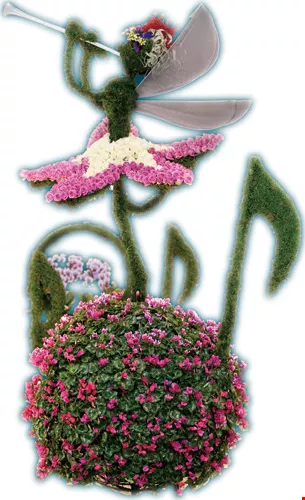
Just like the opening of the gifts in Tchai-kov-sky's The Nutcracker, the Expo Dome offers surprises galore.
Following this event is the Lunar New Year Celebration exhibit, then the Floral Creations exhibit highlighting Taiwan's burgeoning floriculture industry, and then Taipei International Orchid Show 2011, showcasing over 1,000 varieties of Phal-aen-op-sis including Taiwan's own Phal-aen-op-sis aph-ro-dite.
The Expo Dome can only hold 2,000 people at a time, but since the opening of the Flora Expo, some 30,000 to 40,000 have entered each day. But such vast streams of people are not ideal for appreciating flowers, or for the flowers themselves. Some people will only be able to give them a passing glance, with no time to savor them. Within the crowded venue, the lifetimes of the flowers are also shortened, and rotation of flowers must be increased. But no matter what, the spectacularly creative and colorful Expo Dome is well worth repeat visits, because though flowers bloom every year, the Flora Expo does not.

Sixteen different themed exhibitions and competitions are scheduled to take place at the Expo Dome, the pavilion into which the most manpower and flower power have been invested.

@List.jpg?w=522&h=410&mode=crop&format=webp&quality=80)

@List.jpg?w=522&h=410&mode=crop&format=webp&quality=80)


